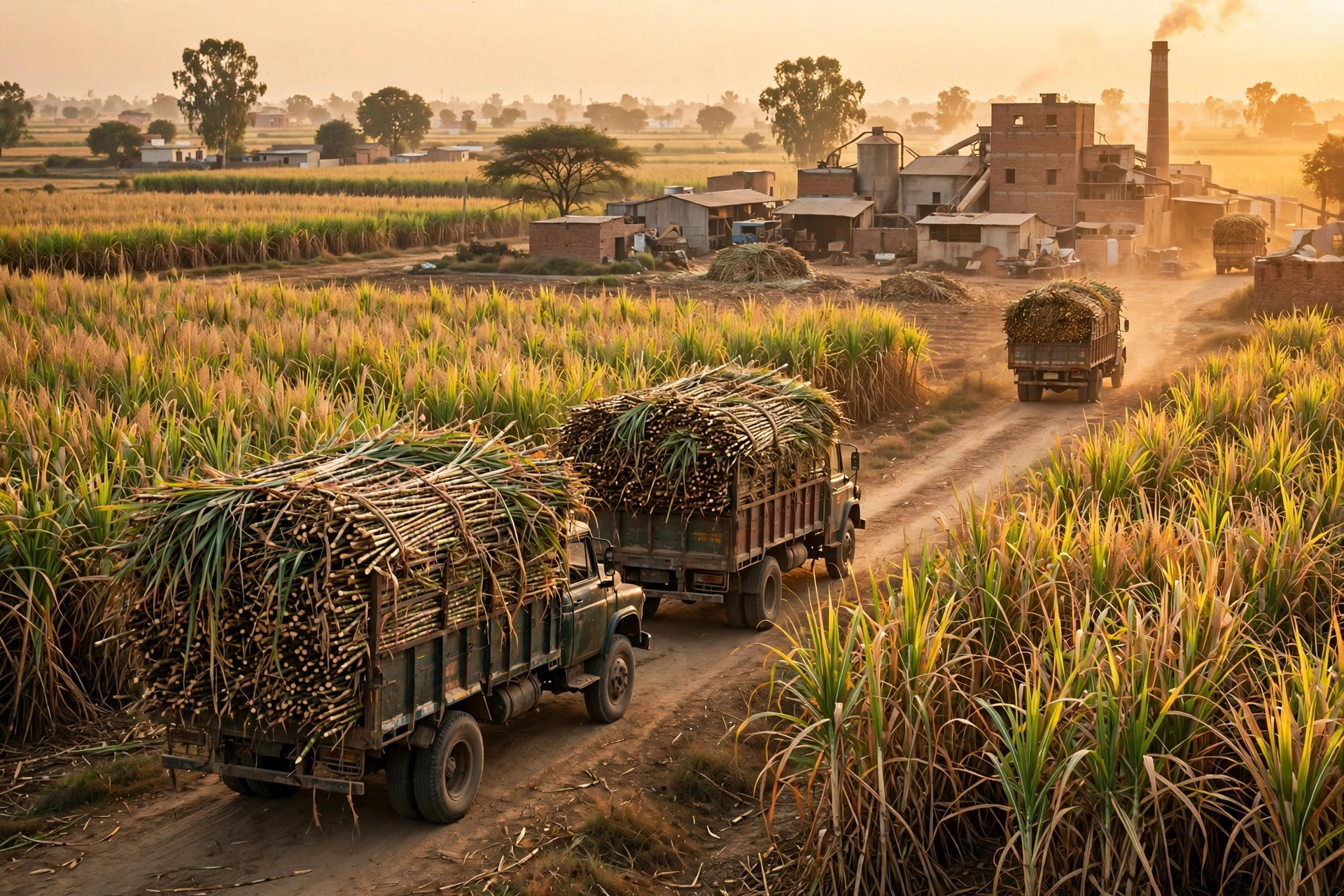
KARACHI: Few industries pack their entire year into a few winter months the way sugar does. From roughly late autumn, trucks queue outside mills across Punjab and Sindh loaded with sugarcane that must be crushed within hours of harvest before its sugar content fades. By spring, the crush ends, the warehouses hold a year’s production, and the mills settle into a long season of selling, lobbying and waiting. Pakistan is among the world’s larger sugar producers and consumers, and dozens of mills have listed on the stock exchange over the decades. Their shares are famous for sharp moves and unreliable earnings — and once you understand cane, recovery rates and export politics, the volatility stops being mysterious.
The crushing season: a factory that runs in sprints
Sugarcane is a bulky, perishable crop. Unlike wheat, it cannot sit in storage; cut cane loses sucrose quickly, so mills operate around the clock during the season, and the season’s start date is set in consultation with provincial governments, which also influence when mills must begin buying. A mill’s crushing capacity is measured in tonnes of cane per day, and its season output depends on three variables multiplied together: how many days it runs, how much cane farmers in its zone bring, and how much sugar it extracts per tonne.
That extraction rate — the sucrose recovery rate — is the industry’s key quality number. Better cane varieties, fresher cane and better machinery push recovery up; drought-stressed or stale cane drags it down. A difference of even half a percentage point in recovery, spread over millions of tonnes of cane, is worth a fortune, which is why mills invest in cane development programmes, seed varieties and farmer relations in their reserved zones. When you read a sugar company’s annual report, the directors’ discussion of crushing days, cane crushed and recovery rate tells you more than the profit line does.
The off-season is not idle. Mills maintain and overhaul machinery, sell sugar from inventory through the year, and manage the politics described below. Many mill groups have diversified into the by-products and beyond: molasses sold to distilleries, ethanol production for fuel and industrial use, bagasse — the fibrous cane residue — burned to generate power that some mills export to the grid under the bagasse cogeneration framework, and in larger groups, entirely separate businesses in textiles, farming or energy. Those sidelines can stabilise earnings, but the core remains the crush.
The cane price: cost set by government, fought over by everyone
A mill’s dominant cost is cane, and uniquely among Pakistani industries, its raw material price is announced by provincial governments as a minimum support or indicative price per maund (40 kg) before the season. Farmers’ associations lobby for higher prices, mills argue that high cane prices with controlled sugar prices crush their margins, and the final number lands inside electoral as much as economic logic — cane belts are politically organised constituencies, and mill ownership itself has historically overlapped with political families, a fact of Pakistani public life that shapes the sector’s reputation.
In practice, the price a mill actually pays can exceed the official minimum when cane is scarce and mills compete at the factory gate, or involve deductions and delays when cane is abundant — payment delays to farmers are a recurring grievance and regulatory issue. Meanwhile the mill’s selling price for sugar has been subject to its own interventions: governments have at times moved to fix or pressure retail and ex-mill prices, raided hoards, and negotiated with the industry association. The mill thus sits in a pincer — input price pushed up by farm politics, output price pushed down by consumer politics — and its margin is whatever survives between them.
An illustrative example shows the leverage. Suppose a mill crushes cane costing, in round example figures, Rs 400 per maund, achieves a 10 percent recovery, and therefore needs ten maunds of cane — Rs 4,000 of cane alone, before fuel, labour, chemicals and finance — to make roughly 400 kg-equivalent units of sugar output in this simplified sketch. Small changes in either the cane price or the recovery rate swing unit cost significantly, and because the mill buys most of its year’s raw material in one season with borrowed working capital, interest costs during high-rate periods can rival operating margins. The numbers here are illustrative only; the structure — thin margins, huge seasonal borrowing, policy-set prices on both sides — is the durable fact.
Surplus, shortage and the export decision
Pakistan’s sugar balance swings between surplus and shortage because production depends on one weather-exposed crop while consumption grows steadily with population. In surplus years, the industry presses the federal government to allow exports — sometimes with transport or other support historically provided to move stocks out — arguing that unsold sugar traps cash and will bankrupt mills before the next crush. In shortage years, the same system reverses: exports are banned, imports through public channels are arranged, and prices spike anyway, provoking inquiries into who held stock and why.
The export permission is therefore one of the most consequential single decisions for sugar earnings. It converts inventory that can only be sold slowly at home into foreign sales, releases working capital and often coincides with international prices that make exports lucrative. It is also politically fraught: exporting sugar that later has to be imported back at higher prices is a recurring national embarrassment, and official committees try — with mixed success — to verify surplus estimates before deciding. Investors learn to watch the crop estimates, the industry’s stock statements and cabinet decisions as one connected story, much as power investors watch the payment chain described in our power generation guide.
Smuggling and the Afghan transit trade add a grey margin to the balance in border years, and the sweetener market itself is slowly changing, with industrial buyers, beverage makers and growing scrutiny of sugar in diets. None of these trends moves as fast as the annual policy cycle, though, which remains the sector’s metronome.
Why earnings are so volatile — and so hard to compare
Put the pieces together and sugar profits become a multiplication of accidents: cane availability in the mill’s zone, recovery rate, the cane price actually paid, the sugar price actually realised at home or abroad, the timing of export permissions, inventory valuation at season end, and finance costs on seasonal loans. A mill can do everything right operationally and still lose money in a year when output prices are suppressed; a mediocre mill can post a spectacular year when scarcity lifts prices. Annual earnings therefore carry less signal than in steadier industries, and price-to-earnings ratios on a single year’s profit mislead more than usual.
Profit quality needs extra checks. Inventory is valued on bases that matter enormously when prices move between the balance-sheet date and sale. Related-party dealings deserve attention because many mills sit inside family groups with farms, trading arms and other mills — the group structures explained in our guide to Pakistan’s conglomerates. Seasonal borrowing peaks just after the crush, so a balance sheet dated then looks very different from one dated after a year of selling; comparing like dates matters.
Dividends follow the same weather. Mills in strong surplus-and-export years have paid generously; in squeeze years, payouts vanish while debt is serviced. Long stretches of modest or zero dividends punctuated by bonanzas are the historical pattern, and investors who need predictable income should weigh that rhythm honestly rather than annualise a good year.
Reading a sugar stock: a practical checklist
Start with operations: crushing days, cane crushed, recovery rate, and capacity utilisation versus neighbouring mills. Then the policy exposure: cane price in its province, any price-control actions, export allocations received. Then the balance sheet through the cycle: peak seasonal debt, inventory quantities (in bags or tonnes, usually disclosed), and ethanol or power sidelines that cushion the core. Note the group’s other interests and the auditor’s remarks. Finally, place the year in the national crop cycle — the Pakistan Sugar Mills Association and provincial crop reporting give the context that turns one mill’s numbers into a sector story.
Sugar will likely remain what it has long been on the PSX: a sector of real assets and real cash in good years, permanently entangled with the politics of food prices and farm incomes. That entanglement is not a footnote to the investment story; it is the investment story. This article is educational content only, not financial advice, and it expresses no view on any individual mill’s shares. For a steadier contrast within food-related listings, browse the Aktzien learning library and our sector guides.
Ethanol, power and the by-product economy
A sugar mill is really a biomass refinery, and the by-products increasingly decide who survives the squeeze years. Molasses, the syrup left after sugar crystallisation, feeds distilleries that produce ethanol — for industrial use, pharmaceuticals and, at times, fuel blending abroad — and several listed mills earn a significant second income from distillery operations whose export prices move with global ethanol markets rather than Pakistani politics. Bagasse, the crushed cane fibre, fires the mill’s own boilers, and under the bagasse cogeneration framework mills can export surplus power to the grid at regulator-determined tariffs, turning a disposal problem into a seasonal power business. Press mud becomes fertiliser; some groups have added paper, chipboard, farming and even steel interests off the same cane economy.
These sidelines matter to investors for a specific reason: they are the part of a mill’s earnings not set by the cane-versus-sugar price pincer. A mill with a strong distillery and power export can report respectable profits in a year when sugar itself barely breaks even, while a pure sugar mill swings with the full force of the cycle. Segment disclosures, where provided, let readers separate the two — and explain why two neighbouring mills with identical crushing results can post very different bottom lines.
Water is the by-product discussion’s shadow. Sugarcane is a thirsty crop in a water-stressed country, and the economics of growing it in Sindh and southern Punjab are increasingly debated by agronomists and policymakers: canal water allocations, groundwater pumping costs for farmers, and competition from cotton, maize and other crops all shift the cane supply a mill can count on. Long-horizon readers should watch varietal improvement and water policy as carefully as export permissions, because the crop itself is the industry’s foundation, and foundations move slowly and then suddenly.
Governance, families and what minority holders should watch
Many listed mills are controlled by families whose interests span the whole cane economy — farms, trading, transport and politics itself — and that breadth creates the sector’s characteristic governance questions. Sugar is often sold through group-linked distributors; cane may be bought from group farms; by-products flow to sister distilleries. Each such flow is legal and often efficient, and each is priced by negotiation inside the family rather than by a market, which is why the related-party disclosures and the auditor’s stance on them deserve more time in a sugar annual report than in most others.
Minority holders should also watch the pattern of capacity decisions. Mills have at times expanded crushing capacity beyond what their zones’ cane can feed, chasing market share in cane procurement and political weight, and the result — industry-wide overcapacity bidding up cane while sugar prices stay capped — punishes everyone, shareholders quietly included. A mill that expands cautiously, maintains its plant, pays farmers promptly enough to secure loyal supply and keeps its distillery and power sidelines productive is displaying the only strategy this industry reliably rewards. It rarely makes headlines. In sugar, that is usually a compliment.
One final lens is time. A sugar investment case made in October, before the crush, rests on crop forecasts and hoped-for export permissions; the same case made in April rests on realised recovery rates, warehouse stocks and debt actually drawn. The information content of the two moments differs entirely, and much of the sector’s notorious price drama is simply the market repricing the gap between forecast and fact. Investors who mark their calendars by the crop — sowing reports, crushing starts, production estimates, export decisions, season-end stocks — hold a genuine edge in comprehension over those who watch only the ticker, because in this industry the calendar is the forecast.
Key takeaway: sugar earnings are made in a short crush and decided by three policy-touched numbers — the cane price, the recovery rate and the export decision — so judge mills across full crop cycles, never on a single season.