KARACHI: If Pakistan's economy has a flagship industry, it is textiles. From cotton fields in Sindh and Punjab to spinning mills, weaving sheds, dye houses and stitching units shipping garments to high streets in Europe and America, the textile chain employs more Pakistanis and earns more export dollars than any other manufacturing activity. On the Pakistan Stock Exchange, textile companies are numerous — spinners, weavers, composite mills that do everything under one roof, garment and home-textile exporters — and their shares carry a reputation for being confusing: profits that surge when the rupee falls, vanish when cotton spikes, and seem to obey a logic from Faisalabad rather than from Karachi. The logic is real, and it can be learned. This guide explains the chain from fibre to finished shirt, where margins are made and lost, how cotton and the dollar jointly decide a mill's year, and how to read a textile company's accounts — including the difference between a spinner and a value-added exporter, which matters more than almost anything else in the sector.
The chain: ginning, spinning, weaving, processing, stitching
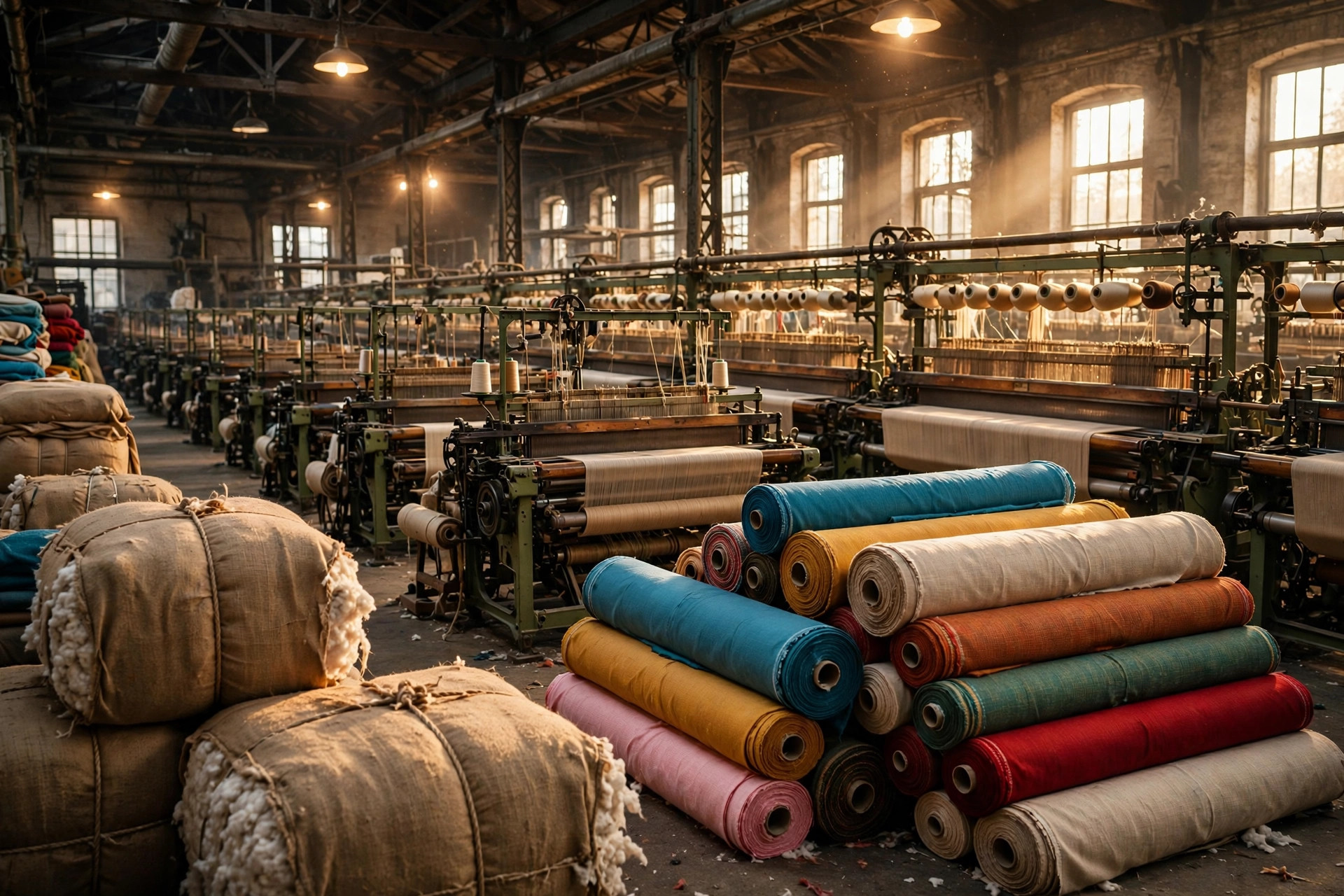
Think of textiles as a staircase, with value added at each step. Cotton is harvested and ginned — seeds separated from fibre — producing lint that spinning mills turn into yarn. Weaving and knitting turn yarn into fabric. Processing — dyeing, printing, finishing — turns grey fabric into something a buyer can sell. Stitching, or made-ups and garments, turns fabric into towels, bed sheets, denim jeans and shirts. A composite company operates several or all of these steps; specialists operate one. Listed companies occupy every combination, and their names do not always tell you which — the notes to the accounts and the segment descriptions do.
Where a company sits on the staircase decides its economics. Spinning is the most commodity-like step: yarn prices track cotton prices and international yarn markets, capacity is plentiful across Asia, and margins are thin and volatile — a spinner is essentially converting cotton and electricity into yarn and hoping the spread cooperates. Weaving is similar, somewhat less raw. Processing and garments are where differentiation lives: a home-textile exporter with design capability, compliance certifications for Western buyers, reliable delivery and long relationships with large retailers can earn steadier, higher margins, because the buyer is purchasing reliability and compliance as much as cloth. This is why two companies both filed under "textiles" can deserve entirely different readings — one is a commodity converter hostage to the cotton-yarn spread, the other is a supplier embedded in a global retail chain. Exports dominate the upper steps: Pakistan's textile earnings come principally from markets such as the United States and the European Union, where preferential access arrangements — notably the EU's GSP+ scheme, which Pakistan has held subject to compliance with international conventions — support competitiveness. The continuation of such preferences is a policy variable investors should monitor through official sources.
Cotton: the harvest that sets the cost base
Cotton is to textiles what gas is to fertilizer and coal is to cement: the raw material whose price frames the year. Pakistan grows its own cotton, but the crop has struggled in documented recent years with weather damage, pests, water stress and competition for land from other crops, and mills routinely supplement local supply with imported cotton. The local harvest's size and quality therefore affect everyone: a poor crop means more imports, paid in dollars, at international prices; a good crop means cheaper, fresher local fibre — though quality issues can still push quality-conscious exporters toward imports for particular orders.
The timing mismatch is where profits are won and lost. Mills buy cotton in the harvest season and hold inventory; yarn and fabric prices move with international markets in the meantime. A mill that stocked cotton cheaply before prices rose reports flattering margins; a mill holding expensive cotton when prices fall writes inventory down and reports a miserable quarter — with identical factories and identical management effort. This is why textile results must be read alongside the cotton cycle, and why the inventory line and any inventory provisioning in the accounts deserve attention. It also explains the sector's working-capital intensity: cotton stocking ties up large sums seasonally, often borrowed, so finance costs swell precisely when raw-material risk is highest. When the State Bank's policy rate is high, carrying a season's cotton is expensive insurance.
The dollar connection: exporter's hedge, importer's headache
Most established textile exporters earn the bulk of their revenue in dollars, euros or pounds, while a large share of their costs — labour, local overheads, some energy — is in rupees. A weaker rupee therefore tends to inflate rupee earnings mechanically: the same dollar order converts into more rupees, while only part of the cost base (imported cotton, dyes, machinery spares) rises in step. This is the origin of the sector's reputation as a beneficiary of depreciation, and it is broadly true for value-added exporters — with three cautions every investor should keep attached to it.
First, the benefit is partly competed away: buyers negotiate, rival exporting countries' currencies move too, and over time local inflation in wages and energy eats the advantage. Second, the benefit is unevenly distributed: a spinner selling yarn domestically in rupees while buying imported cotton in dollars faces the mirror-image squeeze. Third, depreciation usually arrives with high interest rates and energy-tariff pressure in Pakistan's stabilisation episodes, which raise the sector's other big costs. Energy deserves its own emphasis: textile processes — especially spinning and wet processing — are power- and gas-hungry, and the tariffs and availability of electricity and gas for export industry have been a perennial policy battleground, including special regimes for export-oriented units that change over time. Check the latest official position rather than assuming any particular tariff arrangement, and read company commentary on energy cost per unit as carefully as you read its sales growth.
Buyers, compliance and the value-added ladder
Export textiles are a buyer's market. Large Western retailers and brands place orders months ahead, audit factories for labour, safety and environmental standards, and can shift volumes between Pakistan, Bangladesh, Vietnam, India and other suppliers over seasons. Pakistan's strengths are real: a complete domestic chain from cotton to garment (rare among competitors), established expertise in home textiles and denim, and scale. Its vulnerabilities are equally real: energy cost and reliability, logistics, and the country-risk perceptions that affect order placement after political or macroeconomic shocks. For the listed investor, buyer concentration disclosed in annual reports — reliance on a handful of large customers — is a risk factor to note, balanced against the fact that those relationships, once built and audited, tend to be sticky: a retailer does not lightly move a compliant, reliable supplier's programme.
The long-run strategic question for every mill is the climb up the value-added ladder: from yarn to fabric, fabric to made-ups, made-ups to branded or design-led garments, each step adding margin and defensibility but also requiring investment, working capital and management depth. Government export-refinance schemes and duty-drawback arrangements have historically supported the climb by easing financing and refunding input duties on exports; the design and generosity of these schemes change with budgets and IMF programmes, so verify current arrangements through official sources. Companies disclose export incentives and rebates in their accounts — find them, because for some exporters these lines are a material part of reported profit, and profit that depends on a scheme is different in quality from profit earned in the market.
Reading a textile company's accounts
Start with the revenue split: exports versus local sales, and by segment where given. Then gross margin, read against cotton prices and the exchange rate over the period — a margin gain in a depreciation quarter may be arithmetic, not achievement. Inventory deserves a full minute: its size relative to sales, its cotton content, and any write-downs. Receivables from foreign buyers are usually reliable but slow in weak global retail seasons; watch their ageing. Debt structure matters: exporters historically access concessionary export finance alongside normal borrowing, so the blended finance cost and the maturity profile tell you how exposed the company is to rate rises. Finally, look at capacity and capital expenditure — new looms, stitching lines or a move into garments signal strategy more honestly than any chairman's statement.
An illustrative example, with invented round figures: a home-textile exporter ships an order invoiced at 100,000 dollars. At one exchange rate that is, say, Rs 28 million of revenue; if the rupee weakens by ten per cent, the same order becomes roughly Rs 31 million, while its largely rupee costs barely move — profit jumps without a single extra towel sold. Reverse the currency move and the magic runs backwards. The example is why comparing textile earnings across years without an exchange-rate column beside them is a recipe for self-deception.
Risks and the long view
The sector's risks list reads like Pakistan's macroeconomic diary: cotton crop failure, energy tariffs and shortages, loss or dilution of trade preferences, buyer-country recessions, shipping disruptions, and domestic rate and currency swings that help and hurt in the same year. Climate risk is not abstract here — floods and heat directly strike the cotton belt and factory operations, as documented national episodes have shown. This article is educational content, not financial advice. Textiles reward investors who learn to separate the three layers of every result: what the company did, what cotton and the dollar did, and what policy did. Aktzien, the app being built behind this site, plans to make diversified, low-cost investing easier for beginners — useful in a sector like this, where single-company exposure means single-crop exposure too. For a neighbouring lens on export dollars, see how they drive earnings in pharmaceuticals in reverse — there, imports cost dollars; here, exports earn them.
Spinning versus garments: a tale of two mills
A contrast makes the value-chain point concrete, using invented illustrative figures. Consider two companies, each with Rs 10 billion of annual sales. The first is a pure spinner. Its costs are dominated by cotton — perhaps two-thirds or more of its total cost — plus electricity. Its yarn sells into a competitive regional market priced off international benchmarks. In a year when cotton rises sharply after the mill has sold yarn forward at older prices, its entire margin can disappear; in a year when it stocks cotton shrewdly, it can look brilliant. Its earnings chart over a decade resembles a cardiogram, and its survival skill is purchasing: the cotton buyer's judgement is, in effect, the company's strategy.
The second company makes bed sheets and towels for foreign retail chains. Cotton and yarn are still its largest costs, but design, dyeing quality, compliance, packaging and dependable shipping dates now share the bill. Its buyers pay for a finished, shelf-ready product, compare it against suppliers in several countries, and renew programmes season after season when quality holds. Its margins move — retail recessions abroad and cotton spikes still bite — but within a narrower band, and growth comes from winning programmes and adding product categories rather than from guessing the cotton market. Neither business is "better" in the abstract: the spinner needs less capital in finishing equipment, can switch products quickly, and in its best years earns handsomely. But their risks are different species, and a portfolio or a judgement that treats them as identical twins will be surprised by both. When you open a textile annual report, identifying which of these animals you are looking at — spinner, weaver, composite, garment exporter, or a deliberate climb in progress between them — is the single highest-value minute you will spend.
Denim, home textiles and where Pakistan is strongest
Within the export basket, some product lines deserve an investor's special attention because Pakistan's position in them is genuinely distinctive. Home textiles — bed linen, towels, and related made-ups — are a category in which Pakistani exporters supply large global retailers at scale, competing on integrated production from local cotton through to finished, packaged goods. Denim is another: Pakistani mills produce fabric and garments for international jeans brands, a business that rewards consistency of shade and quality over thousands of metres. Workwear, canvas and institutional textiles add quieter, steadier niches. Against these strengths, basic yarn and grey fabric remain the most contestable, price-led segments, where regional competitors with cheaper energy can undercut Pakistani offers in any given season. When a composite company reports its segment mix drifting toward home textiles, denim garments and other finished goods, that drift — more than any single quarter's margin — is the strategy working. When the mix drifts the other way under price pressure, the company is sliding back down the staircase toward commodity conversion, and its earnings volatility will rise accordingly, whatever the current quarter happens to show.
Key takeaway: in textiles, position on the value chain is destiny — spinners live on the cotton-yarn spread, value-added exporters on buyer trust — and the dollar and the cotton crop will explain as much of any result as management does.