KARACHI: Flat steel is where a developing economy's ambitions become visible: the gleaming sheet inside a refrigerator door, the body panel of a car, the cladding of a factory roof. Pakistan historically imported much of that steel — until International Steels Limited, ISL, built a modern flat-steel complex in Karachi and substituted a large share of those imports with local production. ISL is a young company by Pakistani industrial standards, incorporated only in 2007, but it was born from an old house: it is the subsidiary and corporate child of International Industries Limited, the Chinoy Group's pipes pioneer of 1948, created in joint venture with two Japanese partners of the first rank, Sumitomo Corporation and JFE Steel. Its story shows how Pakistan builds heavy industry when it builds it well — family sponsorship, foreign technology partners, development finance, and expansion in disciplined stages.
2007: a joint venture to make what Pakistan imported
International Steels Limited was incorporated on 3 September 2007 as a public unlisted company. The founding shareholder structure, as recorded in company and group histories, brought together International Industries Limited as the majority sponsor, Sumitomo Corporation and JFE Steel of Japan as equity and technology partners, and the International Finance Corporation — the World Bank's private-sector arm — among the project's financial backers. The plant was commissioned in 2010 at a reported project cost of about US$162 million, on a site in Karachi's Landhi industrial estate, and commercial operations commenced on 1 January 2011.
The logic was import substitution in its classic form. Pakistan's appliance makers, automobile assemblers, pipe producers — including ISL's own parent — and construction industry all consumed cold-rolled and galvanised steel, and the higher grades were substantially imported. A domestic flat-steel mill of international standard could capture that demand, save foreign exchange, and give downstream manufacturers a local supplier whose delivery times were measured in days rather than shipping cycles. The initial capacity was around 280,000 tonnes a year of cold-rolled coil, including about 150,000 tonnes of galvanising capacity — significant, but deliberately a first stage rather than a final ambition.
The market debut came quickly. Following an initial public offering, ISL listed on the stock exchange on 1 June 2011 at a strike price recorded as Rs 14.06 per share, with IIL selling part of its holding to the public while retaining control. The parent has held roughly fifty-six per cent of ISL since, with the Japanese partners retaining minority stakes — Sumitomo around nine per cent and JFE just under five per cent in recent published shareholding patterns — a structure that keeps technology relationships warm while the Chinoy Group runs the company.
Expansion in stages: 2016, 2018 and the million-tonne mark
ISL's growth since commissioning reads as a staircase. A first major expansion completed around March 2016 lifted annual capacity beyond 500,000 tonnes: the cold rolling mill was upgraded, a second galvanising line was added, and a colour-coating plant was established, taking ISL beyond commodity galvanised sheet into pre-painted steel for roofing, cladding and appliances. A further expansion commissioned in June 2018 raised total capacity to about one million tonnes per annum, the scale at which company materials describe ISL as Pakistan's largest flat-steel manufacturer. The pattern — prove the market, then add a line; prove the line, then double the complex — reflects both sponsor caution and the reality of Pakistani demand, which rewards capacity added just ahead of growth and punishes capacity stranded by a downturn.
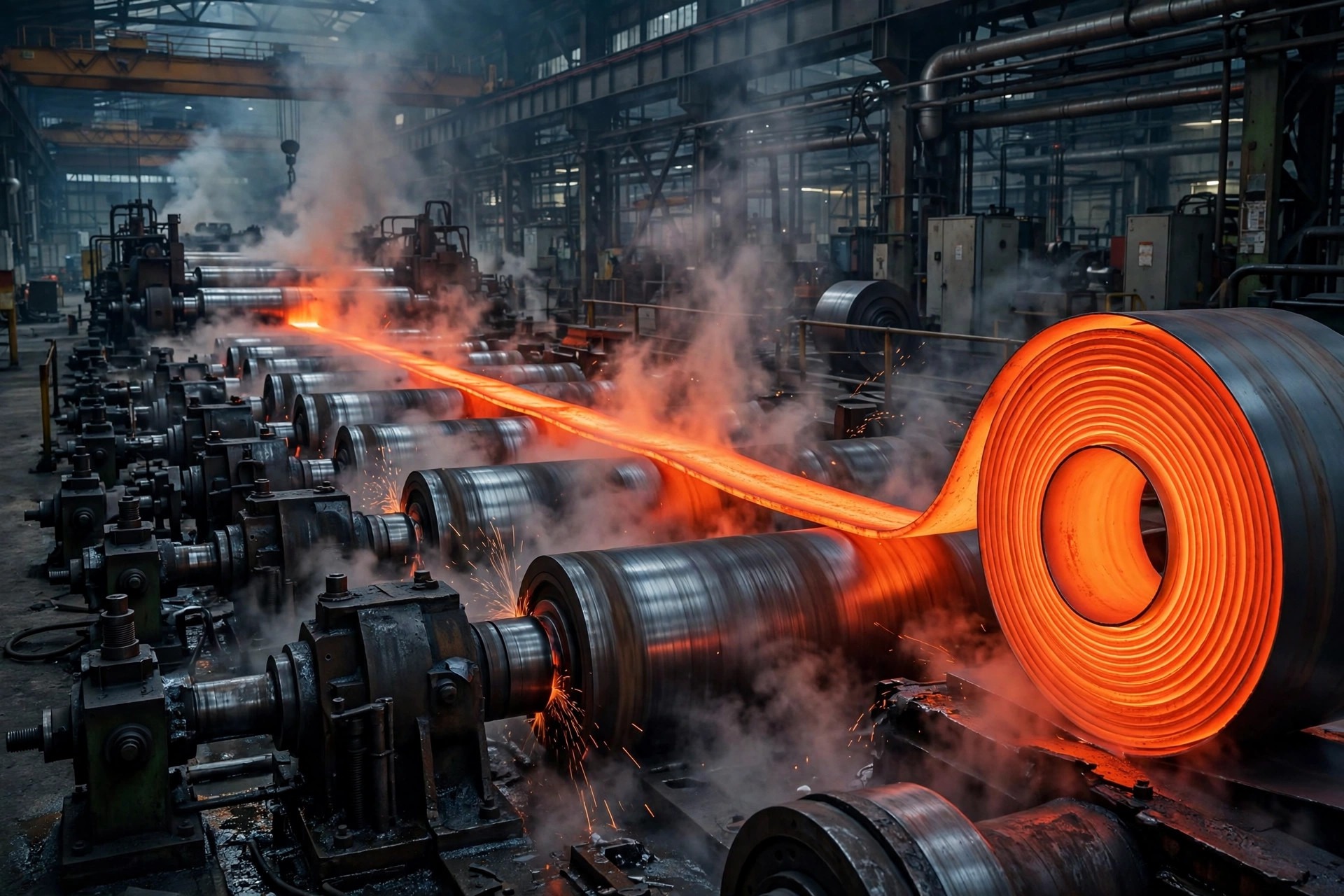
The product range mirrors the staircase. Cold-rolled coils and sheets are the base product: steel rolled thin at room temperature for precision uses. Hot-dip galvanised steel adds a zinc coat for corrosion resistance — the workhorse for construction, ducting, and countless manufactured goods. Colour-coated steel adds paint systems for roofing and appliances, the highest-value finish of the three. All begin from hot-rolled coil, much of it imported, which ISL processes through pickling, cold reduction, annealing, galvanising or coating — a chain of capital-intensive steps performed on its Karachi site and sold through regional offices in Lahore, Islamabad and Multan, with exports to more than twenty countries in the company's account of its reach.
How flat steel makes money
ISL's business is a processing spread at industrial scale. The dominant cost is hot-rolled coil — its raw material — whose price is set in international markets and paid for substantially in foreign currency. Against that, ISL earns the domestic selling prices of cold-rolled, galvanised and colour-coated products, which are benchmarked to the landed cost of equivalent imports: local buyers will pay a local producer roughly import parity, adjusted for quality, reliability and credit terms, but not much more. The margin between the two is the mill spread, out of which ISL must pay energy, zinc and paint inputs, labour, maintenance, depreciation on a very expensive asset base, and financing costs.
Two consequences follow. First, utilisation is everything: a million-tonne complex carries fixed costs that do not shrink when orders do, so capacity utilisation in demand downturns decides whether the year is merely weak or genuinely loss-making. Second, inventory and currency effects are large: steel bought at one exchange rate and price level is sold months later at another, generating inventory gains in rising markets and painful reversals when international prices fall or cheaper imports flood in. Trade-remedy duties on dumped steel, when in force, form part of the competitive weather, as does the health of downstream demand — automobiles, appliances, construction and the pipe industry, including parent International Industries (INIL), itself a consumer of flat products for tube-making. The sector's listed names are compared in our guide to PSX steel stocks.
The parent relationship — and why it matters
ISL cannot be read properly in isolation from INIL. The parent founded it, consolidates it, supplies its leadership tradition, and buys from the same broad customer universe. For INIL's shareholders, ISL is the growth engine inside a mature pipes business; for ISL's minority shareholders, the questions are the standard ones of any listed subsidiary — transfer pricing, shared services, dividend policy and the balance between the subsidiary's own reinvestment needs and the parent's appetite for payouts. The Japanese shareholdings, though small, are a governance signal: Sumitomo and JFE are not passive names, and their continued presence ties ISL to global steel technology and trading networks. The structure is best pictured as a family house with institutional godparents — a distinctly Pakistani solution to the problem of building world-scale plant with local capital.
Its place in Pakistan's industry
Every tonne of flat steel ISL sells to a Pakistani appliance or auto-parts maker is a tonne that did not have to be imported with scarce dollars, and company materials have long framed the project in exactly those terms: foreign exchange saved, downstream industry enabled. Flat steel is also a quality ladder for the whole manufacturing economy — the better the local sheet, the better the fridges, vehicles and buildings Pakistan can make — and ISL's complex is one of the few places in the country where that ladder is being climbed with modern equipment at scale. Its KSE-100 seat gives that industrial role a capital-markets echo, under the index rules explained in how the KSE-100 is calculated.
Who buys flat steel — and why it matters
ISL's customer list is a map of Pakistani manufacturing. Automobile and motorcycle assemblers buy cold-rolled sheet for body panels and components, demanding surface quality that exposes every mill defect. Appliance makers — refrigerators, air-conditioners, washing machines — buy galvanised and colour-coated steel that becomes the visible skin of their products, where a blemish is a rejected unit. Pipe makers, including ISL's own parent, slit and form galvanised strip into tube. Construction takes colour-coated roofing and cladding, ducting and structural decking by the thousands of tonnes. Each segment has its own cycle — cars crash when interest rates spike, construction slows when cement and credit tighten, appliances follow consumer financing — and ISL's order book blends them into something steadier than any single one, though never steady enough to ignore.
That downstream web is why flat steel is treated as strategic far beyond its tonnage. When ISL's mill runs well, Pakistani factories gain a supplier who delivers in days, extends local credit norms and can adjust specifications with its customers' engineers — advantages no import programme, however cheap, fully replicates. When international prices collapse and dumped imports undercut the mill, the policy debate that follows — anti-dumping duties, tariff structures on raw material versus finished steel — is really a debate about whether Pakistan keeps this capability at all. ISL's Japanese partners and IFC-backed origins give it a particular voice in that debate: it was built, with development-finance blessing, precisely to localise a capability the country previously rented from foreign mills.
The environmental ledger is the newest chapter of the story. Steel is energy-intensive, and ISL's published sustainability materials describe a "clean, lean and green" operating philosophy — efficiency, waste reduction and recycling of steel scrap and process by-products. Steel is also the world's most recycled industrial material, and flat-steel plants sit inside that circular economy as both consumers of energy and producers of an endlessly reusable product. As global buyers begin asking supply chains for carbon accounts, the flat-steel mill that can document its footprint gains an argument imports cannot easily match — one more way in which a 2007 import-substitution project keeps acquiring new rationales.
One relationship inside the numbers deserves emphasis: ISL and its parent buy and sell in the same steel world, and ISL's galvanised output competes, in part, for the same construction demand that drives INIL's pipe sales in strong years — the group can win twice from one building boom, once in sheet and once in tube. In weak years the correlation runs the other way, which is why the Chinoy Group's third leg, Pakistan Cables, and its trading interests matter to the family's overall balance even though they sit outside ISL's own accounts. For the ISL shareholder, though, the discipline is to value the mill in front of them: a single-site, single-product-family steel processor whose fortunes are written by the spread between hot-rolled coil and finished sheet, and by how fully its million tonnes are used.
The mill's Karachi location is itself a strategic fact. Flat steel is heavy, damage-prone and expensive to move, so a coastal plant beside the country's largest port and its densest cluster of appliance, auto and construction demand starts with a logistics advantage no inland rival can copy. Imports land at the same port, of course — which is precisely the contest: ISL's delivered cost and service against the importer's landed cost, replayed in every purchase order. The company's two expansions were, in that light, wagers that scale would keep the local mill on the right side of that comparison through the cycle. So far, the wagers have held.
What investors typically watch in International Steels
This profile is educational content, not financial advice. The standard observation points for ISL are:
- Capacity utilisation and volumes — against the million-tonne installed base, the single most informative operating number.
- International steel prices — hot-rolled coil benchmarks that set both input costs and import-parity selling prices.
- The rupee — which moves input costs and the landed price of competing imports simultaneously.
- Downstream demand — automobiles, appliances and construction, plus any import surges or trade-remedy changes.
- Energy tariffs — cold rolling and galvanising are power-intensive, and industrial energy pricing is a perennial Pakistani variable.
In less than two decades ISL has travelled from a 2007 incorporation document to the centre of Pakistan's flat-steel supply — a reminder that the country's industrial story is not only about old family mills, but about new plants built deliberately, with global partners, inside old family groups. The companion profile of its parent, International Industries, completes the picture, and the Aktzien learning library covers the accounting basics — consolidation, subsidiaries and minority interests — that this two-company structure makes impossible to ignore.
Key takeaway: International Steels was created in 2007 by IIL with Sumitomo and JFE Steel, commissioned in 2010, and expanded in stages to about a million tonnes a year — turning an old pipes family's expertise into Pakistan's modern flat-steel champion.