KARACHI: Inflation is the tax nobody votes for and everybody pays. In Pakistan it has been the defining economic fact of ordinary life in recent years — the reason the same salary buys less food, the reason savings parked in a drawer quietly rot, and the reason the central bank's rate decisions matter so much. Yet the official number itself — "CPI inflation" — is widely quoted and rarely understood. How is it measured? Why does your personal experience so often feel worse than the headline? And what actually causes prices to rise here? This explainer answers those questions without quoting any current reading: for the latest figure, the source is the Pakistan Bureau of Statistics, which publishes it every month.
The CPI: a basket, a base year and a very large price collection
The Consumer Price Index is built like a shopping basket. Statisticians at the Pakistan Bureau of Statistics (PBS) define a fixed basket of goods and services that represents the spending of an average household — food and beverages, housing and utilities, transport, clothing, education, health, restaurants and more — and assign each category a weight reflecting its share of household budgets, derived from household income and expenditure surveys. Field staff then collect prices for the basket's items from markets and outlets across dozens of cities, month after month. The index compares today's cost of that fixed basket with its cost in a base period; inflation is the percentage change, usually quoted year-on-year (this month versus the same month last year) alongside a month-on-month figure.
Several features of this construction explain most public arguments about the number:
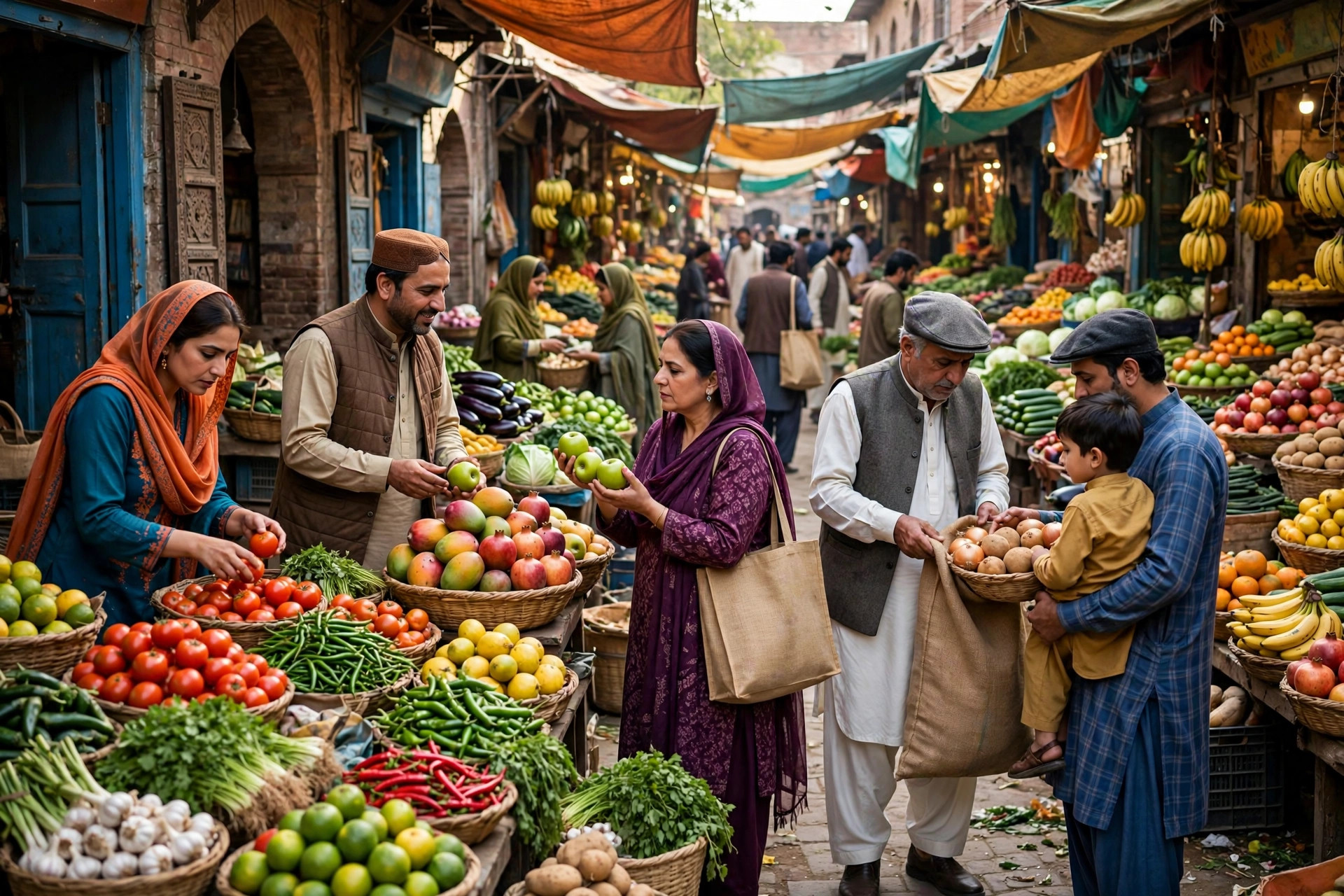
- Food carries a very heavy weight — roughly a third or more of the urban basket — because Pakistani households genuinely spend that share on food. A surge in wheat, milk or vegetable prices moves national inflation more than an identical surge in, say, airfares.
- The basket is fixed between revisions, so it can lag changes in real consumption — new products enter slowly, and substitution (switching from beef to chicken when beef spikes) is only partly captured. The index measures the cost of a fixed basket, not the cost of living as households actually adapt it.
- Urban and rural indices differ, and PBS publishes both, plus the more volatile Sensitive Price Indicator (SPI), a weekly gauge concentrated on essential food and energy items that dominates headlines in price-shock weeks.
- Administered prices sit inside the index: electricity and gas tariffs, and fuel prices set through official formulas, are not market weather — they are decisions, and tariff "adjustments" can add points to inflation in a single month.
So when official inflation prints lower than your kitchen suggests, it is rarely fabrication: it is arithmetic. Your basket is not the average basket. A family spending half its income on food and rent experiences food-led inflation far more intensely than the headline rate; a household whose spending tilts to services and electronics may experience less. Economists call this inflation inequality, and Pakistan's spending patterns make it wide.
Core inflation: the number inside the number
Because food and energy prices swing with weather, harvests and global markets, analysts also track core inflation — measures that strip out food and energy to reveal the underlying trend driven by demand and expectations. The State Bank watches core measures closely when setting the policy rate: it cannot make it rain or lower world oil prices, but if price rises are spreading from fuel into transport fares, school fees, rents and wages — the "second round" — that is the part monetary policy can and must fight. A headline spike with calm core calls for patience; both rising together calls for tightening. Much of the drama of Pakistan's recent inflation episodes, described in general terms here rather than with dated figures, has been about exactly that spread from imported shocks into the domestic core.
Where Pakistan's inflation comes from: the usual suspects
Imported inflation. Pakistan imports its fuel, much of its edible oil, pulses, machinery and industrial inputs. When global prices rise — or the rupee falls, which raises the local price of everything imported even if world prices stand still — costs cascade: diesel into transport fares, transport into food distribution, gas and electricity tariffs into factory costs, factory costs into shelf prices. The exchange rate is therefore an inflation variable, not just a financial one; our rupee explainer traces what moves it.
Food supply. Floods, droughts, crop disease and smuggling-driven shortages can spike specific prices violently — vegetables are the classic weekly drama — and given food's basket weight, supply failures become national inflation events. Perishables cannot be stored or imported fast enough to smooth every shock, which is why Pakistani inflation is structurally more volatile than that of food-importing-stable or food-surplus economies.
Money and the budget deficit. The oldest theory is also the most durable: if the quantity of money grows persistently faster than the supply of goods, prices adjust upward. In Pakistan the mechanism runs through the fiscal door — when governments finance deficits in ways that expand money (directly or through the banking system) while the economy's productive capacity grows slowly, inflation is the eventual release valve. This is why IMF programmes and SBP statements alike obsess over deficit financing, a thread our IMF explainer picks up.
Expectations. Once households and businesses expect inflation, they build it in: workers demand raises pre-emptively, shops reprice in anticipation, landlords index rents informally. Expectations are why inflation is sticky on the way down — and why central banks guard their credibility so jealously, since a public that believes prices will be controlled behaves in ways that help control them.
A worked example: what inflation does to Rs 100,000 (illustrative)
The arithmetic of erosion is simple and brutal. Suppose — as a pure illustration, not a current reading — inflation runs at 20 per cent for a year. Rs 100,000 kept in cash at home still says Rs 100,000 on the notes, but it buys what about Rs 83,000 bought a year earlier: roughly a sixth of its purchasing power has evaporated. If instead the money sat in a savings account earning 15 per cent, it grows to Rs 115,000 nominal — yet in last-year's purchasing power that is about Rs 96,000. The saver lost ground despite a healthy-looking profit, because the real return (about 15 minus 20, or minus 5 per cent) was negative. This single calculation — nominal return minus inflation — is the most important in all of personal finance, and it is why long periods of high inflation quietly transfer wealth from savers and wage-earners whose pay lags prices, to borrowers and owners of real assets whose prices rise with the index.
Compounding makes long horizons unforgiving. At a steady illustrative 10 per cent a year, prices double in roughly seven years; at 20 per cent, in under four. A retirement saved entirely in cash across a high-inflation decade is not a conservative plan — it is a plan to be poor slowly. Conversely, when policy succeeds and inflation falls, the same arithmetic turns friendly: even modest deposit and sukuk returns become genuinely positive in real terms, and long-term investing in productive assets — the subject of the Aktzien learning library — recovers its logic.
Inflation and the investor: reading assets through the price index
- Cash and current accounts lose real value fastest; they are for transactions and emergencies, not storage of wealth across inflationary years.
- Deposits, T-bills and sukuk defend you only to the extent their rates exceed inflation after tax — which is a policy-rate question (tight policy usually means positive real rates eventually; loose policy the reverse).
- Shares are claims on real businesses. Companies with pricing power — the theme of our Nestlé Pakistan explainer — can pass costs into prices and protect real earnings; companies selling regulated or price-capped output into rising costs get squeezed. Inflation thus sorts the stock market rather than lifting or sinking it uniformly.
- Gold and property, Pakistan's traditional hedges, respond to inflation expectations and the rupee, but with their own cycles, costs and illiquidity — hedging is not the same as guaranteed protection.
- Wages and pensions are the household's real hedge when they index or renegotiate upward; where they cannot — fixed pensions, informal wages — inflation bites hardest and longest.
Why your inflation differs, and how to use the official number anyway
Build a rough personal inflation rate once a year: list your big spending categories, note what each actually cost you this year versus last, and average them weighted by your spending. The exercise takes an evening and permanently improves financial decisions — it tells you the real return your savings must beat, which is your number, not the nation's. Use PBS's published CPI for the national picture, SBP commentary for the trend and core measures, and treat any specific rate quoted in older articles (including, by design, none appear in this one) as history: inflation statistics are revised, baskets are rebased, and the current official release is the only safe citation.
This article is educational content, not financial advice. Its aim is the machinery: a fixed basket, heavily weighted to food, repriced monthly by the PBS; drivers split between imports, harvests, money and expectations; and a personal bottom line that depends on whether your income and savings grow faster than your own basket's cost. Master that machinery, and the monthly headline stops being a rumour and becomes a measurement you can interrogate — which is the first step to defending yourself against it.
Food inflation up close: wheat, milk and the vegetable problem
Because food dominates the basket, Pakistan's inflation story is often a food story, and food prices obey their own logics. Wheat and flour sit at the centre: the harvest, the government's procurement and support-price decisions, provincial releases from public stocks and the ever-present leakage across borders together set the price of the roti that anchors every meal — a single commodity whose mismanagement can define a government's economic reputation. Milk prices follow fodder costs, animal supply and the pricing decisions of city-level associations in a market still largely informal, so they ratchet up with costs but rarely glide down. Perishables — tomatoes, onions, potatoes, chicken — are the drama: gluts crash prices, shortages multiply them within weeks, and because they cannot be stored, no policy smooths them fully. Layered over all three is the energy chain: diesel for the truck, gas and electricity for the cold store and the mill. A reader who wants to anticipate Pakistan's inflation, rather than merely react to it, watches harvest estimates, fuel price notifications and the rupee — the CPI, when it arrives, is usually confirming what those three already said.
How households and businesses actually adapt
People are not passive under inflation, and their adaptations feed back into the statistics. Households substitute (cheaper cuts, smaller quantities, loose instead of branded), stock up ahead of expected increases, and shift spending toward essentials — which is why discretionary businesses report pain before the headline index peaks. Businesses shorten price lists' validity, reprice more frequently, shrink pack sizes (the global "shrinkflation" pattern, keeping the price point and trimming the grams), and build expected inflation into contracts and rent agreements. Employers face annual wage rounds in which "we only kept up with inflation" is the neutral outcome, not a raise. Each adaptation softens the blow for the adapter while passing pressure onward — and together they explain why measured inflation can stay elevated even after the original shock fades: the economy's contracts have been rewritten around it, and unwinding takes time, credibility and a stretch of boring, stable months.
A note on the other indices you will hear quoted
Two cousins of the CPI complete the vocabulary. The Wholesale Price Index tracks prices at the first bulk-sale stage — fuel, raw materials, manufactured inputs — and tends to lead the CPI, since wholesale costs reach retail shelves with a lag; a WPI surge is tomorrow's CPI pressure in transit. The SPI, published weekly, covers a basket of essentials and moves fastest of all, which is why it dominates news in shock weeks despite being the narrowest measure. None of the three is "the true inflation" — they are lenses of different focal lengths on the same price system, and quoting one against another without saying which is a reliable sign of an argument being decorated rather than made.
Key takeaway: inflation in Pakistan is measured by repricing a fixed, food-heavy basket every month — and whether it is hurting you depends on the gap between that index and the growth of your own income and savings.