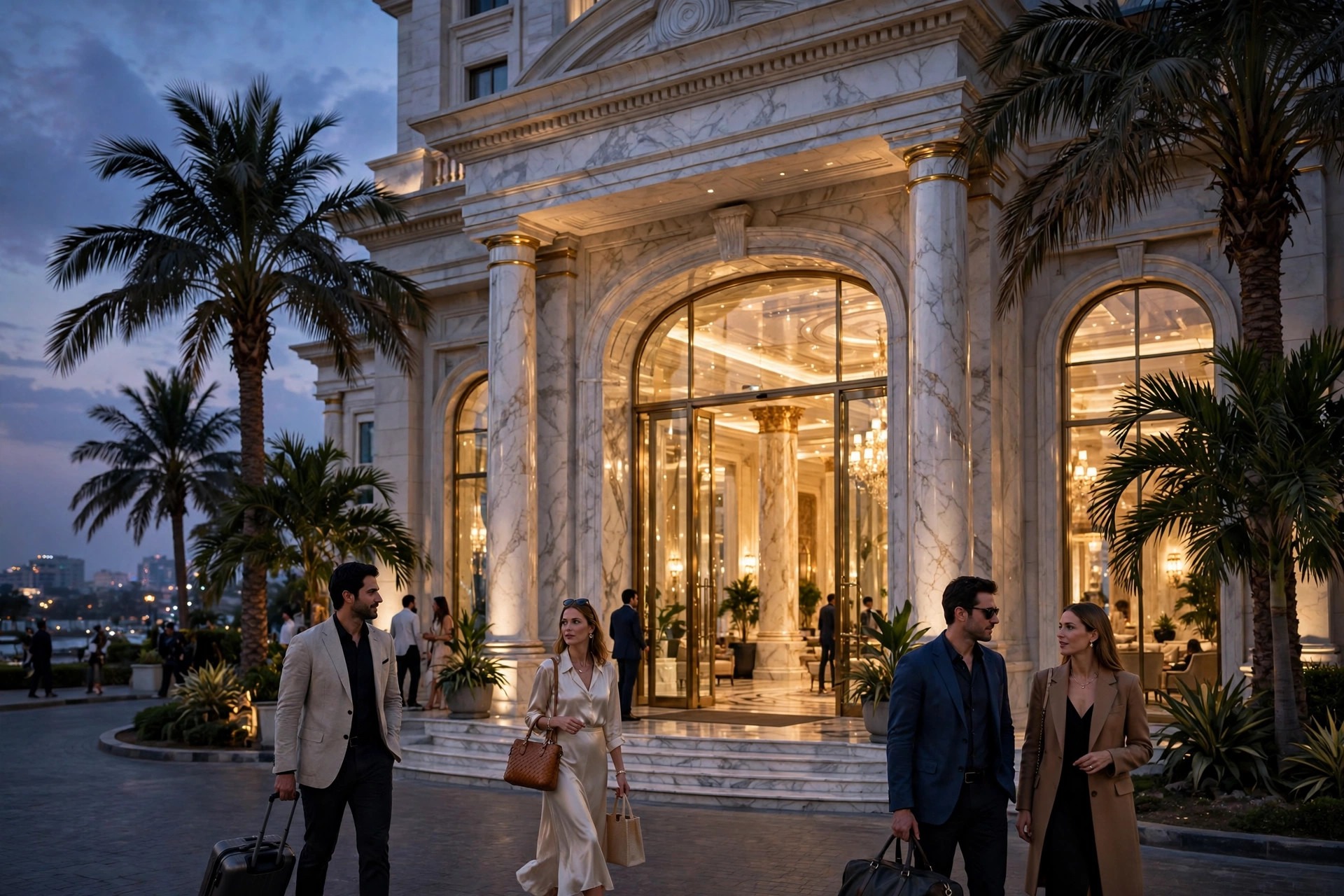
KARACHI: On 10 May 1964, President Ayub Khan inaugurated a gleaming new hotel on Karachi's seafront road — the InterContinental, the first five-star hotel in Pakistan, with air-conditioning, conference halls and a swimming pool that announced the young country's ambitions to every arriving diplomat and businessman. The company that built it, Pakistan Services Limited — PSEL — still owns it today, under the name it has carried since the 1980s: Pearl-Continental. PSL is the listed owner of the PC hotel chain — properties in Karachi, Lahore, Rawalpindi, Bhurban, Muzaffarabad and Malam Jabba, with a four-star sister brand, PC Legacy, in the northern tourist belt — and it is the hospitality flagship of the Hashoo Group, the empire built by Sadruddin Hashwani. It is also one of the KSE-100's most unusual members: a company whose assets are not factories or fields but landmark buildings, banquet halls and room nights.
What the company owns and does
Pakistan Services Limited is principally engaged in the hospitality business: it owns and operates a chain of five-star Pearl-Continental hotels across Pakistan. At its most recent corporate briefings the company counted six five-star properties in major cities and tourist destinations — Karachi and Lahore; Rawalpindi; the hill resort of Bhurban above Murree; Muzaffarabad in Azad Jammu and Kashmir; and the ski resort of Malam Jabba in Swat — with further five-star projects under construction, including hotels in Mirpur and Multan. Below the flagship brand sits PC Legacy, launched in 2021 to serve the four-star segment, with properties in Naran and, from 2023, in Nasirabad, Hunza — placing the group on the road network of Pakistan's booming domestic tourism to the northern areas.
Alongside the hotels, PSL carries smaller businesses from its group's travel interests: it operates in travel and tourism under the Destinations of the World banner, licensed from DOTW in Dubai, and has been engaged in car-rental services. But the economics of the company are the economics of its hotels: large, long-lived real-estate assets in prime urban and resort locations, run as full-service hotels earning room revenue, food and beverage income, and banqueting and events business. Its headquarters are in Islamabad, and its chairman is Sadruddin Hashwani of the Hashoo Group — the parent whose story is inseparable from the company's second act.
1958–1964: an airline-era creation
Pakistan Services Limited was formed on 6 December 1958 in Karachi, with the backing of Pakistan International Airlines and Pan American World Airways — Pan Am being the founder of the InterContinental Hotels chain, which it created to house its crews and passengers across its global network. The purpose was explicit: to build InterContinental hotels in West and East Pakistan, giving the new state the international-standard accommodation its capital cities and ports lacked. The concept was of its era — flag carrier, foreign partner, landmark hotel — the same template then rising across Asia and the Middle East.
The Karachi hotel came first and set the template: inaugurated in 1964 as the country's first five-star property, it joined the Leading Hotels of the World and held that affiliation for over a decade. Hotels for Lahore and Rawalpindi followed in 1967, and a property in Peshawar opened in 1975, giving the chain a presence in each of West Pakistan's major cities. Through the 1960s the PC hotels — InterContinentals, as they then were — became the default setting for Pakistan's official and commercial life: state banquets, trade delegations, weddings of consequence, and the press conferences of visiting dignitaries all happened in their halls, a social centrality the brand has never quite lost.
Nationalisation, and the Hashwani takeover
The 1970s changed the company's owners. In the era of nationalisation — when the government took control of banks and much of industry — PSL passed into government control, and the hotels spent a period as state-held assets, with the InterContinental affiliation and management arrangements evolving as Pakistan's politics turned. The chain's modern era begins in the mid-1980s: in 1985, the Hashoo Group made a successful bid for the majority shares of Pakistan Services Limited, which then owned four InterContinental hotels across Pakistan, and the hotels were re-branded as Pearl-Continental — the name, drawn from Pakistan's "pearl" coastline identity, that they carry today.
The buyer deserves a paragraph of his own. Sadruddin Hashwani founded what became the Hashoo Group in 1960 as Hassan Ali & Company, a commodities-trading business at Karachi Port; by the 1970s it was among Pakistan's largest trading houses. When the government nationalised cotton and rice exports in 1972, Hashwani pivoted into hospitality — opening Holiday Inn hotels in Karachi in 1978 and Islamabad in 1981, later re-branded as Marriotts — and the 1985 PSL acquisition made his group the dominant force in Pakistani hotels. Hashoo later expanded into oil and gas, acquiring international companies' Pakistani upstream operations in the 1990s and 2010s, and into budget hospitality with the Hotel One chain. But Pearl-Continental remains the group's public face, and PSL its listed flagship — a rare case of a Pakistani hotel group whose founder's name is as well known as its brand's.
How a hotel company makes money
Hotel economics are a study in fixed costs and perishable inventory. A room unsold tonight cannot be sold tomorrow; the building, its staff establishment, its energy and maintenance bills run whether occupancy is thirty per cent or ninety. Revenue has three main streams. Rooms: room nights sold multiplied by the average daily rate, summarised by the industry's favourite ratio, revenue per available room. Food and beverage: the PC hotels' restaurants — several of which, from Chinese to barbecue to traditional Pakistani fine dining, are destinations in their own cities independent of the rooms above them — plus room service and minibars. And banqueting and events: in Pakistan this is not a sideline but a pillar, because the great urban hotels are the default venues for weddings, corporate conferences, exhibitions and official functions, and a single wedding season can carry a quarter.
Against that revenue stand heavy costs — payroll for a labour-intensive service, energy for large air-conditioned buildings, food costs, brand and refurbishment cycles, and finance costs on expansion. Two accounting features matter for readers of PSL's statements. First, the balance sheet is dominated by land and buildings carried with periodic revaluations: the company's prime sites, held for decades, mean its asset base is large relative to its annual earnings, and revaluation surpluses are a standing feature of its equity. Second, earnings are unusually exposed to the country's mood and security climate: tourism, business travel, conferences and weddings all contract sharply in crises — terror incidents, political turmoil, pandemics and floods have each, at different times, emptied Pakistan's hotels — and recover just as sharply when confidence returns. PSL's results across the decades trace that national barometer faithfully.
The northern bet: resorts, PC Legacy and domestic tourism
The most significant strategic thread in the company's recent history is geographic. Pakistan's domestic tourism — families driving to Murree, Naran, Hunza, Skardu and Swat in numbers the industry of the 1990s never imagined — has created demand for branded, reliable hotels in the mountains, where supply was historically guesthouses and rest houses. PSL's portfolio maps exactly onto that shift: Bhurban in the Murree hills, Malam Jabba's ski slopes, Muzaffarabad, and the PC Legacy flag planted in Naran and Hunza, with new five-star projects in Mirpur and Multan extending the network into underserved cities. The strategy trades the diplomat-and-businessman market the chain was built for in 1964 for the Pakistani leisure traveller of the 2020s — a larger, more seasonal, more price-aware customer, but one whose growth is driven by roads, incomes and social media rather than by state visits.
Malam Jabba carries the sharpest version of that story. The original resort — built with Austrian assistance under the Pakistan Tourism Development Corporation — was set on fire and destroyed by militants in June 2008, during the Swat insurgency, and for years the hotel stood in ruins above a rebuilt ski slope. The Pearl-Continental flag arrived through a management contract signed in 2018 between Pakistan Services and the Samsons Group, the resort's owners: a new hotel of about a hundred rooms at some 2,650 metres above sea level, run under the PC brand without PSL owning the building. The arrangement matters beyond one property — it shows the listed company can grow its brand through management contracts on other people's assets, a lighter model than the owned-landmark structure on which the chain was built.
Its index membership, for a company of this shape, follows the standard machinery: the KSE-100 selects on the size and trading measures explained in our guides to how the index is calculated and market capitalisation — the hotel company's weight reflects its listed value, not the worth of any single famous building.
Two hotel empires, one group: PC and the Marriott distinction
Newcomers to the stock often confuse PSL with the whole of Hashoo's hotel business, so the boundary is worth drawing precisely. The Hashoo Group's hospitality interests extend beyond Pakistan Services: the group separately owns the Islamabad and Karachi Marriott hotels — the former Holiday Inns it opened in 1978 and 1981 and later re-branded — and the Hotel One budget and mid-range chain, built on a franchise model from 2008. Those assets are not inside PSEL. What the listed company owns is the Pearl-Continental estate: the five-star PC properties and the PC Legacy brand. A reader comparing PSEL's results with headlines about "Hashoo hotels" in general should therefore check which balance sheet a given hotel sits on — the distinction between the listed flagship and its unlisted sisters is the first fact of the company's structure, and management's briefings are careful to maintain it.
The wedding economy and the restaurants
Two features of the PC business are more Pakistani than any occupancy statistic. The first is the wedding economy. In Karachi, Lahore and Islamabad, the great hotels are the prestige venues for wedding functions that can host many hundreds of guests across multiple halls on a single winter evening; the season concentrates into the cooler months, bookings are made a year ahead, and the banqueting calendar — weddings, corporate dinners, exhibitions, official functions — is a revenue pillar in its own right, with its own sales teams and its own cycle tied to consumer confidence rather than to travel. The second is the restaurants as institutions: over decades, individual PC dining rooms built followings independent of the hotels above them — businessmen lunching in the same Chinese restaurant for thirty years, families marking occasions in the same barbecue garden — giving the food-and-beverage division a local, repeat clientele that pure travel demand never provides. Both features cushion the company against the volatility of international arrivals, which Pakistan's hotels have never been able to take for granted, and both explain why the PC balance sheet survived eras — the lean security years above all — that emptied hotels dependent on foreign guests.
The same local rootedness shapes the risks. A hotel cannot be moved, hedged or exported; its market is the city it stands in, and its fortunes are the city's fortunes — Karachi's business cycle for the Karachi PC, the northern tourist season for Bhurban and Malam Jabba, the official calendar for Rawalpindi. PSL is, in that sense, one of the purest listed plays on Pakistan's urban and domestic-tourism economy that the exchange offers: no exports, no dollar revenues, no commodity hedge — just rooms, halls and tables, repriced every single night.
What investors typically watch
Followers of PSEL watch occupancy and room rates at the flagship properties; the wedding and conference calendar's health in Karachi, Lahore and Islamabad; the pace and cost of the expansion pipeline — Mirpur, Multan and the PC Legacy roll-out; the performance of the resort properties through the summer and winter seasons; energy and wage costs; and the ever-present sensitivity of travel demand to the security and political environment. Because the asset base is property-rich, readers also track revaluations and any corporate moves affecting the hotel portfolio. These are observation points, not a recommendation — this article is educational content, not financial advice, and the Aktzien learning library explains the basics of reading company accounts for readers starting out.
Key takeaway: Pakistan Services has owned Pakistan's grand hotels since 1958 — built as InterContinentals with PIA and Pan Am backing, nationalised in the 1970s, and reborn as Pearl-Continental under Sadruddin Hashwani's Hashoo Group since 1985 — earning from rooms, restaurants and the country's wedding halls.