KARACHI: Few purchases in Pakistan carry the emotional and financial weight of a car. It is the second-largest asset most families will ever own, a wedding-season staple, a status symbol and — for investors on the Pakistan Stock Exchange — the centre of one of the market's most dramatic cycles. Automobile shares can multiply earnings in a boom and see them evaporate in a slump, because car demand in Pakistan is exquisitely sensitive to interest rates, the exchange rate, import policy and consumer confidence, all at once. The sector listed on the PSX is broader than the showroom names suggest: alongside the assemblers who build cars, trucks, tractors and motorcycles sit dozens of parts makers supplying everything from batteries and tyres to seats and radiators. This guide explains how assemblers and parts companies make money, why the demand cycle is so violent, what localisation really means, and how to read an auto company's results without being whipsawed by the latest month's sales number.
Assemblers: the showroom end of the chain
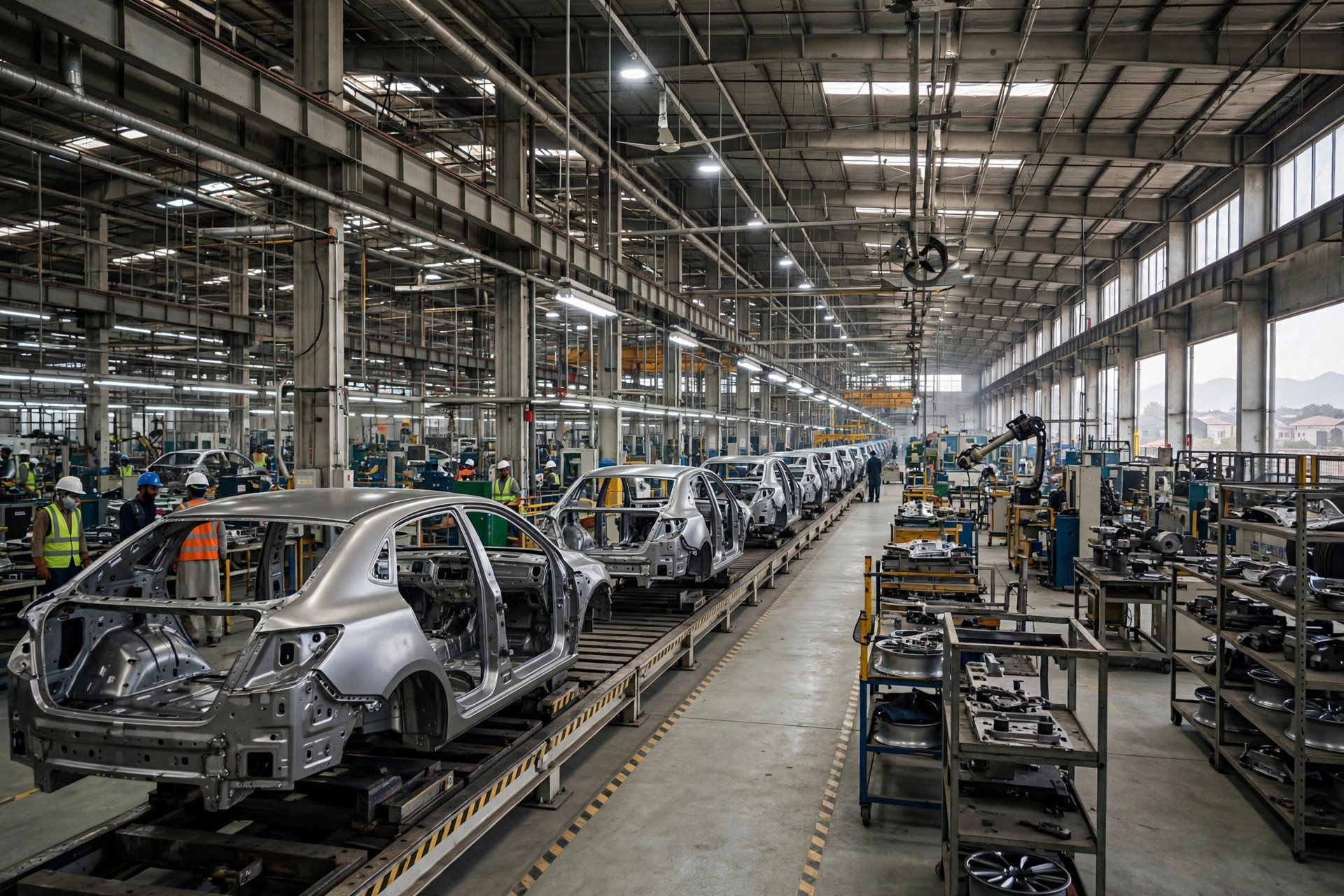
A Pakistani car assembler is typically a joint venture or licensee linked to a global manufacturer, assembling vehicles from a mix of locally produced parts and imported kits and components. The model arrives as engineering and brand from the parent; the local company builds, distributes through a dealer network, provides after-sales service and parts, and remits royalties and technical fees. Revenue is vehicles sold multiplied by price — and prices in Pakistan are set by the assembler but pressured by everything around them: the rupee cost of imported content, taxes and duties that form a large slice of the sticker price, competition from rival models, and the ever-present alternative of imported used cars, whose flow is governed by import policy for overseas Pakistanis and periodic regulatory tightening or loosening.
Product mix matters enormously. Small, fuel-efficient hatchbacks serve first-time buyers and are highly price-sensitive. Sedans and crossovers carry higher margins but depend on a thinner, wealthier customer base and on auto financing. Tractors belong to the farm economy and march to crop incomes, support-price politics and bank agricultural lending rather than to showroom sentiment. Motorcycles — built by the largest-volume producers in the wider sector — are the working transport of the country, cheaper and more resilient in downturns, though not immune. Trucks and buses follow freight rates, trade volumes and public transport schemes. A listed assembler concentrated in one category lives and dies by that category's cycle, so the first task in reading any auto stock is identifying exactly which wheels it sells. The sector's data plumbing helps: monthly production and sales figures for much of the industry are published by the industry association and widely reported, giving investors an unusually frequent — and unusually tempting to over-interpret — stream of numbers.
Parts makers: the quieter half of the sector
For every assembler there is a constellation of listed and unlisted vendors: makers of batteries, tyres and tubes, alloy wheels, radiators, seats, cables, lamps, forgings and glass. Their economics differ from assemblers' in ways investors should respect. A parts maker sells to two markets: the original-equipment market, supplying assemblers' production lines, and the replacement market, supplying the millions of vehicles already on the road. The first market rises and collapses with new-vehicle sales; the second is steadier, because a parc of vehicles already sold needs batteries and tyres in good years and bad. A vendor weighted toward replacement demand is therefore a less cyclical business than the assembler it supplies — a fact often missed when the whole sector is sold off together in a downturn.
Vendor margins are negotiated in the shadow of powerful customers. Assemblers demand annual cost reductions and pass on design changes, while the vendor's own inputs — lead for batteries, rubber and carbon black for tyres, steel and aluminium for components — are commodity-priced and often dollar-linked. The strong vendors respond with scale, tooling capability, quality certifications that assemblers require, and gradually broader customer bases across cars, tractors and motorcycles so that no single programme decides their year. Some have grown into exporters or into adjacent products entirely. When reading a parts maker's report, look for the split between original-equipment and replacement sales where disclosed, customer concentration, and the gross margin trend against its key raw material — that triangle explains most of the story, just as coal explains cement and gas explains fertilizer.
The demand cycle: rates, rupees and confidence
Why is Pakistani car demand so cyclical? Start with financing. A large share of new cars in normal times are bought on bank leasing and auto loans, and the monthly instalment is a direct function of the State Bank's policy rate. When rates rise sharply, instalments jump, loan approvals tighten, and demand can fall by half or more within a year — a pattern visible in documented downturns in Pakistan's recent economic history, when high rates, currency pressure and import restrictions arrived together. When rates fall, the reverse happens with surprising speed, as deferred buyers return and banks compete again for auto loans. Overlay the exchange rate: assemblers' imported content means a weaker rupee pushes sticker prices up repeatedly, sometimes several times in a year, which pulls some demand forward (buy before the next increase) and destroys the rest (the car simply becomes unaffordable).
Policy adds its own swings. The structure of duties and taxes on vehicles and kits, rules on used-car imports, periodic restrictions on opening letters of credit for imports during balance-of-payments stress, and auto-industry policies that set localisation and export expectations for assemblers — all of these are decided in Islamabad and all of them move sector earnings. Fuel prices matter too: expensive petrol raises running costs, shifts demand toward smaller engines and motorcycles, and, over time, toward hybrids and electric options that global parents are gradually introducing. Our overview of how stock prices move is a useful primer on why cyclical earnings like these produce such lively share prices: the market prices the cycle it expects, not the month just reported.
Localisation: what "made in Pakistan" really means
Few auto terms are quoted more and understood less than deletion or localisation — the share of a vehicle's value made locally. High localisation insulates an assembler from currency and import shocks, supports the vendor industry, and is encouraged by tariff structures that tax complete vehicles more heavily than kits and raw materials. But localisation has real limits: engines, transmissions, electronics and safety systems require scale and technology that a market of Pakistan's size struggles to justify for every model, and the global shift to hybrids and electric vehicles is redrawing which components matter. A battery-electric car deletes the engine and gearbox — historically core local content — and adds a battery pack and power electronics made, for now, mostly abroad.
For investors, localisation is best read as resilience, not patriotism. Ask: how much of this model's cost is rupee-denominated? How exposed is the company to import restrictions when foreign-exchange reserves are tight — a condition Pakistan has faced repeatedly, and during which assemblers have historically cut production for want of kits? Companies that plan inventory and supplier payments for such episodes come through with share gains, because a rival's empty showroom is the cheapest advertising there is. The same lens applies to tractor makers, whose local content is typically deep and whose customers — farmers — can sometimes pay cash in a good harvest year, softening the financing cycle that dominates cars.
Cash, bookings and the advance-payment model
Pakistani car buying has long involved booking a vehicle and waiting for delivery, with customers historically paying part or all of the price in advance. This gives assemblers an unusual cash-flow profile: in strong times, customer advances fund working capital, and the balance sheet carries large advance liabilities matched by inventory being built. It also creates consumer-protection sensitivities — delivery delays and price increases applied to booked cars have drawn regulatory and public attention, and rules around advances and compensation for late delivery have been debated and adjusted over time; check current policy if the detail matters to you. For financial analysis, the point is to read advances and inventories together, and to be careful with cash balances that include customers' money awaiting delivery.
An illustrative example, with round invented figures: suppose an assembler sells 1,000 cars in a month at an illustrative average of Rs 4 million each — Rs 4 billion of revenue. If imported content and taxes leave a modest manufacturing margin per car, the month's profit still swings hugely with volume: sell 500 cars instead in a rate-shock month and the same factories, staff and dealer network must be carried on half the gross profit. That operating leverage — high fixed costs over volatile volumes — is the mathematical core of the auto cycle, and it works in both directions, flattering earnings in booms as much as it punishes them in slumps.
Reading the sector without whiplash
A calm routine helps. Monthly sales data tells you direction, not value; compare rolling periods against the same months last year, and remember that comparisons flatter or deceive when the base was a crisis or a boom. In financial results, separate volume, price and mix: revenue growth from price increases alone, on falling units, is a warning dressed as growth. Watch gross margin against the exchange rate's movement in the period. Watch inventory of imported kits — a buffer in good management, a cost trap if models change. For vendors, watch the replacement-market exposure and raw-material spreads. And always ask where the industry sits in the rate cycle, because the State Bank's decisions will explain next year's sector earnings better than any showroom launch.
The risks are the cycle itself, policy reversals on imports and duties, currency shocks, and — over a longer horizon — technology transition, as hybrids and electric vehicles change both the product and the parts industry beneath it. This article is educational content, not financial advice. The auto sector is the PSX's clearest lesson that a wonderful month is not a trend: contrast its swings with the steadier, export-earning world of textiles, where the customer is a foreign retailer and the cycle is written in cotton and dollars.
Tractors and motorcycles: the other two cycles
Two categories deserve separate mention because they follow different clocks from cars. Tractors are farm machinery, and their demand rises and falls with agricultural income: a good cotton or wheat year, supportive crop prices and available bank financing for farmers produce strong tractor sales, while a poor harvest, water shortages or tight rural credit cut them. Tractor makers also live with policy weather — periodic government schemes, tax changes on agricultural machinery and import decisions on built-up tractors have all moved the market in documented episodes. Their local content is typically deep, their customers more often pay from harvest cash, and their cycle is therefore tied to the same rural economy that drives fertilizer demand; a strong rabi can lift both sectors at once.
Motorcycles sit at the opposite end of the showroom: the transport of students, delivery riders, small traders and millions of commuters. Volumes are large, prices are low relative to cars, and demand is steadier — but it is not flat. Fuel prices, inflation squeezing household budgets, and the availability of instalment plans still move sales, and the segment has its own competitive drama between established Japanese-brand producers and lower-priced local and Chinese-linked assemblers competing on price and features. For parts makers, the motorcycle parc is a blessing: tens of millions of machines on the road consume tyres, batteries, chains and cables relentlessly, rain or shine, boom or slump. An investor who understands that the sector contains a farm cycle, a commuter cycle and a car-financing cycle — moving relatedly but not identically — will read its monthly data with far more sense than one who treats "autos" as a single number.
Key takeaway: auto earnings are operating leverage on a demand cycle driven by interest rates, the rupee and import policy — know which vehicles a company sells, how much of it is local, and where rates are heading before you judge a single month's sales.