KARACHI: Drive past any growing neighbourhood in Pakistan and you will see cement at work — in the grey skeleton of a new house, in the piers of a motorway bridge, in the walls of a dam that has been talked about for decades. On the Pakistan Stock Exchange, cement is one of the oldest and most closely watched sectors, and also one of the most misunderstood. Investors often treat cement shares as a simple bet on construction. In reality, a cement company's profit is decided by a tangle of forces: how much capacity it has built, where its plant sits on the map, what it pays for coal and electricity, whether it can export its surplus, and whether the government is spending on development projects or tightening its belt. This guide explains how the sector actually works — how cement is made and sold, why geography matters so much in Pakistan, how costs flow through to earnings, and what to look for when you read a cement company's results. Nothing here is a recommendation to buy or sell any share; it is an explanation of the machinery, so that the numbers in an annual report start to make sense.
How a cement company makes money
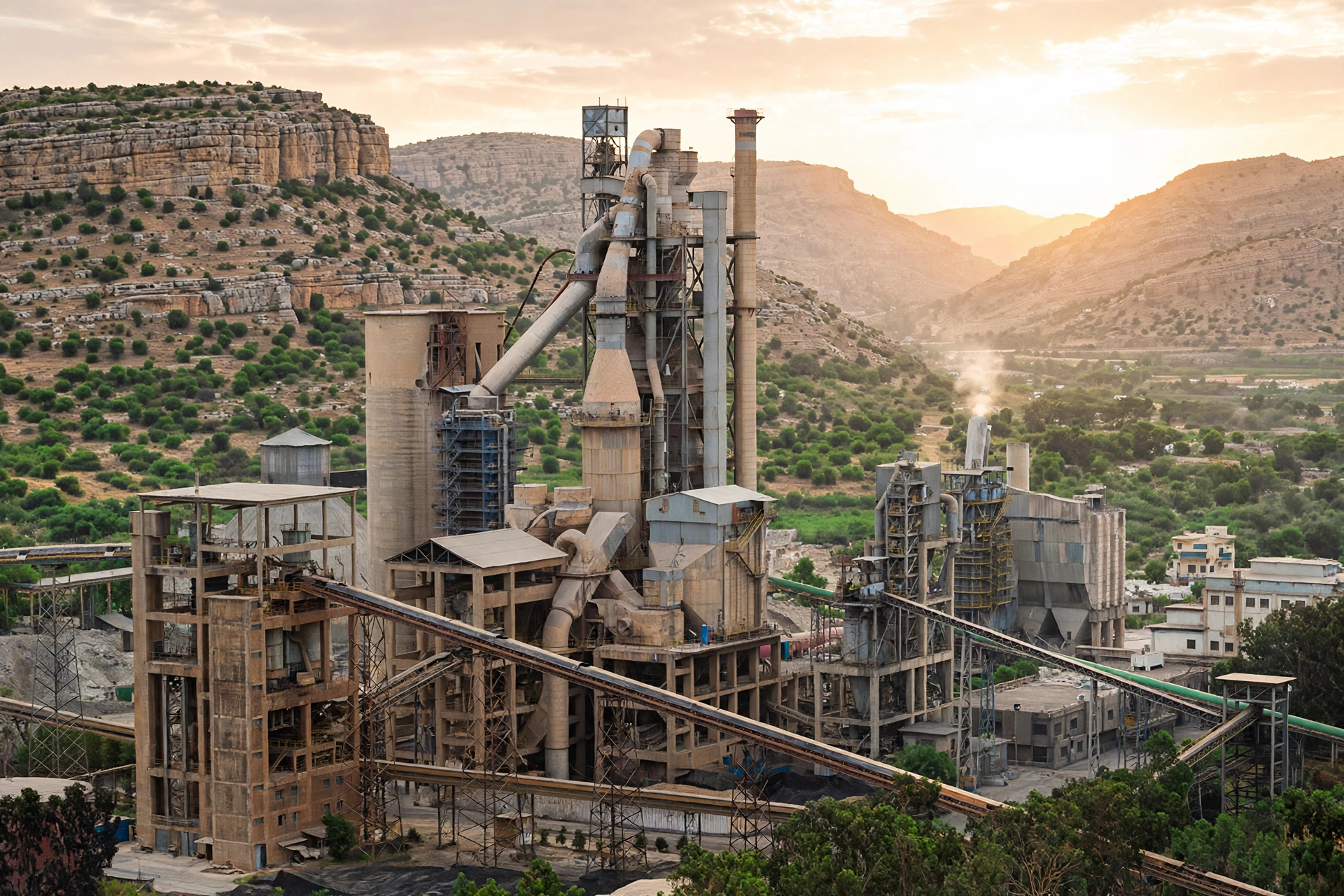
Start with the product. Cement is a heavy, low-value powder made by heating limestone and other raw materials in a kiln at very high temperatures to produce clinker, which is then ground with a small amount of gypsum. A bag sold in a hardware store in Lahore or Karachi is the end of a long, energy-hungry chain. Because cement is bulky relative to its price, transport costs are a large share of what the final buyer pays. That single fact explains most of the sector's structure: plants are built near limestone quarries to keep raw material cheap, and each plant naturally serves a regional market around it, because hauling bags hundreds of kilometres quickly destroys the margin.
Revenue, at its simplest, is bags and bulk tonnes sold multiplied by the price the company can charge after dealer discounts and taxes. Volume depends on demand — houses, commercial buildings, factories, roads, dams and other public works. Price depends on competition in the company's region and on whether the industry as a whole has more capacity than the market needs. When demand is strong and capacity is tight, makers can raise prices and pass on cost increases. When everyone has expanded at once and demand softens, price competition returns and margins compress, even for well-run plants. On the cost side, energy — historically coal for the kiln and electricity for grinding — is usually the largest single item, followed by raw materials, packing, freight and maintenance. Understanding a cement stock, therefore, means understanding both sides at once: the volume-and-price story on the top line, and the fuel story underneath it. The same demand logic, with a very different fuel, runs through Pakistan's fertilizer sector, where gas rather than coal decides the economics.
Capacity, expansions and the cycle that repeats
Cement capacity is added in large, lumpy steps. A new production line takes years to plan, finance and build, and it arrives all at once rather than gradually. Companies tend to announce expansions when times are good, demand is rising and profits are healthy — which is exactly when their competitors are thinking the same thing. A few years later, several new lines can come on stream together, just as demand growth slows. The result is a familiar industry cycle: a period of comfortable utilisation and firm prices, followed by a capacity wave, weaker pricing, and a shake-out in which the lowest-cost producers cope best.
Investors will see the word utilisation often in cement research. It simply means actual production divided by installed capacity. High utilisation spreads a plant's fixed costs — staff, maintenance, depreciation and interest — over more tonnes, so each bag carries less overhead. Low utilisation does the opposite. When you read a results announcement, compare the company's dispatch growth (cement sent out to customers) with the industry's, and ask whether the company is gaining share or merely riding the market. Also watch the balance sheet during an expansion phase. New lines are expensive, and they are often part-funded with debt. Debt taken on at one interest-rate level has to be serviced whatever demand does, which is why the State Bank's policy rate — and the broader interest-rate environment — matters so much to this sector. Expansions financed prudently in good years look very different from expansions that leave a company stretched when rates rise and volumes fall.
The north–south divide
Pakistan's cement map is usually described as two markets. The north — Punjab and Khyber Pakhtunkhwa — holds the larger share of capacity, close to extensive limestone deposits and to the big population centres of Punjab. The south — Sindh and Balochistan — has fewer plants but two advantages: access to Karachi's ports for exports, and proximity to large urban demand in Karachi and Hyderabad. Prices, costs and competitive pressure can differ noticeably between the two zones, and a company with plants in both is partly hedged against weakness in either.
The divide also shapes exports. Cement and clinker can be exported by sea from Karachi to markets in the region and beyond, which gives southern producers an outlet when domestic demand is soft — though export prices are typically lower than domestic prices, and freight and port costs matter. Northern producers, far from the sea, have historically looked to Afghanistan and other land routes, which makes their export volumes sensitive to border conditions, trade policy and the situation in neighbouring markets. For an investor, the lesson is not to memorise trade routes, but to understand that two companies both labelled "cement" can face different prices, different costs and different export options purely because of where their kilns stand. When a company reports results, its commentary will usually separate domestic and export dispatches; that split is worth reading carefully, because a tonne sold abroad at a thin margin is not the same as a tonne sold at home.
Coal, power and the cost of heat
If demand decides revenue, fuel decides survival. Firing a kiln requires enormous, continuous heat. Pakistani producers have used a mix of imported coal, local coal and, increasingly, alternative fuels, and the blend matters. Imported coal links a cement maker's costs to international coal prices and to the rupee-dollar exchange rate: when global coal rises or the rupee weakens, the cost of every tonne climbs, whether or not the company can raise its bag price to compensate. Local coal avoids some shipping and currency exposure but differs in quality and availability, and plants invest in equipment to handle different fuel mixes precisely so they are not hostage to a single source.
Electricity is the second energy leg. Grinding clinker and raw materials uses a great deal of power, and grid tariffs for industrial users change over time. Many producers have invested in captive power — including waste-heat recovery systems that turn kiln exhaust into electricity, and in some cases solar installations — to reduce dependence on the grid and stabilise costs. These investments rarely make headlines, but over a full cycle they separate efficient producers from the rest. As a worked illustration only, imagine a plant that sells a bag for an illustrative Rs 1,000 before taxes and dealer margins. If fuel and power together account for, say, Rs 400 of the cost of making and delivering that bag, a 10 per cent rise in energy costs adds roughly Rs 40 of cost per bag. The company can absorb it, cutting its margin, or try to pass it on in price, risking volume if competitors do not follow. That tension — absorb or pass on — is the central drama of almost every cement results season. Readers interested in how energy costs ripple across the whole market may also find our guide to how stock prices move useful background.
Demand: housing, development spending and interest rates
Where does cement demand come from? Three engines dominate. The largest, in most years, is private construction — individual house building, housing schemes, shops, warehouses and factories. Anyone who has watched relatives build a house in Pakistan knows this demand is financed family by family, often with help from remittances sent by Pakistanis working abroad. The second engine is public development spending: motorways, dams, irrigation works, urban infrastructure and special projects funded through the federal and provincial development programmes. When the government is under fiscal pressure — for example during an IMF-supported stabilisation programme — development budgets are often cut first, and cement dispatches feel it quickly. The third engine is large private and semi-public projects, including energy and industrial construction, which can lift demand sharply in a region for a few years and then fade.
Interest rates work through all three engines. High rates make housing finance and construction borrowing expensive, raise the cost of holding property inventory, and increase the government's own debt-servicing burden, leaving less room for development spending. Low rates do the reverse, though with a lag. Cement shares are therefore often described as cyclical and rate-sensitive: their earnings rise and fall with the economic cycle rather than growing in a straight line. That does not make them good or bad investments — it makes them a particular kind of exposure, and it explains why their prices can move strongly on macroeconomic news that has little to do with any single company's management. It also explains why comparing a cement company's earnings in a boom year with the same company's earnings in a slump year, without adjusting for the cycle, tells you very little. Experienced readers look at performance across a full cycle: who kept costs lowest, who preserved their balance sheet, and who gained share when times were hard.
Reading a cement company's results
A cement income statement rewards a structured read. Start with dispatches and net retention — effectively, the price the company realises per tonne after discounts and certain taxes — because revenue growth driven by price behaves differently from growth driven by volume. Then walk down the cost lines: fuel and power per tonne, raw materials, packing (bags are a real cost), freight, and other conversion costs. Gross margin per tonne is the sector's favourite shorthand, and changes in it usually trace back to coal, power or pricing. Below gross profit, watch finance costs — a company mid-expansion with heavy borrowing will show them clearly — and depreciation, which rises when new lines start operating.
The cash flow statement matters as much as profits. Cement is capital-hungry: kilns need major maintenance, grinding mills wear out, and expansion consumes cash for years before the first bag is sold. A company can report healthy accounting profits while spending even more on plant, funded by borrowing. Neither pattern is automatically wrong — building capacity for the next decade is the business — but investors should understand which phase a company is in: harvesting an existing plant, expanding, or digesting debt from the last expansion. Finally, note dividends. Mature producers with limited expansion plans have historically tended to return more cash to shareholders, while companies in expansion mode retain more. Dividend policy changes with circumstances, so check the company's latest announcements on the PSX disclosure feed rather than assuming last year's payout will repeat. Our guide to researching a listed company sets out a general checklist that applies well here.
Risks, regulation and the long view
Cement carries specific risks worth naming plainly. Demand risk: construction is among the first activities to slow when the economy tightens. Input risk: coal, energy tariffs and the exchange rate can move against producers simultaneously. Pricing risk: the industry has periodically faced regulatory and public scrutiny over bag prices, and competition authorities in Pakistan have examined the sector in the past; investors should follow official announcements rather than rumour. Environmental risk and opportunity run together: cement-making is emissions-intensive worldwide, and producers globally face growing pressure to cut the carbon per tonne — through alternative fuels, waste-heat recovery, blended cements and more efficient kilns. How each Pakistani producer responds will shape its costs and its standing with lenders and export customers over time.
There is also a structural question every long-term holder should ask: is capacity growing faster than the country's underlying construction needs? Pakistan's population growth and low housing stock argue for long-run demand, but long-run demand does not prevent painful multi-year periods of oversupply. This is educational content, not financial advice, and the cement sector is a good place to practise the habit this site returns to often: understand the business first, the cycle second, and the share price last. Aktzien, the app being built behind this site, plans to offer fractional shares and low-cost commissions, which would let a beginner build a diversified position gradually rather than concentrating a small savings pot in a single cyclical stock — but whatever platform you use, sector knowledge like this is what turns a ticker symbol into a business you actually understand. Compare this sector's drivers with a steadier, gas-based one in our guide to fertilizer stocks, and with the construction-linked steel sector.
Key takeaway: cement profits are made where regional demand, installed capacity and the price of coal and power meet — read dispatches, fuel costs and debt together, and judge producers across a full cycle, not a single season.