KARACHI: Every share price quoted in Pakistan is printed in one place: the Pakistan Stock Exchange. PSX is the country's only stock exchange — the marketplace where shares, bonds and other securities change hands, where companies raise capital by listing, and where the KSE-100 index, the headline number for Pakistani equities, is computed. It is also, unusually, a listed company in its own right: the exchange lists itself, so its own shares trade on its own market, under the ticker PSX. That circular arrangement is the end product of a seventy-year story that runs from a Karachi coffee-house era of floor trading, through three rival city exchanges owned by their broker-members, to a demutualised, corporatised company with Chinese exchanges as its anchor shareholder.
What a stock exchange actually does
A stock exchange is market infrastructure. PSX provides the trading platform on which buy and sell orders from brokers meet; it sets and enforces listing rules for the companies whose shares trade on it; it admits and supervises the brokers — called TREC holders, after the Trading Right Entitlement Certificate they hold — who may trade; it runs market surveillance to detect manipulation and insider trading; and it publishes the indices and market data by which the whole market is judged. The actual holding of shares, and the settlement of trades, sit with sister institutions — the Central Depository Company keeps electronic share records and the National Clearing Company handles clearing — but it is the exchange that most people mean when they say "the market".
For listed companies, the exchange is the shop window and the rulebook at once. For investors, it is the source of the price. For the state, regulated by the Securities and Exchange Commission of Pakistan (SECP), it is a front-line regulator of the capital market. PSX performs all three roles while also being a commercial company that must earn its keep — the tension at the heart of the modern exchange model, and the reason its ownership was reformed in the first place.
1949–2012: three bourses, owned by brokers
The story begins in Karachi, the commercial capital of the new state of Pakistan. Trading began in the late 1940s and the Karachi Stock Exchange was formally incorporated on 10 March 1949 as a company limited by guarantee — the legal form of a mutual club. For decades that is what it remained: an institution owned by its member brokers, who alone could trade, governed by boards they elected. A second exchange was established in Lahore in 1970 to serve Punjab's investors, and a third in Islamabad in 1989 for the north. Each ran its own trading floor, its own listings and its own index, with separate managements and systems.
The mutual model had a built-in conflict: the brokers who owned the exchange were also the people the exchange was supposed to police, and they had little incentive to welcome competition, new technology or outside capital. Floor trading gave way to electronic trading around the turn of the century, but ownership reform lagged. Pakistan's market also lived through the era's dramas — booms, the 2008 crisis in which a floor was placed under prices for months, and a long struggle to restore foreign investor confidence. Reformers argued, as they had in market after market abroad, that the answer was demutualisation: separating ownership of the exchange from the right to trade on it, and turning the exchange into an ordinary for-profit company that could raise capital, hire professional management and be regulated without fear or favour.
Demutualisation and the birth of PSX
Parliament supplied the legal machinery in the Stock Exchanges (Corporatisation, Demutualisation and Integration) Act 2012. Under it, the Karachi exchange was corporatised and demutualised with effect from 27 August 2012, converting from a company limited by guarantee into a public company limited by shares. Broker-members received shares in the new company alongside their trading rights, which were separated out as TRECs. The Lahore and Islamabad exchanges went through the same process.
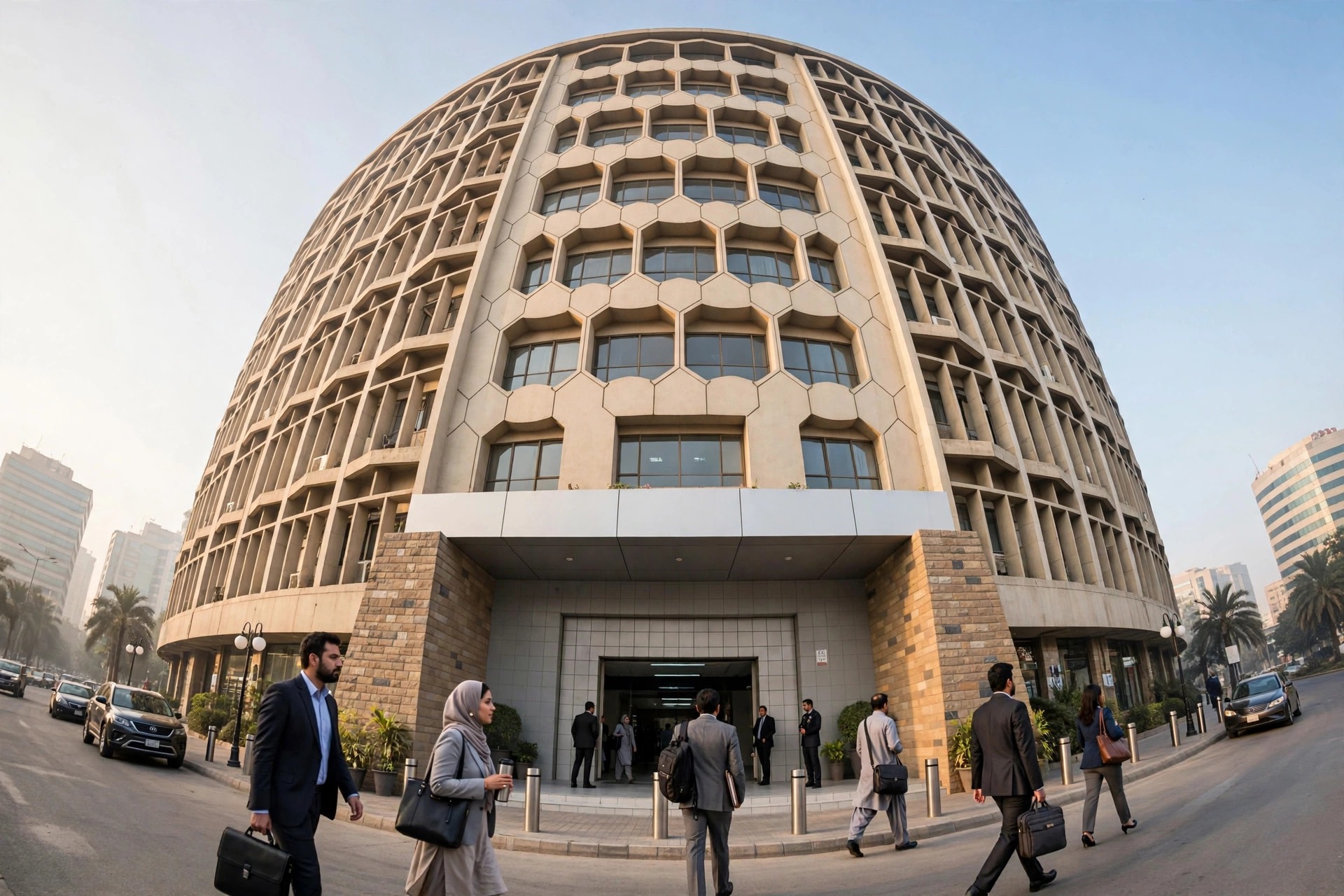
The Act's second phase was integration. On 11 January 2016 the three exchanges merged into a single national exchange: Pakistan Stock Exchange Limited, headquartered in the Karachi exchange's building on Stock Exchange Road. The Lahore exchange's other activities continued in a separate financial-services company and Islamabad's in a REIT management company, while their brokers became TREC holders of PSX. One market replaced three — one rulebook, one trading system, one set of indices, with the KSE-100 retained as the flagship benchmark. How that benchmark is built, from free-float market capitalisation, is explained in our guide to how the KSE-100 is calculated, and our overview of the PSX indices beyond the KSE-100 covers the wider family — the KSE-30, the All Share index and the sector and Islamic indices that sit alongside it.
The Chinese consortium and the self-listing
Demutualisation law required the exchanges to bring in an anchor investor — a strategic shareholder expected to supply technology, governance and international credibility. After a competitive process, in December 2016 a consortium of Chinese exchanges won the bid for a 40 per cent stake in PSX. The consortium brought together the Shanghai Stock Exchange, the Shenzhen Stock Exchange and the China Financial Futures Exchange — heavyweight institutions from the world's second-largest capital market, arriving in the era of the China–Pakistan Economic Corridor. The sale was completed in 2017, making the Chinese exchanges PSX's largest shareholder bloc and placing their nominees on its board.
The final step of the statutory design was the public listing. Under the demutualisation framework, after the anchor investor's stake, a portion of shares was offered to the general public, with the former broker-members retaining the balance. In June 2017 PSX listed its own shares — on itself. The self-listing is less paradoxical than it sounds: several of the world's exchanges are listed companies, and the arrangement subjects the exchange to the same disclosure discipline it imposes on others, with the SECP providing an extra layer of oversight precisely because the referee is also a player. PSX's shares promptly became a KSE-100 constituent in their own right — the market operator sitting inside the benchmark it calculates. Index membership is never permanent, as our explainer on KSE-100 index rebalancing sets out.
How PSX makes money
An exchange earns from activity, and PSX's revenue lines follow that logic:
- Trading and transaction fees — small charges levied on the value or volume of trades executed on its platforms, shared with the ecosystem of brokers and the clearing and depository companies. This is the most cyclical line: it swells in bull markets and shrinks when volumes dry up.
- Listing fees — initial fees when a company lists, and annual listing fees scaled to a company's capital. These are steadier, annuity-like revenues, and they grow when the IPO pipeline is healthy.
- Fees from market participants — charges connected to TREC holders, terminals, connectivity and other facilities provided to brokers.
- Market data and other services — the sale of price data and index products, and income on the company's own investments and deposits.
The cost side is dominated by technology and people: the trading engine, surveillance systems, cyber-security, and the staff who run listing regulation and market operations. The result is a business with high operating leverage — costs are largely fixed, so a surge in trading volumes drops disproportionately to profit, while a quiet market squeezes it. Readers interested in the other side of the trade should see our explainer on how brokers make money: the broker and the exchange charge for different slices of the same transaction, and their interests are aligned on volume but not identical.
PSX in Pakistan's economic life
The exchange's importance exceeds its own modest payroll. It is the exit and entry point for savings on a national scale: pension funds, mutual funds, insurance companies and hundreds of thousands of individual CDC accounts meet on its platform. It provides the pricing signal by which privatisation sales are judged, the index by which Pakistan's market is classified by global index providers — Pakistan was upgraded to MSCI emerging-market status in 2017 and later moved back to frontier-market status — and the venue through which the government itself borrows via listed debt instruments. When the KSE-100 hits a record or a crash, it is PSX's systems that carry the load and PSX's numbers that lead the news bulletins.
For ordinary savers, the exchange is also becoming more accessible: online trading apps, easier account opening through the CDC and Roshan Digital Accounts for overseas Pakistanis have all lowered the barriers that once made the market a brokers' preserve. Aktzien, the investing app being built for Pakistan, plans to route its customers' orders into this same market infrastructure — a reminder that every modern trading app ultimately rests on the exchange, the depository and the clearing house described here. Background reading for new investors is collected on our learn hub.
Technology, products and the modern trading day
The physical trading floor — men in jackets shouting bids around a ring — belongs to the Karachi exchange's past. Today's market is entirely electronic: brokers' terminals and investors' phone apps route orders into a central matching engine, and in 2021 PSX introduced a new trading and surveillance platform developed with the Shenzhen Stock Exchange, one of its anchor shareholders — the clearest practical dividend yet of the Chinese investment. Trading runs in a continuous session with opening and closing auctions, circuit breakers halt individual shares that move too far too fast, and most retail volume now arrives through internet trading accounts rather than branch visits.
Beyond ordinary shares, PSX lists government debt securities, corporate bonds and sukuks, exchange-traded funds, and a growth board (the GEM board) intended for smaller companies unable to meet main-board requirements. Futures contracts on individual stocks and indices give traders hedging tools, though the cash equity market remains the centre of gravity. The product list matters to PSX-the-company because nearly every line maps to a fee: more listed instruments and more active trading mean more revenue without a matching rise in costs. It also matters to the market's development — a persistent criticism of Pakistan's capital market is that it lists plenty of companies but trades narrowly, with liquidity concentrated in a few dozen large names, and that corporate debt and new listings have not kept pace with the economy's financing needs. The exchange's own strategy documents dwell on exactly these gaps: deepening the investor base, bringing state-owned and family companies to listing, and expanding the debt market.
Investor access has been the bright spot. Centralised know-your-customer arrangements, the CDC's investor accounts, broker apps and the State Bank's Roshan Digital Account channel for overseas Pakistanis have steadily lowered the cost of opening an account and placing a first trade — progress that only works because the underlying plumbing of exchange, depository and clearing house, built up over the decades described above, is already in place.
PSX's demutualised structure deliberately separates three functions that the old mutual exchange fused. Commercial management runs the business. A regulatory affairs function, walled off from the commercial side, handles listing compliance and broker supervision under SECP oversight. And the board balances nominee directors of the Chinese anchor investors, representatives connected to the broker-shareholders, and independent directors, with the chief executive a professional manager rather than a trading member. The arrangement is not frictionless — brokers remain simultaneously owners, customers and regulated entities — but it is a world away from the pre-2012 club, and it is the governance framework within which every dispute about fees, products or enforcement is now argued.
What investors typically watch
Those who follow PSX as a company watch the market's vital signs, because they are also PSX's sales figures: average daily trading volumes and values, the number and size of new listings, and any change in the fee schedule or in the regulatory split of transaction charges between the exchange, brokers and sister institutions. They also watch governance — the interplay between the Chinese anchor shareholder, the broker-shareholders and independent directors — and the exchange's technology roadmap, since new products such as derivatives or expanded debt-market trading would open fresh revenue lines. Finally, they watch classification decisions by global index providers, which influence foreign flows and therefore volumes.
A note on intent: this profile is educational content about how Pakistan's exchange works, not financial advice and not a recommendation to buy or sell PSX shares or any other security.
Key takeaway: PSX is Pakistan's single, demutualised marketplace — a former brokers' club turned listed company, anchored by Chinese exchanges, earning fees from every trade, listing and data feed that flows through the market it also regulates.