KARACHI: Every litre of petrol in a motorcycle tank in Multan and every litre of diesel in a truck on the National Highway passed through the hands of an oil marketing company. OMCs are the distributors of Pakistan's fuel economy: they import or buy refined products from local refineries, store them in depots and installations around the country, move them by pipeline, rail and tanker, and sell them through the petrol pumps whose brands dot every road — plus directly to airlines, power plants, factories and the armed forces. On the Pakistan Stock Exchange, listed OMCs range from the state-linked giant that dominates national supply to smaller private players, and their shares confuse many newcomers: revenue figures are enormous, profit margins are razor-thin, and quarterly earnings can double or halve on nothing more than the direction of oil prices during the weeks fuel sat in their tanks. This guide explains the regulated margin at the model's heart, the inventory gains and losses that dominate reported results, the working-capital and circular-debt entanglements that define the sector's risks, and the deregulation debate that could rewrite the business.
The chain: from port and refinery to pump
An OMC's operations begin with supply. Pakistan refines part of its petroleum needs domestically and imports the rest as finished products — petrol (motor gasoline), high-speed diesel, and smaller volumes of other fuels — through Karachi's ports. The OMC takes title to product at the refinery gate or the jetty, stores it in bulk installations, and distributes it onward: by pipeline where the network reaches, otherwise by fleets of tank lorries operated by contractors, to company-owned and dealer-operated retail sites and to bulk customers. Alongside fuel, the retail network sells lubricants — a smaller, higher-margin business where brands compete on quality and distribution much like a consumer good — and, increasingly, convenience retail at flagship stations.
Revenue is volume multiplied by price, and both need unpacking. Volumes — usually discussed in tonnes or litres by product — follow the economy's pulse: diesel tracks agriculture, freight and industry; petrol tracks the vehicle fleet, especially motorcycles and cars; furnace oil, once a mainstay for power generation, has shrunk as the power mix shifted toward gas, RLNG and other sources, a structural decline that reshaped OMC product mixes. Prices at the pump, however, are not set by the OMCs. Petrol and diesel prices in Pakistan have historically been determined under a government-approved formula, announced for set periods — in recent practice, reviewed fortnightly — in which the ex-refinery or import-parity price, built from international product prices and the exchange rate, is combined with taxes, levies, inland freight arrangements and the margins allowed to dealers and to OMCs. The Oil and Gas Regulatory Authority (OGRA) administers much of this machinery under federal policy. Details of the formula, the petroleum levy and tax components change with budgets and policy; verify the current structure in official OGRA and government sources rather than relying on any summary, this one included.
The regulated margin: small per litre, huge in aggregate
The OMC's core earning is a fixed margin per litre on petrol and diesel — an amount in rupees set through the pricing framework, intended to cover the costs of storage, distribution, financing and retail operations and leave a profit. Two consequences follow. First, the margin is not a percentage: when fuel prices double, the OMC does not automatically earn double per litre — it earns the same rupees per litre on (usually) fewer litres, while its working-capital costs rise with the price of every litre it must finance in storage and transit. This is the opposite of the pricing-power world of branded consumer goods, and it surprises investors who expect fuel-price inflation to be good for fuel sellers. Second, margin revisions are political decisions, negotiated between the industry and the government against the background of pump-price sensitivity; the industry argues its costs — financing at high policy rates, depot and safety compliance, exchange losses — and revisions arrive irregularly rather than by formula.
Volumes are therefore the OMC's real growth variable, together with market share — the percentage of national product sales each company handles, published monthly by the industry's advisory council and watched closely. Share shifts between companies reflect retail-network expansion, supply reliability (a pump that never runs dry wins loyal fleets), dealer relationships and pricing discipline in the unregulated niches. Non-fuel income — lubricants, retail rents and convenience sales, LPG distribution for some players, aviation and industrial supply contracts — adds margin-rich diversity on top of the thin regulated core, and the better-run OMCs cultivate it deliberately. When you read an OMC result, separate these streams in your mind: regulated fuel volume at a fixed margin is an annuity-like base; everything else is where management adds or subtracts value.
Inventory gains and losses: the quarterly lottery
Now the feature that dominates reported earnings. An OMC holds weeks of national fuel supply in its tanks. That stock was bought at the prices of the day it was acquired, but it is sold at the regulated price of the day it is sold. When international prices and the rupee push pump prices up between purchase and sale, the company sells dearer fuel bought cheap — an inventory gain. When prices fall, the reverse: stock bought dear must be sold at the new, lower regulated price — an inventory loss. In times of stable prices this effect is minor; in volatile oil markets it can swamp the underlying margin business entirely, producing a spectacular quarter in a mediocre year or a shocking loss in a perfectly well-run one.
The analytical discipline is to strip it out, at least mentally. Look at volumes, share and the margin per litre implied by gross profit before inventory noise; compare operating performance across several quarters; and treat one quarter's inventory windfall as what it is — a timing gain belonging to the calendar, not to strategy. Companies' own commentary often quantifies the inventory effect; use it. An illustrative example, with invented figures: an OMC holds 100 million litres of diesel bought at an average cost equivalent to Rs 250 per litre. The regulated price rises so the same stock is sold at the equivalent of Rs 265. The Rs 15 difference on the opening stock is roughly Rs 1.5 billion of inventory gain — earned without selling one extra litre. Next period, prices fall by the same amount on a similar stock, and the Rs 1.5 billion returns as a loss. An investor who annualised either quarter would understand nothing about the business.
Working capital, receivables and the energy chain's debts
Fuel distribution runs on credit in every direction. OMCs pay suppliers and refineries on short terms, finance their own stocks and the transit pipeline, extend credit to industrial customers and dealers, and — most consequentially — sell to power-generation and state-linked customers whose payment delays have historically fed Pakistan's circular debt problem, the web of unpaid bills circulating among fuel suppliers, generators, distribution companies and the state. Receivables from such customers can sit on an OMC's balance sheet far beyond normal commercial terms, financed by bank borrowing at the policy rate; the finance cost line of a large OMC is therefore partly a charge for funding the energy chain's arrears, not its own operations. Investors should track receivables ageing, any provisions against doubtful energy-sector dues, and the extent to which reported profit is cash or merely booked — the cash flow statement will say, if you read it.
Exchange risk runs alongside. Imports are priced in dollars; between ordering a cargo and the pricing formula catching up, rupee depreciation can impose exchange losses, and the treatment of such losses within the pricing framework has been a recurring industry-government negotiation. Demurrage — port charges when cargoes wait — smuggling and adulteration pressures from informal fuel flows across borders, and periodic supply disruptions when pricing disputes or logistics failures interrupt the chain are the operational risks that periodically remind investors that this is a physical business moving flammable product through a large country, under safety regulation whose enforcement matters. Storage and retail-site safety standards, tightened after documented accidents in the wider industry, impose real compliance costs that responsible operators carry willingly.
Deregulation: the debate that could rewrite the model
Periodically, and with growing seriousness in recent policy discussion, Pakistan debates deregulating fuel prices — freeing OMCs and dealers to set their own margins and pump prices, with the regulator retreating to competition oversight and quality control. The case for: margins set by negotiation lag true costs, discourage investment in storage, safety and retail quality, and mute the price signals that would reward efficient logistics and punish waste; competitive markets elsewhere deliver fuel at varied prices by location and service level. The case for caution: fuel prices feed directly into transport costs, food prices and inflation expectations in a country with limited household buffers; competition is uneven across regions — a city with twenty stations is not a remote district with one — and the transition itself, including who absorbs existing stocks' value changes, must be designed carefully. Partial steps, such as freeing some products or components of the chain while retaining oversight of others, are the usual middle path in such reforms.
For the PSX investor, deregulation is a regime question, not a quarterly one. Under full competition, the winners would be the companies with the best-located retail networks, the cheapest logistics and the strongest non-fuel income — because margin would be earned rather than administered — while weak, sub-scale players would face the squeeze that administered equality currently softens. Under continued regulation, the analysis in this guide stands: volumes, share, inventory discipline and receivables management decide results. Either way, verify the current policy position in official sources before acting on any commentary, ours included.
Reading OMC results, and the risks that remain
A sound routine: volumes and market share by product first; underlying margin excluding the inventory effect second; non-fuel income third; receivables and finance costs fourth; cash flow fifth; dividends last — OMC payouts have historically been as cyclical as the inventory cycle that drives reported profit, so judge a payout against underlying, not headline, earnings. Compare across years, and be specially careful with a result announced just after a sharp oil-price move in either direction.
The risks gather into three baskets: commodity timing (inventory losses in falling markets), state entanglement (receivables, margin decisions, tax and levy changes made through the pump price), and transition (deregulation, the shift of transport toward gas, hybrids and electric vehicles over the long term, which will gradually reshape petrol and diesel volumes altogether). This article is educational content, not financial advice. OMCs close this sector series where it began — with a regulated price deciding private profits, as in fertilizer and pharmaceuticals — a reminder that on the PSX, reading policy is not an optional extra; it is half the analysis. Our beginner guides cover the trading and settlement basics that sit underneath any of these shares.
Lubricants, LPG and the businesses behind the brand boards
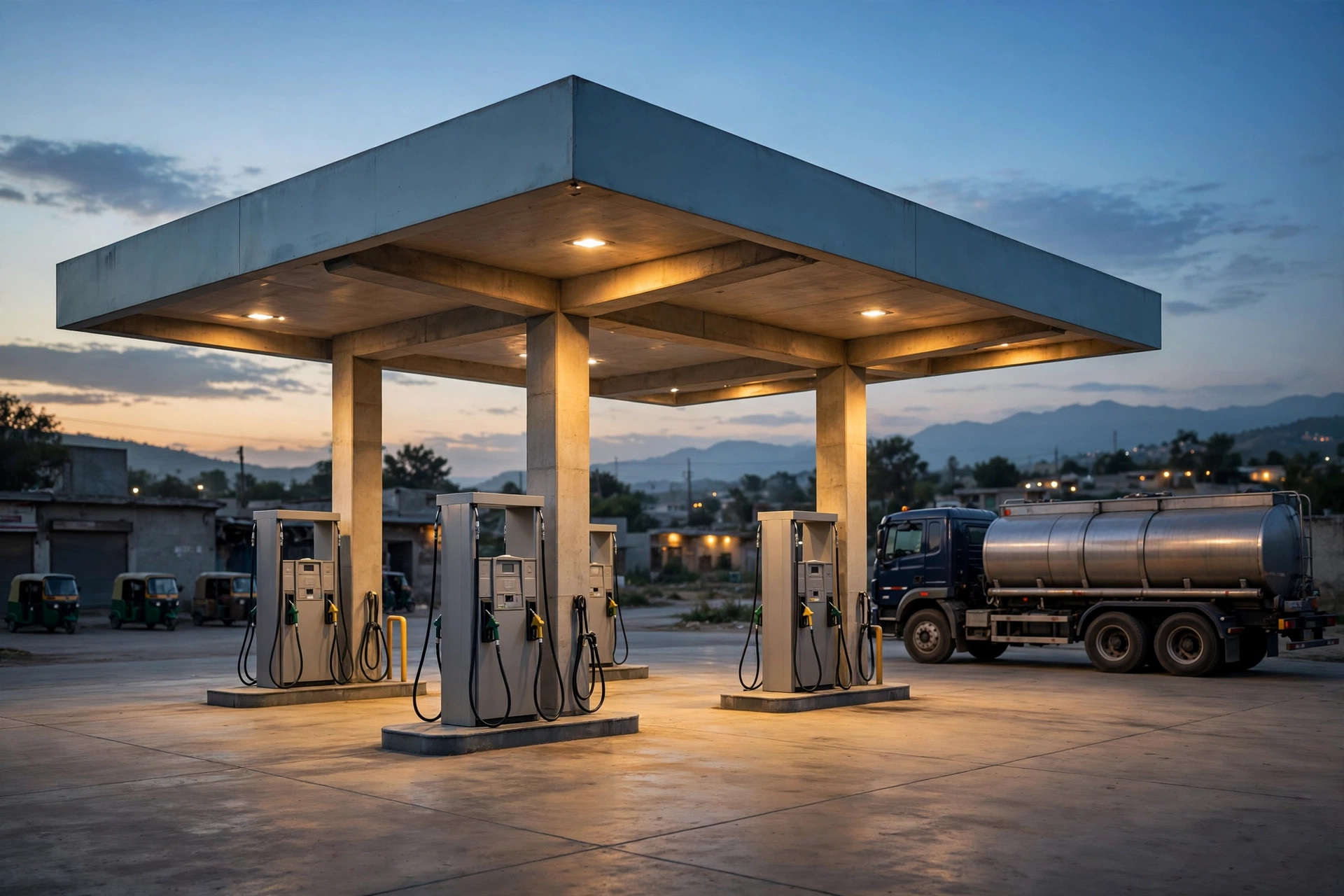
Look again at a modern petrol pump: the fuel islands are the regulated core, but the signs around them advertise the OMC's second businesses. Lubricants are the most important — engine oils and industrial lubricants sold under the company's brands through pumps, workshops and distributors, at margins set by competition rather than formula, where brand trust and mechanic recommendations drive choice in a market plagued by counterfeits. A strong lubricants franchise is, in effect, a small consumer-brands business hiding inside an energy distributor, and it deserves the pricing-power reading: volume held, premium tiers growing, distribution widening. Liquefied petroleum gas (LPG) — the bottled cooking fuel of off-grid Pakistan — is distributed by several OMCs and affiliates, a business of cylinders, bottling plants and safety discipline in a market with a large informal fringe. Aviation fuel supply at airports, bitumen for road-building seasons, and convenience stores and quick-service food at flagship urban sites round out the non-fuel picture. Individually small next to fuel volumes, these streams matter because they are the only parts of the model whose margins the company actually controls — and under any future deregulated regime, they are the rehearsal for competing on merit across the whole business. When comparing OMCs, the share of gross profit earned outside the regulated fuel margin is one of the cleanest quality signals available.
Key takeaway: OMCs earn a small regulated margin per litre on very large volumes — strip out inventory gains and losses, watch market share, receivables and finance costs, and treat deregulation as the long-term regime question that will separate efficient networks from the rest.