KARACHI: Most companies in the KSE-100 make things, move things or lend money. Shifa International Hospitals makes diagnoses, performs transplants and treats cancers. SHFA is Pakistan's only listed hospital group of scale — the company behind Shifa International Hospital in Islamabad, one of the country's best-known private tertiary-care hospitals, and a growing network around it. It is also one of the index's more unusual stories: a hospital dreamed up by Pakistani doctors working in the United States, financed by hundreds of sponsors before it treated a single patient, opened in 1993 with just 36 beds, and built over three decades into a multi-hundred-bed institution that performs some of the most complex medicine practised in Pakistan. For investors, Shifa offers direct exposure to private healthcare — a sector most stock markets reach through insurers or drugmakers, but which Pakistan reaches through a hospital.
What Shifa does
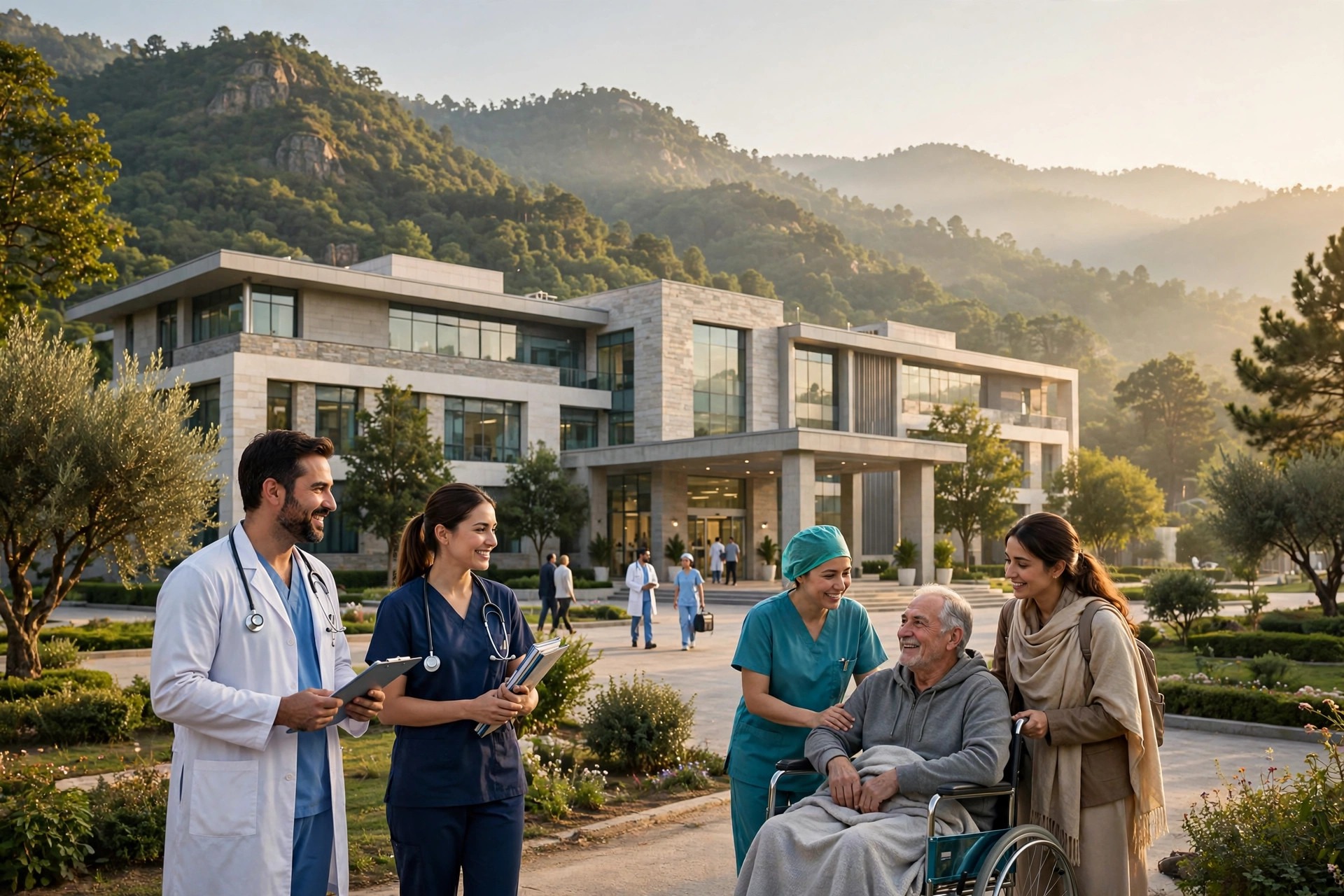
Shifa is, at its core, a tertiary-care hospital group. Tertiary care means the specialised end of medicine: the complex surgery, intensive care, oncology, cardiology, neurology and transplant work that smaller hospitals refer upwards. Its flagship, Shifa International Hospital in Islamabad's H-8 sector, runs inpatient wards and critical-care units, outpatient clinics across dozens of specialities, operating theatres, emergency services, laboratories, imaging and a pharmacy — the full vertical stack of a modern hospital under one roof, employing its own consultants, many of them trained in the United States, Britain and other major systems.
Around the flagship sits a group. Shifa operates additional medical centres in Islamabad, has been developing Shifa National Hospital in Faisalabad as a majority-owned subsidiary, and holds stakes in related ventures spanning healthcare services and development. It is woven into medical education as well: Shifa College of Medicine and the Shifa College of Nursing train doctors and nurses in association with the hospital, and the related Tameer-e-Millat Foundation — a significant shareholder — anchors the founding charitable impulse inside the structure. The company's classification on the exchange sits in the miscellaneous/healthcare space rather than a dedicated hospital sector, a reminder of how rare its business model is on the PSX.
1985–1993: an idea carried home
The founding story is unusually well documented, because the founders told it themselves. In July 1985, Dr Zaheer Ahmad — a Pakistani physician who had completed his training in the United States — hosted a meeting at his apartment in Brooklyn, New York, with four Pakistani colleagues and friends, all working in America. Their subject was audacious: to build a hospital in Pakistan offering the standard of care they practised in the US, and to finance and govern it as a public-spirited company rather than a family clinic or a state project. Dr Zaheer was tasked with the feasibility work; by the end of 1985 he had moved to Islamabad to pursue it.
The company was incorporated on 20 September 1987 as a private limited company, and converted to a public limited company on 12 October 1989 — the listing route chosen early, deliberately, so that hundreds of sponsors could own a piece of the project. Land of over eleven acres was acquired in Islamabad's H-8 sector, a hospital-development firm from Princeton, New Jersey was engaged to plan and design the facility, construction began in 1988, and the foundation ceremony took place in October 1989. By opening day the sponsor base had grown past four hundred people, and the equity raised — around half a billion rupees in the money of the time, by the founders' account — had been assembled without borrowing: the hospital opened debt-free, with its first block built and equipped.
Shifa International Hospital officially opened on 26 June 1993, with eight outpatient clinics and 36 beds. Judged against its ambition, it was tiny. Judged as a proof of concept — that a publicly owned, professionally governed hospital could be built in Pakistan by Pakistanis, many of them reversing the brain drain to staff it — it was the whole idea in miniature.
Building a tertiary-care institution
The decades after 1993 were spent climbing medicine's ladder of complexity, one speciality at a time. In 1994 Shifa opened the first private-sector radiation oncology department in Pakistan, the seed of what became a dedicated cancer centre, inaugurated in fully developed form in 2012, offering medical oncology, radiation therapy and bone-marrow transplant services. Transplant medicine became a signature: the hospital developed programmes in liver, kidney, bone-marrow and corneal transplantation, and by the late 2010s was performing the large majority of Pakistan's liver transplants — a programme that also brought scrutiny, including a suspension in 2018 following allegations by a patient's family, illustrating the regulatory and ethical weight that transplant medicine carries. Capacity grew in step: further blocks, more beds — the flagship today operates on the order of five hundred beds including a large critical-care complement — more clinics, and outpatient volumes measured in the thousands per week.
The transplant timeline can be dated more precisely, and the dates show how methodical the build-out was. Corneal transplantation came first, with services operating from 2001. Bone-marrow transplantation followed in 2009, developed with leading specialists in the field, and the programme was later accredited by the College of Physicians and Surgeons Pakistan to train fellows in clinical haematology and bone-marrow transplantation. Liver transplantation — the most demanding programme of the three — arrived in April 2012, when Shifa performed the first private-sector living-donor liver transplant in Pakistan; the same month, its team performed the country's first paediatric living-donor liver transplant, on a 12-year-old patient, under a surgical team led by Dr Faisal Saud Dar, who had returned from a career in Britain to build the programme. Each step added a capability that Pakistani patients had previously had to travel abroad to find.
Quality credentials were pursued as strategy, not decoration: international accreditation work, including the Joint Commission's Gold Seal of Approval referenced in the hospital's materials, signals to patients — and to the overseas Pakistanis who fly home for treatment, or fly parents abroad without it — that the institution submits to outside audit. The education arm deepened in parallel, giving Shifa its own pipeline of doctors and nurses in a country chronically short of both. Expansion beyond Islamabad followed the same logic, with the Faisalabad hospital project extending the model into Punjab's industrial heartland.
The education arm also has a precise chronology worth recording. Shifa College of Medicine opened its doors in December 1998, five years after the hospital itself, fulfilling a founding intention that the hospital should teach as well as treat. The college was approved by the Pakistan Medical and Dental Council and listed in the international medical-education directories maintained through the World Health Organization and FAIMER. In 2012 the structure was formalised at a higher level: an Act of Parliament established Shifa Tameer-e-Millat University as a federally chartered university, jointly sponsored by Shifa Foundation, the Tameer-e-Millat Foundation and Shifa International Hospitals, and the College of Medicine became a constituent college of the new university, alongside nursing and other health-science colleges. For a listed hospital company, owning a chartered university inside its wider family is unusual — and it hard-wires the supply of trained doctors and nurses described above into the group's long-term future.
How a hospital makes money
Hospital economics are a blend of the hotel, the laboratory and the operating theatre. Revenue arrives through several doors at once:
- Inpatient care — bed charges, theatre fees, intensive care and the professional fees of consultants, billed per admission and per procedure. A full hospital with complex cases is the revenue engine; empty beds earn nothing while costing almost as much to staff.
- Outpatient clinics — consultation volumes that are lower-value per visit but feed the inpatient pipeline and keep the institution at the centre of its patients' care.
- Diagnostics — laboratory tests, imaging and screening, high-throughput services used by Shifa's own patients and by referrals from outside doctors.
- Pharmacy and consumables — medicines and medical supplies dispensed through the course of treatment.
The cost side is dominated by people — consultants, nurses, technicians — and by imported technology: imaging machines, theatre equipment and many medicines are priced in foreign currency, so a weak rupee raises costs even as most patients pay in rupees. Occupancy is the swing variable investors learn first: the same building, staff and equipment can produce thin results at low occupancy and strong ones when beds and theatres are busy with the right case mix — complex, well-reimbursed procedures rather than simple ones. Unlike most businesses, a hospital also cannot choose growth at any reputational price: clinical outcomes, infection control and trust are the franchise, and a single scandal can undo years. Readers building general investing background will find the foundations on our learn hub.
Shifa in Pakistani life
Pakistan's healthcare system leans heavily on a strained public sector and a sprawling informal private one; organised, accredited, corporate tertiary care is the exception. Shifa's place in national life is therefore larger than its bed count. It is a destination hospital for the northern half of the country, a trainer of specialists who staff other institutions, a proof that complex programmes — transplantation, advanced cancer care — can be run at home rather than in Dubai or Bangkok, and, through its foundation-linked and charitable work, a provider of subsidised care alongside its paying practice. Its listing makes it something rarer still: a hospital whose annual report any citizen can read, in a sector where accountability is usually private.
Its presence in the KSE-100 gives the benchmark a healthcare name of genuine scale — and gives healthcare a share price. The mechanics of index membership are explained in our guide to KSE-100 rebalancing, and its size relative to other listed companies follows the principles set out in our explainer on market capitalisation.
Who owns a hospital? Shifa's shareholder structure
Shifa's ownership is as distinctive as its founding. There is no single controlling family or state shareholder. Two institutional anchors stand out in the share register: the Tameer-e-Millat Foundation, the charitable foundation associated with the founders' educational and welfare vision, holding a stake in the low teens of per cent, and the International Finance Corporation — the World Bank Group's private-sector arm — holding a comparable stake of around twelve per cent. The IFC's presence, the product of its investment in Pakistani private healthcare, imposes the governance and reporting standards of a development-finance shareholder, and signals to other investors that the institution has passed international due diligence on clinical as well as financial practice. Around these anchors sits a dispersed register of institutions and individual shareholders — many of them, in the company's tradition, doctors, sponsors and their families — giving SHFA a public-company character unusual among Pakistani hospitals, most of which remain private or family-held.
Shocks and adaptations: pandemics, inflation and the digital clinic
The system's stresses have tested the model in public. During the Covid-19 pandemic Shifa operated as a front-line treatment and vaccination centre in the capital, with the paradox common to hospitals in that period: surging demand for isolation and critical care alongside collapsing volumes of the elective surgery and outpatient visits that pay for them. Recovery brought the opposite problem set — medical inflation. Hospital costs are heavily imported, from imaging equipment and surgical consumables to patented medicines, so the rupee's sharp depreciations of recent years raised Shifa's cost base faster than many patients' ability to pay, forcing the careful repricing at which private hospitals must balance occupancy against affordability in a country where most healthcare spending is out-of-pocket and insurance penetration is thin.
The group's responses include the usual repertoire of modern hospital management — day-care surgery, shorter stays, package pricing for common procedures — and a digital layer: telemedicine consultations and a patient-facing digital service arm within the group, extending Shifa's clinics into homes and into the overseas Pakistani market, where a consultation with an Islamabad consultant is now a video call rather than a flight. None of this changes the fundamental economics of beds and theatres, but it widens the funnel that feeds them, and it is the direction in which listed healthcare everywhere is moving.
The outpatient and diagnostic engine deserves emphasis, because it is where most Pakistanis actually meet Shifa. Thousands of consultations a week across its clinics, a laboratory and imaging service used heavily by patients who never occupy a bed, and screening programmes aimed at the cancers and cardiac disease that dominate the country's burden — these activities fill the building daily, feed the inpatient pipeline, and give the institution a community presence no advertising could buy. They also smooth the economics: theatre and bed revenue is episodic, but a capital city's demand for consultations and tests is a river that rarely runs dry.
What investors typically watch
Followers of SHFA watch bed occupancy and outpatient volumes as the demand gauges; case mix — the share of complex, higher-value work — as the quality gauge; and average revenue per patient as the pricing gauge. They watch consultant recruitment and retention, since a hospital's earnings literally walk out of the door if its star physicians leave; capital spending on new blocks, equipment and the Faisalabad expansion; receivables from corporate clients and insurers; and the regulatory environment for private healthcare pricing and transplant oversight. Dividend history and the foundation-linked shareholder base are watched for signals about how the company balances charitable mission against shareholder return.
This profile is educational content about Shifa's history and business model — not financial advice, and not a recommendation regarding SHFA shares.
Key takeaway: Shifa is Pakistan's listed hospital group: dreamed up by expatriate doctors in 1985, opened in Islamabad in 1993 with 36 beds, and grown into a tertiary-care institution whose earnings turn on occupancy, case mix and clinical trust.