KARACHI: Every benchmark index has a member that makes people ask: how did that get in? In the KSE-100, S.S. Oil Mills Limited — ticker SSOM — is a strong candidate. It is not a bank with thousands of branches, a cement giant or a national energy company. It is a single-plant edible-oil business based in Lahore, with a solvent-extraction factory at Vehari in southern Punjab, a compact workforce and a small number of shares in public hands. Yet under the index rules it qualifies, and its presence is a useful lesson in what an index actually is: not a hall of fame for the biggest brands, but a rules-based basket chosen for size and tradability within the market as a whole. To understand SSOM, you have to understand two things — how cooking oil is extracted from seeds, and how the KSE-100 is calculated.
What the company actually does
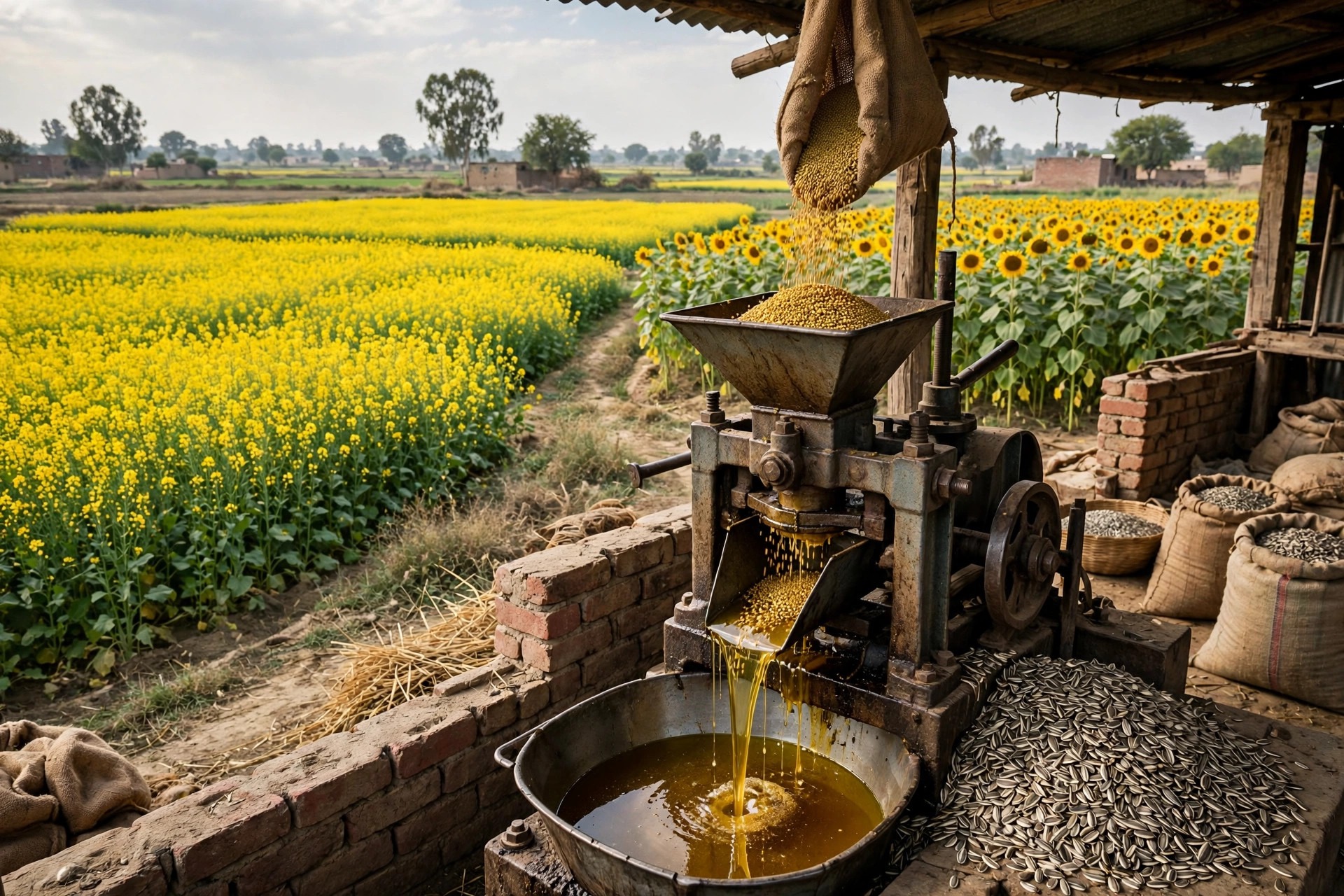
S.S. Oil Mills is engaged in solvent extraction. In plain language, it buys oilseeds — the sources describe canola, sunflower and soybean among them — and separates each seed into two products: crude edible oil and meal, the protein-rich solid that remains after the oil is removed. The company's own description of its business is the extracting, refining and processing of oilseeds and the sale of semi-refined washed oil and meal at competitive prices. Its registered office is at 2-Tipu Block, New Garden Town, Lahore, and its plant is at Vehari, in the cotton-and-oilseed belt of Punjab, within reach of the seed-growing districts it buys from.
That two-product split is the whole business, and neither half is optional. The oil goes onward to refiners and blenders who turn it into the cooking oils and ghee sold in shops across Pakistan. The meal goes mainly to animal-feed makers, because poultry and livestock rations need exactly the protein that solvent extraction leaves behind. A solvent-extraction plant is therefore really two factories sharing one input: an oil factory and a feed-ingredient factory. When either market weakens — if feed demand softens, for example — the plant cannot simply stop producing meal, because meal is what is left when you make oil. Managing the balance between the two revenue streams is a permanent part of the job.
Solvent extraction, explained simply
Traditional oil mills press seeds mechanically, squeezing oil out the way a press squeezes juice. Pressing is simple but leaves a meaningful share of oil trapped in the pressed cake. Solvent extraction goes further. Crushed and prepared seed is washed with a food-grade solvent that dissolves the oil out; the solvent is then recovered and reused, the oil is separated for refining, and the leftover meal is dried and sold. The method extracts more oil per tonne of seed, which matters enormously in a business where the seed is by far the biggest cost and margins per tonne are thin.
The economics follow from that arithmetic. The plant's profit on a tonne of seed is, roughly, the combined selling value of the oil and meal it yields, minus the price of the seed, the energy and chemicals used, transport, and the cost of running the factory across its operating season. Seed prices are set in agricultural markets — increasingly linked to international oilseed and edible-oil prices, because Pakistan imports a large share of its edible-oil needs — while the selling prices of oil and meal move with domestic supply and demand. The miller sits in the middle of that spread, which processors call the crush margin. A wide spread means a good season; a narrow or negative spread means even a busy, well-run plant can lose money. Volume helps only when the margin is positive.
A company of the 1990 expansion
The verified record of SSOM's early life is short, and this profile will not pretend otherwise. The company was incorporated in Pakistan on 21 August 1990 as a public limited company under the Companies Ordinance then in force, and its shares are quoted on the Pakistan Stock Exchange. Its own company-in-brief describes a modern solvent-extraction plant at Vehari, built with contemporary processing, oilseed-storage and quality-control systems, with processing capacity the company has described as exceeding 90,000 tonnes of oilseeds a year across an operating season of more than 300 days. Beyond that, the public trail is thin: there is no widely published founding-family epic, no famous acquisition, no privatisation drama. SSOM belongs to a generation of early-1990s industrial incorporations that set up in Punjab's agro-processing economy and simply got on with crushing seed, season after season.
That thinness is itself information. Many small listed companies in Pakistan publish what the law requires — accounts, notices, directors' reports — and little more. There is no investor-relations machine producing profiles and roadshows. For a reader learning the market, SSOM is a reminder that a listing is a legal status, not a publicity level: a company can be fully listed, fully regulated and almost entirely undocumented in the public conversation. Everything an outsider can responsibly say about it must be built from its exchange filings and its own brief self-description, which is why this profile describes its business model in depth and its corporate legend hardly at all. Where the record is silent, honesty requires leaving the silence intact.
Edible oil in everyday Pakistani life
The industry's importance is easier to see than the company itself. Few products touch daily life as directly as cooking oil and ghee: they are in the karahi, the paratha, the daal tarka and almost every festive dish. Pakistan's demand for edible oils has long outrun what domestic oilseed harvests can supply, so the country imports large volumes of palm oil and oilseeds, and local crushers like SSOM compete and coexist with that import trade. When international palm-oil prices jump, or the rupee weakens, the price of a tin of cooking oil in a Lahore or Vehari bazaar moves within weeks — one of the most visible forms of inflation for ordinary households.
Domestic oilseeds — canola, sunflower, rapeseed and mustard, soybean where it is grown — give local farmers an alternative cash crop and give crushers a local raw material whose price is influenced by, but not identical to, import prices. Government campaigns to expand oilseed cultivation surface regularly precisely because every tonne crushed at home is a tonne not bought abroad with scarce dollars. SSOM's meal output matters in the same everyday way, one step removed: poultry feed is the largest cost in producing chicken and eggs, so the price of extraction meal feeds directly into the price of the most affordable animal protein in the Pakistani diet. Our guide to food and personal-care stocks on the PSX places businesses like this alongside the branded food giants whose products fill the same kitchens.
How S.S. Oil Mills makes money
The revenue mechanics can be written as a short chain. Buy seed — from farmers, commission agents and traders, in volumes that follow harvest seasons and import availability. Crush and extract — sell the washed oil to refiners and edible-oil brands, and the meal to feed mills. Live on the spread — because both outputs are commodities, the company is largely a price-taker on what it sells and what it buys; its skill shows up in procurement timing, extraction efficiency (how much oil is recovered per tonne), plant uptime across the season, and how quickly it turns inventory into cash.
Working capital is the hidden engine. Seed must be paid for promptly, often in cash-heavy rural markets, while oil and meal buyers may take credit. A crusher therefore carries significant stock and receivables, frequently financed by bank borrowing, and interest costs can rival operating margins in high-rate years. Storage matters too: buying seed well at harvest, when prices are seasonally soft, and processing it through the year is a classic way such plants earn their keep — but it ties up cash and exposes the company if output prices fall while the godowns are full. Readers of its accounts typically watch inventory levels, borrowing, the gross margin's swing from period to period, and whether production volumes reported by the company are rising or falling, since utilisation of a single plant is the closest thing this business has to a growth story.
Why a company this small sits in the KSE-100
The KSE-100 is built from the largest and most liquid listed companies, selected by rules centred on market capitalisation — share price multiplied by shares in issue — with sector representation built into the selection so the index reflects the whole market, not just its biggest industries. A company does not need to be huge in absolute terms to qualify if it is among the most substantial listed names in its corner of the market and its shares trade actively enough. SSOM's sector on the exchange is the vanaspati and allied industries grouping — the traditional home of ghee and edible-oil companies — a sector with few listed members, which is how a compact Vehari crusher comes to hold a seat that casual observers assume belongs only to giants.
Index membership is also temporary by design. The index is reviewed periodically, and companies enter and leave as their size and trading activity change — a process explained in our guide to KSE-100 index rebalancing. For SSOM, membership brings a measure of visibility and inclusion in index-tracking portfolios, but it changes nothing about the underlying business: the same plant, the same seed markets, the same spread. The Aktzien learning library covers how indices work for readers who want the mechanics in full, and it is worth remembering the general rule this company illustrates — an index seat is a statement about a share's market footprint, never a certificate of quality or safety.
Risks and watch points, stated plainly
The observation points for a business like SSOM are mostly external. Oilseed and edible-oil prices, set in world markets and translated through the exchange rate, drive both its input costs and its selling prices. Energy costs matter because extraction and drying are heat-hungry processes. Interest rates matter because the model runs on borrowed working capital. Local harvests matter because a poor canola or sunflower crop pushes the plant toward pricier imported seed. And with a single production site, operational problems at Vehari — a breakdown, a fire, a supply disruption — have no sister plant to absorb them.
There is also a market-structure point worth understanding rather than fearing. SSOM has a relatively small free float — the proportion of shares actually available to trade — as its PSX profile shows. Small floats can make a share price move sharply on modest buying or selling, in both directions, and can make it hard to buy or sell a large position quickly. That is a feature of many smaller PSX listings, and learning to check float and trading volumes before forming any view of a small company is one of the practical skills the learning library exists to teach. None of this profile is a judgement on whether SSOM's shares are attractive or unattractive; it is an explanation of what the company is, and this article is educational content, not financial advice.
A note on scale: what "small" means in the index
It is worth pausing on how small SSOM is beside the index's giants, because the contrast teaches the index's design better than any definition. The company's PSX profile records a share count in the single-digit millions and a free float of roughly a quarter of those shares — figures that would make it a rounding error next to a big bank's register, yet sufficient, in a thin sector, for benchmark membership. Its workforce, as data providers record it, is barely over a hundred people. None of this makes its inclusion an error. Indices that ignored small sectors entirely would misdescribe the market they claim to summarise; the KSE-100's sector-conscious construction deliberately keeps industries like vanaspati and allied products represented, so that the index's movements reflect the whole exchange and not merely its fashionable corners. SSOM is what that principle looks like when it reaches a Vehari crushing plant.
Key takeaway: S.S. Oil Mills is a one-plant solvent extractor turning Punjab oilseeds into cooking oil and feed meal, earning the thin, volatile spread between seed prices and commodity selling prices — and its KSE-100 seat shows how index rules reward sector representation and tradability, not just sheer size.