KARACHI: On 1 October 2026, the KSE-100 quietly gained a new cement maker. Thatta Cement Company Limited — THCCL — entered Pakistan's benchmark index in the recomposition based on the March–August 2026 review period, one of four incoming names in that reshuffle. For a mid-sized, single-plant producer from Makli in Sindh's Thatta district, it was the latest turn in a long industrial life: incorporated in 1980 as part of the state cement sector, commissioned in 1982 with Japanese-supplied dry-process technology, privatised in 2004 to a consortium of the Arif Habib and Al-Abbas groups, listed in 2008, and upgraded in stages ever since. This is the story of how a state plant became a private survivor in one of Pakistan's most competitive industries.
What Thatta Cement does
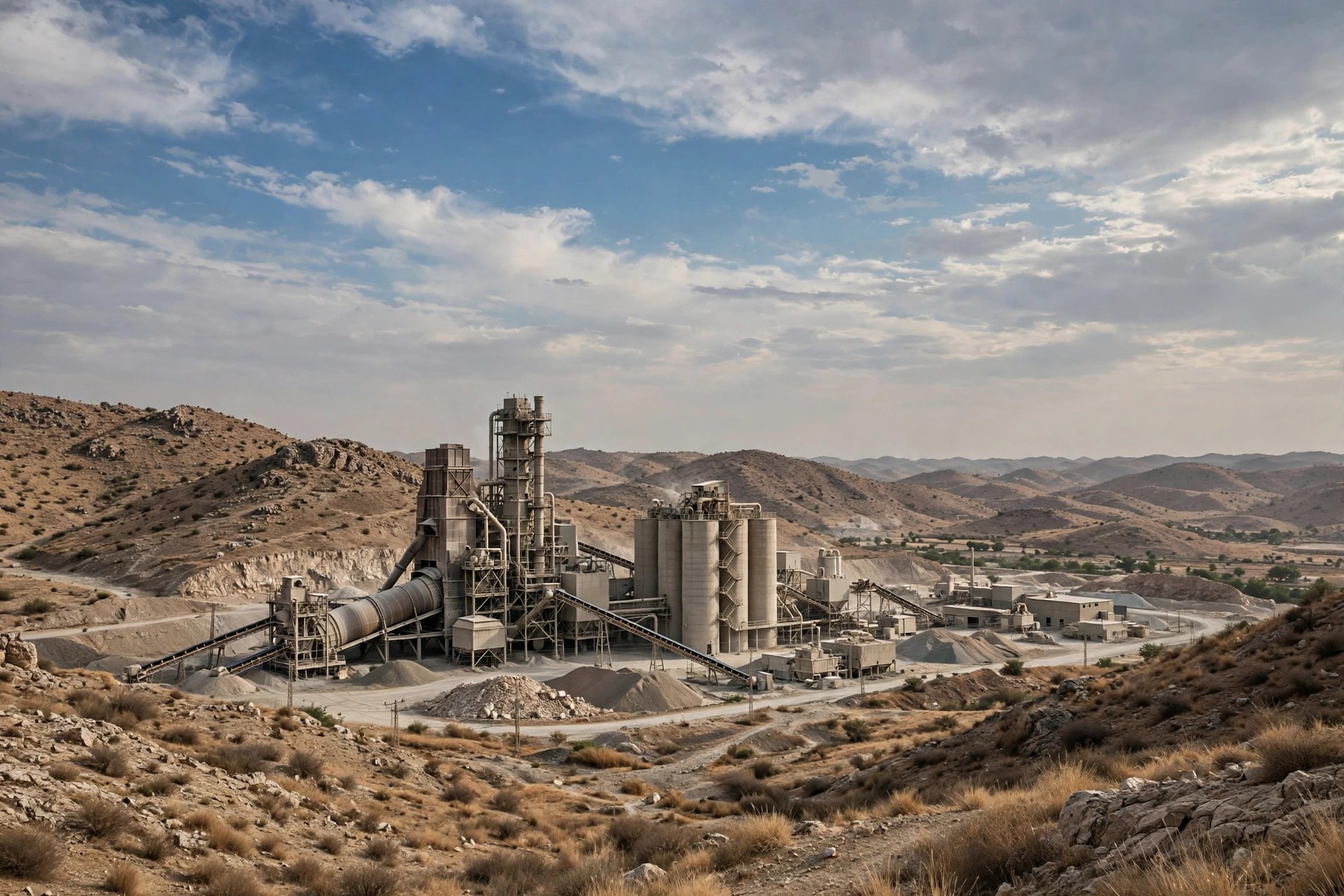
Thatta Cement's main business, in its own filings' plain wording, is the manufacturing and marketing of cement. The production facility sits on Ghulamullah Road at Makli, District Thatta — a site the company describes as spread across more than 230 acres, roughly 115 kilometres north-east of Karachi — with its registered office in Karachi. Cement is a simple product to describe and a demanding one to make: limestone and clay are quarried, crushed, blended and burned in a rotary kiln at temperatures that turn the mix into clinker, the grey nodular intermediate that is then ground with gypsum into the finished powder, bagged and despatched overwhelmingly by road to builders, dealers and ready-mix users.
Location is strategy in this trade, because cement is heavy and cheap per tonne, so transport costs define the radius within which a plant can compete. Makli places Thatta inside the southern market — Karachi, Hyderabad and the Sindh interior — quarrying close to home: the company has long reported limestone, shale/clay and silica-sand mining rights over substantial acreages near the plant, with limestone reserves it describes as sufficient for many decades. It also owns a majority stake — 62.43 per cent, as consistently reported in its accounts — in Thatta Power (Private) Limited, a subsidiary whose business is generating and supplying electric power, giving the group a captive energy arm alongside the kilns. For the sector-wide picture, our guide to PSX cement stocks sets Thatta alongside the northern giants and its fellow southern producers.
Born in the state sector: 1980 to 2004
Thatta Cement was incorporated in Pakistan in 1980 as a public limited company, and it began life as a wholly owned subsidiary of the State Cement Corporation of Pakistan — the holding body through which the state then ran much of the industry. The manufacturing facility was commissioned in 1982. The plant was built on dry-process technology with an installed capacity, in the company's standard history, of 1,000 tonnes per day of clinker, and the equipment was supplied by Mitsubishi Corporation of Japan.
To place that in context: the Pakistan of 1980 built cement capacity the way it built steel and fertiliser capacity — as a state industrial project, intended to supply a construction sector short of material and to industrialise districts like Thatta that had limestone but little else in the way of large employers. State ownership brought patient capital and a guaranteed sense of purpose; it also brought the familiar weaknesses of the era's public enterprises — soft budget discipline, political staffing pressures and investment that waited on Islamabad's fiscal weather. By the 1990s, Pakistan's cement map was already changing as private groups built modern plants, and the state sector's share of the industry was set for the great unwinding of the privatisation years.
Privatisation, 2004: the Arif Habib chapter
That unwinding reached Thatta in 2004, when a consortium of Mr Arif Habib and the Al-Abbas Group acquired 100 per cent of the company's shares from the Privatisation Commission and took over management control. Thatta thereby became part of the Arif Habib Group — a diversified Karachi financial-industrial house whose interests, as the company's own profiles list them, span fertiliser, steel, cement, real estate, commercial banking, asset management, securities brokerage and private equity. The change of owners was the single most consequential event in the company's history: control passed from a state corporation managing many plants to a private group for whom this plant had to earn its keep.
What followed, by the company's account, was a programme of performance and efficiency initiatives — and a sequence of physical upgrades that reads like a diary of the plant's second life. In 2005 the line was upgraded from 1,000 to 1,500 tonnes per day of clinker, with major equipment modifications carried out with L.V. Technology of Thailand. A further balancing, modernisation and replacement programme in 2015, executed with the Danish equipment major FLSmidth, lifted capacity from 1,500 to 1,800 tonnes per day, adding an inline precalciner, an energy-efficient cross-bar clinker cooler and upgraded dust-collection equipment. Each step matters beyond its tonnage: newer kiln lines burn less fuel per tonne of clinker, and in cement, fuel and power are the costs that decide who survives a downturn. The company was listed on the stock exchange in 2008 — four years after privatisation — opening its register to public shareholders, and a later share subdivision changed each Rs 10 share into five shares of Rs 2, a technical step that multiplies the share count without changing any owner's proportion.
How a cement plant makes money
The arithmetic of cement is tonnes and spreads. Revenue is despatches — tonnes of cement sold — multiplied by the realised price per bag or tonne in the southern market, where Thatta competes with other Sindh and Balochistan plants and feels Karachi's construction pulse directly. Against that revenue stand the industry's heavy costs: coal and other kiln fuels, electricity (partly eased, in Thatta's case, by its power subsidiary), limestone and clay extraction, grinding media and refractory wear, bags, freight, and the maintenance of a plant that runs hot and continuously. Fixed costs are large, so capacity utilisation is destiny: a kiln at high utilisation spreads its costs over many tonnes, while the same kiln in a demand slump produces expensive cement into a weak market.
Three external dials dominate the southern producer's fortunes. Construction demand — housing, infrastructure, Karachi's building cycle — sets volumes and prices together. Coal prices, substantially imported, set the fuel bill and move with world markets and the rupee. And competition sets the ceiling: when industry-wide capacity outruns demand, price discipline frays and every producer's margin compresses, whatever its individual efficiency. Captive power, nearby limestone and an upgraded kiln line are Thatta's structural answers to those dials — advantages of degree in an industry where degrees decide survival.
Entering the KSE-100
THCCL's index entry in October 2026 illustrates the machinery explained in our guides to how the KSE-100 is calculated and index rebalancing. The index is recomposed periodically from the exchange's largest, most tradable companies by market capitalisation and liquidity, with the October 2026 change reflecting the March–August 2026 review. Thatta's arrival — alongside a returning bank, a power company and an embroidery maker, while four other names departed — was therefore not an award or an endorsement; it was the arithmetic of a share whose market footprint had grown enough, in a review window, to cross the line. For the company the practical consequences are visibility and a place in index-following portfolios. For readers, it is a live demonstration that index membership is a moving border crossed in both directions, and that mid-cap industrials — not only banks and energy giants — cross it.
What investors typically watch
The cement watch list applies in full. Southern-market despatches and retention prices, and whether the industry holds pricing discipline when demand softens. Coal and energy costs, and the contribution of the power subsidiary. Capacity utilisation through the construction cycle, and any further balancing or expansion the company announces. The state of the plant itself — a 1982-vintage site, however upgraded, carries maintenance realities that newer mega-plants do not. And the group's allocation choices, since Thatta sits inside a large financial-industrial house with many calls on capital. The Aktzien learning library covers the underlying skills — reading capacity, utilisation and commodity margins — in plain language.
Thatta Cement's story compresses forty years of Pakistani industrial policy into one factory: built by the state, sold by the state, rebuilt by private owners, and finally measured by the market's own index as one of the hundred names that matter most to it. This article is educational content, not financial advice — an explanation of how the plant got here, and of the tonnes, fuel and prices that will decide where it goes next.
Life as the south's smaller producer
Scale shapes Thatta's strategic reality in ways a reader should hold in mind. Pakistan's cement industry is led by plants several times Thatta's size, many of them built in the great expansion waves with the newest kiln lines and, in the north, access to captive coal and export routes through Karachi's ports for southern players. A producer of Thatta's size cannot win a price war against bigger rivals and does not try to: its defences are the classic ones for a regional plant. Proximity to its Sindh market keeps freight — the silent margin-killer in cement — low on its home turf. Long-secured limestone and clay rights near Makli remove a cost and a worry that plants dependent on leased or distant quarries carry. A captive power subsidiary softens the blow of grid tariffs and outages. And the staged upgrades of 2005 and 2015 mean its kiln, while not the industry's youngest, burns fuel at efficiencies the original 1982 line could not approach.
The southern market itself gives the plant its rhythm. Karachi's construction cycles, Sindh's infrastructure programmes, housing demand in Hyderabad and the corridor towns, and the seasonal pulse of building through the year all arrive at Makli's gate as despatch orders. When the south builds, a well-run 1,800-tonne line sells out; when it stops, no marketing can invent demand for a commodity as local as cement, and the whole southern peer group feels the same weather at the same time — which is why sector despatches, published monthly by the industry association, are the first document an analyst of any southern producer reaches for.
The plant's social footprint deserves a sentence too. In a district like Thatta — better known for Makli's historic necropolis and the Keenjhar Lake than for industry — a cement works and its colonies are among the largest formal employers, and its trucks, contractors and suppliers form a small economy of their own. That rootedness is typical of Pakistan's older industrial plants, state-founded ones above all: they were sited as development policy, and they remain development facts long after the policy that planted them has been privatised away.
The privatisation generation to which Thatta belongs is now old enough to judge as a whole. Across Pakistani cement, the state plants that passed to private groups in the 1990s and 2000s were, almost without exception, modernised, debottlenecked and run harder than their public-sector decades allowed — not because private owners are magicians, but because a plant that must cover its own fuel bill from its own despatches behaves differently from one whose losses settle in a ministry. Thatta's staged climb from 1,000 to 1,800 tonnes a day, financed and executed under Arif Habib-era ownership, is the local instance of that general story, and its arrival in the KSE-100 in 2026 is, among other things, the market's long-delayed acknowledgement of it.
Its grinding journey, to borrow the plan's phrase, is therefore best read literally: a plant that has spent four decades grinding — first as a state project proving Sindh could make cement, then as a privatised works proving it could compete, and now as an index constituent whose tonnes are counted in the benchmark's own arithmetic every trading day.
Key takeaway: Thatta Cement began as a 1980 State Cement Corporation project at Makli, was privatised to an Arif Habib–Al-Abbas consortium in 2004, listed in 2008 and upgraded from 1,000 to 1,800 tonnes per day — a trajectory capped by its entry into the KSE-100 on 1 October 2026.