KARACHI: Some listed companies are born on the stock exchange; others arrive there after a long private apprenticeship and a change of owners. AGP Limited is firmly in the second group. The business has operated in Pakistan's pharmaceutical industry since 1989, but the company investors know today was assembled in the middle of the last decade: acquired by a consortium led by the OBS Group in July 2014, merged from three companies into one in December 2015, rebuilt around a portfolio of branded medicines — names like Rigix, Ceclor, Osnate-D, Anafortan and Keflex — and finally listed on the Pakistan Stock Exchange on 5 March 2018, in what was reported at the time as the pharmaceutical sector's first initial public offering in more than two decades. AGP is now a mid-sized, Karachi-based maker and marketer of medicines in the PSX pharmaceutical sector and a member of the KSE-100. Its story is a case study in how ownership changes a drug company — and in how the modern Pakistani pharma business actually works.
Before the takeover: a business dating to 1989
Rating-agency and company histories agree that AGP's operations go back to 1989. For most of that early life the business was private and comparatively quiet, manufacturing and marketing pharmaceutical products — a mix of its own branded generics and products licensed from international principals. Branded generics are the backbone of Pakistani pharma: medicines whose patents have expired, sold under a manufacturer's own brand name and promoted to doctors, rather than under the originator's global brand. A company in this market wins by having products doctors remember, a field force that visits them regularly, and reliable supply.
The predecessor structure was untidy, as long-lived private businesses often are: operations sat across more than one company. That matters to the later story, because the new owners' first big job was not launching a product — it was untangling and merging the corporate structure so the business could be financed, audited and eventually listed as a single entity.
2014–2018: new owners, a merger and an IPO
The turning point came in July 2014, when AGP was acquired by the OBS Group, a Pakistani healthcare group, leading a consortium of investors. OBS brought what the business had lacked: a sponsor with deep pharmaceutical experience, other drug companies under common ownership, and ambitions to professionalise and expand AGP rather than simply harvest it. Under the new owners, the company launched new brands and line extensions across therapeutic areas, and entered a strategic alliance with the international generics company Mylan, agreed in 2015, to promote and market Mylan's portfolio in Pakistan — an arrangement that added volume and locally manufactured products to AGP's range.
In December 2015 the three companies that held the business — Apollo Pharma, AGP (Private) Limited and AGP Healthcare — were merged into a single company, which took the AGP name in its current form; the present AGP Limited had been incorporated as a public limited company in May 2014 in preparation for this restructuring. Then came the listing. AGP's offer of 35 million shares — 12.5 per cent of its capital — was the first pharmaceutical IPO in Pakistan in 23 years, according to reporting of the issue at the time, and the company was listed on the PSX on 5 March 2018. A sector that had been dominated for decades by old listed names suddenly had a new one, with a recent takeover, a merged structure and a growth story to explain to public investors.
Who owns AGP: the OBS structure
Understanding AGP means understanding the ownership chain above it. The majority shareholding — reported at around 53 per cent in the company's 2021 interim accounts, and around 55.8 per cent in later rating reports — is held by Aitkenstuart Pakistan (Private) Limited, which sits within the OBS healthcare structure; the company's 2021 accounts named West End 16 Pte Limited of Singapore as the ultimate parent at that time. Below and beside the listed company sits a distribution relationship that defines its route to market: Muller & Phipps Pakistan (M&P), one of the country's largest pharmaceutical distributors and itself a shareholder in AGP, has historically handled the great bulk of AGP's distribution — rating agencies have put the share of business routed through M&P at roughly four-fifths. That concentration is a double-edged feature we return to below.
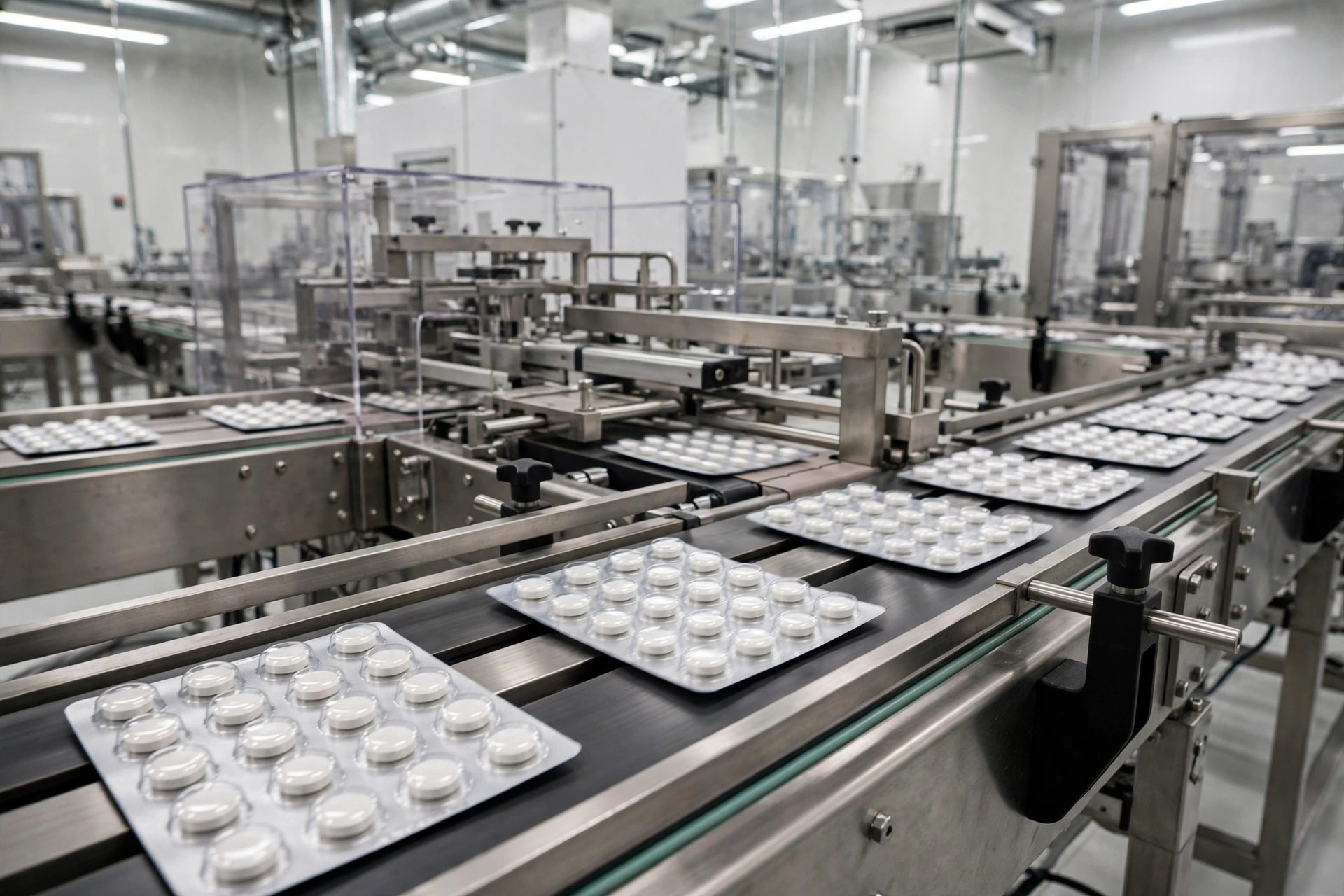
The OBS Group context matters too. AGP is the group's listed flagship among several pharmaceutical entities, which gives it siblings to share knowledge, licensing relationships and management depth with — and means group-level decisions can shape the listed company's future, for instance through acquisitions of brands or businesses routed to AGP rather than to a private sister company. After the period covered above, AGP continued that brand-buying habit: rating reports describe a company that has kept adding products and expanding facilities, including a third plant equipped for nutraceutical products, alongside its two Karachi pharmaceutical plants in the S.I.T.E. industrial area — one for general medicines and a cephalosporin facility developed as a joint venture associated with Eli Lilly.
What AGP sells
AGP manufactures, imports, markets and distributes pharmaceutical products, in its own words spanning "all kinds" of medicines. The portfolio has been described in its offering and rating documents as more than a hundred variants across several dozen products, divided into business units by therapeutic area — gynaecology, orthopaedics and pain management, antibiotics, paediatrics, internal medicine and gastroenterology among them — and extended by the newer owners into areas such as hepatology, oncology, neuropsychiatry, cardio-metabolism and ophthalmology.
The names Pakistani patients are most likely to recognise illustrate the model. Rigix is an anti-allergy brand; Osnate-D is a calcium and vitamin D supplement for bone health; Ceclor and Keflex are antibiotics with international brand heritage, marketed under licensing arrangements; Anafortan is a long-established anti-spasmodic and pain product. Notice the pattern: AGP's strength is not discovering new molecules — almost no Pakistani company does that — but owning, licensing and energetically marketing trusted brands, and manufacturing them reliably. Alongside its own brands, licensed products from international principals give the portfolio depth and give AGP's sales force more to discuss on each doctor visit. The nutraceutical expansion — vitamins, supplements and wellness products that sit outside the prescription-drug pricing regime — is a logical extension of the same logic into a faster-growing, less regulated shelf of the pharmacy.
How AGP makes money
The mechanics resemble those of every Pakistani pharmaceutical manufacturer, with AGP's own twists. Revenue comes from selling finished medicines to its distributor at trade prices; the distributor, overwhelmingly M&P, moves them through wholesalers to pharmacies and hospitals across the country. Prices for most prescription products are capped under the Drug Regulatory Authority of Pakistan's pricing framework, with adjustments linked to policy formulas, so revenue growth comes mainly from selling more units, adding brands, winning licences and — when the regulator allows — price revisions.
Costs start with active pharmaceutical ingredients, much of them imported and therefore priced in foreign currency, plus packaging, plant overheads at the Karachi facilities, quality control, and the large field force that promotes brands to doctors — the industry's real marketing engine. Two levers distinguish AGP's version of this model. The first is portfolio renewal: since 2014 the company has launched a steady stream of brands and line extensions, and acquired products, so that growth does not depend on ageing brands alone. The second is distribution economics: selling through a single dominant distributor that is also a shareholder simplifies logistics and credit, but concentrates counterparty risk — if that one channel stumbles, AGP's route to the pharmacy shelf narrows abruptly. Rating agencies flag this concentration explicitly, while also noting the comfort that comes from the distributor's own stake in the company. It is a good example of a risk that is neither hidden nor simple — exactly the kind of detail that only appears when you read past the headline profit figure, a habit our guides in the learning library try to build.
AGP's place in the industry — and in the index
Pakistan's pharmaceutical industry is crowded, fragmented and overwhelmingly local in ownership compared with a generation ago — a shift AGP's own chairman highlighted at the time of the IPO, noting how the balance between multinational and local companies had inverted over a decade. In that industry AGP sits in the tier of substantial local manufacturers: big enough to run multiple plants, a national field force and a licensed international portfolio; small enough, beside the multinational giants, that individual brand acquisitions can visibly change its size. That "rebuilt by acquisition" character is the honest summary of the modern AGP — growth assembled product by product and company by company, rather than inherited.
Its 2018 listing also gave the stock market something new. As the first pharma IPO in over two decades, AGP's offer was a test of investor appetite for the sector, and its subsequent inclusion in the KSE-100 — whose workings are explained in our guide to how the KSE-100 is calculated — put a mid-sized drug maker into the benchmark basket. Index membership is reviewed periodically, as our explainer on KSE-100 rebalancing describes, and depends on market capitalisation and liquidity rather than on how worthy a company's story is.
One further point belongs in an honest AGP profile: how young the listed company still is. Most of its KSE-100 pharmaceutical peers carry decades of listed history, long dividend records and settled identities. AGP's public story — takeover, merger, IPO, expansion — unfolded within a single decade, which means its track record through a full pricing and currency cycle is still being written, and each annual report adds proportionally more information than a peer's. Followers who value that freshness, and those who discount it, are really expressing a view about how much history a judgement requires.
What followers of AGP watch
The observation list for AGP starts with the sector dials — drug pricing decisions, the rupee's effect on imported ingredient costs, and raw-material availability — and then turns to the company-specific ones. Brand momentum: are the flagship products holding their positions with doctors, and are new launches and acquisitions adding real volume? The licensing pipeline: alliances of the Mylan type and new principals can reshape the portfolio faster than internal development. The distribution relationship: any change in the M&P arrangement, for better or worse, matters more to AGP than to almost any peer. And the balance sheet habits of an acquisitive company: purchases of brands and plants are funded from cash flow and borrowing, so followers watch how much debt the growth story carries.
Finally, the group dimension. AGP's majority owners have other pharmaceutical interests, and announcements about which entity in the group is buying what deserve a careful read. None of this constitutes a view on the share's value — this article is educational content, not financial advice — but it is the checklist a careful reader brings to AGP's results each quarter.
Exports, nutraceuticals and the next chapter
Two growth directions have featured in AGP's plans since the takeover era. The first is geographical. Even before listing, the company was pursuing product registrations in markets such as Sri Lanka, Myanmar and Tajikistan — the standard first rung of pharmaceutical exporting, in which a Pakistani manufacturer registers its brands with foreign regulators and ships finished products through local partners. Export revenue is attractive to every local drug maker for the same reason: it is earned in foreign currency, while most of the cost base sits in rupees, so it hedges the imported-ingredient problem described above.
The second direction is categorical. The third plant acquired and equipped for nutraceutical production takes AGP into vitamins, supplements and wellness products — goods sold on brand and distribution like its medicines, but outside the prescription pricing regime and riding the consumer-health trend visible in every urban pharmacy. Neither direction changes what AGP fundamentally is: a brand-and-distribution machine applied to health products. But both show the post-2014 owners doing what acquirers of mature private companies are supposed to do — widening the base on which the original franchise stands, rather than merely polishing it for sale.
Key takeaway: AGP is a 1989-vintage drug business rebuilt after 2014 by OBS-led owners — merged into one company, stocked with owned and licensed brands like Rigix and Osnate-D, distributed mainly through M&P, and listed in 2018 in the sector's first IPO in 23 years.