KARACHI: Every smartphone sold in Pakistan passes through a chain of hands — a global brand, an importer or assembler, a distributor, wholesalers, and finally the shop in the mobile market where the deal is done. For the past decade, one of the biggest pairs of hands in that chain has belonged to Air Link Communication Limited. Airlink built its name as a distributor — the official channel in Pakistan for brands including Samsung, Huawei, Xiaomi, Tecno, itel, TCL and Apple products through partners — and then, as government policy pushed the industry from importing finished phones to assembling them locally, it crossed the line from trader to manufacturer, opening a large assembly plant in Lahore, listing on the Pakistan Stock Exchange in September 2021, and expanding into televisions and other devices through its subsidiary Select Technologies. It is one of the most recognisable names in the PSX technology and communication sector, and its story doubles as a history of how Pakistan's mobile phone market was formalised.
Origins: a distribution business in a grey market's shadow
Sources differ slightly on the founding year — company materials and profiles variously date Airlink's establishment to 2010 or 2011, and its smartphone distribution business to 2012 — so the honest summary is that the company was founded in the early 2010s by Muzzaffar Hayat Piracha, who remains its chief executive and, with his family, its majority sponsor. What is not in doubt is the market it entered. Pakistan in the early 2010s had one of the world's fastest-growing mobile subscriber bases and one of its leakiest device markets: a large share of handsets arrived through informal channels, untaxed and unregistered, undercutting every legitimate distributor.
Airlink's wager was that formality would win. It built a nationwide distribution machine — its own descriptions cite a network running through more than a thousand wholesalers and several thousand retailers, with logistics hubs across the country's regions — and won distribution mandates from the global brands that dominate Pakistani handsets. Huawei recognised it with channel awards; Samsung, Xiaomi and the Transsion brands (Tecno and itel) became core principals. Distribution is a volume-and-trust business: brands hand their national volumes to partners who can finance inventory, reach small-town retailers, honour warranties and report sell-through honestly. Airlink's growth through the decade — by its IPO in 2021 it was describing revenue that had grown from very small beginnings in 2012 to tens of billions of rupees — says it passed those tests repeatedly.
The roster of principals also kept widening beyond the early Samsung, Huawei and Transsion mandates. In 2021 Airlink announced a distribution agreement with realme covering the brand's full range in Pakistan — mobile phones and accessories, internet-of-things products and televisions. Each such mandate matters for the same reason: a distributor that carries several competing brands is less dependent on any one launch cycle, and a retailer dealing with Airlink can stock multiple price tiers from a single supplier, with one credit relationship and one warranty channel standing behind them.
The policy turn: DIRBS and the assembly opportunity
Two government decisions transformed Airlink's industry. The first was DIRBS, the Pakistan Telecommunication Authority's Device Identification, Registration and Blocking System, rolled out in the late 2010s, which tied every handset's IMEI to tax payment and progressively blocked unregistered, smuggled devices. Grey imports did not vanish, but the economics of smuggling collapsed — and legitimate distributors and assemblers inherited the demand. The second was the Mobile Device Manufacturing Policy, which slashed duties on semi-knocked-down kits for companies assembling phones in Pakistan while keeping finished imports expensive. Suddenly the profitable place in the chain was not the import desk but the factory floor.
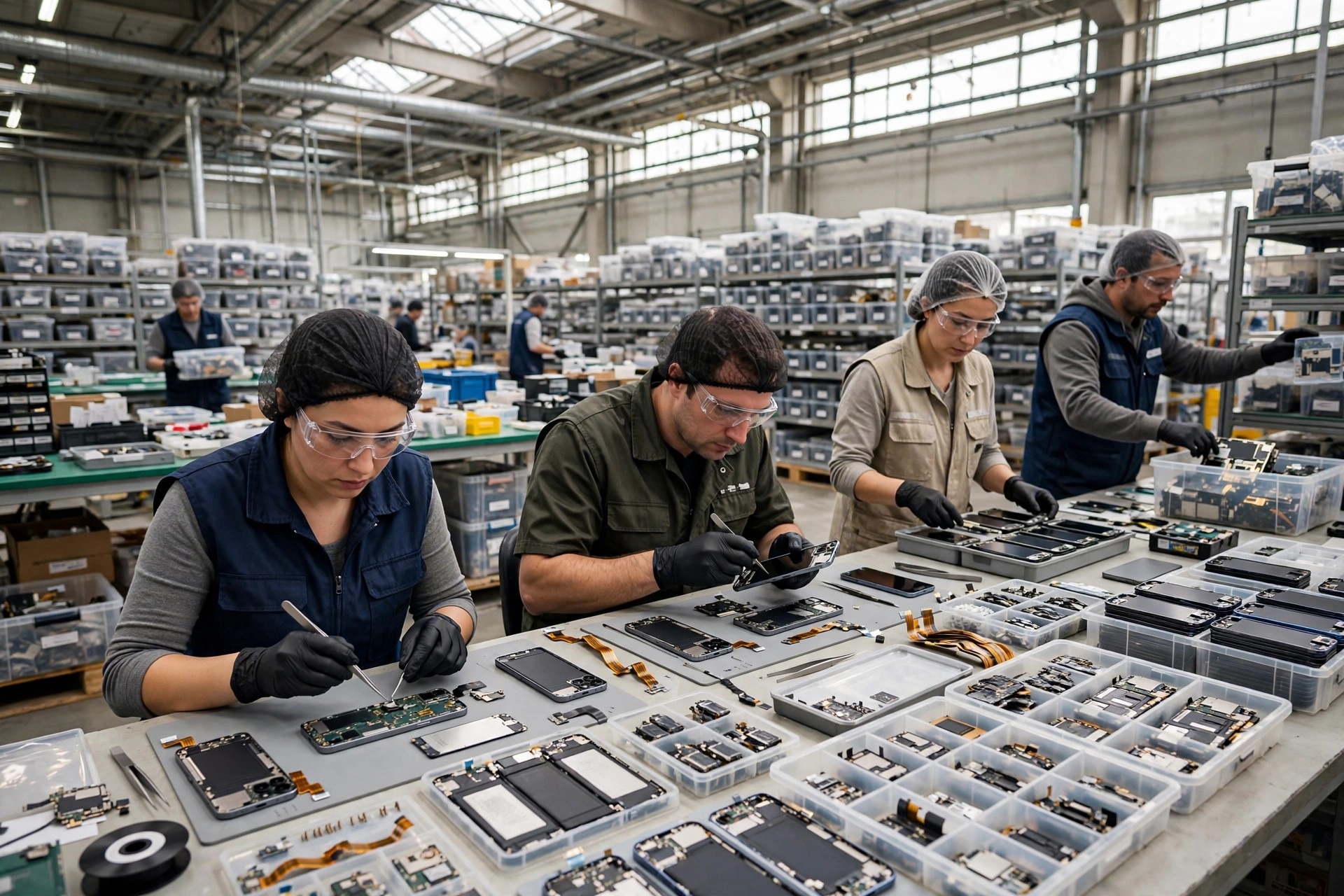
Airlink moved quickly and with its own money. It established a state-of-the-art smartphone production facility in Lahore — inaugurated in 2021 by the then federal finance minister, with an initial stated capacity of around six million units a year, later described in analyst materials at around eight million handsets — initially assembling for brands including Tecno, itel and TCL. Its wholly owned subsidiary Select Technologies (Private) Limited became the vehicle for a flagship partnership: manufacturing and distributing Xiaomi smartphones in Pakistan, and later producing Xiaomi smart televisions locally — Select Technologies launched locally manufactured Xiaomi TV sets, including very large 4K models, in the period since. The company has also talked of adjacent categories, from laptops and tablets with partners to electric-vehicle ambitions — announcements that followers treat, correctly, as options rather than facts until production lines and sales exist.
The Xiaomi arrangement also shows how formal the assembly regime had become. Select Technologies received a Pakistan Telecommunication Authority manufacturing licence for Xiaomi handsets in November 2021, and its plant — set beside Airlink's existing facility in the Quaid-e-Azam Industrial Estate at Kot Lakhpat, Lahore — was inaugurated on 4 March 2022. Company filings at the time of the announcement targeted an initial two-and-a-half to three million Xiaomi handsets a year, subject to supply chains running smoothly. In other words, assembly was no longer a workshop activity at the edge of the trade: it was licensed, located in a planned industrial estate, and organised in millions of units.
Listing in 2021 and the shape of ownership
Airlink converted to a public unlisted company in April 2019 and listed on the PSX in September 2021 — one of the notable consumer-technology IPOs of that market cycle. The sponsoring family retained a large majority — rating agency reports describe the sponsors holding roughly seventy-three per cent — with the balance spread among public, institutional and foreign holders. That concentration is typical of Pakistan's founder-led listings and cuts both ways: decisions can be fast and long-term, but minority shareholders are passengers on the family's strategy, and the free float is thinner than the company's fame suggests — a point that matters for how the share trades, and one explained generally in our guide to market capitalisation and free float.
The company also moved down the chain toward the customer. Alongside wholesale distribution it built its own retail footprint — flagship stores in marquee malls in Karachi and Lahore, including Dolmen, LuckyOne, Packages and Emporium — selling the complete iPhone range among other products, and it distributes Apple products in Pakistan through its partnership arrangements (the Apple-authorised distributor relationship it publicises via GNEXT). Retail gives Airlink a showroom for the brands it carries and a margin slice distributors normally leave to shopkeepers.
How Airlink makes money
Three engines, with different economics. Distribution is the original: Airlink buys handsets (or kits) from brands, finances the inventory, and sells to wholesalers and retailers at a margin. It is a working-capital business — the art is turning stock fast, extending credit to retailers carefully, and never being caught holding depreciating models when a brand launches its next range. Margins per phone are thin; the money is in velocity and scale. Assembly earns a manufacturing margin instead: importing semi-knocked-down kits at concessional duties, adding labour, testing, packaging and local value, and selling finished devices — for its partner brands and through Select Technologies for Xiaomi. Assembly margins depend on plant utilisation: a line built for millions of units is profitable when it runs busy and a burden when demand slumps. Analyst commentary has tracked utilisation climbing as local assembly took share from imports — by the mid-2020s, locally assembled phones were meeting the overwhelming majority of domestic demand, according to industry reporting. Retail earns the shopkeeper's margin plus services, on much smaller volumes.
Across all three runs a common exposure: the rupee. Handsets and kits are priced in dollars at origin; the Pakistani consumer pays in rupees, and demand is brutally price-sensitive. A sharp currency fall raises Airlink's cost per unit overnight, while raising shelf prices too fast kills volume — the distributor-assembler's permanent tightrope. Import restrictions, which Pakistan imposed during its 2022–23 balance-of-payments crisis when letters of credit for many goods were rationed, hit the industry directly: no kits, no assembly. Airlink's results through that period, and its recovery as imports normalised, are the clearest demonstration that this is a policy-and-currency business as much as a technology one.
Airlink in everyday Pakistani life
The company's real product is availability. Pakistan's phone market runs on small shops — the mobile plazas of Karachi, Lahore, Rawalpindi and a thousand smaller towns — and on buyers for whom a smartphone is among the largest purchases a family makes, often on instalments arranged at the counter. The brands on those shelves, the warranty that stands behind them, and the price on the box are all shaped upstream by distributors and assemblers like Airlink. Its Lahore plant also represents the industrial-policy hope attached to the sector: thousands of assembly, testing and logistics jobs, skills transfer, and the first rung of a ladder that policymakers want to climb toward component manufacturing and exports of finished phones to the region.
In the benchmark index, Airlink carries the flag for consumer technology hardware — a different animal from the software exporters that dominate the rest of the sector's story. Its membership of the KSE-100 follows the standard machinery described in our explainers on how the index is calculated and rebalancing: size, liquidity and periodic review, not sector sentiment.
The risks inside a success story
An honest profile should name the pressures that come with Airlink's model. The first is principal risk: a distributor's volumes are borrowed from its brands, and mandates can be renegotiated, split or lost — Samsung, Xiaomi or a Transsion brand reshuffling its Pakistan channel would move Airlink's revenue faster than any operational improvement. The second is the consumer cycle. Phones are postponable purchases; in the inflation squeezes of recent years Pakistanis held handsets longer, replacement cycles stretched, and the whole chain — brands, assemblers, distributors, retailers — felt the volume drought together. The third is grey-market relapse: the formal market's gains rest on continued enforcement of device registration and tax rules, and any weakening reopens the price gap that informal imports exploit.
There is also a strategic question about depth. Assembling imported kits is the first rung of manufacturing, not the summit: the local value added per phone remains modest while screens, chipsets and cameras are imported, and sceptics ask whether Pakistan's assemblers will climb toward components or remain screwdriver operations exposed to the next policy change. Airlink's answers so far — televisions, a broader device range, retail, export talk — are attempts to thicken its role in the chain. Judging whether they amount to a moat or to diversification for its own sake is the live debate among the company's followers, and it is best conducted on evidence: segment results, utilisation and cash conversion, rather than on launch-day announcements.
One final feature of the model deserves emphasis because it explains the company's resilience through Pakistan's recent economic storms: Airlink sells a necessity that behaves like a luxury. A phone is essential — banking, work, family and the state itself now assume one — but the replacement is discretionary, and in hard years the installed base simply ages. The company's counterweights are its breadth across price tiers, from entry-level itel handsets to flagship iPhones, which lets it follow the customer up or down the ladder as incomes move, and its growing manufacturing share, which ties its fortunes to the formal market's expansion rather than to any single brand's year. Few KSE-100 companies offer so direct a read on the Pakistani consumer's wallet.
What followers of AIRLINK watch
The dials are unusually tangible for this stock. Monthly PTA and industry figures on locally assembled versus imported phones set the weather. Brand fortunes matter — a strong Xiaomi or Samsung launch cycle lifts the distributor-assembler attached to it — as do the win or loss of distribution mandates, which can move volumes between rivals at a stroke. Plant utilisation at Lahore and Select Technologies' output tell whether the manufacturing bet is earning its keep. Working capital is the quiet killer in distribution: receivable days from retailers and inventory levels reveal stress long before the profit line does. And policy headlines — duty structures on kits versus finished phones, DIRBS enforcement, import rules — can reprice the whole model in a budget speech.
Finally, the expansion promises: televisions are real and locally produced; laptops, tablets and electric vehicles sit, for now, in the "announced" column, and careful followers weight them accordingly. This article is educational content, not financial advice. For the foundations — how distribution margins, working capital and index membership work — the Aktzien learning library is the place to start, and Aktzien is being built to make following companies like Airlink simpler when it launches.
Key takeaway: Airlink rode Pakistan's phone market from grey imports to formal distribution to local assembly — earning thin margins on huge volumes, first as the brands' distributor and now, through its Lahore plant and Select Technologies, as a manufacturer whose fortunes turn on the rupee, import policy and plant utilisation.