KARACHI: If Pakistan has a national vehicle, it is not a car. It is a small red motorcycle with a chrome tank, ridden by students, office clerks, delivery riders, farmers and fathers with three children arranged along the seat — and the odds are heavy that it was built by Atlas Honda. Atlas Honda Limited — ATLH — is Pakistan's largest motorcycle manufacturer, a joint venture between Pakistan's Atlas Group and Honda Motor Company of Japan, and the maker of the CD 70 and CG 125, two models so embedded in everyday life that their names function as generic words for "motorcycle" in much of the country. The company's roots lie in an investment firm founded in Karachi in 1962 by Yusuf H. Shirazi and a technical collaboration with Honda signed in 1963. It is the flagship two-wheeler name among PSX automobile stocks and a long-standing KSE-100 constituent. This profile tells how a small Karachi venture became the backbone of Pakistani personal transport, how a motorcycle factory actually makes money, and what the people who follow this unusually steady company tend to watch.
1962–1963: Shirazi, Atlas and the Honda handshake
The Atlas Group's foundation stone, by the company's own account, was Shirazi Investments (Private) Limited, set up in 1962 by Yusuf H. Shirazi with an initial capital of Rs 500,000 and two associates. Using the funds that venture generated, Shirazi signed a technical collaboration agreement with Honda Motor Company in 1963 for the production and sale of Honda motorcycles in Pakistan. The operating company formed from that venture was Atlas Autos Limited, with its first manufacturing facility in Karachi. The timing was shrewd: Pakistan in the 1960s was industrialising, its cities were growing, and a cheap, reliable, fuel-sipping motorcycle answered a need that neither bicycles nor scarce, expensive cars could meet.
Expansion came quickly, and with it the era's defining trauma. In 1968 the group formed Atlas Epak Limited with a plant in East Pakistan — a business lost in 1971 when East Pakistan became Bangladesh. Company histories describe the loss as a massive financial blow from which Atlas Autos nonetheless recovered — an early demonstration of the conservatism that still characterises the group. Through the 1970s the Karachi operation deepened its local roots, progressively manufacturing more components in Pakistan rather than merely assembling imported kits.
CD 70, CG 125 and the second plant
Two launches defined the company's destiny. In 1976, Atlas introduced the CD 70 and the CG 125 — models whose basic formula proved so right for Pakistani roads, fuel quality, repair skills and wallets that descendants of both remain in the range half a century later. The CD 70 became the default first motorcycle: economical, simple, fixable by any roadside mechanic, with spare parts in every bazaar. The CG 125, louder and prouder, became the aspirational upgrade, famous for durability under abuse.
Capacity followed demand. In 1979 a second motorcycle plant was established at Sheikhupura, near Lahore, under the name Panjdarya Limited — placing production beside the Punjab market that would always be the industry's heartland. Then, in 1988, the relationship with Honda deepened from technical collaboration to a formal joint venture agreement. In 1991 the two operating companies, Atlas Autos and Panjdarya, were merged, and the consolidated business took its present name: Atlas Honda Limited. The shareholding settled into the shape it retains today — the Atlas Group holding the majority (about 55 per cent) and Honda Motor Company a substantial minority (about 35 per cent), with the balance in public hands. Few industrial partnerships in Pakistan have lasted, unbroken and in the same business, for six decades; the Atlas–Honda venture is the outstanding example.
What Atlas Honda makes and sells
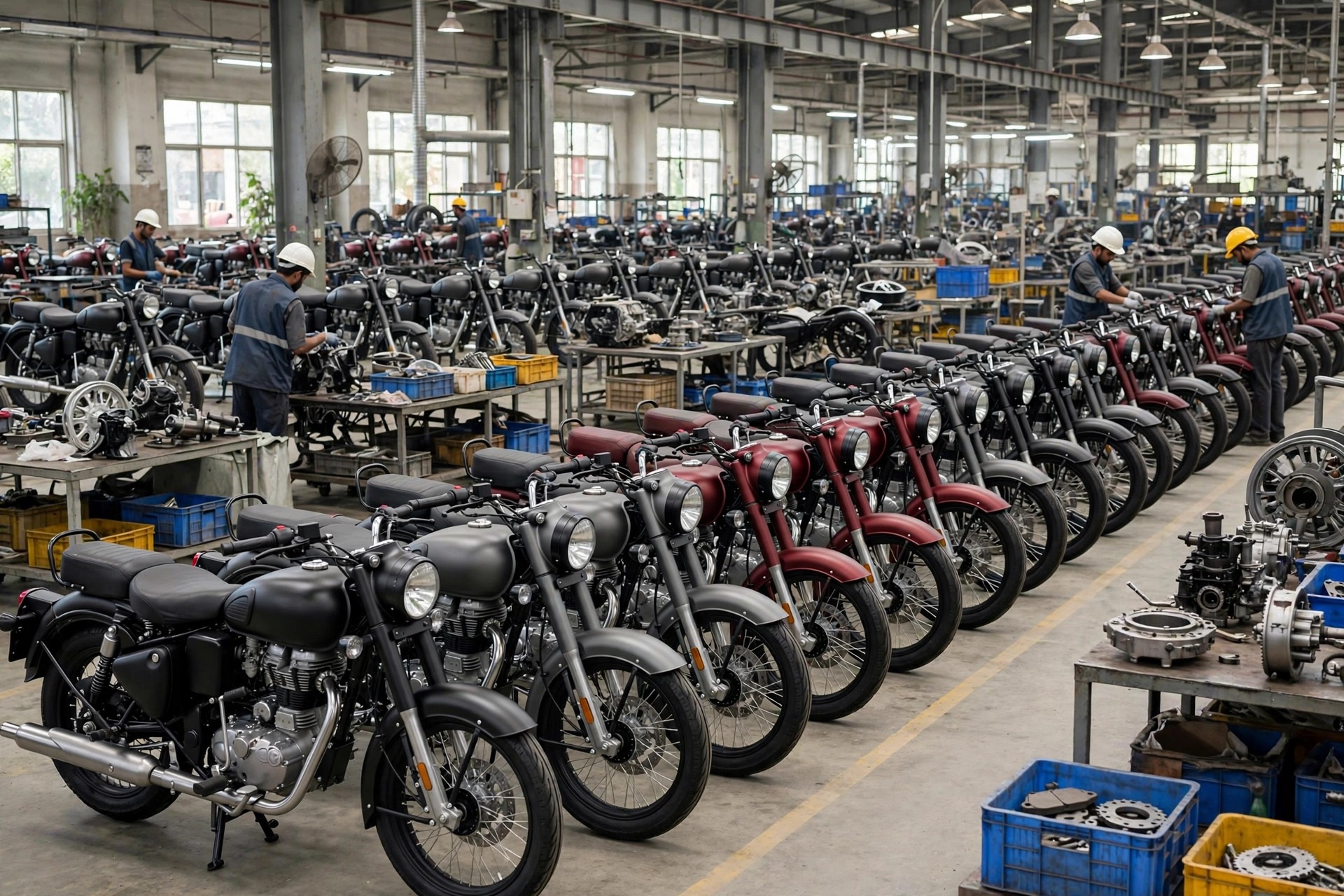
The company's business is the progressive manufacture and marketing of motorcycles and spare parts. "Progressive manufacture" is the industry's term for localisation: over the decades Atlas Honda has moved from assembling imported kits to manufacturing engines, frames and a wide range of components in-house at its Karachi and Sheikhupura plants — the company describes its in-house capability, including research and development and tool-making facilities, as the largest in the local industry — while a vendor ecosystem of Pakistani parts makers supplies the rest. Annual assembly capacity across the two plants has been reported at about 1.35 million units, with the great majority at Sheikhupura.
The showroom range is a ladder. At the bottom sit the 70cc commuters descended from the CD 70 — the volume engine of the whole industry. Above them the 100cc and 125cc classes, including the CG 125 and its variants, then 150cc models such as the CB150F for riders trading up, plus scooters and periodic special editions. Around the bikes sits the second business that outsiders underestimate: genuine spare parts, engine oils and the after-sales network — a nationwide web of sales, service and spare-parts dealers that company profiles have numbered in the many hundreds. Atlas Honda also exports modest volumes of motorcycles to markets including Sri Lanka, Afghanistan and Bangladesh, though the home market has always been the story. In the industry's own terms, the company has historically supplied the majority of Pakistan's new motorcycle sales — the market's centre of gravity in a way no car assembler matches in its segment.
How a motorcycle maker makes money
The revenue line is unit sales multiplied by price, across a range whose prices Atlas Honda effectively anchors for the industry: as the dominant maker, its list prices set the ceiling under which Chinese-brand and rival assemblers compete. The margin on each bike is the difference between that price and the cost of steel, aluminium, engines components, tyres, vendor parts, labour, energy and the yen- and dollar-linked content that localisation never fully eliminates — royalties and technical fees to Honda, and imported components and materials. This creates the model's characteristic tensions. Costs are partly foreign-currency; prices are set in rupees for buyers of modest means, so a weakening rupee squeezes the margin until prices are raised — and every price increase tests demand in the most price-sensitive vehicle market in the country.
Two stabilisers explain the company's famously steady financial character. The first is localisation itself: a high local content blunts currency shocks compared with pure assemblers, and scale — hundreds of thousands of units a year — spreads the plants' fixed costs thinly. The second is the parts and service annuity: every motorcycle sold joins a parc of millions on the road, consuming genuine parts, oil and service for a decade or more, through cycles in which new-bike sales rise and fall. Add conservative financial management — the company has famously operated with little or no debt for long stretches — and the result is a manufacturer whose profits move with unit demand and input costs, not with financial engineering. Industry volumes are published monthly by the Pakistan Automotive Manufacturers Association, making this one of the most transparent demand stories on the exchange; our guide to automobile stocks sets Atlas Honda beside the car and tractor assemblers whose cycles differ from its own.
The motorcycle in Pakistani life
It is difficult to overstate what the cheap motorcycle did to Pakistan. It collapsed distances for rural families, made the daily commute survivable in cities with thin public transport, put delivery and ride-hailing work within reach of young men with no capital, and quietly changed women's mobility in households where a family bike, whatever its limits, beats none. The CD 70's economy — famously frugal fuel consumption — made it the first motorised asset for generations of families, bought new from the dealership with ceremony or second-hand in an endless chain of resale that keeps even decades-old Hondas in daily service.
Atlas Honda's role in that transformation was to make the product dependable and ubiquitous: a bike that starts every morning, parts in every town, a mechanic on every corner who knows it by sound. Competitors — rival Japanese brands and a long tail of cheaper local and Chinese-badge assemblers — have chipped at its share for decades, particularly at the bottom of the market, yet the Honda badge's resale value and durability kept the premium franchise intact. That brand equity, built bike by bike since the 1960s, is the company's true factory.
Conservatism as a strategy
Ask a veteran of Pakistan's auto industry to describe Atlas Honda in one word and "conservative" arrives quickly. The group behind it built its reputation on understatement: modest model changes rather than annual revolutions, capacity added in measured steps, a balance sheet kept free of borrowing through cycles in which rivals geared up, and dividends paid from cash actually earned. In a market addicted to drama, that temperament can look like a lack of ambition — until a downturn arrives, input costs spike or credit tightens, and the debt-free manufacturer with the deepest vendor network is the one still supplying bikes and parts without interruption.
The same conservatism shapes the product philosophy. Where rivals chase styling and features, Atlas Honda's range evolves slowly — a new graphic here, an emission or safety improvement there, a self-starter added to a model that sold for decades without one. Critics call it complacency; defenders answer that the customer for a 70cc commuter values the tenth year of reliability over the first year's novelty, and that the resale market — where a used Honda commands its premium — votes for the defenders. The electric transition will test this philosophy hardest: too early, and capital is stranded in a market without charging habits; too late, and a nimbler rival owns the next generation's first bike. Watch how the tortoise of Sheikhupura times that move; it will say a great deal about the next sixty years.
Beyond the numbers, the company offers the exchange something scarce: duration. A listed manufacturer whose core models, plants and partnership have been continuous for decades gives long-horizon investors a rare Pakistani example of compounding through consistency — the same franchise, reinvesting in the same capability, across every economic weather the country has produced since the 1960s. Whether the electric era extends that record or interrupts it is the question that now hangs over the investment case, and it will be answered in showrooms and on assembly lines, not in presentations.
Atlas Honda in the KSE-100 — and what followers watch
ATLH's benchmark presence reflects a large, liquid, profitable manufacturer in a sector — vehicles — that the index needs for breadth; the mechanics are those described in our explainers on how the KSE-100 is calculated, market capitalisation and rebalancing. The stock has historically attracted investors who prizes steadiness: a dominant franchise, high localisation, cash generation and a record of substantial dividend payouts from a debt-light balance sheet.
The watchlist is refreshingly concrete. Monthly industry volumes first: motorcycle sales are a high-frequency proxy for the purchasing power of Pakistan's lower-middle class, and they respond quickly to fuel prices, interest rates on instalment plans, harvest incomes in rural Punjab and Sindh, and the general economic weather. Second, pricing and input costs — the yen and dollar against the rupee, and steel and aluminium prices — which determine whether volume strength becomes profit. Third, competition and product news: rival launches, the slow arrival of electric two-wheelers (a segment the whole industry, Atlas included, is probing), and any shift in the localisation rules that govern the sector. Fourth, capacity and utilisation at Sheikhupura and Karachi: the plants' ability to flex output up in boom years, when waiting lists form, is a recurring operational theme.
None of these dials amounts to advice — this article is educational content, not financial advice, and not a recommendation. Readers building their foundations — how unit economics, localisation and dividends work — will find them in the Aktzien learning library.
Key takeaway: Atlas Honda turned a 1963 technical collaboration into Pakistan's dominant motorcycle franchise — building CD 70s and CG 125s at scale in Karachi and Sheikhupura, localising deeply, and earning steady margins on volume, parts and an unmatched dealer network.