KARACHI: The Bank of Punjab — BOP on the Pakistan Stock Exchange — is the bank Pakistan's largest province built for itself. Created by an act of the Punjab Assembly in 1989, majority-owned by the Government of Punjab ever since, it began as a modest provincial institution, grew recklessly in the mid-2000s, came within sight of collapse in 2008 after one of the country's most notorious lending scandals, and was then rebuilt — slowly, under regulatory forbearance and repeated government support — into a national commercial bank with hundreds of branches, a large agricultural and government-programme franchise, and a seat in the KSE-100. Few listed companies carry so much of Pakistan's political economy inside their own history: provincial ambition, patronage lending, a chief minister's rescue, and a modern management's attempt to turn a government bank into a competitive one. That is precisely what makes BOP worth understanding.
What the Bank of Punjab does today
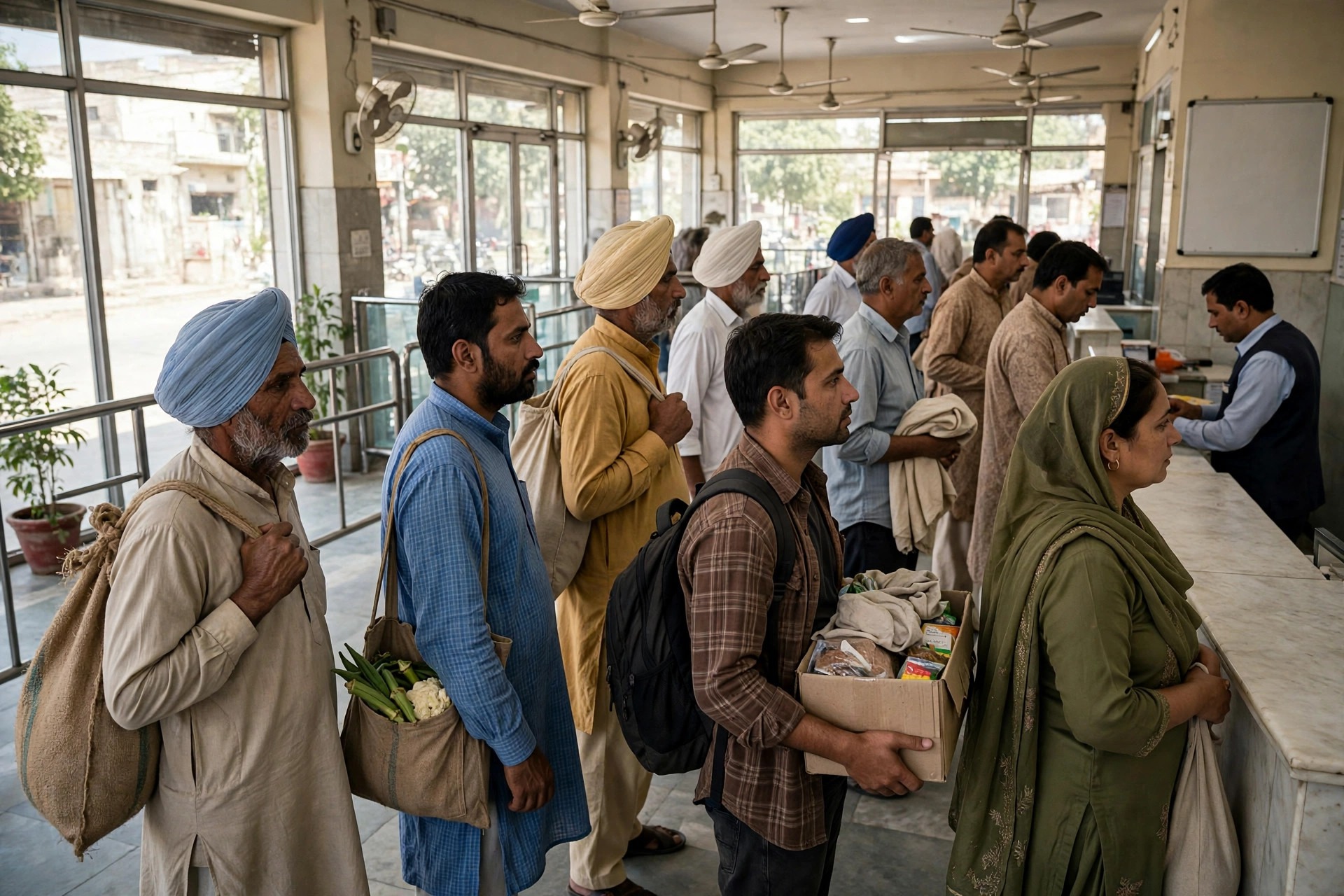
BOP is a scheduled commercial bank headquartered at BOP Tower in Gulberg, Lahore. It serves the usual segments — corporate, commercial, SME, consumer and treasury — but with two emphases that follow from its ownership. The first is Punjab's public sector and its programmes: the bank handles government business and delivers provincial schemes at scale, most visibly agricultural lending under the Chief Minister's Kissan Card programme, which provides interest-free input financing to small farmers through digital onboarding. The second is agriculture and the middle market more broadly: crop loans, agri-business finance and SME lending across Punjab's farming and trading economy, in line with a mission the bank has long stated in terms of leveraging its government relationship for the agriculture and middle-tier markets. Islamic banking is offered through a growing network of Islamic branches alongside the conventional network.
The bank's subsidiaries reflect its history; First Punjab Modaraba, established in the early 1990s, is managed within the group and represents the era when every ambitious bank sponsored a modaraba. In the listed sector — surveyed in banking stocks on the PSX — BOP occupies a distinctive category: not a state bank of the federation like National Bank, not a family or foreign-owned private bank, but a provincial bank, listed and professionally audited, yet with a provincial government as controlling shareholder and policy partner.
1989–2000: a province builds a bank
The bank was established in October 1989 under The Bank of Punjab Act, 1989, passed by the Provincial Assembly, during the chief ministership of Nawaz Sharif. The logic of the era was straightforward: Punjab, Pakistan's most populous and economically largest province, wanted a financial institution aligned with provincial development priorities, able to bank provincial entities and to channel credit to Punjab's agriculture and industry. Politics delayed the start — the bank operated initially as a non-scheduled bank with limited powers, and only on 19 September 1994, under Chief Minister Manzoor Wattoo, did the State Bank grant it scheduled-bank status, allowing full commercial banking. It had already been listed following an initial public offering in 1991, and in 1992 it set up First Punjab Modaraba.
Through the 1990s BOP remained a second-tier institution, growing with the provincial economy but overshadowed by the big nationalised banks and the new private banks of the 1991 liberalisation. Its ownership never changed: the Government of Punjab held the majority throughout, appointing its leadership, and — critics would later say — treating its lending decisions as part of provincial politics. The bank's early decades thus set up both sides of its later story: a genuine provincial franchise and branch reach that a purely commercial rival would envy, and a governance culture in which the line between banking judgement and political direction could blur.
2002–2008: breakneck growth and the Haris Steel collapse
Pakistan's mid-2000s credit boom transformed BOP — on paper, for the better. Deposits multiplied several-fold between 2002 and 2007, growing far faster than the industry average, as the bank gathered high-cost deposits and lent aggressively. Subsequent investigations and reporting attributed much of that growth to imprudent, politically connected lending under the provincial government of the day. The emblematic case was Haris Steel: a Lahore steel business that borrowed around Rs 9 billion from the bank — vastly beyond prudent limits — through what investigators described as fraudulent documentation and collusion involving bank officials, including the bank's then president, Hamesh Khan, who left Pakistan in 2007 and was later extradited from the United States to face charges.
When the global financial crisis struck in 2008 and Punjab's government changed, the reckoning arrived all at once. Bad loans surfaced across the book, the bank operated for much of 2008 without a full-time president until Naeemuddin Khan's appointment that September, and by the bank's own later accounts it stood close to failure. What saved it was its owner. Under Chief Minister Shehbaz Sharif, the Government of Punjab backed the bank with deposits and advance subscription money — Rs 10 billion placed in 2009 and a further Rs 7 billion in 2011 against future share issuance — and issued letters of comfort on the strength of which the State Bank granted multi-year relaxations from normal provisioning rules for a large block of problem advances. In plain language: the province stood behind its bank while the bank worked off its losses in instalments the balance sheet could bear. It was a bailout in everything but name, and it worked — at the price of years of constrained, convalescent banking.
The long rebuild: from patient to national competitor
The 2010s were BOP's rehabilitation ward. Successive managements cleaned the loan book as provisioning relaxations were gradually unwound, rebuilt capital to above regulatory minimums, and expanded the branch network from a few hundred outlets to well over six hundred, with Islamic branches growing within it. The franchise logic shifted towards the business its ownership naturally feeds: Punjab government transactions, salary and pension payments, development programmes and agricultural finance, alongside a push into consumer and digital banking to compete beyond the province's borders. By the end of the decade the bank could present itself — in its own thirtieth-anniversary telling — as one of the country's leading financial institutions, a claim that would have been unthinkable in 2008.
The current era is associated with president and chief executive Zafar Masud, appointed in 2020, a career banker with multinational and development-finance experience (and, unusually, a survivor of the 2020 Karachi plane crash, about which he later wrote a book). Under his leadership the bank has emphasised priority-sector lending — SMEs, agriculture, housing and women-led businesses — over passive investment in government securities, expanded digital channels, and taken a central operational role in the Punjab Kissan Card, through which interest-free crop financing has been delivered to hundreds of thousands of small farmers with high reported recovery rates. The bank also markets itself nationally rather than provincially, competing for corporate and retail business across Pakistan while Punjab remains its heartland. The arc — provincial bank, scandal patient, programme-delivery powerhouse — is complete in outline, whatever debates continue about the proper role of government-owned banks.
How BOP makes money
The earnings engine is standard commercial banking. Net interest income — returns on advances and on a large book of government securities, minus the cost of deposits — dominates, and like all Pakistani banks BOP's investment income swells when the State Bank's policy rate is high. Fee income comes from trade, cards, remittances and the transaction flows of government business. What differs is the mix and the mandate: programme lending such as Kissan Card financing is high-volume and policy-directed, with economics shaped by government arrangements rather than pure market pricing; agricultural and SME lending carries higher yields but demands more credit work per rupee than lending to blue-chip companies; and the provincial relationship brings stable institutional deposits alongside reputational exposure when provincial politics turns turbulent.
On the other side of the ledger, the bank carries the costs of a large branch network, heavy technology investment for programme delivery at scale, and provisions — the line on which its history makes every reader pause. The central analytical question for BOP has never been whether it can grow; it is whether underwriting standards hold when growth is encouraged by its owner. That is why its non-performing loan ratios and coverage levels are watched more sceptically, and more closely, than those of purely private peers.
Place in the index, and what investors watch
BOP's KSE-100 membership reflects a market value and liquidity that grew with its rehabilitation — an arc described generically in how the KSE-100 is calculated. Its presence alongside the federal state bank in the benchmark gives index followers exposure to both levels of Pakistan's government banking. Followers of BOP typically watch deposit growth and mix, especially low-cost accounts gathered through government and programme flows; the advances book's composition between sovereign-linked, programme, SME and corporate lending; asset quality and provisioning coverage, for the historical reasons above; capital adequacy without reliance on fresh provincial support; and programme scale — Kissan Card disbursement and recovery — as a gauge of both franchise value and policy dependence. Governance signals matter unusually here: board and management stability, and any sign of lending decisions bending towards politics, move this stock's story more than a new product launch ever will.
This profile is educational content, not financial advice. The Bank of Punjab's value as a case study is that it compresses Pakistan's banking dilemmas into one institution — the usefulness of a development-minded provincial bank, the danger when its credit culture bends, and the long, expensive work of rebuilding trust afterwards. Background explainers on banks, ratios and government debt sit at Aktzien Learn for readers who want the toolkit to read BOP's own reports.
BOP also illustrates a wider question Pakistan keeps debating: what government-owned banks are for. The arguments in favour are visible in its recent work — a provincial bank can be directed to lend where private banks hesitate: to small farmers without conventional collateral, to first-time home buyers, to women entrepreneurs and to districts the market under-serves, and it can deliver a chief minister's flagship programme through its branches and systems at a speed a ministry cannot match. The arguments against are written in its own 2008 file: an owner who can direct lending for development can also direct it for patronage, and the taxpayer — here, the province — ultimately holds the losses. The modern settlement, in Pakistan as elsewhere, is governance: professional boards, independent risk functions, transparent reporting and a regulator willing to treat a government bank's breaches as seriously as a private bank's. BOP's trajectory since its rescue — restored capital, unwound regulatory relaxations, published results that withstand analyst scrutiny — is best read as a test of whether that settlement can hold in a provincial setting, through changes of government in Lahore. Its shareholders, who include the public investors holding the listed minority, have a direct interest in the answer.
The bank's physical and digital spread tells the rehabilitation story in miniature. From the Lahore head office, its network reaches district towns across Punjab where private banks maintain only token presence, and into the other provinces as its national ambitions grew — the branch map of a bank that must be simultaneously a provincial utility and a commercial competitor. Its Islamic windows and branches, its mobile and internet platforms, and its programme dashboards for disbursing and recovering small farm loans are all comparatively recent constructions on an institution whose systems, in the crisis years, were part of the problem. For the farmers who receive a Kissan Card, none of this history is visible; they meet a functioning modern bank. That invisibility is, in its way, the measure of the rebuild: a bank founded by a province, broken by its politics, and rescued by its owner now competes for the same customers, on the same apps and high streets, as the private banks that once expected it to disappear.
Key takeaway: The Bank of Punjab is Punjab's own listed bank — founded in 1989, broken by the Haris Steel-era lending scandal and a provincial rescue, then rebuilt into a national lender whose modern identity is agricultural and government-programme banking at scale.