KARACHI: Most people who have shopped at Dolmen Mall Clifton, eaten in its food court or worked in the offices next door have never thought of themselves as landlords. Dolmen City REIT — DCR on the Pakistan Stock Exchange — is the structure that lets them become something close to it. It is not a company that makes or sells anything. It is a trust that owns a famous piece of Karachi real estate, collects the rent that shops and offices pay to be there, and passes most of that income on to the people who hold its units. Understanding DCR means understanding a different kind of listed investment altogether: one whose fortunes rise and fall not with a factory or a loan book, but with footfall, leases and the health of a single, very prominent address on the Clifton waterfront.
What a REIT actually is
A real estate investment trust, or REIT, is a pooled vehicle. Instead of one investor buying a whole building — something only the very wealthy or large institutions can do — many investors buy units in a trust that owns the building for them. The trust is created under a trust deed, overseen by an independent trustee, regulated by the Securities and Exchange Commission of Pakistan (SECP), and managed day to day by a specialist REIT management company. The income the property earns, mainly rent, flows through the trust and out to unit holders as distributions, after the costs of running the property and the manager's fee.
DCR is a rental REIT, which is the simplest kind: the property already exists, is already occupied, and already earns rent. It is also structured as a perpetual, closed-end and Shariah-compliant scheme, according to its own documents. Perpetual means it has no fixed winding-up date. Closed-end means the pool of units is essentially fixed — investors buy and sell existing units to each other on the stock exchange rather than the trust issuing new ones on demand. Shariah-compliant means its activities, including where it places its cash, are screened to comply with Islamic finance principles. Our explainer on how REITs work in Pakistan walks through the regulatory framework, the trustee's role and the tax and payout rules that shape all Pakistani REITs, and it is the natural companion to this profile.
The asset: Dolmen City on the Clifton waterfront
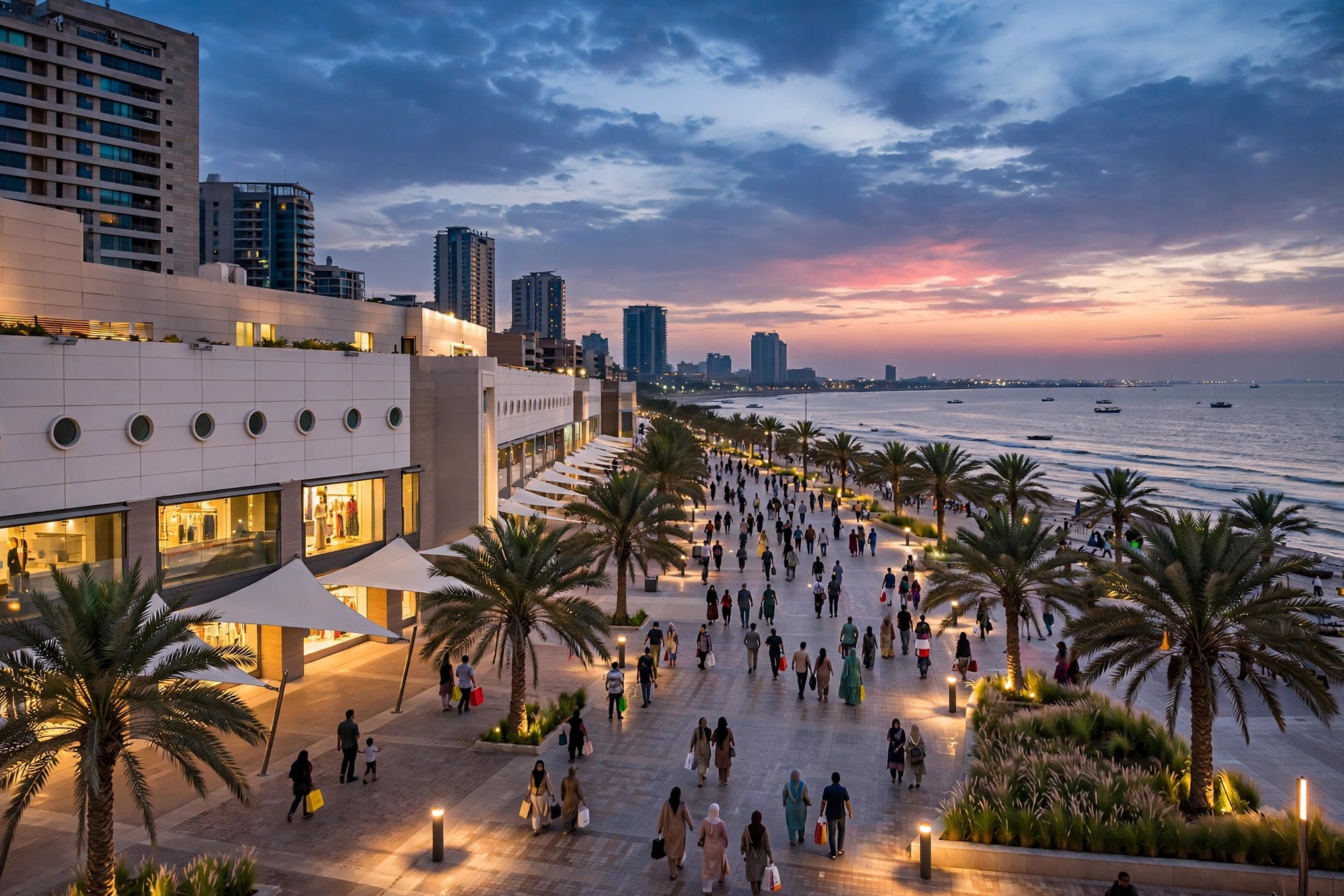
The property at the heart of DCR is the Dolmen City project in Clifton, Karachi, overlooking the Arabian Sea. It has two main parts. The first is Dolmen Mall Clifton, which opened in 2011 and is regularly described as one of Pakistan's first shopping malls built to international standards. Briefing material from the REIT's manager describes a mall of roughly 543,000 square feet with more than 130 outlets, a large hypermarket and a food court seating around 1,200 people, mixing local and international brands. For many Karachi families it became the default weekend destination — the place for Eid shopping, school-shoe runs and dinners out — and it helped shift the city's retail culture from open bazaars and high-street shops towards the enclosed, air-conditioned mall.
The second part is Harbour Front, an office building of roughly 257,000 square feet across 19 floors, home to multinational and large local companies. The pairing matters. Retail rent depends on consumer spending and shoppers' moods; office rent depends on corporate budgets and longer leases. Having both under one roof diversifies the trust's income a little, so a soft season for shopping does not hit every rupee of rent at once. What the pairing cannot diversify away is geography: this is one project, in one neighbourhood, in one city. That concentration is the defining feature — and the defining risk — of DCR.
How DCR came to exist
Pakistan had REIT regulations on paper from 2008, but for years no scheme actually launched: the tax and land-transfer rules made the arithmetic unattractive, and the industry spent years negotiating with the SECP and the revenue authorities. The sponsor side of the story is the Dolmen Group, the Karachi property group behind the Dolmen malls, which developed Dolmen City through its project company. The finance side is the Arif Habib Group, one of Pakistan's best-known capital-markets houses. Together they formed Arif Habib Dolmen REIT Management Limited, incorporated in 2009 and described by the company as Pakistan's first REIT management company — a joint venture combining Dolmen's property development and management skills with Arif Habib's investment and capital-markets reach.
The scheme itself followed once the rules were workable. DCR's trust deed was executed in January 2015 between the management company and the Central Depository Company of Pakistan as trustee, the SECP registered the scheme in May 2015, and units were offered to the public in June 2015 through a book-building process. At launch the fund was valued at about Rs 22.2 billion. The structure of the deal tells you how REITs are typically born: the property's owner, International Complex Projects Limited, transferred the real estate into the trust and received most of the units — around three-quarters — as payment, while the remaining quarter was sold to public investors for cash. In other words, the developer swapped bricks for units, and the public bought a minority slice alongside it. DCR is widely recognised as Pakistan's first REIT and the first listed REIT scheme in South Asia.
Who sponsors it, who manages it, who watches it
Three roles keep a REIT honest, and DCR's documents name all three. The sponsor and anchor unit holder is the Dolmen side: International Complex Projects Limited held the large majority of units issued against the property, so the group that built Dolmen City kept most of the economic interest and its incentives stay tied to the mall performing. The manager is Arif Habib Dolmen REIT Management, which makes the decisions a landlord would otherwise make — lease strategy, tenant mix, capital spending on the building, and how much income to distribute — and charges a management fee for doing so. The trustee, the Central Depository Company, holds the asset on behalf of unit holders and is meant to ensure the manager follows the trust deed and the REIT regulations. On top of that sit the SECP as regulator, external auditors, property valuers who periodically revalue the building, and a Shariah adviser for the compliance the scheme promises.
This separation is the point of the structure. A unit holder is not trusting a single property company with both the building and the rulebook; the building sits in a trust, a licensed manager runs it, and a trustee and regulator watch the manager. When you read about a newer entrant such as TPL REIT Fund I, you will see the same three-part shape — sponsor, manager, trustee — applied to a different portfolio and a more developmental strategy.
How a rental REIT earns — and pays out
The income statement of a rental REIT is refreshingly plain. Money comes in as rent from mall shops, anchor tenants such as the hypermarket, food-court outlets, kiosks and common-area charges, plus office rent from Harbour Front tenants, and often parking and promotional income on top. Money goes out as property operating costs — security, cleaning, utilities for common areas, maintenance, insurance — plus the REIT management fee, trustee fee, audit, valuation and listing costs. What is left is net operating income, and the REIT model is built around passing the bulk of it to unit holders rather than retaining it. Pakistani REIT rules, like REIT regimes in many countries, encourage high distributions, and DCR's own briefing material has historically highlighted a rising annual payout per unit as a headline measure of the scheme's health.
Two features deserve a beginner's attention. First, rent in prime malls is rarely flat for ever: leases typically contain escalation clauses and are renewed over time, so income can grow gradually if the mall stays desirable — and can wobble if big tenants leave. Second, a REIT's reported profit can include unrealised gains when valuers mark the property's value up (or down). Those paper gains are not cash and cannot be spent twice; careful readers separate the recurring rental profit, which funds distributions, from revaluation movements, which mainly change the stated net asset value per unit. That distinction — cash earnings versus valuation swings — is the single most useful lens for reading any REIT's results.
Everyday Karachi life, listed on an exchange
Part of DCR's appeal in the market's imagination is its tangibility. A shareholder in a cement plant may never see the plant; a DCR unit holder can walk through the asset on a Saturday afternoon, watch how full the car park is, notice which shops have closed and which new brands have arrived, and queue for coffee next to the tenants whose rent funds the distribution. Occupancy is the industry's word for that fullness: the manager's briefings regularly report occupancy in the high nineties per cent, and the ebb and flow of that single number says a great deal about the scheme. The mall's role in Karachi life — a safe, cooled, family space in a city short of public leisure infrastructure — is also its commercial moat, because tenants pay premium rents to be where the crowds reliably are.
DCR also sits inside the KSE-100 index, which means its unit price feeds into the benchmark that summarises the whole market. How index membership is decided, and why a relatively small, single-asset trust can hold a seat among giant banks and energy companies, is covered in our guide to KSE-100 index rebalancing; the short version is that size and liquidity, measured by market capitalisation and trading activity, earn the place — not the glamour of the underlying building.
A last structural point completes the picture. Because DCR is closed-end, its unit price is set purely by buyers and sellers on the exchange, not by the value of the building on any given day — so the price can sit at a premium or a discount to net asset value for long periods, widening when property sentiment is poor and narrowing when income-hungry investors compete for distributions. Because it is perpetual, there is no maturity date forcing a sale of the mall to crystallise value. And because the sponsor kept the great majority of units at launch, the free float — the units actually available to trade — is comparatively small, which can make the price jumpier than the rent roll underneath it. None of that makes DCR better or worse than an ordinary share; it makes it a different instrument, to be read with a landlord's questions rather than a manufacturer's.
What investors typically watch in DCR
Because the model is simple, the observation list is short and concrete:
- Occupancy and tenant mix — how much space is let, and whether the brands filling it are the ones drawing Karachi's shoppers.
- Rental income and lease renewals — the growth in rent per period, and the terms on which expiring leases are re-signed.
- Distribution per unit — the cash actually paid out, and whether it is covered by recurring rental profit rather than one-off items.
- Net asset value per unit versus the traded price — REIT units can trade above or below the valued worth of the property minus liabilities, and the gap itself is information.
- Concentration events — anything affecting that one waterfront site: major tenant departures, competing malls, infrastructure works, or changes in REIT taxation and regulation.
Newer platforms being built for Pakistani savers, Aktzien among them, plan to make this kind of company information easier to follow in one place — but the underlying questions stay the ones above. Treat this profile as educational content, not financial advice: DCR shows how a familiar building becomes a financial instrument, with a landlord's steady rent on one side and a single property's concentrated risk on the other, and understanding that trade-off matters more than any one year's payout.
Key takeaway: Dolmen City REIT owns Karachi's Dolmen Mall Clifton and Harbour Front offices in trust, collects their rent through a licensed manager, and distributes most of it to unit holders — property income, in stock-market form.