KARACHI: Every banking system has one institution that serves as its reference point — the bank against which the others are measured, whose results set the tone for results season and whose branches define what a bank looks like in the public mind. In Pakistan that institution is Habib Bank Limited, HBL. It is routinely described as the country's largest bank by assets and deposits, it is a heavyweight of the KSE-100, and its dark-green branches reach from Karachi's financial district to towns where it may be the only formal financial presence. A companion guide, how HBL makes money, takes apart the bank's profit engine — interest margins, fees and its investment book — in detail. This profile tells the other half of the story: how a family bank founded in Bombay in 1941 came to be, by turns, a national symbol, a state department in all but name, and the flagship privatisation of modern Pakistan.
1941: a family bank in Bombay
Habib Bank was established on 25 August 1941 in Bombay by the Habib family, Muslim merchants and private bankers of the city, with Mohammed Ali Habib and Dawood Habib at its head, and it began business with modest capital by the standards of what it would become. Its first branch stood on Muhammad Ali Road, and company tradition records that Muhammad Ali Jinnah — then leading the movement for Pakistan — opened a personal account and encouraged the venture as an institution Muslim India could call its own. In the fluid years before Partition, the bank extended its operations toward Karachi, and as independence arrived it made the decisive move: its headquarters were shifted to Karachi on 7 August 1947, a week before Pakistan came into being. HBL is consequently described as the first commercial bank established in Pakistan — a claim rooted in that transfer, which put a functioning bank at the new state's disposal from its first days. Company histories record that in those difficult first months, when the new government was desperately short of funds, the bank stepped forward with substantial financial support — an early deposit of goodwill on which the Habib name traded for decades.
Growth with the young country, 1947–1973
For its first quarter-century, HBL's biography and Pakistan's were written in parallel. The bank financed the trade and industry of a country building from near zero — cotton and textile commerce, imports of machinery, the first generation of Pakistani manufacturing — and followed Pakistanis abroad: its first overseas branch opened in Colombo in 1951, and an international network grew across the Gulf, Europe and beyond, serving traders and, later, the remittance flows of overseas workers. At home the branch network spread down to district level, making the bank a piece of national infrastructure as much as a business.
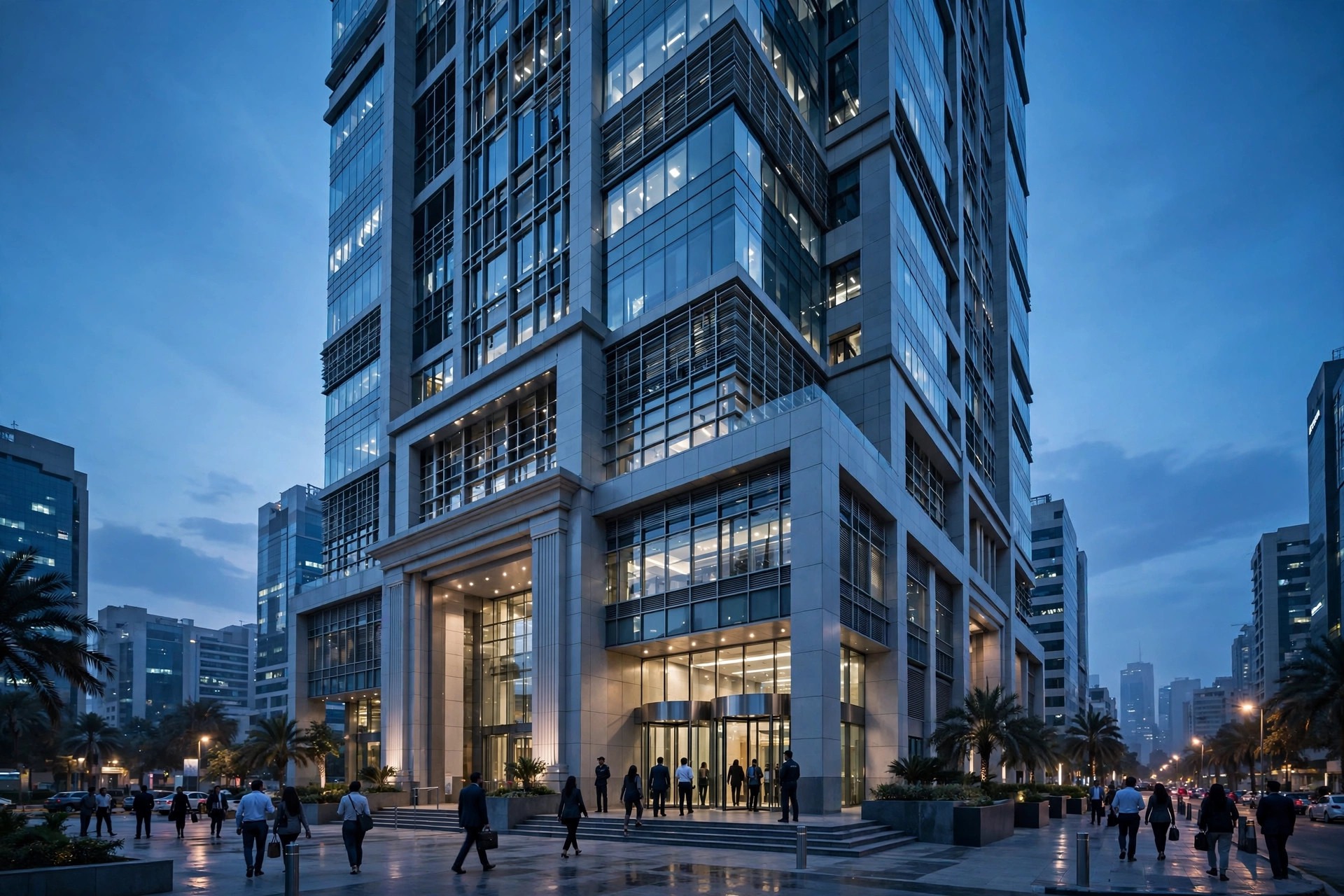
The era's monument still stands over Karachi's I. I. Chundrigar Road: Habib Bank Plaza, completed as the bank's headquarters in 1972 and at the time the tallest building in South Asia. The tower announced that a Pakistani bank had reached a scale to build a skyscraper — and it was finished, with some historical irony, on the eve of the event that would take the bank out of its founders' hands entirely.
The Plaza rewards a closer look, because few corporate buildings are woven into a country's civic life as this one is. Construction began in 1963 and the 22-storey tower — inaugurated around the bank's twenty-fifth anniversary and in operation from the early 1970s — was, for a period while still rising, counted among the tallest buildings in Asia, and remained the tallest building in Pakistan for some four decades, until the MCB Tower, on the same road, surpassed it in 2005. Its height gave it an unlikely second job: Pakistan's official Ruet-e-Hilal Committee, the body that sights the moon to fix the dates of Ramadan and Eid, has regularly used the building for its moon-sighting meetings. A bank headquarters that doubles as the nation's moon-sighting station is a fair symbol of the place HBL occupied in the young country's imagination — simultaneously a commercial institution and a piece of the state's furniture.
Nationalisation: thirty years a state bank
On 1 January 1974, the government of Zulfikar Ali Bhutto nationalised Pakistan's major banks, HBL among them. The Habib family was compensated per share and the bank was delisted; for the next three decades HBL was run as a state-owned institution. Nationalisation changed the bank's character in ways students of Pakistani business should register carefully. Lending decisions acquired political gravity; staffing expanded as public employment; the branch network kept growing and the bank continued to bank the government and the economy at enormous scale — by some measures it held an outsized share of national deposits — but commercial sharpness dulled. By the 1990s the state banking sector, HBL included, was carrying the scars: problem loans, weak profitability and balance sheets that needed repair, with the State Bank at one point injecting capital to stabilise the bank at the end of that decade. The Habib Bank that entered the 2000s was simultaneously Pakistan's biggest bank and one of its most obvious privatisation candidates — too large to fail, too state-worn to flourish.
2004: the AKFED privatisation
The reprivatisation of HBL remains a landmark of Pakistan's economic reform era. The Privatisation Commission announced on 29 December 2003 that the government would grant the Aga Khan Fund for Economic Development — AKFED, the economic arm of the Aga Khan Development Network, headquartered in Geneva — rights to 51 per cent of the bank's shareholding against an investment of about Rs 22.4 billion, and management control was handed over in February 2004. It was described at the time as the largest privatisation transaction in Pakistan's history. The government retained a substantial minority stake for a period, and the bank in due course returned to public listing, restoring the public float through which ordinary investors hold it today.
The choice of buyer mattered beyond the price. AKFED was not a speculative bidder but a long-horizon development investor with a portfolio of financial institutions across Asia and Africa — including microfinance institutions in Pakistan itself — and it took HBL as a strategic, decades-long holding, which it remains. Under AKFED's control the bank was professionally restructured: credit discipline, technology and product breadth were rebuilt, and the franchise was extended by acquisition, including Citibank's Pakistan consumer business in 2013 and Barclays' Pakistan operations in 2015, both absorbed as foreign banks retreated from the market. A licence to operate in Ürümqi, in China's Xinjiang, followed in 2016 — a small branch with large symbolism, banking the China–Pakistan trade corridor at its far end.
The China chapter did not stop at Ürümqi. HBL's engagement there had begun with a representative office in Beijing in 2005, and branch operations in Ürümqi commenced in 2017; in March 2021 the bank opened a branch in Beijing itself, becoming the first Pakistani bank to operate one in the Chinese capital. The bank describes both Chinese branches as equipped with foreign-exchange and renminbi licences, able to offer end-to-end RMB intermediation — the plumbing, in other words, through which China–Pakistan Economic Corridor projects and ordinary trade between the two countries can be invoiced, financed and settled without detouring through third-country currencies. For a bank whose overseas network was originally built to follow Pakistani traders and workers, the Beijing branch marks the network's newest logic: following not the diaspora but the corridor, and planting the flag where the next generation of Pakistan's trade is expected to flow.
The bank Pakistan uses
Today's HBL is best understood as several banks wearing one name. There is the corporate and investment bank serving Pakistan's largest companies, trade finance and government business. There is the retail bank of one of the country's largest branch networks, payroll accounts and consumer finance. There is an Islamic banking operation serving the fast-growing Shariah-compliant segment. There is Konnect, its branchless-banking platform, aimed at customers — small merchants, rural savers, young first-time account holders — whom branches never reached, and a mass-market mobile app that made the bank a daily digital habit for millions. Around the core sit group satellites in the AKFED tradition, notably in microfinance through HBL Microfinance Bank, extending the family's financial-inclusion logic down to the smallest borrowers. Internationally, the bank retains a presence across multiple countries and continents, channelling remittances — the lifeline sent home by overseas Pakistanis — into accounts at both ends.
That ubiquity is why HBL functions as a benchmark. When HBL reports, analysts read the whole sector's weather in it: deposit growth as a proxy for formal savings, lending appetite as a proxy for the economy, fee income as a proxy for payments activity. The bank's repeated inclusion in global rankings of the world's largest companies, such as the Forbes Global 2000, underlines that this is not merely local significance. Within the PSX banking sector, HBL is the large, diversified, state-history counterweight to the Islamic model of Meezan and the focused franchises of its other rivals. Its social footprint matches its financial one: through the HBL Foundation and the bank's sponsorships — most visibly its long title association with the Pakistan Super League, which put the HBL name in front of the country's cricket audience season after season — the brand operates as a piece of popular culture as well as a balance sheet, a form of presence no advertising budget alone could buy and one that continually refreshes the depositor trust on which the funding model rests.
The digital turn
The most recent chapter of HBL's history is the migration of its scale from branches to phones. A bank built on physical reach — the Plaza, the branches, the overseas offices — faced the same question as every incumbent of the smartphone era: whether its size would become an anchor or a springboard. HBL's answer was to push its mass market onto digital rails early and hard. Konnect, launched as a branchless-banking service with its own agent network and simplified accounts, was aimed squarely at the Pakistan that branches served worst: young people, small-town merchants, and the recipients of remittances and government transfers who previously cashed out through informal channels. Alongside it, the bank's mobile and internet platforms turned salary accounts into daily-use wallets for bills, transfers and card management. For the historian of the company, the parallel with 1947 is hard to miss: in both eras, HBL's strategic bet was the same — be present, early and at scale, where Pakistan's money is about to move. The competitive context has changed, though: where the twentieth-century rivals were other banks, the digital contest includes telecom-led wallets and fintech entrants, and the bank's defence is the trust, licences and balance sheet that eight decades built. How successfully that defence converts into the next generation of account holders is the live question hanging over the current chapter of the story.
What moves HBL — briefly, because another guide goes deep
Deliberately, this profile does not re-derive the bank's earnings mechanics; how HBL makes money does that work, explaining how deposits fund loans and government securities, how the net interest margin behaves as the State Bank's policy rate rises and falls, and how fees from cards, trade, remittances and digital channels supplement interest. The history above explains the rest of what a reader sees in the numbers: why the deposit base is so large (eight decades of branch banking and public trust), why the state still matters to the story (a retained historical stake and the bank's role in government finance), and why management quality is judged over decades rather than quarters (the AKFED horizon). For the index-minded, HBL's weight in the KSE-100 reflects free-float market capitalisation under the rules set out in how the KSE-100 is calculated and index rebalancing explained — as one of the market's largest tradable companies, it anchors the index rather than merely belonging to it.
What followers of HBL typically watch
Observers of HBL typically follow deposit growth and the low-cost current-and-savings mix that funds the bank cheaply; the balance between private lending and government securities as interest rates cycle; asset quality after each credit swing; the growth of Konnect and digital transaction volumes; Islamic banking's expansion; and the dividend, which for many long-term holders is the tangible annual output of the whole machine. Strategic watchers add the international footprint and any further portfolio moves by AKFED. This profile is educational content, not financial advice, and none of these points is a recommendation to buy or sell HBL shares. Aktzien, the app being built for Pakistan, plans to pair every profile like this with the mechanics explainers it links to, so that a company's story and its engine can be read together; the learning library is where that paired reading begins.
Key takeaway: HBL is Pakistan's banking reference point because of its history as much as its size — founded by the Habib family in Bombay in 1941, moved to Karachi at independence, nationalised in 1974, and reprivatised in 2004 to the Aga Khan Fund for Economic Development, under whose long-term control it remains the sector's benchmark.