KARACHI: Pakistan's pharmaceutical industry is usually described in two tribes: the multinational subsidiaries, with their imported brand heritage, and the local champions, built molecule by molecule at home. Highnoon Laboratories Limited — HINOON on the Pakistan Stock Exchange — is one of the clearest examples of the second tribe reaching the first tribe's league. Founded in Lahore in 1984, listed in 1995, it grew from a modest local enterprise into a company whose brands Pakistani doctors prescribe across a dozen therapy areas, whose subsidiary makes cephalosporin antibiotics for home and export, and whose name — a promise of brightness at the day's peak, under the motto "Highnoon for a healthier nation" — has become a fixture of the Lahore industrial landscape. Its story shows how a Pakistani pharma company is actually built: not by a single discovery, but by alliances, brand franchises and four decades of showing up.
Lahore, 1984: a private company with global manners
Highnoon was established in 1984 as a private limited company in Lahore, the cultural and commercial heart of Punjab, with its registered office and manufacturing plant on Multan Road and, in time, its corporate office in the city as well. From its earliest years, company accounts emphasise two founding choices that distinguished it from a typical small local maker. The first was a deliberate pursuit of strategic alliances with established international pharmaceutical houses — licensing and partnership arrangements that brought proven products and formulations into its portfolio and, just as importantly, exposed a young Lahore company to global standards of production and marketing. The second was a marketing-led culture: aggressive but, in the company's own framing, ethical promotion to the medical profession, building the prescriber relationships on which branded-generic success in Pakistan depends.
The combination worked. Company histories describe Highnoon as the first pharmaceutical company of Pakistani origin to break into the industry's top-twenty league — the tier long occupied by multinational subsidiaries — a milestone that announced that local firms could compete on brands, not only on price. In November 1995 the company converted its success into a public listing, becoming a public limited company with shares traded on the stock exchange, and the capital-market discipline of published accounts and outside shareholders became part of its structure from its second decade onward.
The founder's own biography underlines the company's outsider origins. Jawaid Tariq Khan came to pharmaceuticals from banking: he began his career as a trainee officer at Habib Bank, rose through its ranks, served on MCB's executive board, and helped build Middle East Bank's overseas network before taking early retirement at the end of 1983 and returning to Pakistan to go into the pharmaceutical business instead. Within seven years of its founding, contemporary industry accounts describe Highnoon as the largest national — that is, Pakistani-owned — company in the sector, and its founder was elected chairman of the Pakistan Pharmaceutical Manufacturers' Association for 1991–92. The pattern is worth noticing, because it recurs in Pakistani industry: a financier's grasp of capital, distribution credit and institutional relationships turned out to be as valuable in building a drug company as laboratory credentials, provided the marketing and manufacturing talent was hired around it — which, on the evidence of the following decades, it was.
Building franchises, therapy by therapy
Ask a Pakistani pharmacist about Highnoon and the answer comes as a list of brand franchises rather than molecules. In gastroenterology, Ulsanic — its sucralfate brand for ulcer and reflux care — became one of the names that built the company. In respiratory medicine, Combivair, its inhaled combination therapy, leads a portfolio addressing asthma and chronic lung disease. In cardiovascular and metabolic care, brands such as Triforge and Loprin are long-standing fixtures of prescription pads. Around these anchors the range spreads across allergy (Kestine among its known names), anti-infectives, musculoskeletal care, obstetrics and gynaecology, paediatrics, urology and other areas — a breadth that means no single product's fate decides the company's year, and that its medical representatives can walk into a clinic with something relevant for almost every doctor they meet.
That franchise model is the economic heart of a branded-generic company, and it is worth understanding precisely. Highnoon does not, in the main, discover new molecules; it develops, manufactures and markets formulations — many of them established medicines — under brands it builds over years. The asset being accumulated is prescriber trust: a doctor who has prescribed Ulsanic or Combivair for a decade, with predictable results, does not switch lightly. Marketing spending that looks like a cost in any single year is therefore better read as investment in that trust, and the return on it is the pricing resilience and volume stability that established brands show relative to anonymous generics. It is the same logic that powers the multinational portfolios described in our GSK Pakistan profile — executed here by a Lahore company rather than a London one, which is the point of the comparison.
The dated milestones behind those franchises show the alliance strategy at work in practice. The company moved into its present Multan Road facility in 1990, and exports began in 1994 with a first order to Turkmenistan — early proof that the Lahore plant could satisfy buyers abroad as well as at home. In 1996 it launched Tanatril, an ACE-inhibitor brand licensed from Japan's Tanabe, exactly the kind of arrangement — a proven molecule, a respected originator, a local partner with the field force — on which the early portfolio was assembled. Quality credentials accumulated alongside the brands: ISO 9002 certification in 1998, and in 2000 the introduction of Heprovac-B, a recombinant hepatitis-B vaccine, an unusually ambitious product for a local firm of its size at the time. Combivair itself, now a flagship, dates its launch to 2010, within a respiratory range built around Rotacaps and the Rotahaler device. External recognition has followed the same arc: Highnoon has been named to Forbes Asia's "Best Under a Billion" list of notable listed companies three times, and rating-agency coverage notes that the company also toll-manufactures for other houses — Abbott among them — a quiet compliment from competitors who could inspect its plant before trusting it with their products.
Curexa and Route2Health: the group takes shape
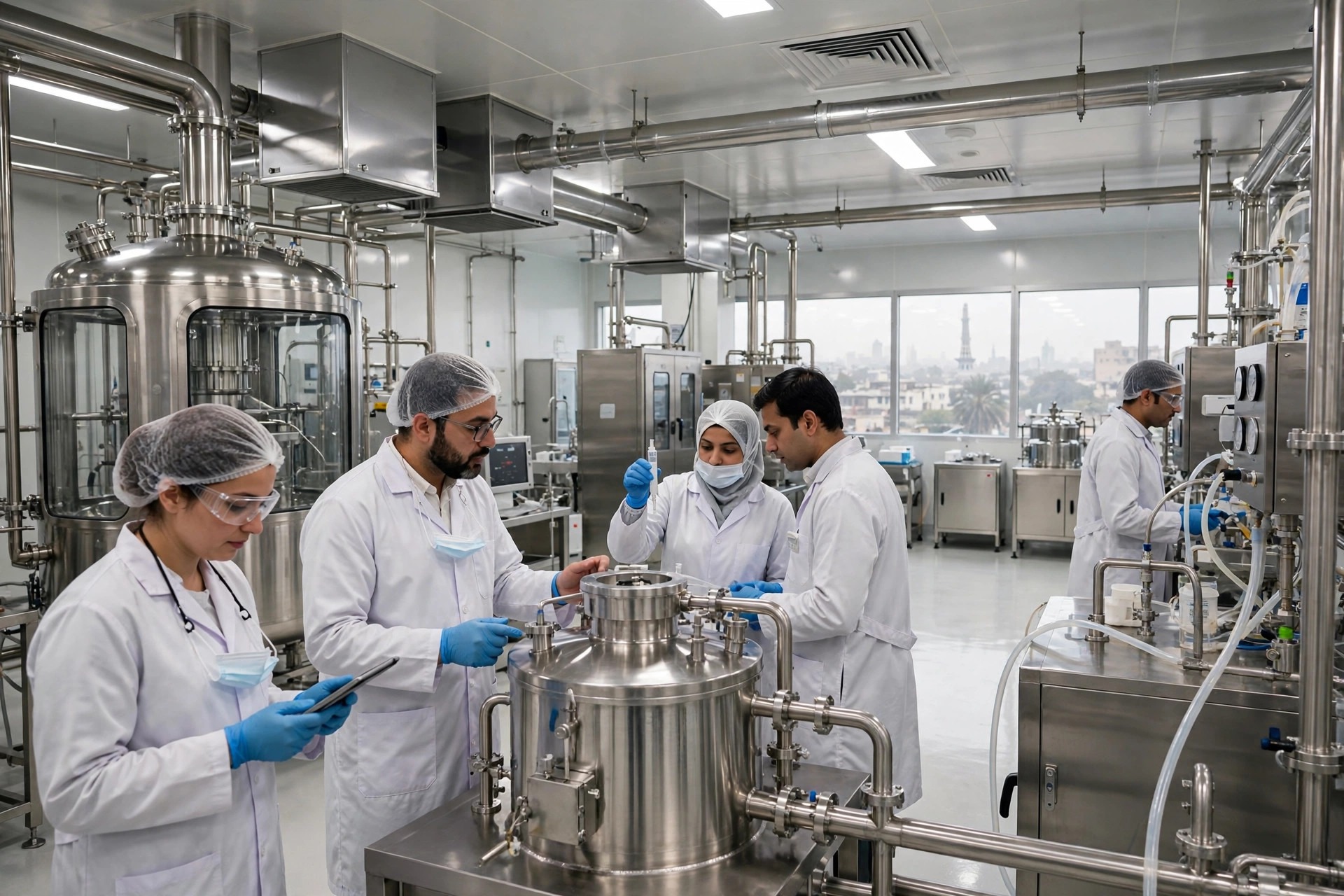
As Highnoon matured, it organised its growth into satellites. Its wholly owned subsidiary, Curexa Health (Private) Limited, specialises in antibiotics — particularly the cephalosporin family — producing sterile powder for injections, oral suspension powders and capsules from a cGMP-compliant facility, for the local market and for export. Cephalosporins require dedicated, contamination-controlled production, and housing them in a focused subsidiary is both a regulatory and a commercial choice: the parent keeps its main plant for its broad range while Curexa carries the antibiotic growth story. Beyond pharmaceuticals proper, Highnoon holds an associate, Route2Health, which manufactures and markets herbal remedies and dietary supplements, operating in Pakistan with a presence extending to Canada and the UAE — a hedge into the consumer-wellness market that sits adjacent to, but outside, the prescription world and its price controls.
Exports thread through the whole structure. Highnoon's own reporting and profiles describe sales reaching markets across Asia, the Middle East and Africa — Afghanistan, the Emirates, Sri Lanka, Cambodia, Kenya, Iraq and Tanzania among them, with shipments recorded as far as France. Rating-agency coverage has also noted investment in expanded capacity, including work toward a new facility to support future growth — the standard late chapter of a successful branded-generic story, in which yesterday's plant becomes the constraint on tomorrow's portfolio.
How Highnoon makes money
The revenue engine is the standard branded-generic machine of the PSX pharmaceutical sector, tuned to Highnoon's particular shape. Formulations are manufactured — largely at the Lahore plant, with antibiotics through Curexa — from active ingredients that are substantially imported, sold through distributors to pharmacies and hospitals, and pulled through the channel by prescriptions the company's field force works to win and keep. Profit per product is the regulated or market price minus ingredient, conversion, packaging, distribution and promotion costs. Across the portfolio, four forces do most of the explaining:
- Pricing regulation. As with every Pakistani drug maker, prices of registered medicines sit under the Drug Regulatory Authority of Pakistan's framework; the company's room to offset cost inflation depends on the category of each product and the regulator's decisions in any year.
- The exchange rate. Imported active ingredients make the rupee a cost line; export sales provide a partial offset and a strategic reason to keep widening the export book.
- Brand mix. Established franchises carry better economics than new or commodity products, so the balance between the legacy anchors — Ulsanic, Combivair, Triforge and their peers — and newer launches shapes the margin as much as total volume does.
- Capacity and compliance. Sterile and cephalosporin production, export registrations and cGMP standing are licences to operate in the higher-value segments; maintaining them is a fixed investment that scale makes worthwhile.
One further feature distinguishes companies of Highnoon's type from the multinationals: decision-making is local and concentrated. Product selection — spotting which established molecule, in which new form or combination, Pakistani practice is ready for — is the firm's core intellectual skill, and company narratives credit its early product choices with much of its trajectory. When that judgement is right repeatedly, a mid-sized Lahore maker compounds; the four-decade record is the evidence offered for it.
The industry Highnoon grew up in
Highnoon's trajectory also mirrors its industry's coming of age. When the company was founded in 1984, Pakistan's pharmaceutical market was dominated by multinational subsidiaries, and local firms were widely seen as small formulators at the margin. Over the following decades — through the growth of the Drug Act's regulatory machinery into today's Drug Regulatory Authority of Pakistan, the spread of cGMP expectations, and the professionalisation of local marketing — Pakistani-owned companies collectively took the larger share of the market by volume, and the strongest of them, Highnoon among them, began exporting and building subsidiaries of their own. The industry's recurring debates run through Highnoon's accounts as they do through every peer's: how prices should balance affordability against the viability of local manufacture; how dependent the country should remain on imported active ingredients, most of which arrive from a small number of foreign suppliers; and how quality enforcement can keep substandard and counterfeit products — a genuine public-health menace — from free-riding on honest brands. A company of Highnoon's standing has interests on every side of those debates: it argues for workable pricing as a manufacturer, suffers as a brand owner when counterfeits circulate, and invests as an exporter whose registrations abroad depend on the reputation of Pakistani regulation at home.
There is a human-capital thread, too, familiar from the multinational profiles in this series. Local champions became training grounds in their turn: medical representatives, quality managers and plant engineers who learned the trade at companies like Highnoon now staff the wider industry, and the firm's Lahore base places it in the same Punjab talent ecosystem that supplies much of Pakistan's pharmaceutical management. For a reader weighing what a KSE-100 seat signifies for a company of this size, that ecosystem role — employer, exporter, trainer, taxpayer — is part of the honest answer, alongside the franchises and the plant.
Highnoon in the KSE-100
Highnoon's presence in the benchmark is instructive about what the KSE-100 is: not a hall of fame for the largest companies, but a free-float, market-capitalisation selection that is recalculated at each review, as our explainers on how the KSE-100 is calculated, market capitalisation and index rebalancing describe. A mid-sized, tightly held growth company can qualify when its traded value and liquidity meet the rules — and pharmaceutical representation in the index thereby stretches from multinational subsidiaries such as GLAXO and Haleon Pakistan to a home-grown Lahore champion, three different answers to the same industry's economics sitting in one basket.
What followers of Highnoon typically watch
Readers of HINOON tend to watch prescription-market data for its key franchises and therapy areas; the pace and quality of new product launches; export growth and new market registrations; Curexa's antibiotic volumes and the capacity-expansion programme; DRAP pricing developments across its categories; and the gross margin's sensitivity to the rupee, which tests how much of the cost pressure its brands can pass through. Dividend and bonus history provides a further read on how management balances reinvestment against shareholder returns in a growth story. This profile is educational content, not financial advice, and none of those points is a recommendation to buy or sell the shares. Aktzien, the investing app being built for Pakistan, plans to tell every listed company's story in this form — origins first, mechanics second, verdict never — with the learning library supplying the concepts a reader needs to test the story against the accounts.
Key takeaway: Highnoon Laboratories is a home-grown Lahore pharmaceutical company — founded in 1984, listed in 1995 — that built prescriber-trusted franchises such as Ulsanic, Combivair and Triforge, extended into cephalosporin antibiotics through its Curexa subsidiary and supplements through Route2Health, and earns branded-generic margins that hinge on pricing regulation, the rupee and the strength of its brands.