KARACHI: Start with a cement plant in the hills of Khyber Pakhtunkhwa, add three decades of relentless reinvestment, and you end up assembling Kia cars in Karachi, making polyester and pharmaceuticals, operating cement plants in Iraq and the Democratic Republic of Congo, and assembling Samsung phones in Pakistan. That is the Lucky story: a single commodity business whose cash flows were so strong, for so long, that its owners — the Yunus Brothers Group, founded by the Tabba family — built one of Pakistan’s most diversified industrial groups around it. This explainer traces how the cement core makes money, how the surplus was redeployed, and what that means for anyone reading Lucky Cement’s accounts. It describes a business model; it does not recommend the share.
The core: cement economics at Lucky scale
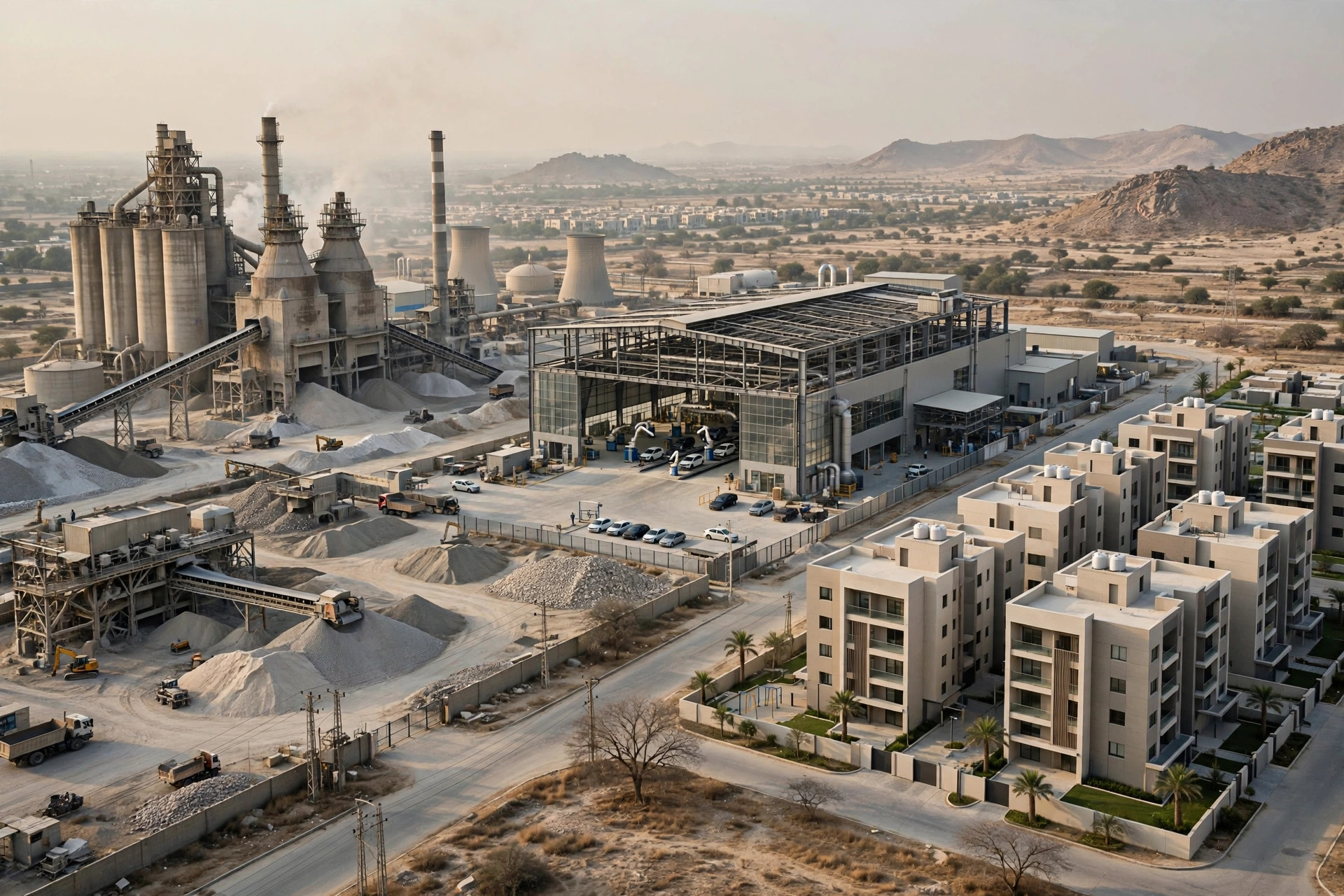
Lucky Cement is among Pakistan’s largest cement producers, with integrated plants at Pezu in Khyber Pakhtunkhwa and in Karachi, giving it the rare advantage of serving both the northern and southern markets that structure the industry in our cement sector guide: northern plants serve Punjab and KP demand and Afghan export routes, while the Karachi plant serves Sindh, Balochistan and — crucially — seaborne exports of cement and clinker. Capacity has grown through successive expansions, and scale itself is a strategy in cement: bigger kilns, captive power, waste-heat recovery and bulk purchasing all shave the per-tonne cost that decides survival in downturns.
The basic cement arithmetic is simple to state and hard to execute. Quarry limestone, crush and grind it with corrective materials, burn it at extreme temperature into clinker — the energy-hungry step, traditionally coal-fired — then grind clinker with gypsum and additives into cement, bag or bulk it, and sell through dealers, retailers and direct institutional buyers. Revenue is tonnes sold times the retention price the producer actually keeps after dealer margins, transport arrangements and taxes. Costs are dominated by energy — coal or gas for the kiln, electricity for grinding — followed by raw materials, freight and the maintenance of very heavy machinery. When coal prices spike or demand sags and retention prices fall, margins compress across the whole industry within a quarter; when construction booms, the same fixed-cost leverage works gloriously in reverse.
Lucky’s particular strengths in this contest have historically been its low-cost northern limestone and scale, its southern export option when home demand disappoints, its investments in captive and alternative power — including waste-heat recovery and solar additions described in its reporting — and a balance sheet conservative enough to fund expansions largely from internal cash. Exports deserve a nuance: they usually earn thinner margins than domestic sales, but they keep kilns turning, spread fixed costs and earn dollars, so a tonne exported is worth more to the profit statement than its price alone suggests.
From surplus to empire: the redeployment years
Pakistan’s cement industry enjoyed long stretches of strong pricing and demand — housing, infrastructure and periodic development booms — and Lucky converted its share of that prosperity into new industries rather than only into more cement. The vehicle for much of the diversification sits inside the listed company itself: Lucky Cement’s consolidated accounts fold in subsidiaries and associates, so the parent share became a group share. Its long-standing associate, renamed Lucky Core Industries, carries the chemicals heritage of ICI Pakistan — polyester staple fibre, soda ash, pharmaceuticals, animal health and seeds — a portfolio of steady, branded, less cyclical businesses that smooth the cement cycle inside the same group accounts.
Then came the consumer ventures. Lucky Motor Corporation brought Kia assembly to Pakistan and later added Peugeot, riding — and then enduring — the automobile cycle described in our automobile sector guide: a demand boom powered by cheap credit, then a brutal contraction when interest rates, import restrictions and inflation hit together. A separate venture with Samsung began assembling mobile phones locally as policy pushed the industry from imports to domestic assembly. Each venture applies the same template: a global partner’s brand and technology, Lucky’s capital, land, regulatory fluency and distribution muscle, and a policy environment — the auto policy, the mobile-device manufacturing policy — designed to reward local assembly.
Overseas cement completes the map: grinding and integrated capacity in Iraq and the DR Congo, built or acquired over the past decade, give the group earnings in markets whose construction cycles do not move with Pakistan’s — and a partial natural hedge when the rupee falls, since foreign profits translate back at weaker rates. A large power plant investment through a group company added infrastructure exposure on top. Read the consolidated segment note and you are reading four or five industries wearing one ticker.
How the money stacks: reading Lucky’s accounts
Because the diversification lives largely inside the listed company, Lucky’s reporting differs from a pure holding company’s. The consolidated income statement adds cement revenue, motor revenue, phone-assembly revenue and the rest line by line, with share of profit from associates — notably the chemicals group and overseas and power interests accounted for that way — arriving further down. The practical consequence: headline revenue growth can reflect cars and phones more than cement, and profit can be supported by associates in a year when the kilns struggle. Investors who want the cement story must excavate it from segment disclosures; investors who want the group story must accept that no single multiple fits all its parts.
Dividends tell the allocation story from the other side. Lucky historically paid modest cash dividends relative to its earnings for long stretches, preferring to fund growth internally — new kilns, foreign plants, car and phone ventures — while also, at times, buying back shares. That is the classic conglomerate bargain described in our conglomerates guide: shareholders lend the sponsor their retained earnings, at a discount for the trust involved, in exchange for the sponsor’s building record. Whether the bargain stays attractive depends on the returns of each new venture — car assembly in a shrunken market earns very differently from the boom years in which it was conceived — and that judgement, venture by venture, is the real analytical work on this stock.
An illustrative sketch, with invented figures: suppose cement contributes Rs 60 of every Rs 100 of group operating profit in a strong construction year, chemicals Rs 20, motors and phones Rs 10 and associates Rs 10. In a cement downturn with a recovering auto market, the weights can invert surprisingly fast. The group is not diversified because its parts are steady; it is diversified because its parts rarely slump simultaneously — and the years when several do are the years that test the model.
Risks: cycles, coal and concentration of judgement
Cement remains the swing factor, and its risks are Pakistan’s: demand tied to development spending, interest rates and remittance-fed housing; energy costs tied to imported coal; pricing discipline among regional competitors tested in every downturn. The overseas plants add country risk of a different flavour. The consumer ventures import kits and components priced in foreign currency into a market whose customers earn rupees — the mismatch that crushed auto volumes when the rupee and rates moved together. And above the operating risks sits the allocator’s risk common to all groups: each new empire extension is funded before it is proven, from cash that could have been dividended.
Set against that is a long, documented record: cost leadership at home, early and successful foreign cement expansion, a chemicals business with genuine brands, and survival — with balance sheet intact — through repeated national crises that broke more leveraged rivals. Both columns are true at once, which is precisely why the stock rewards study rather than slogans.
The fair one-line summary: Lucky makes money by being very good at cement, and then by being a disciplined, sometimes daring, reinvestor of cement’s rewards into whatever Pakistan is industrialising next. This article is educational content, not financial advice, and takes no position on the share’s value. Next, from industry to finance: how HBL makes money.
The power beneath: energy strategy as cement strategy
No account of Lucky’s cement economics is complete without its energy strategy, because in cement, energy is not a utility bill — it is the product. Lucky invested early and repeatedly in captive generation: gas and dual-fuel plants at its sites, waste-heat recovery systems that turn kiln exhaust into electricity, coal handling built to blend domestic and imported grades, and more recently renewable additions. Each investment attacks the same number — cost per tonne — from a different direction, and together they explain how the company sustained margins through coal-price spikes that squeezed less-prepared rivals. The group extended the logic into a large coal power investment held through an associated company, selling electricity under the capacity-and-energy framework described elsewhere in this series, so that energy became not only its largest cost managed but also a business in its own right.
Freight is the second hidden business. Cement is heavy and cheap per kilogram, so transport decides which markets a plant can serve profitably; Lucky’s plant locations, its southern port access for exports, and investments in logistics and bulk handling are competitive weapons as real as its kilns. An investor comparing Pakistani cement makers should map plants against demand centres and ports before comparing any financial ratio — geography sets the ceiling that management quality then approaches.
There is a final, quieter asset: the brand and dealer network. In a product outsiders treat as a pure commodity, masons and retailers in Pakistan hold real preferences built on consistency of quality and supply reliability across decades. That preference supports retention prices through downturns and lowers the cost of launching every adjacent building-materials venture the group attempts. Intangibles rarely appear on cement balance sheets, but they compound exactly like the financial kind.
Succession, structure and the next reshaping
Like most great Pakistani groups, Lucky’s long story eventually becomes a story about structure and succession. The group has periodically reorganised — merging, demerging and listing vehicles to separate its cement, chemicals and consumer ambitions more cleanly for investors, and restructuring proposals announced in recent years pointed towards giving the non-cement empire a more distinct corporate home. Such exercises matter beyond their paperwork: they change which cash flows sit behind which share, they can shrink the conglomerate discount by making assets separately ownable, and they reveal how the founding generation intends the empire to be governed by the next.
For the reader of accounts, the discipline is simple to state: whenever the structure changes, rebuild the map before reusing any old ratio. Per-share earnings, segment weights and dividend flows all restate under a new perimeter, and comparisons across the break are meaningful only after adjustment. Lucky’s history suggests the map will keep being redrawn — growth companies reorganise because they outgrow their containers. The investor’s job is not to resist the redrawing but to price each new map on its own merits, with the group’s long record of execution as evidence, not as a guarantee.
A note on evidence, for readers who want to go further: Lucky’s disclosures reward the effort. Its annual reports discuss plant-level capacities, energy mix and export markets in operational detail; its investor presentations separate the group’s ambitions venture by venture; and the segment accounts let an outsider test management’s diversification narrative against audited numbers, year after year. Few Pakistani companies offer a longer, richer public record of a strategy unfolding — from a single northern plant to a multinational group — and for students of how businesses in this market actually grow, that record is worth reading as history as well as analysis, whatever one concludes about the shares themselves.
That dual reading — cement company and emerging group, judged on different evidence and different clocks — is the whole discipline this stock demands, and it is why one-line verdicts about Lucky, bullish or bearish, so reliably miss the point.
Key takeaway: Lucky Cement’s kilns generate the cash, but its shares now price a group — chemicals, cars, phones, foreign cement — so analyse it segment by segment and judge it on reinvestment returns, not cement alone.