KARACHI: In 1993, when Lucky Cement was founded, Pakistan's cement industry was a landscape of state-built plants and modest private ones, and few observers would have picked a new venture in Pezu, in Lakki Marwat district, as the seed of the country's largest cement group. Three decades later, Lucky Cement — LUCK on the Pakistan Stock Exchange — is the flagship of the Yunus Brothers Group, among the very largest companies on the exchange, a leading exporter with its own terminal at Karachi Port, and the parent or sibling of businesses spanning chemicals, automobiles, power and consumer electronics. This profile tells the history side of that story: how the company was founded, how it grew, and how a cement maker became the centre of an empire. The mechanics of its profits — kilns, spreads and export economics — are covered in our companion explainer, how Lucky Cement makes money, and are only sketched here.
The Tabba family and the founding bet
Lucky Cement was founded in 1993 by Abdul Razzak Tabba, the head of the Yunus Brothers Group — a Karachi-based family business, rooted in textiles and trading, that took its name from his brother. The group's existing strengths were yarn and textiles, businesses in which it remains a major presence through companies such as Yunus Textile Mills, Gadoon Textile Mills and Lucky Textile Mills. Cement was the diversification bet: a heavy, capital-intensive industry far from the family's trading origins, chosen because Pakistan's construction demand was chronically undersupplied and the sector was opening to private capital after decades of state dominance. It was also, in retrospect, a bet on the family's own patience: cement plants take years to build and decades to pay back, and a group accustomed to the quick turns of textile trading was committing itself to the slowest money in Pakistani industry.
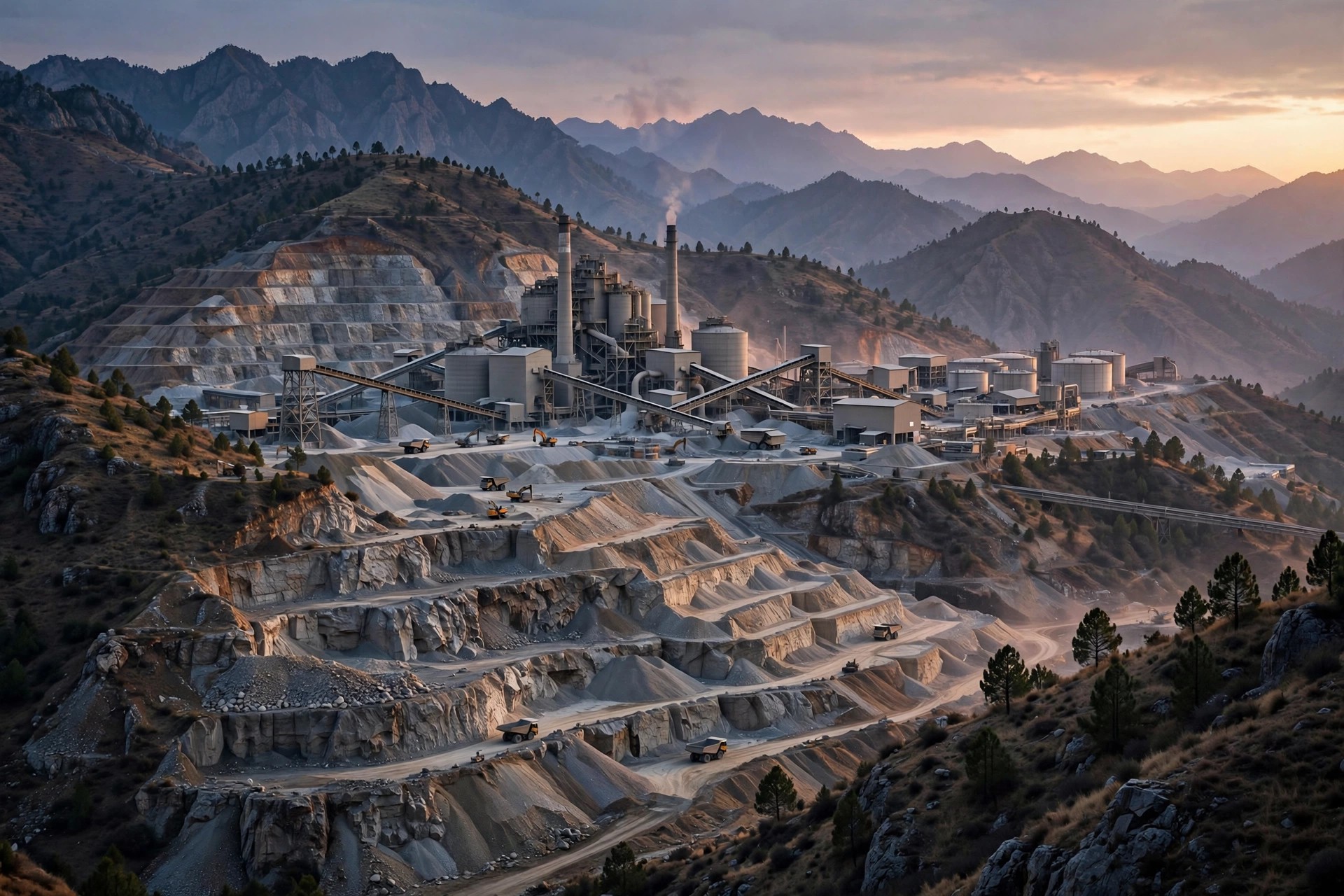
Even the company's name carries the founding geography. Company accounts connect the name "Lucky" to Lakki Marwat, the district in what was then the North-West Frontier Province — now Khyber Pakhtunkhwa — where the first plant was built, at Pezu. The site followed the industry's oldest logic: limestone in the nearby hills, and a position from which to serve the northern market's demand centres. Starting in the north also meant starting against entrenched competitors — the privatised state plants and the military-foundation groups — with no inherited brand, no legacy dealer network, and a greenfield plant that had to be financed, built and sold into a market that did not yet know its name. The speed of what followed is the core fact of the company's history: within a year of founding, in 1994, Lucky Cement was listed on the Karachi Stock Exchange through an initial public offering, giving a one-plant startup the public capital and the public scrutiny of a listed company almost from birth.
Two coasts of one country: Pezu and Karachi
Pakistan's cement market is really two markets. Freight costs divide the country into a north zone, served from the limestone belts of Punjab and Khyber Pakhtunkhwa, and a south zone around Karachi, and a producer confined to one zone is hostage to that region's demand cycle and can never economically reach the seaports for export. Lucky's defining strategic move was to refuse that confinement. To the original Pezu complex it added production in the south — plants in Karachi, on the Super Highway corridor, and capacity at Nooriabad in Jamshoro district — building a two-zone footprint that let it sell in both markets and, crucially, export.
The export build-out was the company's signature. Lucky describes itself as Pakistan's first cement maker to export sizeable quantities of loose (bulk) cement, and it remains unusual in owning its own loading and storage terminal at Karachi Port, with storage capacity of about 24,000 tonnes. Owning the terminal changed the economics of exporting: instead of depending on congested common-user facilities and bagged-cement logistics, Lucky could load bulk carriers directly, serving markets in the Gulf, East Africa and beyond, and using the sea as a pressure valve whenever domestic demand sagged. Through successive expansions the company's total cement capacity grew to about 15.3 million tonnes a year in recent reporting — the largest in Pakistan — while the product range settled into the industry's standard shelf of ordinary Portland cement, sulphate-resistant cement, block cement and clinker. That two-zone footprint also changed the company's relationship with demand itself: a housing boom in Karachi no longer had to be watched from across the country, a northern slowdown could be answered with southern and export volumes, and the dispatch mix became a management decision rather than a geographic fate. Few single decisions in the company's history explain as much of its later scale as the refusal to remain a one-region producer.
From cement maker to group flagship
The second half of Lucky's history is the story of the cement cash flows being put to work. As the flagship of the Yunus Brothers Group, the listed company became the vehicle through which the family held and grew its industrial empire. The most consequential step came in 2012, when the group acquired the majority of ICI Pakistan — the diversified chemicals house profiled in this series as Lucky Core Industries — and parked that holding in the Lucky orbit, with Lucky Cement itself the majority holder of LCI today. Around it accumulated a portfolio that a pure cement investor might not expect: Lucky Electric Power, a large coal-fired generation project at Port Qasim; Lucky Motor Corporation, the group's automobile venture assembling international brands; joint-venture cement plants abroad, in Iraq and in the Democratic Republic of Congo, exporting the Pezu playbook to other undersupplied markets; and stakes in energy and other ventures. The group's own description of Lucky Cement's subsidiaries tells the story in a single list — chemicals, power, motors and overseas cement under a company that still introduces itself as a cement maker.
Two features of this expansion deserve note. First, its direction: almost every venture is industrial and long-gestation — plants, not trading positions — consistent with a family group that thinks in decades and builds physical capacity. Second, its financing: the cement business's scale and the group's textile earnings gave it unusual access to capital for a Pakistani company, including an international listing — Lucky maintained global depositary receipts in London for many years, until their delisting in June 2024 simplified its listing back to the PSX alone. The company also points to a distinctive governance marker: it describes itself as Pakistan's first SECP-certified Shariah-compliant company, a designation it has used in presenting itself to Islamic investors. That certification, unusual for an industrial group of its vintage, widened its potential shareholder base to the growing pool of Shariah-screened funds for whom most conventional industrials are off-limits.
How Lucky earns — the short version
Deliberately brief, because the full treatment lives in the companion explainer: Lucky makes cement at Pezu and in the south, sells it through a nationwide dealer network and its own port terminal, and earns the spread between cement retention prices and the costs of limestone, energy — coal above all — and freight. Its historical edge has been cost: large, modern lines, waste-heat recovery and the early adoption of alternative fuels such as refuse-derived and tyre-derived fuel, all of which shave the energy bill that dominates cement economics. Group earnings add the dividends and consolidated results of its subsidiaries and associates, which is why LUCK's consolidated accounts read differently from its standalone cement accounts — a distinction the explainer unpacks. For sector context, our guide to cement stocks on the PSX compares this two-zone, export-capable model with the single-region producers.
Lucky in the market's imagination
Few Pakistani stocks carry LUCK's weight in the market's collective mind. It has for long stretches been among the exchange's largest companies by market capitalisation, a permanent fixture near the top of the KSE-100 under the selection mechanics our index guide explains, and a stock through which foreign and institutional investors have historically expressed a view on Pakistan itself — construction demand, the rupee, political stability and all. That status makes its shareholder meetings and results announcements market events, and makes the Tabba family's stewardship a matter of public commentary in a way few family businesses anywhere experience. It also means LUCK's share price often moves on Pakistan news rather than cement news, a separation between company and stock that new investors in index heavyweights everywhere eventually have to learn.
The efficiency gospel, and the family behind it
Two cultural threads run through Lucky's growth and help explain its pace. The first is a near-obsessive focus on unit cost. Cement is a commodity in which the low-cost producer survives every downturn and funds every expansion from the wreckage of higher-cost rivals, and Lucky organised itself around that truth early: big, modern, automated lines instead of accumulated small ones; captive and waste-heat power to discipline the electricity bill; alternative fuels — refuse-derived fuel and shredded tyres among them — pioneered at Pakistani scale to dilute coal costs; and logistics treated as a production function, from limestone haulage to the port terminal. The second thread is generational continuity with professional depth. Founded by Abdul Razzak Tabba, the group passed its leadership within the Tabba family — Muhammad Yunus Tabba as chairman and Muhammad Ali Tabba as the cement flagship's chief executive in the modern era — while building a professional management cadre beneath the family tier. That combination, family patience with corporate systems, is the standard explanation offered for the group's willingness to build plants whose payback periods outlast political cycles: the Karachi complex, the power project and the overseas ventures were all conceived in years when shorter-horizon investors were leaving Pakistan, not entering it.
The overseas chapter follows the same logic to its conclusion. If the playbook — modern lines, low cost, port access — won in Pakistan, it could win in other cement-short markets: hence the joint-venture grinding and integrated plants in Iraq, serving reconstruction demand from a base in Basra's orbit, and in the Democratic Republic of Congo, where a plant near the coast supplies a market long dependent on imports. Those ventures make LUCK one of the few Pakistani industrials with meaningful hard-currency earnings from manufacturing abroad, and they change the risk conversation around the stock: part of the flagship now answers to Basra and Matadi rather than to Pezu and Karachi. The automobile and power ventures pull in the same direction — a group deliberately assembling earnings streams that do not all rise and fall with the Pakistani construction cycle that gave it birth.
What investors typically watch
The watching brief divides into cement and everything else. On cement: industry dispatch data for both zones, export volumes and prices, coal costs and the company's capacity utilisation across Pezu and the south, plus any announced expansion — Lucky's history suggests reading its capital expenditure as a statement about the next decade, not the next quarter. On the group: the performance and dividend flows of Lucky Core Industries; the automobile venture's sales in a cyclical consumer market; the power business's collections experience, which ties the group to the same circular-debt dynamics as every generator; and the overseas cement plants' ramp-up. Over both sits succession and governance — the group's leadership passed within the Tabba family across generations, and its continuity is part of what long-term holders believe they own.
Lucky Cement's biography — a 1993 greenfield plant, a 1994 listing, a two-zone build-out, a port terminal, then an empire — is the closest thing Pakistani industry has to a founding myth of the private-sector era. This article is educational content, not financial advice. The Aktzien learning library links the money-mechanics explainer and sector guides that complete the picture.
Key takeaway: Lucky Cement, founded by Abdul Razzak Tabba in 1993 and listed in 1994, grew from one plant at Pezu into Pakistan's largest cement producer with southern plants, its own Karachi Port export terminal and overseas ventures — and became the Yunus Brothers Group's flagship holding, chemicals, power and automobiles included.