KARACHI: Open a kitchen cupboard in almost any Pakistani home — or in a Pakistani home in Toronto, Dubai or London — and there is a fair chance you will find a small, bright pack of recipe mix promising a biryani, a karahi or a haleem that tastes the way it should. National Foods Limited built its business on that promise. Incorporated in Karachi on 19 February 1970 as a spice company, it grew by understanding a simple change in Pakistani life: families still wanted traditional flavours, but they had less time, more women in paid work, and a growing appetite for consistency — the same dish, tasting right, every time. From ground spices it expanded into recipe mixes, ketchups and sauces, pickles, desserts, jams, salt, rice and other convenience foods, until it described itself, accurately, as a convenience-food company rather than a spice miller. It also became an exporter early and seriously, following the Pakistani diaspora abroad, and built subsidiaries in the Gulf, Britain and North America. Its story is the story of packaged food in Pakistan itself: the slow, still-unfinished shift from loose, unbranded staples bought by weight to branded packs bought by trust.
1970: a Karachi spice company
National Foods was incorporated in Pakistan on 19 February 1970 as a private limited company. It started as a spice company, grinding and packing the plain spices — chilli, turmeric, coriander, cumin and their kin — that form the base layer of South Asian cooking. That starting point matters. Spices are where a food brand earns its first trust: the product is used daily, quality differences are immediately obvious in the pot, and a household that trusts a maker's chilli powder will listen when the same maker offers something new.
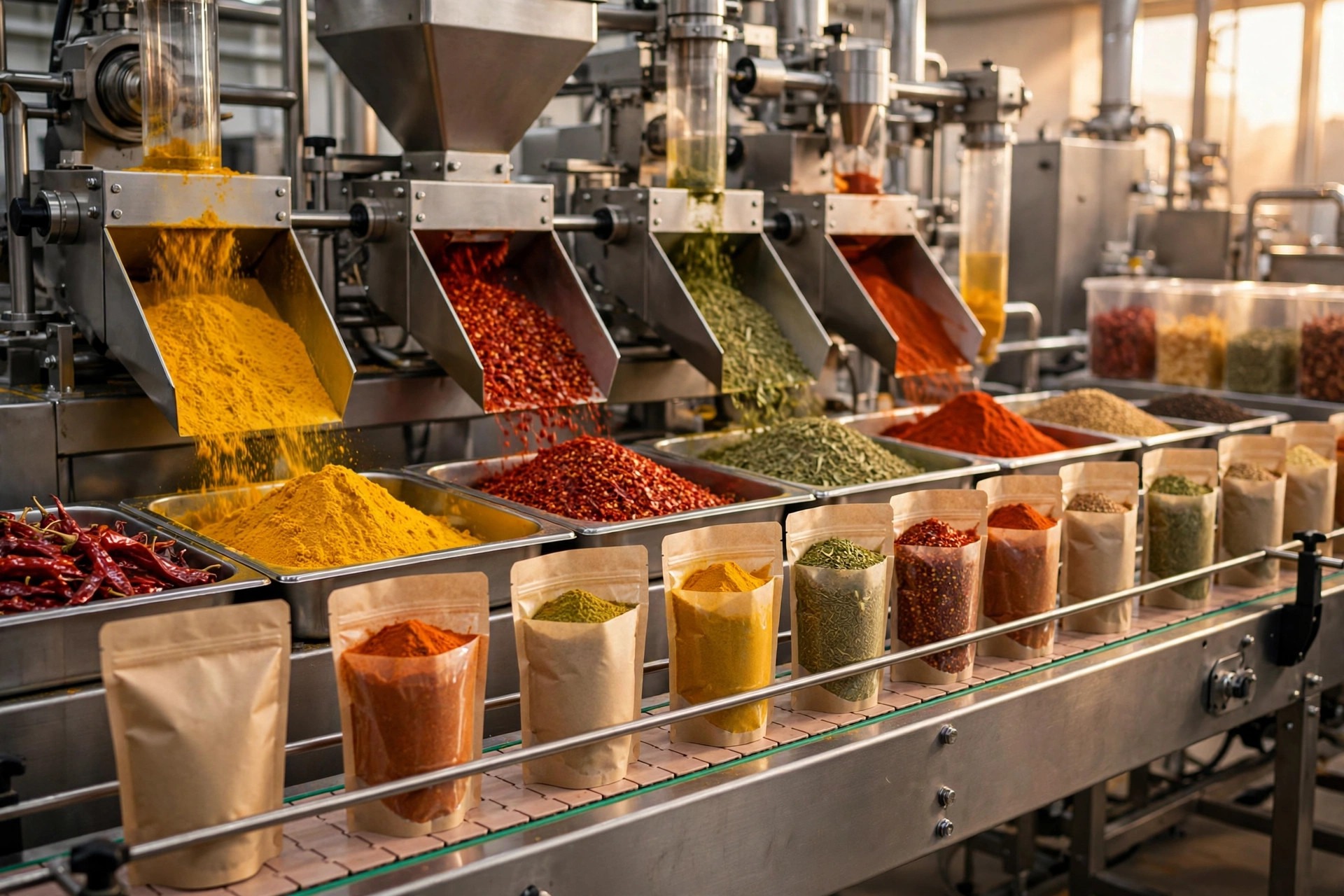
The company's defining innovation was the recipe mix: a pre-blended pack containing the spices and seasonings for a specific dish, in the right proportions, ready to use. Recipe mixes did for home cooking what a good map does for a journey — they removed the risk. A young cook, a busy cook, or a Pakistani cook abroad far from a mother's hand could produce a recognisable biryani on the first attempt. In a market where most spices were still sold loose and unbranded, with quality varying from shop to shop, the branded, sealed, consistent pack was a genuine product revolution, and National Foods was among its pioneers in Pakistan.
In 1988 the company converted from a private to a public limited company and listed on Pakistan's stock exchanges. The same period brought an international credential: in 1988 National Foods became a certified vendor of McCormick, the large American spice company — a relationship that signalled its manufacturing standards could satisfy a demanding global buyer.
From spices to the whole convenience shelf
The decades after listing were a steady widening of the shelf. From plain spices and recipe mixes, the range grew into ketchup and sauces, pickles in oil, jams, dessert mixes and custards, powdered drinks, Chinese-food ingredients, salt, rice and snack items — the company has described a range of more than 250 products across more than ten major categories. Each extension followed the same logic: take a kitchen task that is fiddly, time-consuming or easy to get wrong, and sell the reliable shortcut in a pack.
Production grew with the range. The company developed manufacturing sites including facilities in Karachi — at Port Qasim and in the SITE industrial area — and further plants serving Punjab, including Lahore and Gujranwala, placing production nearer to both its raw materials and its largest consumer markets. Food manufacturing at this scale is a discipline of hygiene systems, batch consistency and shelf life: a recipe mix must taste identical in Karachi and in Peshawar, in January and in July, months after packing.
The competitive field sharpened as it grew. In spices and recipe mixes, National Foods' best-known rival is Shan Foods, another Karachi-born brand, alongside Mehran and others; in sauces and condiments it meets firms such as Mitchell's and Young's, and in every category it competes with the true giant of the Pakistani spice trade — the unbranded loose market, still enormous, where price per kilogram beats brand trust for many households. That is why industry watchers treat the branded share of total spice consumption as the real growth story: National Foods expands both by taking share from branded rivals and, more slowly, by converting loose buyers into pack buyers.
Following the diaspora: exports and subsidiaries
Pakistani food travels unusually well, because Pakistanis travel and take their tastes with them. National Foods built an export business reaching, by its own account, some 40 countries across five continents — wherever Gulf workers, British Pakistanis, North American immigrants and students created demand for the flavours of home. Export food is not simply domestic product on a longer truck: it requires compliance with each market's labelling, ingredient and food-safety rules, distributors who understand ethnic retail, and packaging that survives container shipping and long shelf time.
The company gave that trade a permanent structure. National Foods DMCC was registered in Dubai in November 2012 as a wholly owned subsidiary to drive export sales from the Gulf's trading hub. Beneath it, National Epicure Inc. in Canada, incorporated in 2013, handles North American trading, and a UK company serves Britain and Europe. In 2017 the group took a controlling interest in A1 Cash and Carry, a Canadian wholesale distributor of foodservice products — a move from selling to distributors, toward owning a piece of distribution itself in a major diaspora market. The ultimate parent is ATC Holdings (Private) Limited, under the control model the company reports in its financial statements.
International recognition followed the numbers: in 2013 National Foods appeared in Forbes' list of Asia's 200 Best Under a Billion, the ranking of notable smaller listed companies in the region. Such listings are snapshots, not guarantees, but they marked how far a Karachi spice packer had come.
How a packaged-food company makes money
National Foods buys agricultural and food inputs — whole spices, chillies, salt, sugar, tomatoes, fruit, oils and packaging materials — processes and packs them, and sells through distributors to retailers ranging from Karachi hypermarkets to small neighbourhood shops and overseas wholesalers. The margin in each pack is the difference between that realised selling price and the full cost of ingredients, processing, packaging, freight, marketing and the retailer's and distributor's margins that the price must also carry.
Three features shape those margins. First, raw material exposure: its key inputs are farm products whose prices swing with harvests, weather, global spice markets and the exchange rate for anything imported. A chilli crop failure or a rupee slide raises costs before any price increase can be pushed through to shoppers. Second, pricing power with a ceiling: a trusted brand can charge more than loose spices, but the housewife comparing a pack with the loose alternative sets a hard ceiling — push too far and buyers trade back down. Managing that gap, pack by pack and size by size, is the daily art of the business, including smaller, cheaper packs that keep the brand affordable per purchase even when per-kilogram prices rise. Third, mix: value-added products — recipe mixes, sauces, desserts — generally carry richer margins than plain commodities such as salt or basic spices, so the direction of the product mix matters as much as total volume. These are the standard economics of the sector set out in our guide to food and personal care stocks on the PSX, and National Foods is one of its clearest illustrations.
Exports add a currency dimension. Sales in dollars, dirhams, pounds and Canadian dollars against a largely rupee cost base can flatter earnings when the rupee weakens — and squeeze them when foreign markets slow or freight rates spike, as container costs periodically do.
National Foods in everyday life
The company's deepest presence is not in its factories but in rituals: the Eid biryani made from a pack because the family recipe's author is no longer there to supervise; the expatriate student's first attempt at karahi in a shared flat abroad; the iftar table in Ramadan where its desserts, drinks and chaat seasonings appear by habit. Packaged convenience food is sometimes discussed as if it were the opposite of tradition. National Foods' success rests on the opposite insight — that a recipe mix sells precisely because it promises fidelity to tradition, standardised. It sells memory, with a barcode.
That role carries responsibilities the company must manage publicly: food safety and quality consistency, honest labelling, salt and sugar content in an era of rising concern about diet-related disease, and sourcing that can withstand scrutiny of farm conditions deep in its supply chain. For a brand whose entire asset is trust at the stove, a quality failure is not a marketing problem; it is an existential one.
What investors typically watch
Observers of National Foods watch volume growth in its core categories and whether branded conversion — loose buyers becoming pack buyers — continues; gross margin through raw-material cycles, especially chilli and spice prices; the export business, including the performance of its Dubai, UK and North American arms and the Canadian distribution investment; new product launches and whether they gain repeat purchase rather than one-off trial; and working capital, because food companies carry spice inventories bought in season and receivables from distributors. Its KSE-100 seat, like every constituent's, follows the index's size and liquidity rules rather than any judgement on its kitchens — see how the KSE-100 is calculated.
For readers building general skill rather than a view on one stock, National Foods is a tidy classroom: a company whose economics you can verify in any grocery aisle, watching which packs move, which sizes shrink, and which new flavours survive their second season. More such frameworks are collected on our Learn page. This profile is educational content, not financial advice.
Milestones between the spice years and the export years
National Foods' own published timeline fills in steps that sit between the founding story and the modern export business, and they show how methodical the widening was. The pickle range was launched in 1991, taking the company beyond dry spices into wet, preserved foods that use different processing and jars rather than sachets. In 1992 the company joined hands with UNICEF in an awareness effort promoting iodised salt, connecting its branded salt business to a public-health campaign against iodine deficiency — an early example of a food company attaching its product to a national nutrition problem. The company records ISO certification in 1998, formalising the quality systems its McCormick vendor status had already implied a decade earlier. On the manufacturing side, a new production facility at Port Qasim was opened in 2006, giving the Karachi operations a modern, larger-scale base alongside the older SITE site.
The range details matter too. Alongside recipe mixes, the company's catalogue has included ready-to-eat dishes — versions of qorma, karahi, biryani, haleem and nihari — powdered drinks, and halal frozen and snack lines, reflecting a push from ingredients that help cooking towards foods that replace cooking altogether. In North America, the group later extended its selling channels to e-commerce portals, listing products through major online marketplaces and its own storefronts in the United States and Canada. Each step follows the pattern set in 1970: identify where a household task is becoming harder to do from scratch, and move one step closer to the finished plate.
The contest that will decide its next decade
National Foods' long contest is not really with any single rival brand. It is with the structure of Pakistani food shopping itself. As modern trade grows — supermarkets, e-commerce, quick-commerce delivery — branded packaged food gains shelf space and data about its buyers. As incomes are squeezed, the loose market and smaller pack sizes fight back. Health trends press on salt, sugar and processed categories, while the diaspora market rewards exactly the traditional flavours reformulation might dilute. The company's answers so far have been the classic ones of its own history: extend into adjacent convenience categories, keep entry packs affordable, invest in the export structure rather than treating foreign sales as surplus disposal, and protect the quality consistency on which the original 1970 trust was built. Whether a spice company founded when Karachi shoppers bought everything loose can keep leading a market it helped create is the genuinely open question in its story — and the reason its annual results are read well beyond the food sector. This profile is educational content, not financial advice.
Key takeaway: National Foods began in Karachi in 1970 as a spice company, turned recipe mixes into a national habit, listed in 1988, and followed the Pakistani diaspora into some 40 export markets — a convenience-food maker whose margins turn on farm input prices, brand trust and product mix.