KARACHI: Few companies on the Pakistan Stock Exchange are as old as the country itself. Pakistan Tobacco Company — PAKT — was registered on 18 November 1947, barely three months after independence, when its parent, British American Tobacco (BAT), folded its pre-partition operations in the new state into a single Pakistani company. It was among the first foreign investments in Pakistan, and it grew into the country's largest cigarette manufacturer, with factories at Akora Khattak and Jhelum, a leaf-buying operation rooted in Khyber Pakhtunkhwa's tobacco belt, and brands — John Player Gold Leaf, Capstan, Benson & Hedges, Dunhill — that are fixtures of the formal cigarette market. This profile treats the company factually, as it treats any other: what it is, how it began, how it earns, and what shapes its results, including the heavy taxation and public-health regulation that define its industry.
What the company does today
Pakistan Tobacco Company Limited is a subsidiary of British American Tobacco, the London-listed global tobacco group, and is itself listed on the PSX. Its core business is the manufacture and distribution of cigarettes. It buys flue-cured Virginia tobacco leaf — much of it grown under contract by farmers in Khyber Pakhtunkhwa — processes and blends it, manufactures cigarettes at its two factories, and distributes them through a nationwide network of distributors and retailers. The Akora Khattak site, near Nowshera, both processes green leaf and makes cigarettes; the Jhelum factory makes cigarettes and, in recent years, the company's nicotine pouches.
Alongside conventional cigarettes, the portfolio includes newer categories developed by the BAT group: Velo, a tobacco-free oral nicotine pouch launched in Pakistan in 2019, and the vaping brand Vuse. The company has also developed an export business, shipping cigarettes and processed tobacco from Pakistan to markets in the Middle East and beyond under a "Made in Pakistan" initiative launched in 2019. Like its consumer-sector sibling in the index, Colgate-Palmolive Pakistan (COLG), PAKT is a local subsidiary of a global consumer multinational — though the product it sells is, of course, far more heavily regulated.
Before Pakistan: the BAT inheritance
The company's roots run into British India. BAT built a sales network across the subcontinent in the first decade of the twentieth century, with branches in cities including Karachi, and the Imperial Tobacco Company of India was incorporated in 1910. When independence came in August 1947, the territory that became Pakistan had no machine-made cigarette factories of its own. BAT's answer was to create a dedicated Pakistani company: Pakistan Tobacco Company was formed to take over the local operations of three predecessor businesses — the Imperial Tobacco Company of India, Tobacco Manufacturers (India) and the Indian Leaf Tobacco Development Company.
It began humbly, with a single warehouse near Karachi port. Cigarette production started in Karachi in 1949, first at a small plant at West Wharf and, from March 1950, at a larger factory at Mauripur built with government support. A leaf re-drying plant followed at Akora Khattak in the then North-West Frontier Province, anchoring the company's leaf supply in the region where Pakistan's Virginia tobacco is grown, and a factory at Jhelum followed in 1956. The company became a public limited company in 1955 and listed on the Karachi Stock Exchange in 1956 — making PAKT one of the exchange's longest continuously listed names.
Loss of the east, and the difficult 1990s
For its first quarter-century, PTC — as it is still widely called — operated on both wings of Pakistan, with factories in Karachi, Jhelum, Dhaka and Chittagong. The independence of Bangladesh in 1971 ended that: the eastern business was separated and incorporated in 1972 as Bangladesh Tobacco Company. In what remained of Pakistan, a new factory at Akora Khattak was officially opened in 1976, and the company remained the market leader through the era of unrestricted cigarette advertising, with Gold Leaf positioned as its flagship premium brand and Capstan as a mass-market staple. Benson & Hedges was introduced to Pakistan in 1996.
The 1990s, however, were hard. Smuggled and duty-evaded cigarettes eroded the formal market, and the company recorded losses through the second half of the decade. A restructuring around 2000–01 cut the workforce substantially, the Karachi factory site was sold, the head office settled in Islamabad, and the company returned to profit in 2001. That episode still shapes how the company talks about its industry: the formal, tax-paying sector's central argument — made by PTC for decades — is that high excise duties combined with weak enforcement push smokers toward untaxed illicit cigarettes, shrinking both government revenue and the legal market the listed company serves.
How a cigarette company makes money
The mechanics are simple to state and heavily taxed in practice. PTC sells cigarettes by volume — sticks produced at its factories and sold through distributors to hundreds of thousands of retail outlets. The retail price of a pack, however, is not the company's revenue in any straightforward sense: federal excise duty and sales tax absorb a large share of what the smoker pays, and the rates and structure of that excise — historically a tiered system based on price bands — are set in the federal budget and have been raised repeatedly. What remains after excise, leaf and other input costs, manufacturing, distribution and marketing is the company's margin.
Three consequences follow. First, budget season is the industry's most important event: an excise change can reset prices, volumes and the boundary between the formal and illicit markets overnight. Second, because excise is largely a fixed amount per stick, the economics reward a portfolio spanning price points — premium brands such as Dunhill and Benson & Hedges at one end, value brands at the other — which is exactly the ladder PTC maintains. Third, leaf is an agricultural input with a regulated floor: the company contracts with growers in Khyber Pakhtunkhwa and Punjab, supports cultivation of Virginia tobacco it helped pioneer in the region, and carries the working-capital and crop risk that comes with an annual harvest. Since 2019, exports and the Velo pouch business have added smaller, newer revenue streams whose economics differ — pouches are manufactured at Jhelum and sold both at home and abroad, inside BAT's global shift toward what it calls reduced-risk categories.
Regulation, health policy and the public debate
No profile of this company is complete without its regulatory environment, because few industries operate under comparable scrutiny. Pakistan ratified the WHO Framework Convention on Tobacco Control in 2004, and the decades since have brought pictorial health warnings on packs, restrictions on advertising and promotion, smoke-free rules, and a track-and-trace system intended to stamp out illicit production. The size of pack warnings has itself been contested terrain: the health ministry at one point proposed warnings covering most of the pack, and after industry lobbying the requirement settled at a smaller coverage — a sequence documented in international reporting and in the company's own history.
For the reader of the stock, the practical point is structural rather than moral: PAKT's volumes, pricing and costs are unusually exposed to decisions made in finance and health ministries, and to the state's capacity to police the illicit trade. Those are policy variables, not factory variables, and they can move the investment case independently of how well the company is run. Its presence in the KSE-100, whose membership is reviewed and rebalanced on size and liquidity criteria, reflects its scale within the listed market.
Beyond the factory gates, the group's use of Pakistan itself has widened in recent years. In December 2020 the company announced a global business services hub in Pakistan, serving BAT's Asia-Pacific and Middle East operations, after BAT relocated shared-services work from Malaysia — an example of the multinational using Pakistan as a services base as well as a manufacturing one. In July 2025, that BPO arm changed hands: Systems Limited, the PSX-listed technology company, acquired BAT's Pakistan services business, in a deal that linked two of the exchange's best-known names. PTC itself remains, at its core, what it has been since 1947: BAT's manufacturing and selling arm in Pakistan, paying substantial excise and corporate taxes into the federal exchequer each year — a contribution the company cites prominently, and which fiscal policymakers weigh against the public-health costs of smoking that health authorities cite just as prominently.
The leaf economy behind the factories
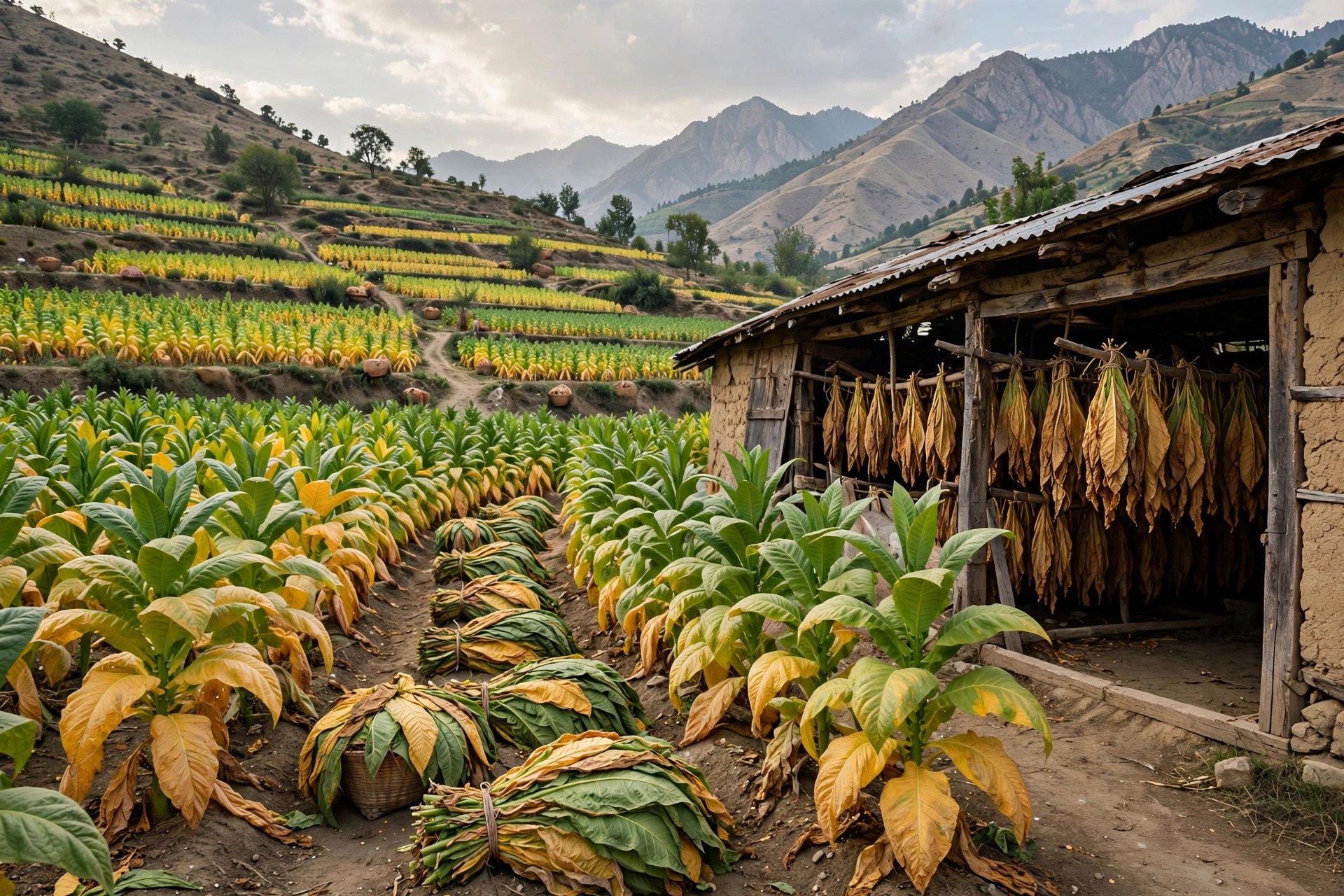
Behind the cigarette factories stands an agricultural supply chain that PTC itself helped create. Flue-cured Virginia tobacco — the bright leaf cured in barns that forms the backbone of the company's blends — was introduced to the region's farming with the company's encouragement in its early decades, and the crop became a mainstay of parts of Khyber Pakhtunkhwa, around Swabi, Mardan, Charsadda and Mansehra, with further buying in Punjab. The company contracts growers, supplies inputs and technical advice, and buys the cured crop through its leaf depots, grading it before it moves to threshing at Akora Khattak. Tobacco buying in Pakistan operates under a statutory framework: the tobacco board sets minimum prices and indicative grades, and the large manufacturers are required to take up their declared quotas of the crop — a system that periodically produces friction when a harvest exceeds what the formal industry declared it would buy, leaving growers, the board and the companies in public dispute over surplus leaf.
For tens of thousands of farming households, this makes PTC an agricultural buyer as much as a manufacturer: its demand underwrites a cash crop in districts with few alternatives of comparable value per acre, which is one reason tobacco policy in Pakistan is argued simultaneously in the languages of health, revenue and rural livelihoods. The company's leaf operation also carries a working-capital rhythm outsiders sometimes miss — the crop is bought in a season and paid for in cash, then manufactured and sold across the following year — and an export dimension, since processed Pakistani leaf and finished cigarettes both leave for foreign markets under the post-2019 export push.
Ownership, dividends and the formal-sector argument
PTC's share register is dominated by its parent: British American Tobacco holds the controlling majority, with the remaining shares held by institutions and the public on the PSX. That structure has two practical consequences. Strategically, product and category decisions — the launch of Velo in 2019, the development of the Jhelum pouch plant, participation in BAT's global portfolio shifts — are group decisions taken with Lahore and Islamabad input but within a multinational's framework. Financially, the company has historically distributed a large share of its earnings as dividends, so its cash generation flows substantially to the parent — a pattern common to Pakistan's multinational subsidiaries, and one reason such stocks are followed closely by income-oriented local investors when payouts are declared.
The company's public argument, maintained consistently across decades and governments, is the formal-sector case: that cigarettes will be consumed in Pakistan regardless, and the policy question is whether they are consumed from taxed, regulated, track-and-traced production or from the illicit trade — smuggled brands, counterfeit packs and unregistered local manufacture — which pays no excise, carries no compliant warnings and undercuts legal prices. Health authorities and anti-tobacco campaigners counter that affordability itself drives consumption, and that excise should rise toward international benchmarks regardless. Both positions are on the public record, in budget submissions, parliamentary debates and the company's annual reports; a reader of PAKT does not need to settle the argument, but does need to know it exists, because excise schedules — and therefore the company's single largest cost line — are where the argument lands each June.
What investors typically watch
Followers of PAKT usually focus on: excise policy in each federal budget and any move toward a single-tier duty structure; formal-market volumes and evidence about the illicit market's size; leaf crop conditions and buying prices in Khyber Pakhtunkhwa; the growth and regulation of the nicotine-pouch category; and export volumes from the Jhelum and Akora Khattak plants. Dividend policy also draws attention, as BAT subsidiaries have historically returned a large share of earnings to shareholders, though payouts always depend on board decisions and cash needs. These are observation points, not recommendations — this article is educational content, not financial advice. Readers new to the market can start with the Aktzien learning library, which explains how listed companies, dividends and index membership work in plain language.
Key takeaway: Pakistan Tobacco Company has made and sold cigarettes in Pakistan since 1947 as BAT's local arm — a business whose fortunes are shaped as much by excise budgets, health regulation and the illicit trade as by its factories at Akora Khattak and Jhelum.