KARACHI: Every building you have ever entered is held up by steel you cannot see — bars buried in concrete columns, beams over doorways, pipes in the walls. Pakistan's listed steel companies melt, roll and coat that steel, and on the Pakistan Stock Exchange they form a sector that is small in number but outsized in what it reveals about the economy. Steel demand is construction demand in its purest form, steel costs are a world tour of commodity markets — scrap ships from abroad, energy from the grid and gas network, electrodes and alloys from global suppliers — and steel prices are set in a fiercely competitive market where a rival's discount travels faster than any advertisement. This guide explains how steelmakers on the PSX actually earn money, from the scrap yard to the rolling mill, why the construction cycle hits them so hard, how energy costs can matter as much as the price of scrap, and how to read their results alongside their close cousin, the cement sector, with which they share customers, cycles and headaches.
The long and flat of it: two families of products
Steel products divide into two families, and listed Pakistani companies tend to specialise. Long products are the steel of construction: reinforcement bars (rebar or sarya), billets (the semi-finished blocks from which bars are rolled), sections and wire rod. Their buyers are builders, contractors and the retail market of small constructors and house-builders who purchase through dealers. Demand is driven by housing, infrastructure and commercial building — the same engines that drive cement — and it is seasonal and credit-sensitive, slowing in extreme heat, in Ramadan-period working patterns in some years, during monsoons, and whenever interest rates squeeze construction finance.
Flat products are the steel of manufacturing: cold-rolled coil, galvanised and colour-coated sheets used in appliances, vehicles, drums, roofing and fabrication. Flat steel in Pakistan is made from imported hot-rolled coil, processed locally through rolling, annealing, galvanising and coating lines. Its customers are industrial — fan, appliance and auto manufacturers, pipe makers and construction-product firms — and its pricing is tied to international coil prices plus processing margins. Pipe makers, a related listed group, turn coil into the tubes used in construction, furniture, fencing and, at the heavy end, large-diameter line pipe for energy and water projects, where orders are lumpy and tender-driven. A company's family decides its cycle: long products ride the building cycle directly; flat products ride manufacturing and consumer durables; pipe makers ride a mixture of both plus public-project tenders. Identifying which family — and which customers — a company serves is the same first discipline as identifying which wheels an auto maker sells.
From scrap to sarya: where the margin lives
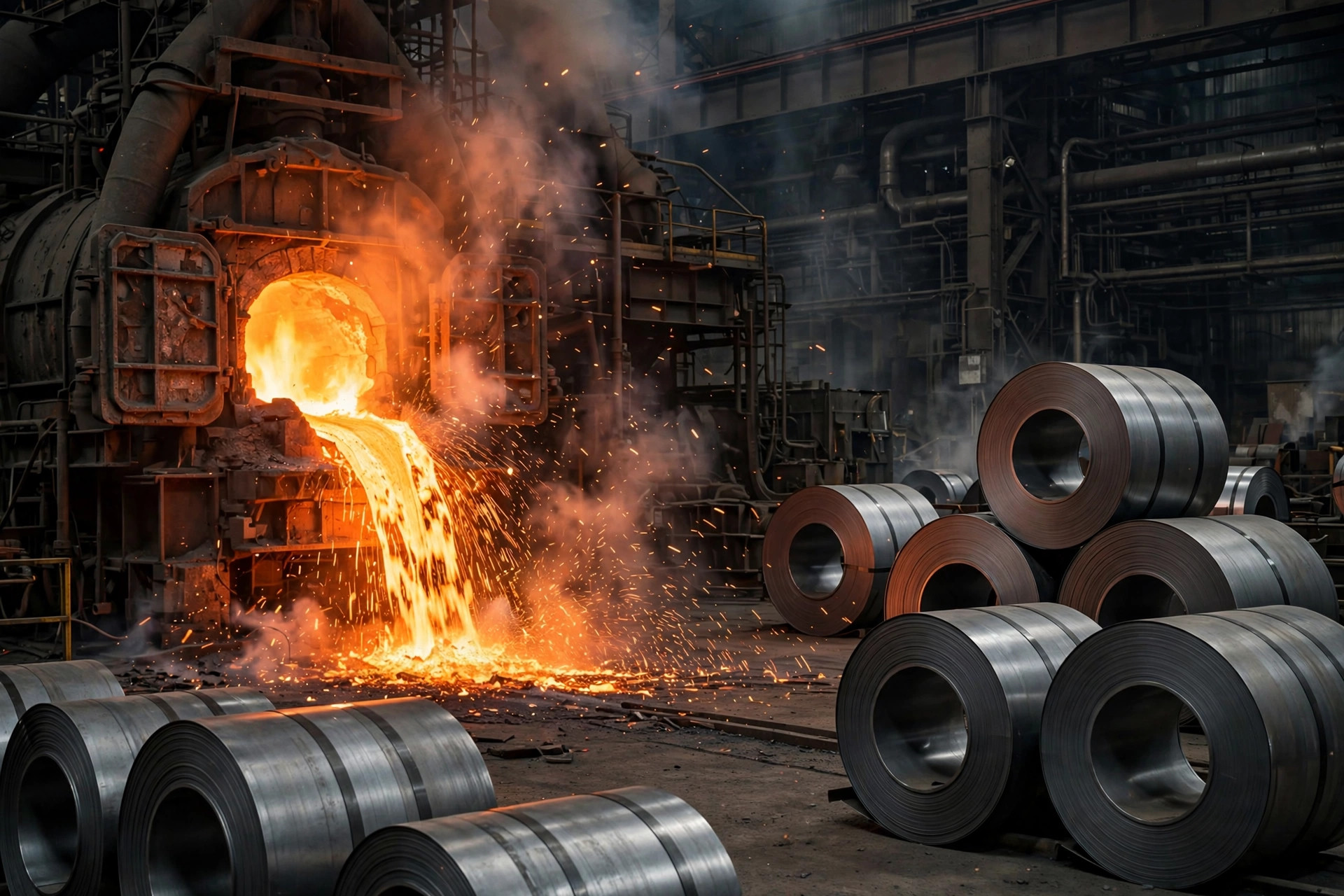
Most Pakistani long-steel production begins with scrap. Melting shops buy local and imported shredded scrap, melt it in electric furnaces — induction furnaces at smaller scale, electric arc furnaces at larger — and cast billets. Rolling mills reheat billets and roll them into bars. The profit of the whole chain lives in a spread: the selling price of rebar minus the cost of scrap, the large quantity of electricity consumed in melting, ferro-alloys, electrodes, rolling costs and freight. Each element moves on its own market. Imported scrap is priced in dollars off international benchmarks and arrives through Karachi's ports; when the rupee weakens or global scrap tightens, billet costs climb within weeks. Local scrap — from ship-breaking at Gadani, industrial offcuts and collected metal — supplements imports at prices that follow the same gravity.
Because rebar is a commodity sold by many producers to well-informed dealers, no single maker sets the price; the market does, city by city, sometimes day by day. Margins therefore expand when construction demand is strong enough for makers to pass cost increases through promptly, and compress brutally when demand is weak and mills chase volume to keep furnaces fed — a furnace, like a cement kiln, is a costly thing to run half-empty, and the fixed costs of melting capacity press managers toward production even at thin margins. Brand matters at the margin: builders pay small premiums for bars they trust to meet grade specifications, and leading producers invest in quality certification and dealer networks for exactly that reason. Export possibilities exist regionally but, for a bulky low-value product, freight confines most long steel to its home market, sharpening the domestic cycle's bite.
Energy: the second raw material
Melting scrap is one of the most electricity-intensive activities in industry, and rolling and reheating add gas or furnace-oil demand. Energy is therefore not an overhead in this sector; it is a raw material rivalling scrap itself. The tariff a mill pays for electricity — and whether gas is available at workable prices for reheating furnaces — can decide competitiveness as surely as scrap buying does. Industrial energy tariffs in Pakistan change through official determinations, and periods of sharp tariff increases have historically squeezed melters hard, particularly when they coincided with weak construction demand that blocked pass-through. Larger producers have responded with efficiency investments, better furnace technology and, in some cases, captive generation; smaller induction-based melters, numerous in the unlisted economy, compete with lower overheads but face the same power bills.
This energy exposure links steel to national energy policy in a way investors should track through primary sources: tariff notifications, gas-allocation decisions in winter, and the treatment of industrial consumers all move sector costs. It also explains a recurring feature of steel results — margins that swing between quarters without any change in the company's commercial skill, purely because a tariff or a scrap cargo landed differently. An illustrative example, with invented figures: if melting and rolling a tonne of rebar consumes energy costing, say, Rs 25,000 within a total conversion-and-material cost of Rs 200,000 per tonne, a 20 per cent rise in energy prices adds roughly Rs 5,000 per tonne of cost. On thin commodity margins, that increment can be the entire profit — or the entire loss. The arithmetic is why steel analysts watch the energy pages of the newspaper as closely as the property pages.
The construction cycle, amplified
Steel inherits every driver of construction demand — private housing, developer activity, public development spending, interest rates — and adds amplification of its own. The dealer chain stocks and destocks: when prices are expected to rise, dealers and builders buy ahead, flattering mills' dispatches; when prices are expected to fall, the chain lives off inventory and orders dry up even if final construction continues. This bullwhip means mills' monthly volumes exaggerate the underlying building cycle in both directions. Public projects matter disproportionately to some producers: dams, motorways and energy projects consume steel in large, specified lots, and progress payments and project timelines in the public sector transmit fiscal stress directly to suppliers.
Raw-material inventory plays the same role here as cotton inventory does for textile mills. A melter holding scrap bought cheaply reports comfortable margins as prices rise; one holding expensive scrap into a price fall faces write-downs and a squeezed spread simultaneously. The balance sheet tells on both: inventory days and short-term borrowing — mills finance scrap cargoes with working-capital lines — rise and fall with the bet the company has implicitly placed on prices. None of this is necessarily recklessness; holding raw material is how a mill guarantees production. But investors should size the bet: inventory measured against monthly sales, and the finance cost of carrying it at current policy rates, are printed in the accounts for anyone who looks.
Competition, the informal fringe and regulation
Listed steelmakers compete not only with each other but with a large fringe of smaller, less formal producers whose cost structures — on taxes, standards and compliance — differ from those of documented, listed companies. The formal sector has long argued for a level playing field on documentation and product standards, and the broader national debate about undocumented economic activity directly touches this industry's pricing: steel is heavy, traceable in principle, and central to construction invoicing, so measures that document the chain change competitive dynamics. Product standards are a safety issue as much as a commercial one — earthquake-resistant construction depends on bars meeting their specified grade — and enforcement of standards is both a public good and, for quality producers, a commercial tailwind.
Duties and trade policy form the outer wall. Import duties and regulatory duties on finished steel and on raw materials, set through budgets and trade measures, determine how exposed local mills are to imported bars and coils at any moment; changes in those walls — check current official notifications for the position at any time — can redraw margins faster than any factory improvement. Flat-steel makers in particular watch the tariff structure between their imported coil input and finished imports: the spread between the two is, in effect, their protected processing margin.
Reading steel results
A practical read: begin with volumes and capacity utilisation where disclosed; then the rebar-or-coil spread story told by gross margin, interpreted against scrap and international coil prices in the period; then energy cost commentary; then inventory and borrowing; then any one-off gains such as inventory windfalls, which should be identified and mentally separated from the underlying spread. Compare across a cycle, not across quarters — a melter judged only on a boom quarter will always disappoint later, and one judged only on a slump quarter may be discarded at exactly the moment its cost discipline was proven. Dividend behaviour in the sector tends to follow the cycle honestly: generous in fat years, absent in lean ones, because the cash is genuinely not there in lean ones.
The risks are concentrated and knowable: construction downturns, energy-tariff shocks, currency-driven scrap inflation, trade-policy changes, and the working-capital strain of a commodity business at high interest rates. This article is educational content, not financial advice. Steel teaches the same lesson as cement, in a louder voice: in commodity processing, you do not control your selling price or your main costs — you control efficiency, purchasing and your balance sheet, and over a full cycle, that is enough to separate the survivors from the rest.
Pakistan Steel's shadow and the import question
No account of Pakistani steel is complete without the long shadow of the public sector. The country's large integrated steel plant in Karachi, built with Soviet assistance and operated for decades by Pakistan Steel Mills, has been largely idle in recent years amid a long, unresolved privatisation and revival debate — a standing reminder that domestic primary steelmaking at scale has never matched the country's demand, and that the listed private sector grew up in the space it left: melting scrap and imported semi-finished material rather than smelting ore. That history explains the industry's structure today — strong in rolling and scrap-based melting, dependent on imports for flat products' raw coil and for a share of billets and scrap, and periodically debating whether a revived integrated plant would complement or crowd the private mills. For investors, the practical implications are in the present tense: import dependence means the currency and global prices sit permanently inside local steel costs, and any change in the trade or industrial policy governing the old plant, or in duties on imported steel, is sector news to verify in official sources. It also explains why scrap — its collection, grading and import — is strategic infrastructure for this industry, and why ship-breaking at Gadani, which supplies both scrap and re-rollable material, appears so often in steel-market commentary despite its own environmental and safety debates.
One final habit is worth building specifically for steel: keep a small personal dashboard of the four numbers that lead the sector — monthly construction-linked dispatches where reported, the direction of international scrap prices, the latest industrial electricity tariff decisions, and the State Bank's policy rate. None of these requires a subscription or a terminal; all are published or reported openly. When the four point the same way, the sector's next results are rarely a mystery. When they conflict — strong demand but a tariff shock, cheap scrap but expensive money — the results will be mixed in exactly the proportions the dashboard suggested, and you will have understood the quarter before the headlines explain it to you.
Key takeaway: steel profits live in a spread — rebar and coil prices minus scrap and energy — amplified by the construction cycle and dealer stocking; judge mills on cost discipline, inventory judgement and balance-sheet strength across the whole cycle.