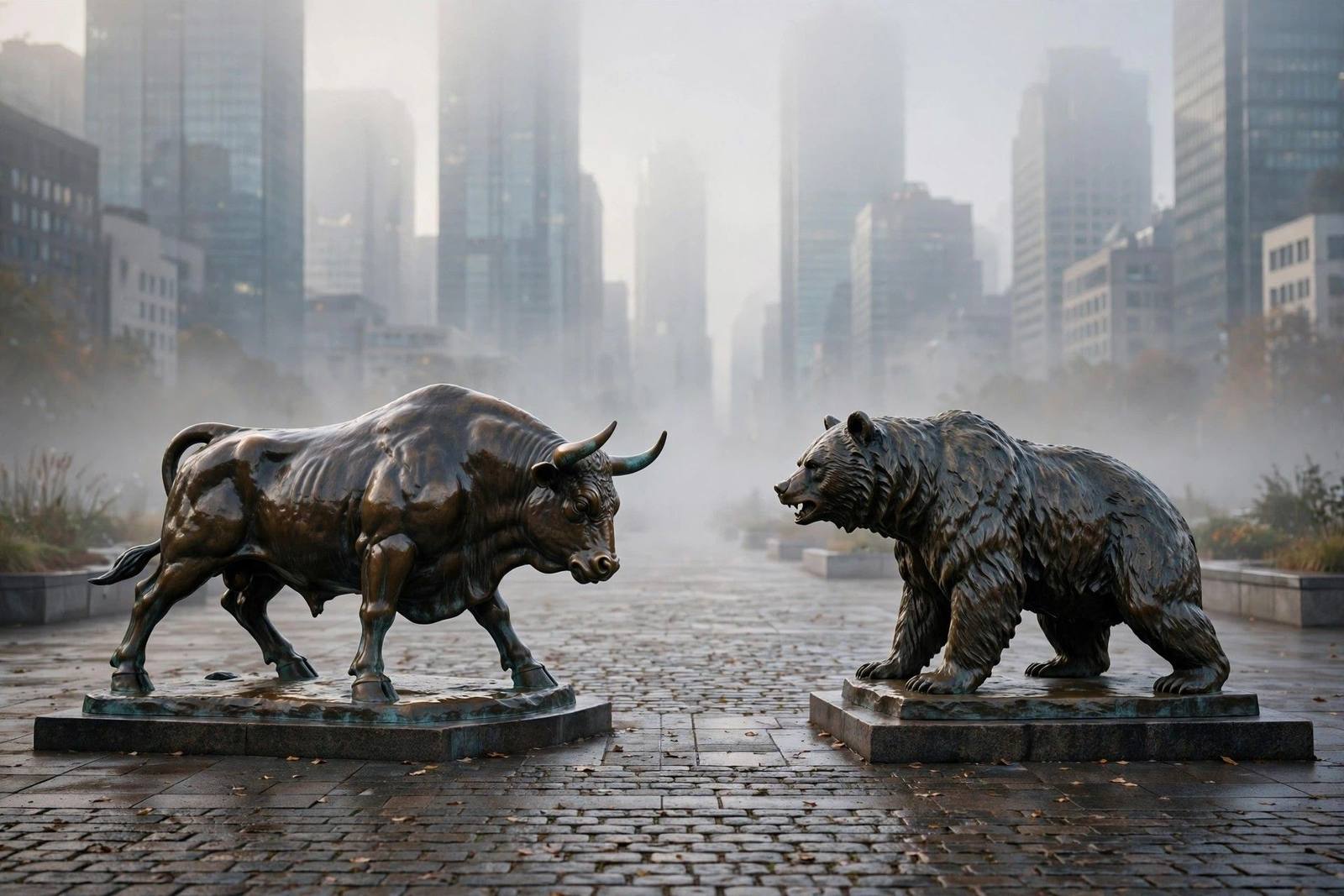
KARACHI: Financial language is a zoo. Markets are led by bulls, ambushed by bears, and populated by stags, pigs, wolves and the occasional dead cat that bounces. Of all these creatures, the bull and the bear matter — not because the metaphors are profound, but because the conditions they name genuinely change what an investor should expect, fear and do. A bull market rewards behaviour that a bear market punishes, and the most expensive mistake in investing is applying the playbook of one regime inside the other: borrowing to chase rising prices just before they fall, or hiding in cash through a recovery because the last decline still hurts. Yet for all their importance, the terms are used loosely — any good week is called a bull, any bad month a bear — and the looseness costs money. This guide pins down what bull and bear markets actually mean, how they are conventionally measured, how they have felt on the Pakistan Stock Exchange across its modern history, what drives them, and how an ordinary investor can respond to each without pretending to predict either.
The definitions, and the percentages behind them
The folklore first: a bull is said to attack by thrusting its horns upward, a bear by swiping its paws downward, and the images stuck. The working definitions used by market commentators are numerical. A bull market is a sustained rise in a broad index — conventionally twenty per cent or more from a recent low — accompanied, in the fuller sense, by improving breadth, earnings and confidence. A bear market is the mirror: a decline of twenty per cent or more from a recent high, sustained rather than momentary. Two smaller categories live inside the taxonomy. A correction is a fall of roughly ten to twenty per cent — painful, common, and usually part of healthy markets. A crash is a fall that is defined less by size than by speed and panic: a very large decline compressed into days or weeks, with forced selling and broken liquidity. Our history of crashes on the PSX and their lessons covers that extreme in the detail it deserves.
Notice what these definitions cannot do: they are only knowable in retrospect. An index down nineteen per cent may be a correction ending tomorrow or a bear market pausing for breath; the twentieth point of decline is crossed at a moment nobody rings a bell for. This is not a pedantic complaint — it is the central practical fact about regimes. You will never receive confirmation that a bear market has begun in time to sell at the top, or that a bull market has begun in time to buy at the bottom. Strategies that require such confirmation fail at exactly the moment they are needed. What the definitions are good for is calibration after the fact: understanding which environment you have been living through, and therefore which of your recent results were skill and which were weather.
What bull markets feel like from inside
A bull market is not simply rising prices; it is a social condition. Early in a bull market — the phase veterans call the most hated rally — prices rise on scepticism, every advance is predicted to fail, and the investors who benefit are those re-entering after a bear phase that taught everyone else to stay away. The middle phase is the pleasant one: earnings grow into valuations, participation widens from a few large stocks to the broader list — the phenomenon technicians call breadth — and ordinary savers begin to arrive. The late phase has a unmistakable atmosphere that Pakistani investors who lived through past PSX manias will recognise: new accounts opening in waves, tips replacing analysis, obscure illiquid shares doubling on rumours, margin money everywhere, and a consensus that caution is a character flaw. The KSE-100's own construction shapes how this reads locally — as our explainer on how the index is calculated shows, a heavy index can look serene while speculation rages underneath it.
Bull markets end for reasons that are usually visible only later: valuations stretching past what earnings can support, interest rates rising until the risk-free alternative competes — a mechanism our guide to the State Bank's policy rate explains from the monetary side — or an external shock hitting an economy with Pakistan's familiar vulnerabilities: thin reserves, an IMF programme in negotiation, a currency under pressure. What they rarely end from is the calendar. Bulls do not die of old age; they die of excess and tightening. The investor's corresponding discipline is to let rising markets improve the portfolio rather than the ego: rebalance toward target weights, refuse leverage creep, and keep the quality bar for new purchases rising with prices, not falling with the excitement.
What bear markets feel like, and why they hurt more
Bear markets have a texture of their own, and it is worth describing honestly because the emotional experience, not the arithmetic, is what breaks investors. Declines rarely proceed in straight lines; they alternate with violent rallies — bear-market rallies of ten or fifteen per cent that recruit hopeful buyers and then fail — so that the experience is not steady pain but repeated hope and disappointment. Good news is ignored or reinterpreted as bad; earnings that would have been celebrated a year earlier are sold. Liquidity thins precisely when everyone wants it, smaller stocks gap down on trivial volume, and in Pakistan's market the lower circuit limits can lock a seller into a falling share for days — a mechanical feature of the local market that turns paper losses into a feeling of imprisonment. The financial media, retail sentiment and dinner-party conversation all turn funereal at roughly the moment prospective returns have quietly become the best in years.
The asymmetry of loss explains the damage. A fifty per cent fall requires a hundred per cent rise to undo, which is why capital preservation in deep bears matters more than brilliance in bulls. But the deeper asymmetry is behavioural: bull markets make money for almost everyone who participates, while bear markets transfer money from those who sell in despair to those with cash, patience and a list prepared in advance. The bear's gift — and it is real — is that quality companies periodically trade at prices that assume their futures have been cancelled when they have merely been postponed. Defensive stocks exist for this weather: businesses whose earnings bend rather than break. And the bear's trap is symmetric: shares that look statistically cheap because their businesses are genuinely impaired, the value traps that fall eighty per cent and then halve again.
What actually drives the cycle in Pakistan
Regimes are not weather systems; they have causes, and in Pakistan the causes form a recurring cast. Interest rates lead: sustained cuts in the policy rate lower the return on the deposits and government paper that compete with equities, push money toward the stock market and re-rate every share's valuation upward; sustained hikes reverse the flow with interest. The external account follows: a stable or strengthening rupee, rebuilding reserves and a performing IMF programme invite the foreign and institutional buying that deepens a bull phase, while a reserves scare can drain confidence regardless of how cheap shares have become. Corporate earnings translate the macro into the micro — banking profits on rate cycles, cement and autos on demand and construction, textiles on the exchange rate and export orders — and political stability, or its absence, prices itself into the risk premium investors demand for holding Pakistani assets at all.
Understanding the drivers matters because it replaces superstition with a checklist. An investor who knows that local bull markets are usually midwifed by falling rates and external calm will watch the State Bank's calendar and the reserves data with more profit than the tip channels — and will understand, when rates are being raised into a weakening currency, why the market's falls are not a conspiracy but a repricing. None of this delivers timing. The drivers turn slowly, overlap and contradict each other for months at transitions, which is precisely why the professional response to regimes is positioning — how much equity risk, of what quality, with how much liquidity — rather than prediction.
Living with both animals: a regime-proof routine
The practical synthesis is a set of behaviours that do not require knowing which regime you are in. Keep an emergency fund outside the market so that a bear phase never forces a sale — the sequence in building the fund before investing exists for exactly this. Invest on a schedule, in amounts you can sustain through a fifty per cent decline without changing the plan; rupee-cost averaging, covered in our explainer, is less a return strategy than a regime-survival strategy. Prepare, during calm markets, a written list of companies you would buy at lower prices and the prices that would tempt you, because in a live bear market the list cannot be written — the emotions that prevent writing it are the bear's main weapon. Rebalance annually rather than trading regimes tactically. And measure yourself honestly: returns earned in a roaring bull market are partly the market's gift, and treating them as proof of genius is how investors arrive at the next bear leveraged, concentrated and certain.
One more distinction for the vocabulary: within every regime, individual stocks live their own cycles. A market-wide bear can contain a company doubling on a contract win; a roaring bull leaves behind companies whose businesses are rotting. Regime awareness should set your overall exposure and your emotional expectations — it should never replace examining the business in front of you, which remains, in all weathers, the actual investment. The animals describe the climate, not the crop.
Secular years and cyclical waves: the long view from Karachi
Step back further and a second rhythm appears beneath the bull-bear alternation. Within long stretches — Pakistan's market has known multi-year periods of stagnation in dollar terms even while rupee prices ground upward — the index can deliver years of advance that inflation and depreciation quietly reclaim. This is why judging a regime by the index alone deceives: a bull market measured in rupees during rapid currency decline may be a bear market wearing a costume for anyone whose future spending is priced in dollars, imports or foreign education. Our explainer on real versus nominal returns supplies the adjustment every regime judgement needs. The honest question is never only "is this a bull market?" but "a bull market in what, for whom, after what costs?" — and the investors who ask it are markedly harder to stampede in either direction.
There is a corresponding long-view comfort, and it is earned rather than sentimental. Every Pakistani bear market in the exchange's modern history — through crises of reserves, politics, security and global finance — has eventually been followed by recovery in the prices of businesses that survived with their earning power intact, while the permanent losses concentrated exactly where this guide would predict: leveraged positions liquidated at lows, speculative names whose stories were the bull market's invention, and investors forced to sell by needs outside the market. The regime cycle is survivable. What is not survivable is the combination of leverage, low quality and no cash reserve — in any regime, but lethally in the wrong one.
This article is educational content, not financial advice. Bull and bear markets will both visit every long investing life, probably several times, and the order is not yours to choose. What is yours is the preparation: the cash buffer that prevents forced selling, the quality standard that rises with prices, the list written in calm times for use in frightening ones, and the humility to call a rising market a rising market without mistaking it for your own brilliance. Investors are rarely ruined by bears; they are ruined by meeting a bear dressed as the bull they had arranged their finances around.
Key takeaway: a twenty per cent rise or fall defines the animals on paper, but you will only ever know the regime in hindsight — so build a routine that survives both: cash reserves, scheduled investing, a pre-written buying list, and quality standards that tighten as prices rise.