KARACHI: Few investments stir the Pakistani imagination like agricultural land. The city family that buys a farm an hour from the motorway is buying several things at once — a hedge against inflation in the oldest asset of all, a weekend of mango trees and tube-well water, a bride-price of status among relatives, and, in the daydream version, an income from crops that someone else will grow. Sometimes the maths even works. More often, the honest return on farmland comes from exactly one source the brochure did not emphasise — the city expanding toward the land — while the farming itself, run at arm's length by tenants and managers, yields roughly what a savings account would, with considerably more theatre. None of this makes farmland a bad asset; it makes it a misunderstood one, because the buyer is really purchasing three different businesses in one deed: a rental property whose tenant is a farmer, a farming operation whose manager must be supervised, and a long option on urban growth. This guide separates those three businesses, explains how farmland in Pakistan is owned, recorded, leased and taxed, and sets out the checks — title, water, possession, access — that decide whether the romance survives contact with the revenue record.
What the land record actually says
Every farmland purchase begins in the record of rights, the provincial revenue record that names the owners of each parcel — identified by its khasra numbers within a village's boundaries — and records mortgages, tenants and transfers through the process called mutation. The buyer's working documents are the fard, the extract of ownership issued from that record, and the registered sale deed executed before the sub-registrar; the patwari, the hereditary-village-accountant figure of the old system, remains a person to understand even where digitisation has advanced. Punjab's Land Records Authority has put much of the rural record online through its land-record management system and service centres, letting a buyer pull a fard and verify a seller from a desk in Lahore — a genuine revolution in a system where the paper register was power. Sindh, Khyber Pakhtunkhwa and Balochistan run their own record systems at varying stages of digitisation, and peri-urban land everywhere sits in the danger zone where revenue records, housing-society claims and old allotments overlap.
The trap list is agricultural-specific. Land can be owned jointly by a dozen heirs under inheritance shares never formally partitioned, so the smiling seller owns a fraction he cannot separately deliver. Government and evacuee-era allotments carry conditions and histories a lay buyer will not spot. Land recorded as agricultural may be entangled in watercourse rights, rights of way, or tenants whose occupancy has matured into legal protection. And possession — the simple question of who is physically on the land and considers it theirs — can diverge from the paper record in ways that take years of litigation to reconcile. The professional sequence exists for a reason: verify the fard and mutation history, engage a revenue-competent lawyer, walk the land with the neighbours present, and treat any resistance to verification as the answer itself. Our guide to plot files covers the parallel paper risks of urban schemes; farmland's version is older, slower and no more forgiving.
The two ways farmland pays rent
A farming owner who does not farm has two classical arrangements to choose from. Under batai, sharecropping, the tenant — the hari in Sindh's vocabulary — supplies labour and part of the inputs, the owner supplies land, water access and the rest, and the harvest is divided in agreed shares that vary by crop, region and who pays for seed, fertiliser and the tube well's diesel or electricity. Sharecropping aligns incentives imperfectly but shares risk both ways: a failed crop hurts both parties, and the owner must still monitor what was actually harvested from his fields. Under a cash lease — theka — the tenant pays a fixed rent per acre for a season or a year and keeps the entire crop, which transfers production risk to the tenant and gives the owner a clean, knowable income, at the price of watching the tenant mine the soil's fertility and water for short-term gain unless the lease polices it.
The third mode is self-cultivation through a manager or contractor — the city owner's favourite in theory and hardest in practice, because agriculture punishes absentee management daily: water turns missed, fertiliser diverted, harvests understated. Tenancy law overlays all three modes: provincial tenancy legislation descended from the mid-twentieth-century reforms protects sitting tenants in defined ways, regulates eviction and in places rent, and gives the relationship a legal memory longer than any handshake. Whoever buys tenanted land buys the tenancy with it, which is why the fard's tenancy entries and a frank conversation with the sitting cultivator are not formalities but the core of the valuation.
The maths the brochure skips
Run farmland honestly as a rental asset and the yield is usually modest. Productive canal-irrigated land in the settled districts commands prices that capitalise its crop income at levels leaving a rental return comparable to — and often below — what bank deposits or government securities pay in the same season, before counting supervision costs, land revenue and agricultural income tax obligations, and the owner's share of water and maintenance expenses. The economics improve in specific situations: underpriced land with reliable water in districts where rents are rising with high-value crops — vegetables, orchards, fodder for the dairy economy — or land whose farming income is merely the coupon while the real thesis is development. Orchards deserve their own caution: a mango or citrus orchard is a factory with a multi-year construction period, paying nothing until the trees mature and demanding skilled care throughout, which is why orchard economics belong to those who will genuinely run them.
The development option is the return most buyers are actually chasing. Land on the path of a city's growth — along a new motorway interchange, beside an expanding housing authority, in the path of a ring road — can convert from agricultural value to urban value at a multiple that dwarfs decades of rent. It is also a speculation with specific failure modes: the road moves, the scheme stalls, the zoning or the authority's acquisition plans change, and the land remains farmland priced like a future suburb, earning farm income on a city price. Our guide to urbanisation and Pakistan's housing economy explains the growth machine that creates these conversions, and our farm-economy guide, Pakistan's farm economy explained, gives the agricultural baseline any conversion thesis should be compared against. The disciplined formulation used by old land families is worth copying: buy at a price the farming can justify, and treat the city as a free option — never pay the option's hoped-for value in advance.
Water: the asset inside the asset
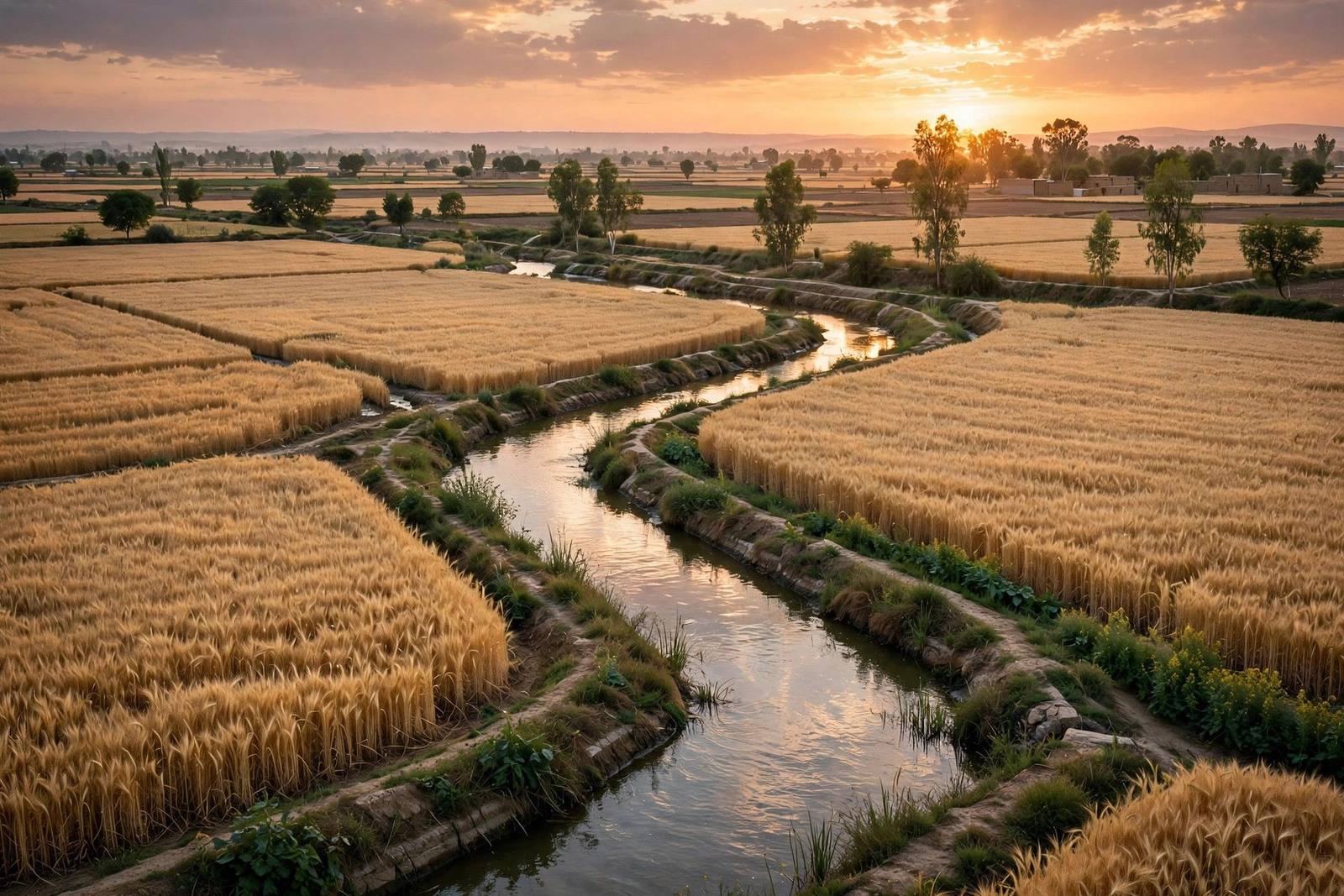
In Pakistani agriculture, land without water is a certificate, not a farm. The buyer's due diligence must therefore value the water as carefully as the soil: the parcel's place in the canal system's warabandi rotation — the scheduled turns of water through the watercourse — the reliability of that supply in recent seasons, the condition and sharing of the watercourse itself, and the groundwater beneath: its depth, its quality (much of the groundwater in the southern districts runs brackish), and the cost of lifting it by tube well at current energy prices. Solar tube wells have changed the pumping arithmetic across the plains, cutting running costs while raising a collective problem the hydrologists warn about — unpriced groundwater invites over-extraction, and a falling water table is a slow tax on every neighbouring farm. Rivers, canals and aquifers also make farmland Pakistan's most climate-exposed asset: the 2022 floods stood in fields for months across Sindh, and any valuation that ignores flood history, drainage and the land's level relative to its watercourses is a fair-weather document.
Crops, orchards and the seasons of return
The income side of farmland is a calendar, and understanding it prevents the commonest buyer error — valuing every acre as if it were the best acre in its best year. The agricultural year turns on the kharif season sown with the summer — cotton, rice, sugarcane, maize — and the rabi season sown in autumn, dominated by wheat, with fodder, vegetables and oilseeds filling the margins. A tenant's rent offer already prices that calendar: land that can carry a high-value kharif crop and a full rabi crop, with water in both seasons, is a different asset from land that yields one uncertain crop a year, and per-acre prices a district apart can differ several-fold for exactly this reason. Sugarcane deserves its local reputation as the lazy landlord's crop and the soil's stern test — long in the ground, thirsty, paid for through the mill economy with its own payment delays — while fodder and dairy-linked cropping near cities has quietly become some of the most dependable farm income in the peri-urban belt, because a city's milk demand does not crash the way a commodity price can.
Risk rides the same calendar. A single failed season — a canal closure at the critical watering, a pest year in cotton, a heat spike at wheat's grain-filling — can erase the year's entire margin, which is why rents are bargained hard and why owners who share risk through batai sometimes out-earn fixed-rent owners across a full cycle, at the cost of constant involvement. Crop insurance in Pakistan remains thin and largely pilot-scale despite repeated official interest, so the traditional insurance is diversification the owner must build personally: more than one tenant, more than one crop, and reserves held back from the good years. The investor who cannot describe the last three seasons on the specific land being bought does not yet know what they are buying.
Finally, the paperwork of a well-kept farm is itself an asset. Mutation entries completed on every inheritance, tenancy terms written rather than remembered, water turns documented, agricultural income tax filings in order — the farm that can prove its history sells at a premium to the identical farm that cannot, because the buyer is purchasing freedom from the seller's disputes. Owners who treat the revenue record as part of the crop, harvested annually like any other, quietly earn the best return in this entire guide: the clean-exit premium.
Ceilings, reforms and the corporate-farming question
Pakistani farmland carries a political history that still shapes its law. The land reforms of 1959, 1972 and 1977 imposed ceilings on individual holdings and resumed surplus land for distribution — each round litigated for decades, the later reforms substantially undone by court judgments on Islamic grounds around 1990 — and the episode left both the fragmented ownership map of today and a permanent political sensitivity around large holdings. In recent years the sensitivity has returned in a new form: proposals for corporate and mechanised farming on large tracts, including military-associated green-initiative projects bringing underused state land under cultivation with modern irrigation, have revived the national argument about who should farm Pakistan — smallholders with support, or corporations with capital. For the investor the practical translation is simple: very large acquisitions carry political and legal weather that small ones do not, and the tenancy and ceiling history of a specific tract belongs in the lawyer's brief from day one.
Farmland, held patiently and bought at farming value, has preserved Pakistani family wealth through every currency crisis of the republic's life — that much of the romance is true. It has done so illiquidly, management-hungrily and with returns that arrive as a city's headlights approach rather than as a monthly cheque. Buy it as a farmer-landlord and the asset behaves; buy it as a lottery ticket on a road that may never come, and price it as one. This article is educational content, not financial advice.
Key takeaway: Farmland pays honestly through rent and crops — usually modestly — and spectacularly only when cities grow toward it, so verify title, tenancy and water first, and buy at a price the farming alone can justify.