KARACHI: For a certain kind of Pakistani family, the milestones are counted in Hondas: a first City bought in the late 1990s, a Civic upgraded to in the 2000s, children who learned to drive on the same ageing sedan. Honda Atlas Cars (Pakistan) Limited — HCAR on the Pakistan Stock Exchange — is the company behind that lineage. It is a joint venture between Honda Motor Company of Japan and Pakistan's Atlas Group, and since its first car rolled off the line in May 1994 it has been one of the three Japanese pillars of Pakistan's car industry. Its story, though, starts thirty years earlier and on two wheels: you cannot understand the car company without the motorcycle partnership that made Honda trust Atlas with its name in the first place.
Atlas first: the motorcycle marriage, 1962–1992
The Atlas Group was founded in 1962 by Yusuf H. Shirazi, who began with an investment company, Shirazi Investments, capitalised at half a million rupees with a staff of three, trading in shares and real estate. In 1963 Atlas entered a technical collaboration with Honda Motor for the production and sale of motorcycles in Pakistan — the beginning of one of the longest-running Honda partnerships anywhere outside Japan. That motorcycle venture grew, through mergers of its Karachi and Sheikhupura operations, into Atlas Honda Limited, the dominant maker of the two-wheelers that put Pakistan on the move and the subject of its own profile as Atlas Honda (ATLH). The car venture, when it came, was explicitly built on that record: at Honda Atlas Cars' twentieth-anniversary celebrations, Honda's leadership recalled that after thirty years of a successful motorcycle relationship with Shirazi, a new chapter was added — cars.
The group around the ventures widened meanwhile into batteries, insurance, financial services, power and trading, but engineering with Japanese partners remained its signature. For HCAR's future shareholders, the relevant point is structural: the car company was never a licence bought by strangers. It was an equity joint venture between a Japanese principal that contributed models, technology and quality systems, and a Pakistani group that contributed three decades of local manufacturing credibility, vendor relationships and distribution know-how.
1992–1994: a plant in eleven months
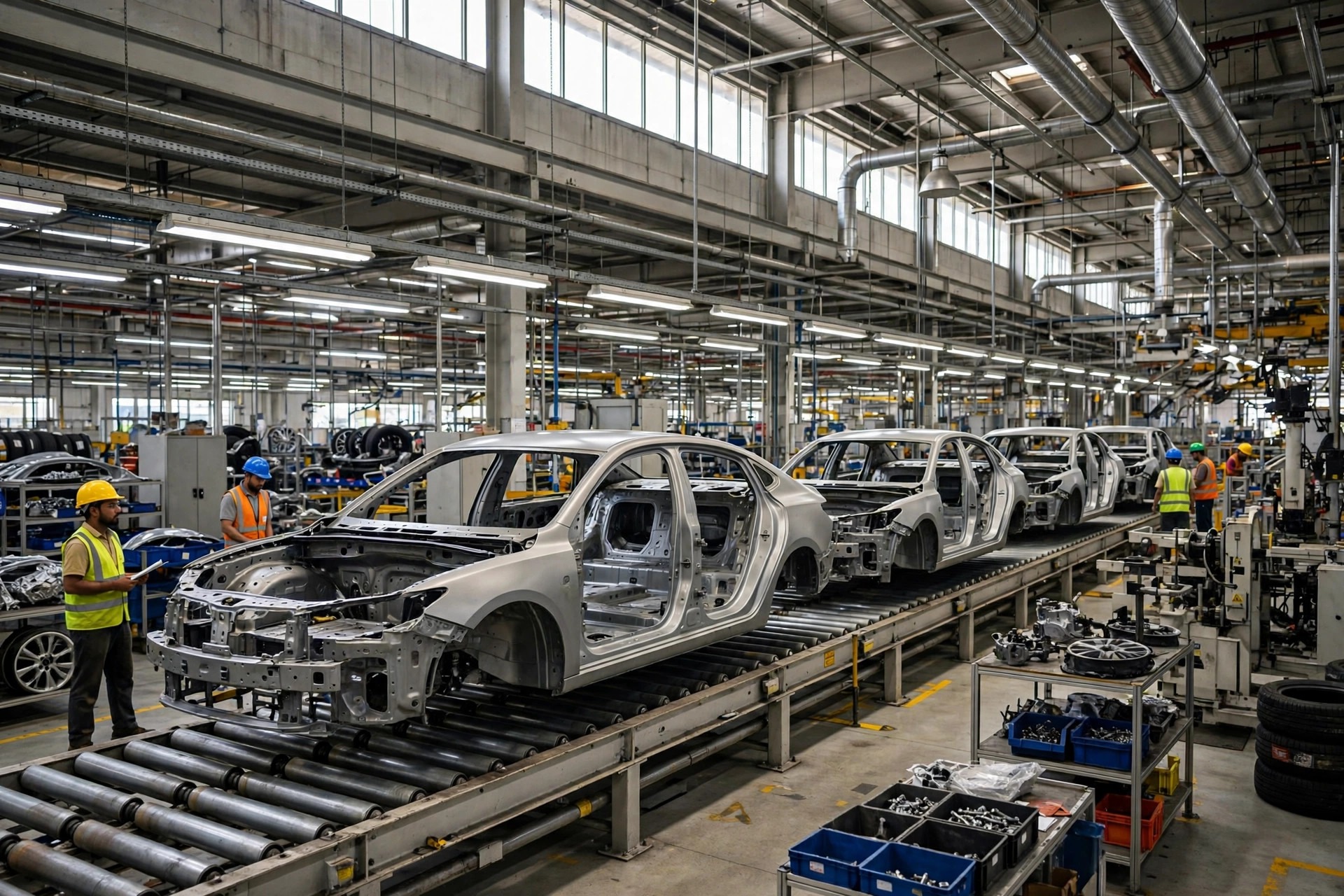
Honda Atlas Cars was incorporated on 4 November 1992, and the joint venture agreement between Honda Motor and the Atlas Group was signed on 5 August 1993. Construction moved at a pace the company still advertises: ground was broken in April 1993, and within roughly eleven months the plant near Lahore was built and its machinery erected. The first car rolled off the assembly line on 26 May 1994, and the official inauguration was performed by the then President of Pakistan, Sardar Farooq Ahmad Khan Leghari, with the president of Honda Motor in attendance. Bookings opened on 14 July 1994 through six dealerships in Karachi, Lahore and Islamabad, and in October 1994 the company was listed on the Karachi Stock Exchange — giving the public a share of the venture barely a year after the first car was built.
The car that carried the launch was the Civic, Honda's global compact sedan, and it defined the company's positioning from day one: Honda Atlas would sell technology and refinement — engines, handling, build quality — at a premium to the mass market, rather than chase the cheapest segment. The City, a smaller sedan, followed in the later 1990s and became the volume and family staple, while the Civic remained the aspirational flagship of the range. That two-sedan ladder, refreshed through successive global generations, structured the company's next three decades; crossovers and other models — the BR-V and HR-V sport-utility vehicles among them, and imported offerings such as the Accord and CR-V at different times — widened the showroom without changing its centre of gravity.
The City's arrival can be dated precisely: Honda Atlas added the smaller sedan to its production line-up in January 1997, completing the two-car structure within three years of the first Civic. The generations then rolled in step with Honda's global programme, Pakistani buyers learning to read the calendar the way Honda households elsewhere do — each new Civic or City generation an event in the classified-ad pages as much as in the showrooms, resetting used values down the chain. The eleventh-generation Civic reached Pakistan in March 2022, in the middle of the industry's most difficult supply period, which says something about the joint venture's standing in Honda's allocation of kits: even in a shortage, the flagship sedan's launch was not deferred out of the market.
The network, the vendors and the deletion era
A car company is also a network. From the original six dealerships, Honda Atlas built an authorised system of 3S outlets — sales, service and spare parts under one roof — supplemented by 2S service-and-parts points and parts-only shops, spread across Pakistan's major cities and built to Honda's global dealership standards. Behind the plant sits a second network: Pakistani parts vendors, nurtured under the government's localisation (historically, "deletion") policies, which required assemblers to source a rising share of each car locally. Honda Atlas describes a deliberate programme of patronising local vendors and auditing their output against international standards; the result, over decades, was a components industry — seats, glass, radiators, wiring, tyres, batteries (some from within the Atlas Group itself) — whose existence is one of the car industry's main claims on policymakers' protection.
The plant itself grew in steps behind that network. A major expansion completed in 2006 raised production capacity to 50,000 units a year on a double-shift basis — the scale at which the Manga Mandi site, on Multan Road outside Lahore, has broadly operated since, with output in any year determined less by the building than by the demand and kit-supply cycle described below. The cumulative tally tells the longevity story in a single line: the company marked its 400,000th locally produced car — a BR-V, fittingly one of the newer shapes — at a plant ceremony in 2018, with the City the largest contributor to the total and the Civic close behind, and company profiles since then describe cumulative production past the half-million mark. For a venture whose first year's Civic sales were counted in the low thousands, the milestones mark the distance travelled from a niche importer-substitute to a fixture of the middle-class street.
The shareholder structure mirrors the partnership: Honda Motor holds the majority stake (51 per cent), the Atlas Group a substantial minority (about 30 per cent), and the remainder is the public float traded on the PSX. Governance therefore has a particular shape — product and technology decisions are ultimately Honda's, local strategy is jointly owned, and minority shareholders ride on the alignment between a global principal that guards its brand jealously and a local partner whose entire reputation is bound up with Japanese joint ventures.
How Honda Atlas makes money
HCAR is a CKD assembler on the model explained in our guide to PSX automobile stocks, with a sedan maker's particular sensitivities. It imports knocked-down kits and major components from Honda's supply system, combines them with locally made parts, welds, paints and assembles at its Lahore plant, and sells through dealers at prices it announces — prices Pakistani buyers watch the way they watch the exchange rate, because the two are connected. The profit equation's moving parts:
- Volume — car demand in Pakistan is intensely cyclical, driven by income growth, car financing costs and confidence; in boom years waiting lists form and in slumps the whole industry's plants run part-time, while fixed costs continue.
- The yen, the dollar and the rupee — kit costs are foreign-currency costs; sustained rupee weakness forces the price increases that have repeatedly reset Pakistani car prices upward, testing demand each time.
- Model cycles — a new Civic or City generation reliably re-energises orders; ageing models must be defended with variants and packages until the successor arrives, so Honda's global launch calendar is a Pakistani commercial fact.
- Local content — every additional locally made part trims both cost and currency exposure, within the limits of what vendors can make to Honda standards.
- Parts and service — the large and ageing parc of Hondas on the road generates a steadier after-sales stream through the dealer network, supporting margins in years when new-car sales falter.
Policy frames all of it: import rules for used cars, which compete directly with local sedans; duties on kits versus parts; and the periodic auto-industry policies through which governments have tried to balance consumer prices against localisation. HCAR's premium positioning cuts both ways in that debate — its buyers are less price-fragile than entry-segment buyers, but its cars sit squarely in the range where imported used alternatives beckon when rules allow them.
Booms, slumps and the long game
No honest profile of a Pakistani car maker can skip the cycle, because the industry's graph looks like a mountain range. The 2000s brought a credit-fuelled boom in which bank leasing put sedans within middle-class reach and assemblers ran flat out. The global financial crisis and Pakistan's own balance-of-payments troubles cut volumes hard. A second great expansion ran through the mid-2010s as financing returned and ride-hailing demand arrived, pulling crossover and small-car investment into the country. Then came the pandemic's stop-start pattern — closed plants, then a demand surge — followed by the severe contraction of 2022–23, when foreign-exchange shortages and import restrictions on kits starved assembly lines across the industry and volumes fell to a fraction of their peak, before a gradual, still-incomplete recovery. Honda Atlas lived every one of those swings; its results in any given year say as much about where Pakistan stood in that cycle as about anything management did.
Surviving that graph for thirty years is itself the strategy's evidence. The joint venture's protections are the ones this profile has described: a principal with global depth, a local partner with other businesses to lean on, a dealer and parts network that earns when new cars do not sell, and an owner base whose loyalty shows up in resale prices — the second-hand market's verdict on a brand, quoted in every classified listing. The newer contest, against Korean and Chinese entrants with aggressive pricing and features, tests the premium formula more sharply than the old three-way Japanese rivalry ever did, and the crossover shift in Pakistani tastes — away from the sedan shape Honda Atlas was founded on — is the product question of the current decade. How the City and Civic lines, the HR-V and whatever follows them answer that question will write the next chapter of a story that began, improbably, with motorcycles in 1963.
HCAR among its peers — and in the index
Within Pakistan's industry, Honda Atlas has played the quality-premium Japanese role against Toyota Indus's scale and Suzuki's small-car dominance, with Hyundai, Kia and a rising Chinese contingent contesting the field in recent years. Its competitive asset is less any single model than the compound interest of trust: resale values, dealer coverage and a three-decade owner base that tends to replace a Honda with a Honda. Its KSE-100 membership follows the standard free-float market-capitalisation mechanics set out in how the KSE-100 is calculated and market capitalisation explained — an auto stock's index weight will swell in industry booms and shrink in slumps along with its traded value.
There is a final, quieter service the company performs for the market itself. As a listed assembler with a majority foreign shareholder, audited disclosures and a three-decade reporting record, Honda Atlas is one of the data points through which outsiders — rating agencies, foreign investors, researchers — read the health of Pakistani manufacturing as a whole. Its announced expansions are treated as confidence signals; its shutdown days, announced to the exchange during supply crises, as distress signals for the entire supply chain behind it. Few mid-sized companies carry that signalling weight, and it is a direct product of longevity: a firm that has reported through every Pakistani economic weather system since 1994 becomes, whether it wishes to or not, one of the instruments by which that weather is measured.
What followers of Honda Atlas typically watch
Readers tracking HCAR tend to watch monthly industry sales for the sedan and crossover segments; the launch timing of new City and Civic generations and variants; the exchange rate and any announced price revisions; car-financing conditions, since a large share of sedans are bought on bank leases; used-import policy; and localisation and capacity announcements. The Atlas Group's wider results, and Atlas Honda's motorcycle volumes, provide a useful read on the same consumer from the two-wheeler side. This profile is educational content, not financial advice, and Aktzien — the investing app being built for Pakistan — plans to present these company stories together with the sector mechanics in its learning library, so that the narrative and the numbers can be weighed side by side.
Key takeaway: Honda Atlas Cars is the 1992 Honda–Atlas joint venture — built on a motorcycle partnership dating to 1963 — that has assembled the Civic and City near Lahore since May 1994, earning premium-sedan margins that rise and fall with volumes, model cycles and the rupee.