KARACHI: The most successful Pakistani company most Pakistanis have never heard of may be the one dressing their feet. Interloop Limited — ILP — began in Faisalabad in 1992 with ten computerised sock-knitting machines and grew into one of the world's largest hosiery manufacturers, supplying socks, leggings and increasingly denim and apparel to global brands whose labels are household names on several continents. Its 2019 stock-market debut was, at the time, the largest initial public offering ever completed by a private-sector company in Pakistan. Interloop's story is the modern Pakistani export story at its best: start with one specialised product, master it completely, win the trust of demanding foreign buyers, and then climb — carefully — into everything adjacent.
1992: ten machines in Faisalabad
Interloop was incorporated in Pakistan on 25 April 1992 as a private limited company. Its founders included brothers Musadaq Zulqarnain and Navid Fazil, together with Tariq Rashid, and the founding idea was specific: hosiery — socks — made on modern computerised knitting machines imported from Italy. Accounts of the early days describe a modest initial investment raised partly by selling commercial property, and a name taken from the interlooping of yarn in the knitting process itself.
The choice of Faisalabad was no accident. Long called the Manchester of Pakistan, the city is the country's textile heartland, dense with spinning, weaving, dyeing and stitching capacity and generations of accumulated skill. What Interloop added was focus. Rather than spreading across the whole textile chain from day one, it concentrated on a single, technically demanding product category that global sportswear and clothing brands buy in enormous volumes and judge ruthlessly on consistency: a sock that is the wrong shade, the wrong size or a week late is a failed order, repeated millions of times over.
Early growth came through the machinery makers themselves, whose agents connected the young Pakistani producer to European buyers; French and Korean customers followed. The lesson of that decade — that reliability is a product — became the company's operating philosophy, and it shaped everything from its investment in its own yarn spinning to its much-remarked emphasis on worker welfare and environmental standards, which global brands audit as seriously as they audit quality.
Becoming a vertically integrated clothing group
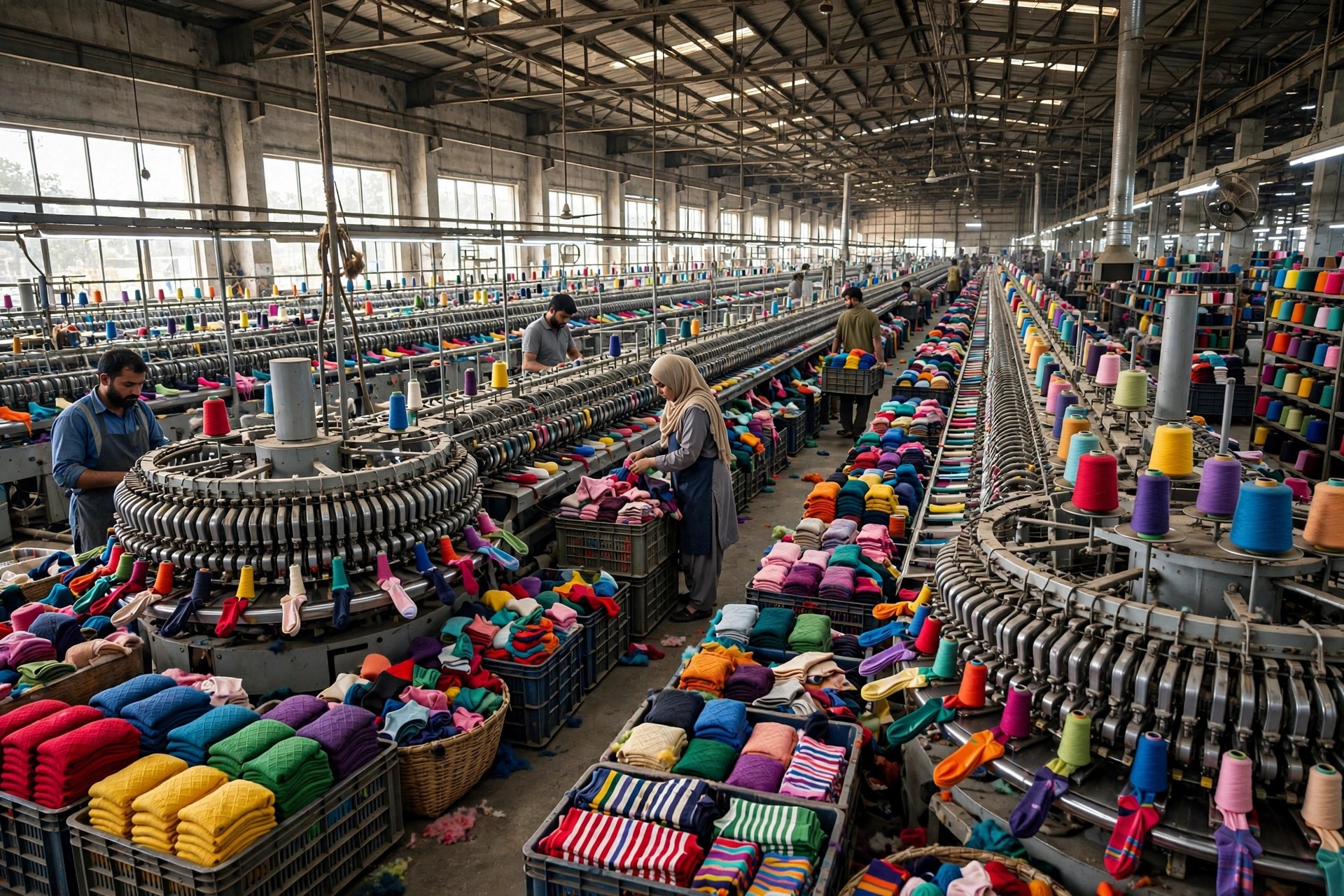
From that hosiery core, Interloop expanded in deliberate rings. It added its own spinning to control the yarn that determines a sock's feel and durability. It built multiple hosiery plants around Faisalabad and Lahore, growing from ten machines to thousands, and from a handful of workers to a workforce counted in the tens of thousands. It established hosiery operations beyond Pakistan, in Bangladesh and Sri Lanka, giving buyers multi-country sourcing from a single supplier.
Then it moved beyond socks. The company developed a denim business, a knitted apparel operation making garments such as sweatshirts, hoodies and tees, and seamless activewear — each step taking it from components toward complete clothing for the same family of customers. Its published customer list reads like a high-street directory: Nike, Adidas, Puma, H&M, Uniqlo, Levi's, Marks & Spencer, Guess, Target and others have all been named as buyers. The company is widely described as the largest hosiery manufacturer of its kind internationally — an exporter whose factory floors in Punjab feed retail shelves in North America, Europe and Asia.
Vertical integration is the thread connecting these moves. A group that spins its own yarn, knits, dyes, finishes and stitches under one management can promise a global brand something a chain of independent subcontractors struggles to match: one accountable partner, traceable inputs, and lead times controlled end to end. That promise, renewed order after order, is Interloop's real asset — more durable than any single plant.
2019: the record-breaking IPO
For twenty-seven years Interloop grew as a private company. That changed in March 2019, when it sold twelve and a half per cent of its shares to the public. The book-building stage was oversubscribed, the issue raised about Rs 5.02 billion — the largest amount ever raised by a private-sector IPO in Pakistan at that time — and the shares listed on the Pakistan Stock Exchange on 5 April 2019. The proceeds were earmarked for exactly the expansion path described above: a new hosiery plant (Plant 5) and a denim apparel manufacturing facility.
The listing mattered beyond one company. Pakistan's market had long been dominated by banks, energy firms and old industrial houses; a modern, export-earning, professionally run textile manufacturer choosing the public market at record scale was a proof of concept for a different kind of listed company. It also placed Interloop among the market's larger companies by market value on debut, and in due course into the KSE-100 — whose selection mechanics are explained in how the KSE-100 is calculated.
How Interloop makes money
Interloop is a business-to-business exporter, and its revenue mechanics follow from that. Global brands and retailers place orders specifying product, quality, quantities and delivery windows. Interloop manufactures to order — yarn in, finished garments out — and earns a conversion margin: the price the buyer pays, minus yarn and other materials, labour, energy, dyeing and finishing, freight and overheads. Earnings are earned largely in foreign currency, principally dollars, while a major share of costs — Pakistani labour above all — is in rupees. That exporter geometry means the exchange rate is a permanent character in the company's results: a weaker rupee raises the rupee value of each export dollar faster than it raises local costs, while a stronger rupee squeezes the same margin from the other side.
Three disciplines decide how much of each order survives as profit. The first is utilisation: plants built for global volumes must be kept full, because idle knitting machines still carry depreciation and salaried overheads. The second is mix: basic socks, technical sports socks, denim jeans and stitched apparel carry different margins, and the steady climb into higher-value categories is the company's long-term margin strategy. The third is input management — cotton and yarn prices, energy tariffs and wage inflation all move between the day an order is priced and the day it ships, and the gap must be managed, hedged or absorbed. Segment reporting separates hosiery, spinning, denim and apparel, letting readers see which ring of the business is carrying the year. Among PSX textile stocks, Interloop is the clearest example of the fully export-oriented, value-added model — the opposite pole from mills selling commodity yarn into the spot market.
Its place in Pakistan's economy
Textiles earn roughly half or more of Pakistan's export income in typical years, and the industry's strategic debate is always the same: ship raw materials and grey cloth, or ship finished garments that employ more people per dollar earned? Interloop is Exhibit A for the second answer. Its plants employ tens of thousands, with a notably large female workforce for Pakistani manufacturing, and its training, welfare and sustainability programmes are part of why global brands — whose own reputations depend on their supply chains — concentrate orders with suppliers they can defend. Every container of Interloop socks or jeans leaving Karachi represents foreign exchange earned not from a commodity windfall but from organisation, quality systems and trust accumulated over thirty years.
The audit economy: why values became a sales asset
To sell socks to the world's biggest clothing brands, a manufacturer must pass two examinations at once: the commercial one — price, quality, delivery — and the ethical one. Global brands publish supplier codes covering working hours, safety, wages, environmental discharge and freedom from child labour, and they audit factories against them, because a photograph from a supplier's floor can damage a brand on another continent overnight. Interloop built its reputation in that audit economy earlier and more thoroughly than most Pakistani manufacturers. Its public materials emphasise worker welfare, training, environmental management and community investment around Faisalabad, and its customer relationships have endured across decades and management changes at the brands themselves — the practical proof that the audits are being passed.
This is not softness; it is strategy. Compliance functions as a moat. A new competitor can buy knitting machines in a year, but cannot buy a ten-year record of clean audits, trained supervisors and trusted quality systems. That moat helps explain the customer list's stability through shocks that battered Pakistani textiles generally — energy crises, currency collapses, the pandemic's demand whiplash — and it explains why expansion capital, including the IPO's, flowed into categories where the same trust transfers: denim and apparel are different products, but they are sold to the same buyers, through the same credibility.
The workforce is the other half of the story. Interloop's plants employ tens of thousands of people, and the company has long highlighted the scale of female employment in its sewing and finishing operations — significant in a country where women's formal manufacturing jobs remain scarce. Training academies, transport, meals and on-site facilities are recurring features of its employer brand. For the Faisalabad region, a single employer of this size is economic infrastructure in itself: its shifts set bus routes, its wages set local benchmarks, and its order book is, in effect, a leading indicator for the city's prosperity. That is the deeper sense in which Interloop's KSE-100 seat represents something new on the exchange — not a bank, not a mill selling yarn, but a people-intensive export platform whose product is organisational trust.
The denim and apparel expansion also changes how the company should be read. A hosiery specialist is judged on dozens of pairs and machine utilisation; a full clothing group is judged additionally on fashion calendars, stitching-line efficiency and the ability to develop products with buyers rather than merely manufacture to specification. Interloop's investments in design, product development and washing and finishing capacity for denim are the unglamorous machinery of that shift — the capabilities that move a supplier from the buyer's cost column toward the buyer's strategy meetings. Each category added also diversifies the order book across seasons: socks, jeans and fleece peak at different moments of the retail year, smoothing the factory calendar that a single-product exporter must otherwise endure.
Interloop's reporting segments offer a ready-made lesson in reading a diversified exporter. Hosiery remains the anchor and the cash engine; spinning exists partly to serve the group itself; denim and apparel are the growth options bought with the IPO's proceeds and subsequent reinvestment. Watching the segment mix shift, year by year, is watching the strategy execute in numbers rather than in presentations — and it is the single most informative exercise a new reader of ILP can perform, because it separates the mature business that funds everything from the younger businesses on which the next decade's growth is supposed to depend.
That is the habit, more than any single ratio, that separates a reader of Interloop from a spectator of its share price.
What investors typically watch in Interloop
This article is educational content, not financial advice. The recurring observation points for ILP include:
- Order flow from global retail — consumer demand in the United States and Europe, and inventory cycles at the big brands, set the volume outlook.
- The rupee–dollar rate — the exporter's exchange-rate geometry described above.
- Cotton, yarn and energy costs — the input side of the conversion margin, including Pakistani gas and power tariffs for export industry.
- Capacity additions and their ramp-up — new hosiery, denim and apparel capacity only pays once buyers fill it.
- Customer concentration and mix — dependence on a handful of global brands is both the model's strength and its standing risk.
From ten Italian knitting machines in 1992 to a multi-country, multi-category clothing group supplying the world's brands, Interloop's history is a reminder that Pakistan's most valuable export asset is not cotton — it is competence. The foundations for reading any exporter's accounts, from revenue recognition to currency effects, are covered in the Aktzien learning library.
Key takeaway: Interloop turned a single-product Faisalabad hosiery start-up into a vertically integrated exporter of socks, denim and apparel for global brands — and its record 2019 IPO showed Pakistan's market what a modern private-sector manufacturer could look like.