KARACHI: Ask a Pakistani family to name a car, and one word does most of the work: Corolla. For three decades the Toyota Corolla — assembled in Karachi by Indus Motor Company Limited, INDU on the Pakistan Stock Exchange — has been the default aspiration of the Pakistani middle class: the car bought after years of saving, trusted for resale, and handed down like furniture. The company behind it is one of Pakistan's most instructive joint ventures: the House of Habib, one of the country's oldest business families, partnered with Toyota Motor Corporation and Toyota Tsusho of Japan. Indus Motor makes and sells cars, but it also tells a larger story — about localisation, about an industry that lives and dies by government policy and the exchange rate, and about why, in Pakistan, a car is never just a car.
1989: a three-way joint venture
Indus Motor Company was incorporated in Pakistan as a public limited company in December 1989, formed under a joint venture agreement among companies of the House of Habib, Toyota Motor Corporation and Toyota Tsusho Corporation. The purpose was precise: to assemble, progressively manufacture and market Toyota vehicles in Pakistan, with Indus as sole distributor for Toyota — and Daihatsu — vehicles in the country. The shares were listed on the Karachi Stock Exchange in 1992, and commercial production began in May 1993 at the company's plant in the Port Qasim industrial zone outside Karachi, a site of over one hundred acres.
Each partner brought something the others lacked. Toyota brought the product, the production system and the brand — including the famous Toyota Production System and its culture of continuous improvement, which Indus has long emphasised in its own corporate descriptions. Toyota Tsusho, the Toyota group's trading arm, brought supply-chain and logistics expertise. The House of Habib brought local standing, capital and a network across Pakistani industry and finance — the same family group whose interests span banking and insurance to engineering. Unlike a simple distributorship, Toyota itself sat on the share register from the start: Japanese skin in the game, aligned with Pakistani partners for the long term.
The Corolla era and the localisation project
Production began modestly — early accounts describe output starting at around twenty vehicles a day — and grew over the years to a daily rate more than ten times that, as capacity, model range and the supplier base expanded together. The Corolla was the anchor from the beginning, joined by the Hilux pick-up in light commercial vehicles and, later, the Fortuner SUV — a three-nameplate local range that maps onto Pakistan's roads: the family saloon, the workhorse pick-up beloved from Karachi to Khyber, and the high-riding SUV of the affluent.
The less visible half of the story is deletion — the industry's term for progressive local manufacture of parts. Pakistan's automobile policy has always pressed assemblers to localise: to buy seats, glass, radiators, batteries, tyres and hundreds of other components from Pakistani vendors rather than importing complete kits. Indus invested heavily in developing that vendor ecosystem, and the plant's engineers and purchasing teams became, in effect, teachers to a generation of local parts makers. The result is that a locally assembled Corolla contains a substantial share of Pakistani-made value — though the industry remains dependent on imported kits and components for engines, transmissions and electronics, a dependence that defines its economics to this day.
Indus also carried a second Japanese badge for a time. From March 2000 it produced the Daihatsu Cuore, a small hatchback based on the Mira, giving the company an entry-level car beneath the Corolla range. Cuore production ended in early 2012 as the model aged out, and the company's local manufacturing settled back to the Toyota range.
Hybrids, exports and a changing market
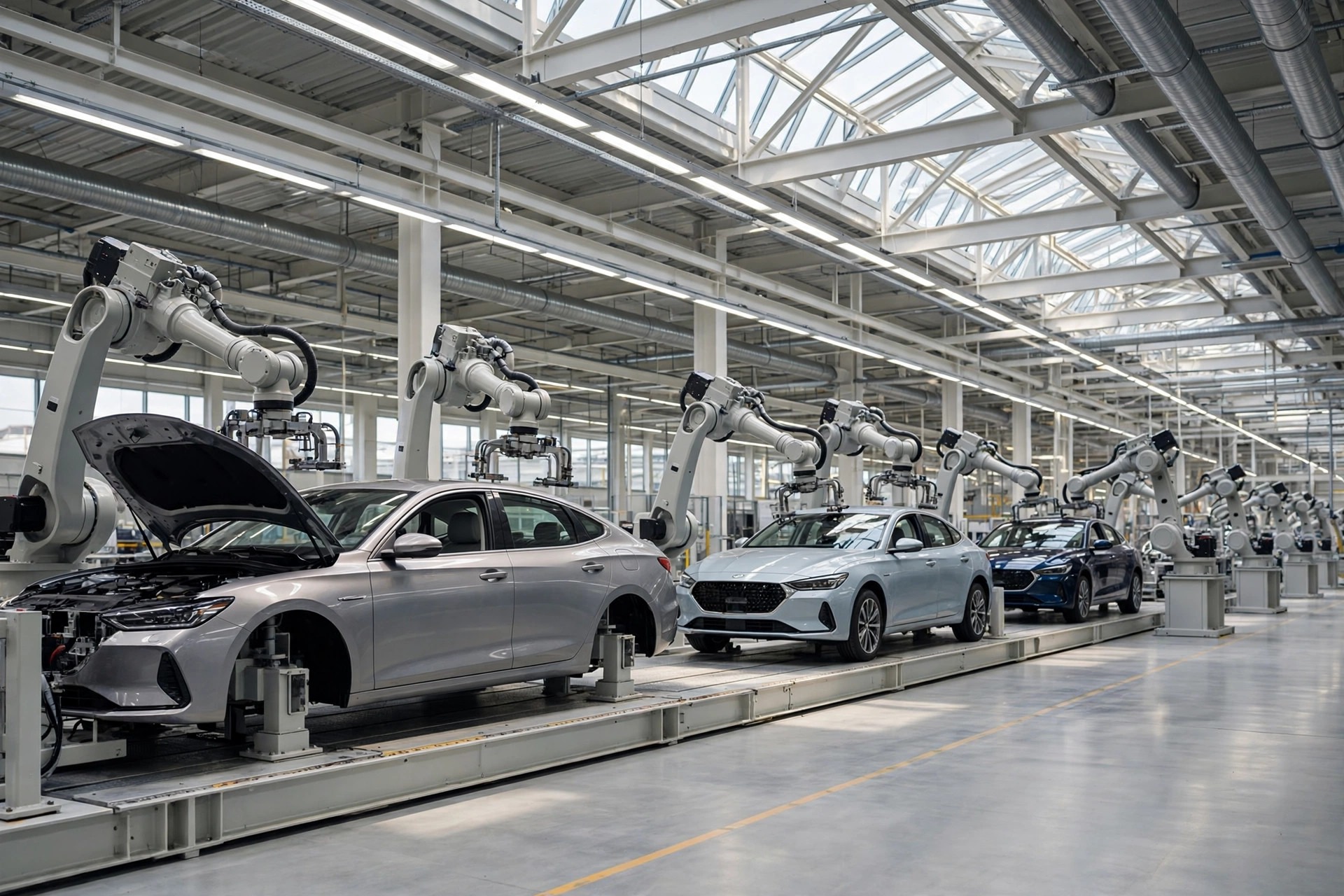
The most significant recent chapter is electrification — partial, pragmatic, and locally built. In December 2023 Indus inaugurated a hybrid electric vehicle assembly line, after an investment the company put at over one hundred million dollars, and began local assembly of the Corolla Cross Hybrid — the first Toyota hybrid to be assembled in Pakistan. The move mattered for three reasons: it cut the fuel consumption of a mainstream model in a country burdened by oil imports; it positioned the incumbent ahead of tightening global technology shifts; and it signalled that the Port Qasim plant's future would be built around newer drivetrains, not only the internal-combustion range that made its name.
The company has also pushed outward. It began exporting automotive parts to Toyota's operations in Egypt in 2023, and in 2024 started exporting locally assembled vehicles — including Corolla Cross, Hilux and Fortuner — to markets in Oceania. Export volumes from a plant built for a protected home market are symbolically large even when commercially modest: they mark the first steps from assembler-for-Pakistan toward participant in Toyota's regional supply network.
All of this unfolds against the industry's famous cyclicality. Pakistani car demand swings violently with interest rates, import restrictions on kits, currency crises and tax changes; the sector endured repeated production shutdowns in the restriction-hit years of the early 2020s, when assemblers across the country, Indus included, halted lines for weeks at a time for want of imported components. A history of Indus Motor that omitted those stoppages would miss the central fact of the business: volumes are granted by the macroeconomy, and the company's skill lies in managing through the droughts and capturing the recoveries.
How Indus Motor makes money
The assembler's model is a conversion business wrapped in a distribution business. Revenue comes overwhelmingly from selling locally assembled vehicles through a nationwide network of independent dealerships — the familiar 3S outlets offering sales, service and spares — supplemented by imported completely built-up vehicles, spare parts and accessories. The company buys completely knocked-down kits and components from Toyota-group suppliers, adds local parts and Pakistani labour and overheads, and sells the finished vehicle at a price shaped by competition, taxes and the exchange rate.
Three variables dominate the profit line. First, volume: an assembly plant's fixed costs are heavy, so margins per car improve dramatically as utilisation rises and collapse when lines stop — operating leverage in its purest industrial form. Second, the rupee: kits are imported, so a weakening currency raises costs before prices can be adjusted, while a stable or strengthening rupee does the reverse; price increases to compensate then test demand, in a loop every Pakistani car buyer knows well. Third, mix and pricing discipline: higher-value models like Fortuner and hybrid Corolla Cross carry richer margins than entry variants, and Indus has historically defended price and resale value rather than chasing volume at any cost. Interest and other income on the company's cash balances — built up in good years — have also been a meaningful, if secondary, contributor in high-rate periods. The sector as a whole is mapped in our guide to PSX automobile stocks.
Its place in Pakistani life
Indus Motor's cultural footprint exceeds its market share. Suzuki sells more cars in Pakistan, but the Corolla occupies a distinct place: it is the reference point for reliability and resale, the car of doctors, executives, landlords and successful emigrants' families, and its Hilux sibling — especially the double-cabin variants — became a status symbol in its own right. The company's dealer and parts network, reaching most significant towns, is a large part of that trust: a Toyota can be serviced almost anywhere in Pakistan, and every owner knows it. For the state, the company is also an industrial asset — an employer, a taxpayer, a trainer of engineers and technicians, and the anchor customer of hundreds of vendor firms whose existence depends on its production schedule.
The vendor economy behind the badge
A Corolla rolling out of Port Qasim carries more Pakistani industry on board than its badge suggests. Around every assembler sits a vendor economy — hundreds of local firms making seats, bumpers, glass, wiring, radiators, air-conditioners, batteries, tyres, lamps and pressed parts to the assembler's drawings and quality audits. Indus, like its peers, grades and develops these suppliers over years; a vendor that masters Toyota-grade quality for Indus can sell to any assembler in the country, and many do. Economists call this the linkage effect, and it is the strongest economic argument for Pakistan's historically protectionist auto policy: the tariff wall sheltered not one company but an ecosystem that now employs far more people in parts-making, dealerships, workshops and logistics than on the assembly lines themselves.
The after-sales world extends the footprint further. Independent dealerships across Pakistan sell and service the cars; beyond them, an informal universe of mechanics, parts shops and importers keeps ageing Toyotas alive for decades — one reason the brand's resale values are the market's benchmark. A used Corolla's price is, in effect, a daily referendum on the whole system's durability, and it feeds back into new-car demand: buyers pay Indus's prices partly because they trust the exit price. Few consumer durables anywhere function so openly as a store of household wealth, which is why Pakistani families speak of cars the way other societies speak of property — and why downturns in this industry register socially far beyond the factory gate.
The hybrid transition tests this ecosystem. Hybrid components — batteries, motors, power electronics — arrive largely imported at first, thinning local content just as policy pushes the other way, and vendors must learn new parts while their old ones still pay the bills. Indus's parts exports to Egypt and vehicle exports to Oceania, begun in 2023–24, offer the ecosystem a second direction of growth: outward. Whether the vendor base follows the assembler into export markets will help decide if Pakistan's auto industry remains a protected enclave or becomes a participant in regional supply chains — the strategic question hanging over INDU's next decade.
There is also a skills legacy that outlasts any model cycle. Generations of Pakistani engineers, technicians and managers have passed through Port Qasim's training systems, learning production discipline — standardised work, quality circles, just-in-time logistics — that they have carried into the wider auto industry and beyond it. When suppliers in Lahore or Karachi describe their quality journeys, Toyota's Pakistani operation is the reference point more often than any textbook. In that sense Indus's most durable local product may not be the Corolla at all, but the industrial culture installed around it: measurable, teachable, and now embedded in hundreds of firms that will outlive any particular car.
Ownership stability underpins that long game. The joint-venture structure agreed in 1989 has endured without the ruptures that mark many Pakistani partnerships, and the House of Habib's majority stewardship, with Toyota as an engaged minority partner, gives the company an unusually patient register. In an industry where the correct decisions — localising a part, building a hybrid line, refusing a price war — pay back over a decade rather than a quarter, patient ownership is not a soft virtue. It is, arguably, the company's core technology, as much as anything installed at Port Qasim.
What investors typically watch in Indus Motor
This profile is educational content, not financial advice. The standard observation points for INDU are:
- Monthly industry volumes — Pakistan Automotive Manufacturers Association figures for the company and the sector, the fastest signal of demand.
- The exchange rate and kit imports — currency moves and any restrictions on letters of credit for components.
- Auto policy — federal budgets, duties on kits versus built-up cars, and incentives for hybrids and localisation.
- Interest rates — car financing costs, which gate middle-class demand.
- New models and competition — including newer entrants and the gradual shift toward hybrids.
Indus Motor remains a constituent of the KSE-100, where weight follows free-float market capitalisation as explained in market capitalisation explained. Its three-decade arc — a 1989 joint venture, a 1993 start, a Corolla-centred rise, and a hybrid-era reinvention now under way — makes it the closest thing Pakistani industry has to a case study in patient, partner-led manufacturing. Readers new to the sector will find the supporting concepts in the Aktzien learning library.
Key takeaway: Indus Motor, the House of Habib–Toyota joint venture incorporated in 1989, turned the locally assembled Corolla into Pakistan's defining car — and is now betting its next era on hybrid assembly and first steps into export markets.