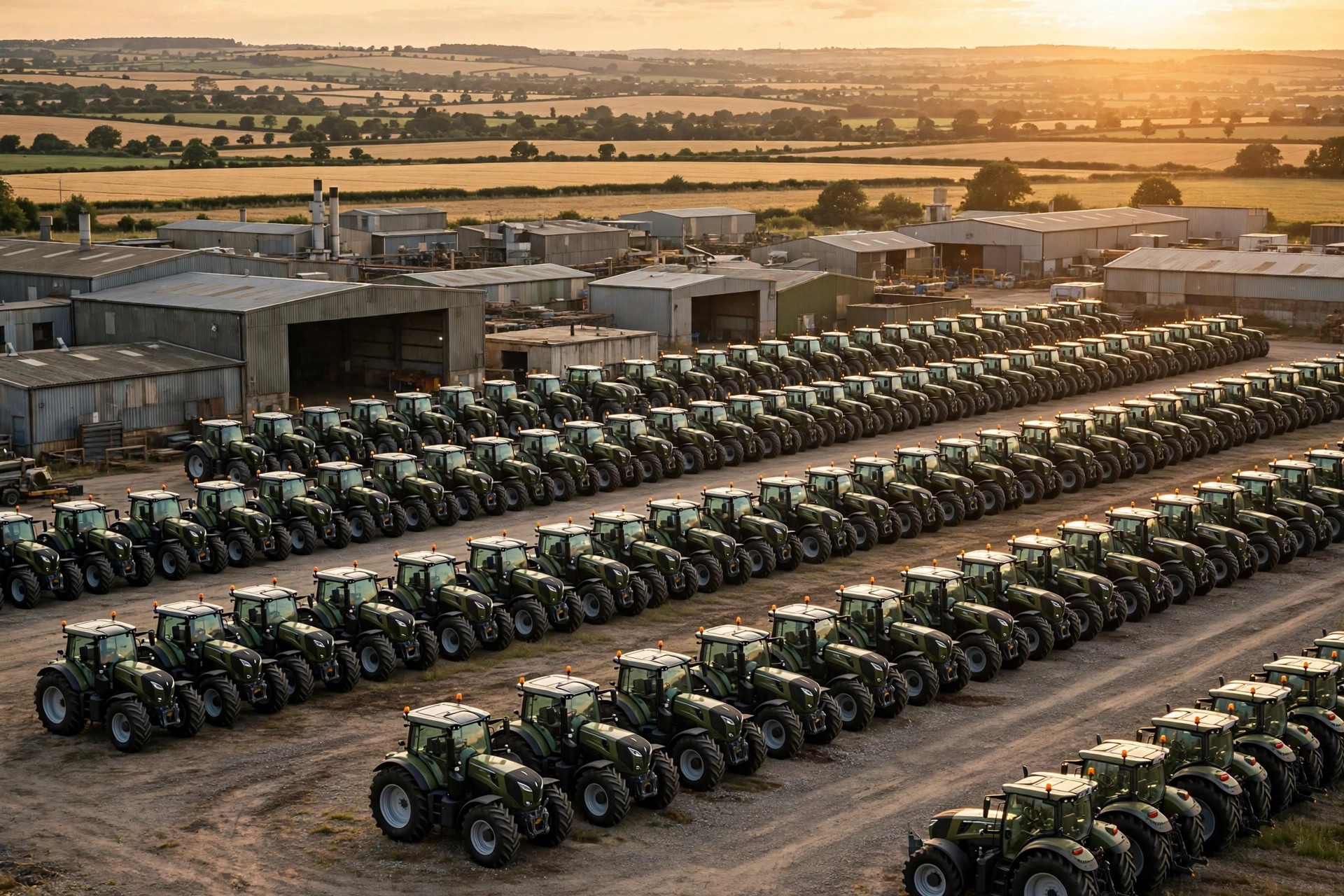
KARACHI: If you want to see Pakistan's farm economy in a single machine, stand at the edge of a wheat field in Punjab at harvest time and watch the tractors. A large share of them, across several generations of models, carry the Massey Ferguson name and were built by one Lahore company: Millat Tractors Limited. Millat is not a car maker that also sells tractors, or a trading house that imports them. It is a specialist manufacturer whose modern history is the story of indigenisation — learning, step by step, to make in Pakistan what it once only imported. Founded in the 1960s as an importer, nationalised in the 1970s, given the job of localising tractor production in the 1980s, and then bought by its own employees in 1992, Millat's path mirrors the country's long argument about whether to assemble foreign designs or truly manufacture at home. Its answer, built over decades, was an engine plant, machining facilities and a network of local parts makers that turned a sales agency into an engineering business.
From Rana Tractors to an assembly line
The company began in 1964 as Rana Tractors and Equipment Limited, founded by Rana Khudadad Khan and Rana Allahdaad Khan, to import and market Massey Ferguson tractors in Pakistan. At first the tractors arrived as completely built units — finished machines shipped in and sold. That model is simple and requires little local industry, but it drains foreign exchange and leaves the seller at the mercy of shipping, currency and the foreign maker's priorities.
The first step inward came quickly. Assembly from semi-knocked-down kits began in Karachi in the mid-1960s, and operations shifted to Lahore in 1967, where the company has remained based. Assembling kits is still not full manufacturing — the valuable parts arrive in crates — but it creates local skills in fitting, testing, painting and quality control, and it builds the dealer and service network that farmers depend on when a machine fails in the middle of a season. The company was listed on the Karachi Stock Exchange in 1965, making it a public company early in its life.
Nationalisation and the indigenisation order
In 1972, amid the nationalisation of major industries, Rana Tractors was renamed Millat Tractors and folded into the state framework through the Pakistan Tractor Corporation, on whose behalf it assembled and marketed tractors. The name change was more than cosmetic: millat means the nation or community, and the renamed company was now an instrument of industrial policy as much as a business.
The policy turn that defined Millat came around 1980, when the government decided tractors should be progressively manufactured in Pakistan rather than merely assembled, and entrusted that indigenisation task first to the Pakistan Tractor Corporation, which passed the role to Millat in 1981. The company's response was fast by the standards of heavy industry. In 1982 it set up Pakistan's first engine assembly line — the heart of the tractor, previously always imported as a unit. When sourcing properly cast and machined parts proved difficult, the company pushed capability outward and inward at once: casting facilities were developed at vendor sites in 1984, and Millat built its own machining facility for essential engine and axle components the same period. Components such as engine blocks, transmission cases and axle housings — heavy, precise castings that must be machined to tight tolerances — came to be made from locally sourced castings. Each deletion, in the industry's language, removed an imported part from the kit and replaced it with a Pakistani one.
1992: the employees buy the company
Millat's second great ownership change came with the privatisation programme of the early 1990s. In 1992 the company was acquired by its own employees in a management and employee buyout — a distinctive route among Pakistani privatisations, where many assets went to established business groups. An employee-owned manufacturer has a particular character: the people making decisions about product quality and investment are, in many cases, shareholders whose wealth rides on the same outcomes, and institutional memory stays inside the building.
Privatisation was followed by investment in a modern tractor assembly plant in the 1990s, lifting single-shift capacity and, in the company's account, bringing build quality up to the standard of major tractor makers elsewhere. Freed from ministry timetables, Millat also began building a group around its core skills. It acquired a majority stake in Bolan Castings Limited in 1993, securing the foundry capability its engines depended on. Millat Equipment Limited followed in 1994 to make gears and shafts — precision components with uses beyond tractors. Millat Industrial Products, established in 1999, took the group into batteries and cells for automotive and industrial markets, and the company later acquired a battery maker in Kasur under the government's privatisation scheme. The logic was consistent: own the difficult, precision parts of the value chain rather than renting them.
What Millat sells, and to whom
The core product line is agricultural tractors sold under the Massey Ferguson brand under its long-standing arrangement with the brand's owner — the company is the authorised manufacturer of Massey Ferguson tractors in Pakistan. The range spans the horsepower classes Pakistani farms actually use, from smaller machines suited to smallholdings and haulage to larger models for bigger farms and contractors. Around the tractors sits a supporting cast that reflects the group's structure: diesel engines and generating sets, forklift trucks made under a foreign licence, agricultural implements, and the batteries and castings of its subsidiaries. The company has also held an interest in a car assembly venture, Hyundai Nishat Motors, alongside the Nishat Group — a reminder that vehicle assembly skills travel across categories, though tractors remain the centre of gravity.
The customer is, overwhelmingly, the Pakistani farmer and the rural contractor — buyers for whom a tractor is the single largest capital purchase of a working life, often financed, and judged brutally on three things: will it start every morning, can the local mechanic fix it, and are parts available in the nearest town at a fair price? That is why Millat's decades of localisation matter commercially and not just patriotically. A tractor built largely from local parts, serviced by a deep dealer network and understood by every mechanic in Punjab, has a resale value and an uptime record that an imported rival struggles to match. Our sector overview of automobile stocks on the PSX places Millat alongside the car and truck assemblers, whose localisation journeys have generally been slower and shallower than the tractor industry's.
Millat is one of two major tractor manufacturers in Pakistan, the other being Al-Ghazi Tractors, maker of New Holland machines. That duopoly, serving a market driven by farm incomes, gives the industry a distinctive rhythm: demand surges when harvests are good, credit is available and support prices reward growers, and it slumps hard when the farm economy is squeezed, when floods destroy crops, or when financing tightens.
How the money is made
Millat earns by manufacturing and selling tractors and related products through its dealer network, plus exports of tractors and components to markets where its Massey Ferguson models are competitive — its trading arm in Dubai supports that outward business. The cost side is dominated by materials: steel, castings, tyres, hydraulics and the remaining imported content in each machine, together with labour, energy and the overhead of running machining and assembly plants.
Two economic levers deserve plain explanation. The first is local content. Every part made in Pakistan is a part whose cost is set in rupees by local suppliers rather than in foreign currency by an overseas maker. High localisation cushions the company when the rupee weakens — though it never insulates it fully, because steel, technology licences and some components still connect costs to the wider world, and because royalty and technical arrangements with the brand owner are part of the model. The second lever is volume against fixed cost. A machining plant and assembly line cost roughly the same to run whether they build many tractors or few, so profit per tractor improves sharply in boom years and compresses in slumps. Tractor demand, in turn, is unusually sensitive to policy: sales-tax treatment of tractors, farm credit schemes and occasional government tractor schemes can move the market within a single season.
Dividends and cash generation have historically been part of the Millat story that shareholders notice, because a mature manufacturer with modest expansion needs can return a meaningful share of its earnings — though, as with any company, payouts depend on the year, on investment plans and on working capital absorbed by unsold machines and dealer credit in a downturn.
What investors typically watch
The observation list for Millat starts with industry tractor sales figures, published regularly for the sector, because Millat's fortunes track the market and its share of it. Watchers then look at the farm economy behind those numbers: wheat and cotton outcomes, water availability, support and market prices for crops, and the state of agricultural credit. Input costs come next — steel and component prices, and the exchange rate for whatever imported content remains — followed by policy signals on tractor taxation and farm support. Finally, the group dimension: how the castings, equipment and battery subsidiaries are performing, since they smooth, a little, the tractor cycle by selling into other markets.
Millat also offers a clean way to understand a broader market idea: how a company's value rests on capabilities that do not appear as separate lines in its accounts — a supplier base built over forty years, mechanics in every district who know its machines, and a brand that farmers trust across generations. Learning to weigh such intangibles, alongside the numbers, is a core investing skill, and the guides on our Learn page work through it step by step. This profile is educational content, not financial advice.
The parts makers and partners behind the tractor
A finished Millat tractor is the visible end of a much longer chain, and the group's own history shows how deliberately that chain was assembled. The battery business, for example, was not a random diversification: in 2001 Millat acquired Rex Baren Batteries, a battery manufacturer based in Kasur, under the government's privatisation scheme, and that acquisition sat alongside Millat Industrial Products, the group's own batteries and cells venture established in 1999. On the foundry side, the majority stake in Bolan Castings taken in 1993 gave the group direct influence over the castings its engines and axles depended on, while Millat Equipment, founded in 1994, concentrated on gears and shafts — small components in size, but among the most precision-sensitive parts in a tractor, and among the hardest to source reliably at local scale in the early indigenisation years.
Technology partnerships form the other half of the picture. Company histories describe technical collaboration arrangements behind the Massey Ferguson tractors themselves, behind the diesel engines the group builds and sells in generating sets, and behind the forklift trucks it manufactures under a foreign licence — in the forklift case, a collaboration with China's Anhui Heli is recorded in accounts of the company's operations. Its outward trade is supported by a Dubai trading arm, TIPEG Intertrade DMCC, in which Millat holds a majority interest. For a reader, the lesson of this structure is that localisation was never a single factory decision. It was a portfolio of foundries, machining shops, component subsidiaries, licence agreements and vendor factories, built so that a disruption in any one imported part did not stop the whole assembly line — and so that skills learned making tractor parts could be sold into batteries, castings and industrial equipment as well.
Reading a tractor maker through the seasons
Millat also teaches a timing lesson that applies across the PSX. Its results arrive after the farm seasons that caused them: a good wheat harvest lifts rural cash in spring, tractor orders follow, and the factory's strongest quarters can look disconnected from the weather outside the investor's window. The same lag runs in reverse after floods or a failed cotton crop. Seasoned watchers therefore read Millat alongside the agricultural calendar — sowing, harvest, support-price announcements, canal water releases — and alongside the KSE-100 itself, where the company's long index membership reflects the size and liquidity rules behind market capitalisation rather than any single season's sales. A manufacturer tied to the land cannot be understood on a quarterly clock alone; its real reporting period is the crop year, and its real annual report is written partly in the fields. This profile is educational content, not financial advice.
Key takeaway: Millat Tractors began in 1964 importing Massey Ferguson machines, was nationalised and renamed in 1972, led Pakistan's tractor indigenisation drive from 1981, and was bought by its employees in 1992 — a manufacturer whose economics turn on local content, farm incomes and tractor volumes.