KARACHI: Every Pakistani economic crisis is, at bottom, a shortage of dollars — and dollars, sustainably, come from only one source: selling things to the rest of the world. Borrowing can rent dollars and remittances bring them in as family support, but exports are the earned income of the nation. So the question "what does Pakistan export?" is not trivia; it is the diagnosis of the country's recurring external problem and the map of where any durable fix must come from. The honest short answer is: mainly textiles, a significant amount of rice and other farm products, a growing stream of IT services, and a long tail of leather, sports goods, surgical instruments and other niches — a list that has changed surprisingly little over decades, and whose concentration explains a great deal. This guide walks the list, explains what drives each part, and sets out why broadening exports is harder than announcing it. It quotes no current export total as fact; the Pakistan Bureau of Statistics (PBS) publishes monthly trade data and the State Bank of Pakistan (SBP) publishes services data — check those for the latest figures.
Textiles: the giant in the middle of the room
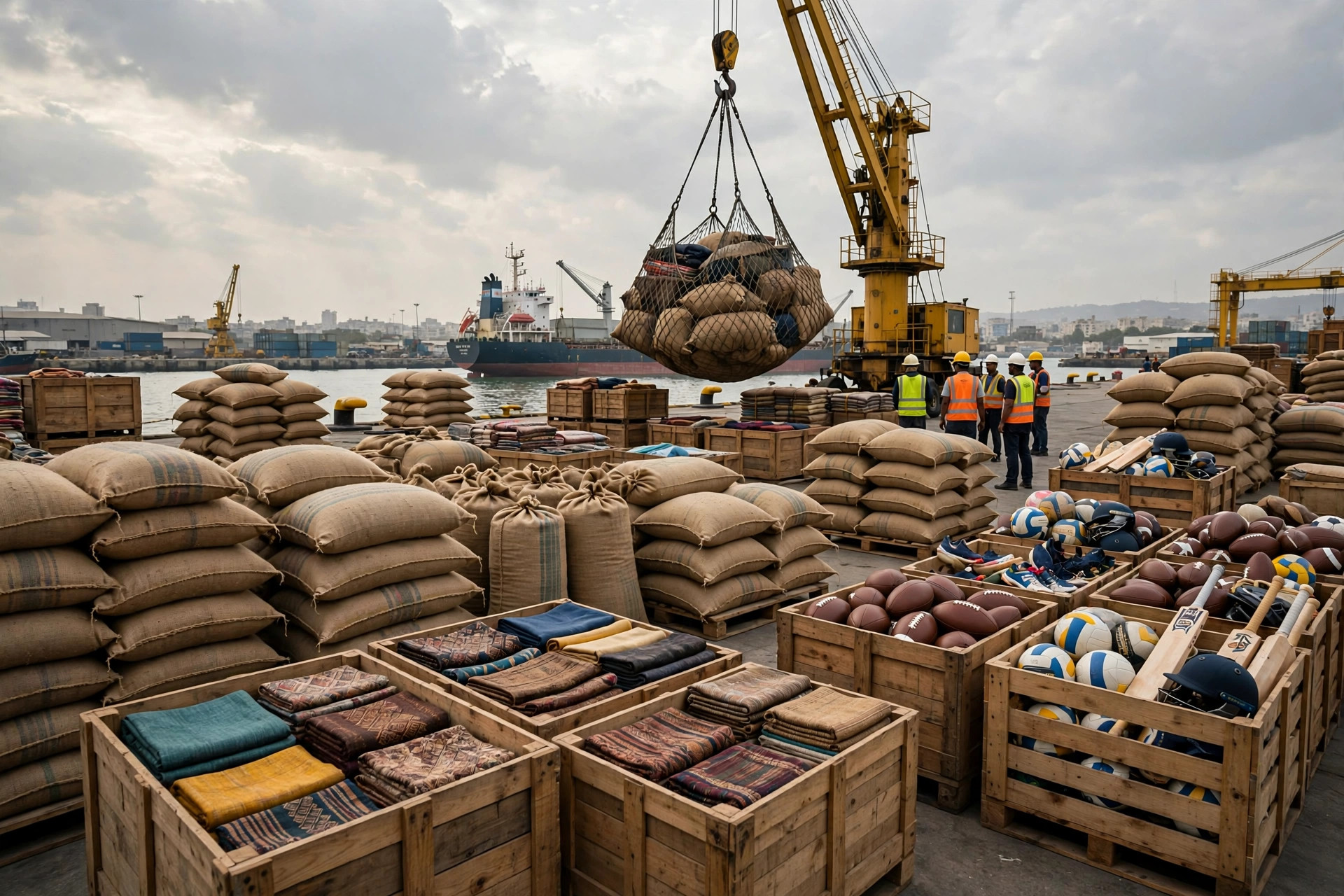
Textiles and clothing have long supplied roughly half or more of Pakistan's goods export earnings — the exact share moves with prices and harvests, but the dominance is structural and decades old. The chain runs from cotton growing through ginning, spinning, weaving, dyeing and finishing to the garments and home textiles — bed linen, towels, denim, knitwear — that fill containers at Karachi and Port Qasim. Pakistan is unusual in possessing the whole chain inside one country, from field to finished shirt, because it grows its own cotton. That integration is a genuine strength: spinners, weavers and garment makers listed on the PSX, covered in our sector guide to PSX textile stocks, can coordinate stages that competitors must trade across borders.
Yet the industry's value mix matters as much as its size. A larger share of Pakistan's textile earnings has historically come from relatively low-value-added stages — yarn, grey fabric, home textiles — than from branded, design-led apparel, where margins and pricing power are higher. Moving up that ladder requires reliable energy at competitive tariffs, compliance with buyer standards on labour and environment, design and marketing capability, and speed to market — the same frictions that appear throughout this guide. Cotton itself is a vulnerability: domestic harvests have been hit in various years by weather, pests and competition for land from other crops, forcing mills to import cotton and lint with the very dollars exports are meant to earn. Global demand cycles in the United States and Europe, Pakistan's biggest markets, transmit directly into mill orders, and preferential access schemes such as the European Union's GSP+ arrangement — which ties trade preferences to compliance with international conventions, and whose status is periodically reviewed — are a policy lifeline no exporter takes for granted.
An illustrative example shows the pricing reality — invented figures, real mechanism. Suppose a mill ships a container of bed sheets invoiced at $50,000. Its costs — cotton, dyes, energy, wages, freight — are incurred mostly in rupees. If the rupee depreciates between order and payment, the mill's rupee receipts rise while many costs stand still, fattening margins temporarily; if energy tariffs jump meanwhile, the gain evaporates. Exporters therefore live at the intersection of the exchange rate explained in the rupee explained and the energy costs explained in Pakistan's energy mix explained, and their lobbying on both is a permanent feature of economic policy debates.
Food and agriculture: rice at the head of a long table
The second great block is agro-based exports. Rice is the star: Pakistan is among the world's significant rice exporters, selling both premium basmati — where it competes on aroma, branding and geographical reputation — and high-volume non-basmati varieties to markets in the Gulf, Africa, Europe and beyond. Rice earnings swing with harvests, global prices and the policies of larger competitors, whose export restrictions in tight years have historically opened market share to Pakistan. Around rice sits a wide table: fruits such as mangoes and citrus, vegetables, meat — where formal exports have grown as Gulf demand met investment in processing and cold chains — seafood, sugar in surplus years, and raw cotton and its by-products when harvests allow.
Agricultural exports carry a distinctive risk profile: they are hostage to water. Indus basin irrigation, groundwater depletion, heat and the catastrophic flooding Pakistan experienced in 2022 — which destroyed crops, livestock and rural infrastructure on a vast scale — all feed straight into exportable surpluses, while a good monsoon can lift them. Food exports also run into the politics of domestic prices: when local food inflation bites, governments restrict exports of items such as onions, wheat or sugar to protect consumers, trading foreign earnings for price calm at home, a tension that reappears in inflation in Pakistan explained. For investors, the relevant listed exposures are indirect but real — fertiliser demand, sugar mills' export quotas, and food companies' regional ambitions among them.
Services: the IT bright spot and its companions
Services exports never appear in photographs of containers, but they are among the fastest-growing lines in the balance of payments. Information technology and IT-enabled services — software development, business process outsourcing, freelancing delivered through platforms, and the overseas earnings of Pakistani tech firms — lead the category. The business model is elegantly simple: earn in dollars, spend largely in rupees on engineers and offices, exactly the economics detailed in how Systems Limited makes money. Growth constraints are human, not physical: the supply of skilled engineers, English proficiency, reliable connectivity and power, and payment channels that let freelancers and small firms actually bring earnings home through the banking system rather than leaving them abroad.
Other services contribute on both sides of the ledger. Transport earnings include Pakistan International Airlines and shipping-related income, while transport payments — freight on the imports Pakistan receives, mostly on foreign carriers — are a heavy outflow. Travel works similarly in reverse: Pakistanis studying and seeking treatment abroad spend more than visitors bring in, though religious, diaspora and adventure tourism add inflows. Financial and business services are growing from a small base. The services account in total usually runs a deficit, but its star component, IT, is one of the few export lines that can plausibly scale without ports, cotton or imported fuel — which is why every recent export strategy gives it pride of place, and why its monthly SBP figures deserve the attention investors usually reserve for textile data.
The long tail: famous niches and manufactured also-rans
Beyond the big blocks sits the long tail that Pakistanis rightly take pride in, and whose small aggregate size is the problem. Sialkot's sports goods — including a large share of the world's hand-stitched footballs — and its surgical instruments, made by clusters of skilled workshops, sell globally on craft skill built over generations. Leather goods and garments, carpets, cutlery from Wazirabad, cement to regional markets when domestic construction slows, fertiliser in rare surplus years, refined and petroleum products in small quantities, pharmaceuticals to developing markets, and auto parts from the engineering cluster all contribute. Each niche has world-class firms; collectively they do not yet add up to a second textiles. The engineering goods sector in particular — fans, pumps, transformers, auto components — is the perennial "potential" story: capability exists, scale and certification for demanding markets are the bottleneck.
Geography concentrates risk as much as products do. The United States, the European Union and the United Kingdom take a large share of goods exports, China is both a major market and the source of most imports, and the Gulf states anchor rice, meat and labour-linked trade. Special economic zones under the China–Pakistan Economic Corridor were designed to pull export manufacturing into Pakistan; their progress, like the broader industrial policy debate, is best tracked through official trade data rather than announcements. When a single big market sneezes — a US retail slowdown, an EU demand dip — the export order books of Faisalabad and Karachi catch the cold within a quarter.
Markets and access: who buys, and on what terms
An export is not complete when a product is made; it is complete when a foreign buyer chooses it over a rival's, at a price that covers costs, and pays. Pakistan's market access rests on three pillars worth understanding. The first is tariff preferences: schemes such as the EU's GSP+ and various bilateral arrangements lower or remove duties for Pakistani goods in major markets, effectively subsidising exporters' price competitiveness — and they are conditional, reviewed periodically and tied to treaty compliance, which makes them a policy asset that must be maintained, not a permanent entitlement. The second is trade agreements, above all with China, and a patchwork of preferential arrangements with regional partners, whose benefits depend on rules of origin and on whether Pakistani products match what those markets actually import. The third is logistics: port efficiency at Karachi and Port Qasim, shipping connectivity, cold chains for perishables, and the cost of moving goods from Punjab's industrial districts to the coast. Exporters consistently rank these unglamorous items alongside energy and the exchange rate, because a two-week shipping disadvantage or a spoiled cold chain quietly erases a tariff preference. Trade fairs, the Trade Development Authority's promotions and Pakistan's commercial counsellors abroad support the search for buyers, but repeat orders are won on delivered quality and reliability — which is why the exporters who survive decades tend to be operationally excellent firms whose names anchor several PSX sectors.
Why the list barely changes: the constraint stack
Ask exporters why broadening is slow and a consistent stack of constraints emerges, none of them mysterious. Energy cost and reliability sit on top: factories competing against Bangladesh, Vietnam and India cannot absorb tariffs inflated by the circular debt burden and cross-subsidies, nor production losses from outages. The real exchange rate follows: periods of an overvalued rupee quietly tax exporters while subsidising importers. Working capital matters more than outsiders expect: exporting ties up cash in inventory and foreign receivables for months, and at high domestic interest rates that financing is expensive, even with the SBP's concessional export finance schemes. Refunds and rebates — sales tax refunds owed to exporters have historically accumulated as arrears, draining the same working capital. Skills, compliance and branding cap the move into higher-value goods. And policy instability — tariffs, taxes and incentives rewritten with each budget, as Pakistan's federal budget explained describes — makes the ten-year factory investment a braver bet than it should be.
None of this is destiny. The same decades produced the IT services rise from nothing, meat exports built on new processing investment, and denim and knitwear segments that compete at genuine quality levels. The demographic story in Pakistan's demographic moment cuts both ways for exports: a vast young workforce is either the labour force of a manufacturing expansion or a larger import-consuming population, depending on whether export industries scale to employ it.
Reading exports as an investor
Practically, treat export data as a monthly diagnostic of the current account, which is where it lands: goods from PBS, services from the SBP, always in trend rather than single-month form, and always asking three questions. Is growth coming from prices or volumes — a cotton price spike flatters textile values without shipping one extra container? Is it broad or narrow — one commodity or market carrying the total? And is it matched by the inputs — cotton imports, energy supply and credit — that next quarter's exports require? For individual listed companies, annual reports disclose export sales shares; comparing a company's claimed export growth with the national data for its category is a quick sanity check that catches exaggeration early.
This article is educational content, not financial advice. Export composition and values change monthly and are revised; consult the PBS, the SBP and the Ministry of Commerce for current data before drawing conclusions about any particular period or company.
Key takeaway: Pakistan earns its dollars mainly from textiles, rice and a growing IT services line, with famous niches in a long tail — the concentration of products, markets and imported inputs in that list is the structural fact behind the country's recurring dollar shortages.