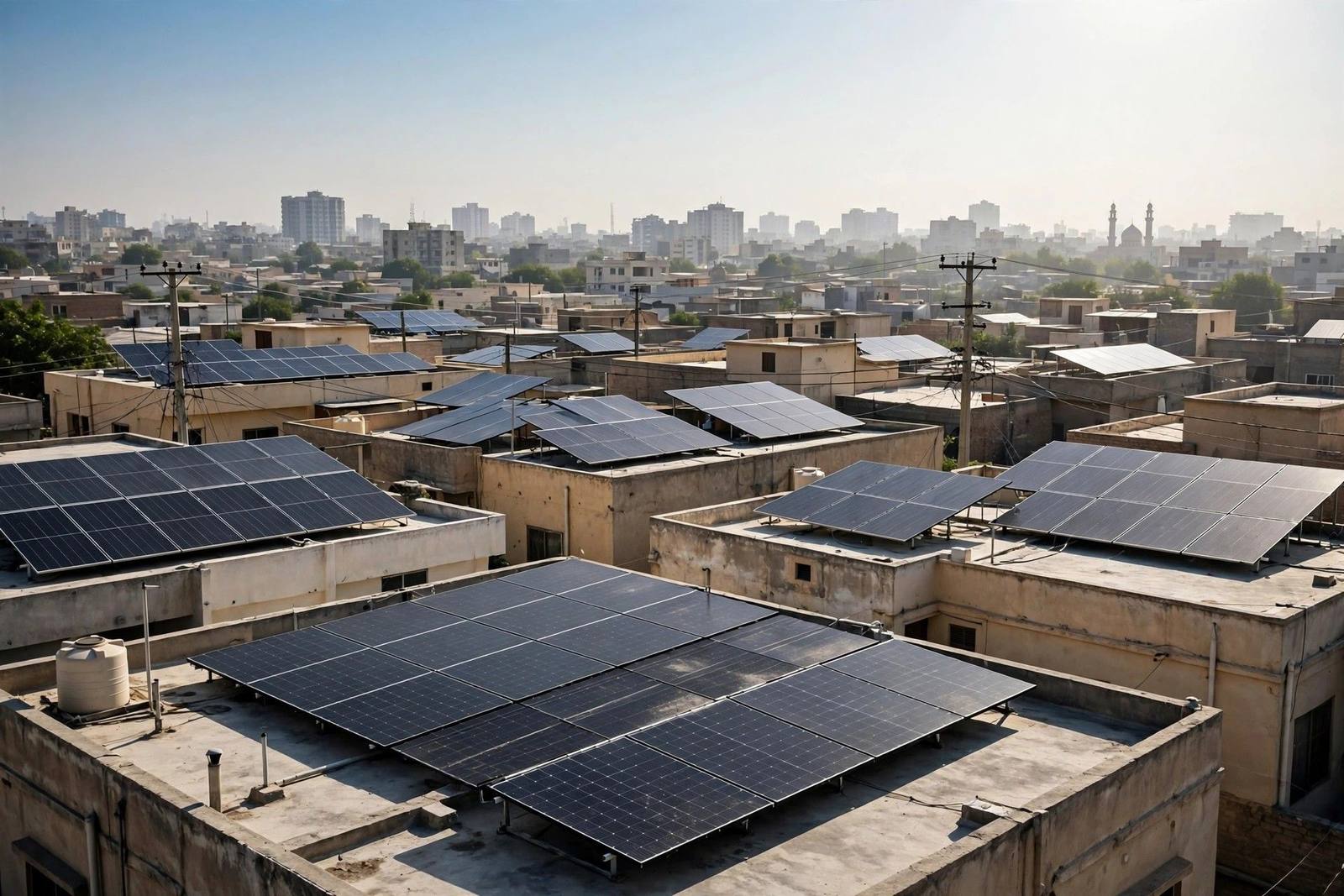
KARACHI: Net metering is a simple idea with revolutionary manners: a household or business with rooftop solar panels draws electricity from the grid when the sun is down or demand exceeds generation, and pushes surplus power back into the grid when generation exceeds demand. The meter records both directions; at the end of the billing cycle the consumer is charged for the net — imports minus exports, valued under the rules the regulator sets. In Pakistan, the framework sits with NEPRA's distributed generation and net metering regulations, administered through the local distribution company — the DISCO — whose network the rooftop quietly joins.
The timing made it explosive. As grid tariffs climbed through Pakistan's energy-cost crisis — the story told in our guides to the energy mix and circular debt — a solar installation transformed from an environmental gesture into the best-performing asset on a middle-class balance sheet. This guide explains the mechanism, the money and the argument now raging over both. A worked example fixes the mechanics better than any definition. Take a home generating forty units on a bright day while consuming twenty-five in daylight hours: fifteen units flow out to the grid and are recorded by the export register; after dark the home draws, say, eighteen units from the grid. Under classic net metering, the bill nets the flows — three net imported units, priced at the tariff, with the export credited under the applicable buy-back arrangement rather than re-sold at full retail. Multiply by a month of seasons, clouds and loads and you have the rooftop economy: the panel earns most when it displaces your own purchase, and least when it merely feeds the street.
How to become a tiny power plant: the process
The formal route runs through your DISCO — IESCO, LESCO, K-Electric and their peers each operate application processes under the national regulations, with AEDB-certified installers and equipment standards in the frame. The consumer applies, the DISCO inspects the installation and the inverter's safety compliance — anti-islanding protection matters, because a rooftop must never energise a line that linemen believe is dead — and a bidirectional meter replaces the old one. A generation licence from NEPRA, issued in a standardised small-consumer form, completes the paperwork, and the export meter starts counting.
In practice, Pakistan's solar boom ran ahead of its paperwork. A large share of installed rooftop capacity began life as plain 'on-grid' or hybrid systems without net-metering approval, sized for self-consumption and daytime load-shaving rather than export. Distinguishing installed panels from licensed net-metering connections is essential to reading the statistics: headline gigawatts of imports are not the same as contracted exporters, and the gap between them is where much of the policy argument actually lives.
Safety and standards are the unglamorous foundation that keeps the system licensable. A net-metered inverter must disconnect instantly when the grid fails — anti-islanding — so exported power never endangers repair crews; earthing, surge protection and certified equipment listings exist because thousands of amateur generation points on one feeder are otherwise a genuine hazard. The AEDB's certification of installers and the DISCOs' inspection regimes are the market's trust machinery: as installations professionalised from the early hobbyist phase, insurers, banks and buyers of second-hand homes all began to treat a documented, approved system as an asset and a lash-up as a liability.
Panels from China and the great import surge
The boom's supply side is a trade story. Chinese panel manufacturing scaled so aggressively that global module prices collapsed to levels that made Pakistani rooftop economics irresistible even before subsidies — and Pakistan, importing essentially all of its panels, inverters and much of its mounting kit, rode the price down. Import data in peak years showed solar equipment arriving at a scale of many gigawatts annually, retailed through a vast new bazaar of importers, installers and Facebook-marketplace engineers in every city.
Note the balance-of-payments irony, because it recurs in Pakistani energy: households spent dollars' worth of imports today to stop buying the grid's dollar-fuelled electricity tomorrow. At the national level, every rooftop kilowatt displaces some furnace oil, LNG or coal burn priced in foreign currency — linking the humble rooftop to the reserves question — while the import bill for panels lands once, up front. Whether that trade is good national arithmetic depends on panel lifetimes and what the grid would otherwise have burned, and on most honest calculations it is favourable.
Feeder-level effects are where the debate gets technical and interesting. A street where half the roofs export at noon can push local voltage above limits, overloading the distribution transformer in reverse — problems solvable with modern inverters' volt-var functions and modest network investment, but only by DISCOs whose finances and staffing are already stretched. This is the strongest version of the utilities' case: not that solar is bad, but that integrating it is work someone must fund. The weakest version — protecting incumbent revenue by throttling a cheaper technology — should be recognised and refused wherever it appears.
The buy-back rate: where the argument starts
Exported units are not valued at the retail tariff the consumer pays for imports. Under the framework as it has operated, exports are credited at a rate linked to the national average power purchase price — the average cost at which the system buys energy — rather than at the full consumer tariff, which also recovers transmission, distribution, capacity and various surcharges. Even so, early net-metering customers often received terms generous relative to later offers, and regulators have periodically revised the export rate downward for new applicants as the system's economics tightened, with existing licensees generally grandfathered for their licence terms.
This is the seam where fairness arguments split. Solar households say: we invested under stated rules, we relieve the grid at peak sun hours, and our exports displace the system's most expensive daytime fuel. The DISCOs answer: the consumer still uses the grid as a free battery and backup plant, pays reduced fixed charges toward its costs, and leaves non-solar customers — poorer, on average — to carry a larger share of the system's fixed costs. Both statements are true; the rate is where society prices the overlap.
Commercial and industrial users run the same maths at larger scale and sharper pencils. A factory or warehouse with a big roof and daytime load is the ideal solar citizen: generation and consumption coincide, exports are minor, and the saving is measured against industrial tariffs that carry the system's heaviest cross-subsidies. Captive and third-party-financed rooftop models — where an investor owns the panels and sells the factory discounted power under a long contract — have grown precisely because they monetise roofs whose owners lack capital. Each megawatt of it is demand the grid loses at its most profitable hours, which is why industrial solar, more than household panels, drives the tariff-design argument.
Capacity payments and the grid's fixed-cost trap
To see why utilities worry, recall how Pakistani generation is paid. Most power plants receive capacity payments — money owed for being available, regardless of how much they generate — on top of energy payments for actual output. When rooftop solar shaves daytime demand, the system buys less energy but owes nearly the same capacity bill, so the fixed cost is spread over fewer grid units and the per-unit tariff for everyone else rises. Solar growth, privately rational, thus tightens the tariff spiral for the non-solar majority — the 'utility death spiral' argument, in a distinctly Pakistani dialect.
The counter-argument is equally structural. Pakistan's marginal daytime generation has historically included expensive oil and gas peaking energy; solar output is correlated with the air-conditioning peak, which is exactly when the system is most stressed; and every unit not drawn from the grid avoids the transmission and distribution losses — among the world's higher — that mean the system generates well over a unit for each unit delivered. A full accounting credits solar with avoided fuel, avoided losses and avoided peak capacity stress, and debits it with fixed-cost shifting. Policy since has been a search for the netting point.
Equity is the argument policy must answer rather than dodge. Rooftop solar's early adopters are, by construction, property-owners with capital or credit — not the renters, apartment dwellers and settlement residents who form most of the load. A settlement in which adopters' savings are financed by higher fixed costs on non-adopters is regressive in a way no amount of green framing cures. The honest policy toolkit therefore includes the other half of the market: community solar, virtual net metering for flats, on-bill financing that reaches the credit-constrained, and lifeline tariff protection for small consumers. A transition that only the villa can join will eventually be regulated by the politics of everyone else.
Net metering versus net billing: the proposed redesign
The reform direction debated in Pakistan — following a path many countries have taken — is from net metering to net billing: exports and imports priced separately and asymmetrically by design, with exports paid at a lower, cost-reflective rate (closer to avoided energy cost) and imports charged at the full tariff, settled in cash rather than in netted units. Gross-metering variants price every generated unit at the export rate and every consumed unit at retail. Each design shifts the payback period of a rooftop system, and therefore the size and speed of the market.
For households, the practical translation is that self-consumption is king under every plausible future regime: a unit you generate and use yourself is worth the full retail tariff you did not pay, under metering, billing or any hybrid. Systems sized to daytime load, businesses running seven days a week, and homes that shift washing, pumping and cooling into solar hours keep their economics in almost all scenarios; systems sized to export heavily are the exposed ones. Policy risk, in other words, has a sizing answer.
International experience is a usable map here, because Pakistan is re-running a sequence other grids know well. Germany's feed-in generosity built scale then convulsed tariffs; California's successive net-metering reforms repriced exports toward avoided cost and triggered the same grandfathering fights; Australia pushed through export limits and flexible connections. The common lesson is that transitions are survivable when rules change prospectively, existing investors are honoured, and the replacement regime still rewards self-consumption and system-friendly timing. Pakistan's regulators have those precedents in front of them; the quality of the local copy will decide the market's next five years.
Batteries, hybrids and the off-grid edge
The market's frontier is storage. Hybrid inverters with lithium or tubular batteries let households bank the afternoon surplus for the evening peak — privately capturing exactly the time-shift the grid struggles to pay for — and rising battery affordability converts net-metering customers into near-autonomous ones who treat the DISCO as backup. At the margin, some large users now contemplate partial or full defection, which is the outcome utility economics fears most: the best customers leave, the fixed costs remain.
Regulators elsewhere have answered with grid-access and fixed charges redesigned for prosumers, time-of-use tariffs that pay evening exports properly, and community and virtual net-metering for apartment dwellers locked out of rooftops. Pakistan's debate imports all of these options at once, complicated by DISCO finances too weak to experiment freely. The investor's takeaway is that the rooftop market's next decade will be shaped less by panel prices — already low — than by tariff design, which is a regulatory document, not a technology curve.
Financing quietly decides adoption speed as much as tariffs do. Bank green lines, State Bank renewable refinance windows and installer instalment plans spread the panel's cost across the years of its savings — converting a capital barrier into a monthly comparison against the electricity bill, which solar usually wins. Where financing is absent, adoption tracks wealth and the equity problem deepens; where it is present and standardised, the middle of the market opens. Read the banks' solar loan books, when disclosed, as the adoption statistic least contaminated by announcements.
What kind of investor studies net metering
Net metering reprices the entire electricity value chain: DISCO revenues and loss dynamics, the dispatch order and capacity-payment burden in the generation fleet, demand for panels, inverters and batteries in the import economy, and the economics of every factory deciding between grid, captive and rooftop supply. Listed exposure runs through the power sector, cable and electrical-goods makers and the banks financing installations; the macro exposure runs through fuel imports and the tariff-inflation channel. This article is educational content, not financial advice. The rooftop revolution began as a consumer arbitrage against high tariffs; it has become a negotiation over who pays for the grid — and negotiations like that are where energy policy, and energy earnings, are actually decided.
Key takeaway: Net metering turned Pakistani rooftops into micro power plants whose payback beats almost any savings product — and forced a national argument about buy-back rates, capacity payments and who should pay for the grid everyone still shares.