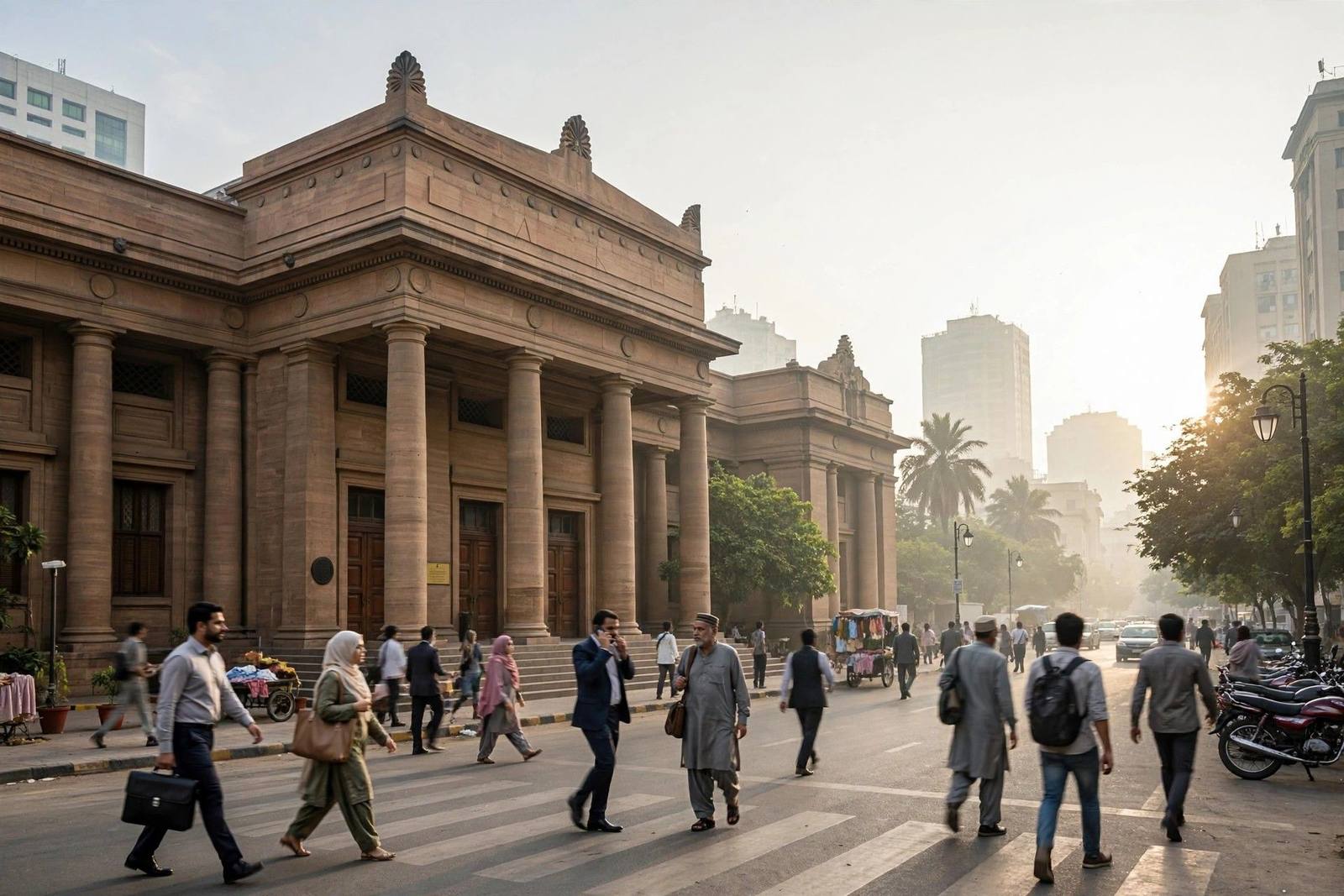
KARACHI: In a walled compound on Karachi's I.I. Chundrigar Road stands the institution that decides what money costs in Pakistan. The State Bank of Pakistan — founded at independence, banker to the government, supervisor of the banks, keeper of the reserves and issuer of every rupee note — touches a citizen's life more often than any ministry: in the interest rate on a loan, the exchange rate on a remittance, the survival of the bank holding a salary, and the inflation that sets the price of flour. Yet its daily work is largely invisible, conducted in committees, payment systems and inspection reports. This guide opens the building: what the State Bank actually does all day, how its parts fit together, and where its power honestly ends.
Origins and design: a central bank built with the country
The State Bank was established in 1948, in the first year of Pakistan's existence, taking over central-banking functions for the new state from the Reserve Bank of India and opening in Karachi — then the capital — under its first governor, Zahid Husain. Its founding statute has been amended repeatedly since, most consequentially in the autonomy reforms of the 1990s and the amendment of 2022, which strengthened its operational independence, clarified price stability as its primary objective, lengthened and protected the governor's tenure, and barred the monetary financing — direct central-bank lending to government — that had historically turned the printing press into a budget line. The design that emerges is the modern central banker's template, adapted to a fiscally hungry state: a governor and board, a statutory Monetary Policy Committee with external members, and accountability exercised through published statements, forecasts and parliamentary testimony rather than through instructions from the finance ministry. How completely that template binds in a crisis is the permanent exam question of Pakistani macroeconomics, examined in IMF programmes in Pakistan explained.
Job one: the price of money
The function the public knows is monetary policy. Roughly every six to eight weeks the Monetary Policy Committee meets to set the policy rate — the interest rate at which the Bank lends to the banking system against government paper — weighing inflation, growth, the external account and expectations in the framework explained in the SBP policy rate explained. The rate then propagates: through the interbank market and treasury-bill auctions into banks' deposit and lending rates, the government's own borrowing cost, the returns on the savings products households compare, and the discount rates at which the stock market values every future rupee — which is why a rate decision in Karachi moves portfolios in Lahore before the press release is an hour old. Implementing the decision is a daily craft, less visible than setting it: open-market operations that add or drain liquidity so the overnight rate trades near the target, reserve requirements on banks' deposits, and the standing lending and deposit facilities that fence the corridor. The Bank's economists publish the analysis behind decisions in monetary policy statements and inflation reports — documents worth reading in the original by anyone who wants to understand, rather than merely predict, Pakistani interest rates.
Job two: the reserves and the rupee
The State Bank holds Pakistan's official foreign-exchange reserves, manages them for safety and liquidity rather than yield, and stands at the centre of the foreign-exchange market whose workings the rupee exchange rate explained describes. Since the move to a market-determined regime, its role is formally not to fix a price for the rupee but to curb disorderly movement, supply and absorb liquidity, and regulate the market's participants — banks and the exchange companies it licenses, whose dollar counters in every bazaar operate under its rules. In practice the reserves themselves are the message: their level, published weekly, is the scoreboard on which import cover, programme reviews and the currency's credibility are read, and rebuilding them — through exports, remittances channelled by its incentive schemes, and the diaspora instruments such as Roshan Digital Accounts and Naya Pakistan Certificates, a companion guide in this series that the Bank built and markets — occupies as much of the institution's external diplomacy as its dealing room. The Bank also acts as the government's banker and debt manager in the domestic market, running the auctions of treasury bills and Pakistan Investment Bonds through which the state borrows from banks — the plumbing beneath Pakistan's government debt — and holds the accounts through which federal money moves.
Job three: watching the banks
The function citizens feel only when it fails is supervision. The Bank licenses banks, development finance institutions and microfinance banks; sets and enforces capital adequacy, liquidity and exposure rules in the Basel family; inspects on site and off site; approves fit-and-proper directors; runs the stress tests and the prompt-corrective-action ladder that tightens as a bank weakens; and operates, in the background, the lender-of-last-resort window and the deposit-protection scheme that insures small depositors up to a statutory limit. Its consumer-protection and banking-conduct work — complaint handling, disclosure rules, the push against mis-sold products — is the retail face of the same mandate. Alongside the conventional system it supervises the Islamic banking industry it has nurtured under a dedicated strategic framework, one of the world's largest experiments in running dual banking under one roof, whose market mechanics are covered in Islamic banking in Pakistan, a companion guide in this series. The boundary of this empire matters: non-bank finance, insurance and the securities markets belong to the SECP, and the two regulators divide the financial system between them.
Job four: the pipes — payments, currency and inclusion
Underneath the speeches, the Bank runs infrastructure. It operates the country's large-value settlement system through which banks settle with finality, oversees the retail payment landscape of cards, mobile wallets and branchless banking agents, and built Raast, the instant-payment system designed to make person-to-person transfers free and immediate — arguably the most consequential piece of public financial technology Pakistan has produced, and the rails on which remittances, gig-economy payouts and government transfers increasingly ride. It prints and manages the currency through its subsidiary arrangements, fights counterfeiting, and runs the unglamorous logistics of clean notes to every district. Its financial-inclusion programmes — agent networks, simplified accounts, women's banking initiatives, the national financial inclusion strategy — attempt the slow work of bringing a majority-cash economy into documented finance, against the informality described in Pakistan's informal economy.
Where the power ends
An honest guide closes with the limits, because Pakistani debate habitually assigns the Bank both more blame and more power than it holds. It cannot set the fiscal deficit that dominates its inflation outlook; cannot create the exports that would make reserves self-sustaining; cannot, under its post-2022 statute, simply finance the government when taxes fall short; and cannot protect the rupee's value against a current-account gap except by the expensive medicine of high rates and compressed demand. What it can do — and is judged on — is the quality of its reaction function: tightening early enough that inflation expectations stay anchored, communicating clearly enough that households and markets can plan, supervising firmly enough that no bank's failure becomes the public's crisis, and husbanding the reserves and the credibility that buy the elected government time to do the jobs only it can do. Read its statements with that job description in hand and the institution comes into focus: not the author of Pakistan's economic story, but the referee, scorekeeper and — on the worst days — the last functioning adult in the room.
This article is educational content, not financial advice, and it deliberately quotes no current policy rate or reserves figure: both are published by the Bank itself, the rate with each committee decision and the reserves weekly.
A day in the life, realistically imagined
To make the institution concrete, follow an ordinary working day assembled from its published functions. Before the markets open, the reserves and treasury teams have the overnight position: what the government's account holds, what maturities fall due, what the banks' liquidity looks like and whether an open-market operation is needed to keep the overnight rate honest. The exchange-policy desks watch the interbank dollar market's opening, the exchange companies' rates and the remittance inflows that arrive with the Gulf's morning. In the banking-supervision wings, examiners work through inspection cycles and the off-site returns — capital, classified loans, liquidity ratios — that flag tomorrow's problem bank while it is still a spreadsheet anomaly. The development-finance and inclusion teams run their slower projects: agent-network targets, SME and housing-finance schemes administered for the government, the statistics division compiles the balance-of-payments and monetary data on which every analyst in the country free-rides, and the currency offices move notes. Above it all, the governor's office manages the institution's true currency — credibility — in calls with the finance ministry, the Fund's reviewers, rating agencies and the banking presidents who will transmit, or quietly resist, the next policy decision. None of this is cinematic. All of it is the state working at its most technically competent, which is precisely why its failures, when they come, are so instructive.
The Bank and the market reader.
For readers of this site, the State Bank is also a primary source of the first rank. Its weekly reserves release, its monetary policy statements and data packs, its annual and quarterly reports on the state of the economy, and its financial-stability reviews are the documents from which honest commentary on Pakistani markets is built — and the discipline of reading them directly, rather than through the day's headlines, separates investors who understand the weather from those who merely feel it. When the Bank speaks about the current account, read its numbers beside those in our companion guides; when it warns about fiscal dominance or credit to government crowding out private borrowers, it is describing, in central-bank language, the binding constraint on the growth every portfolio needs.
There is a final, quieter function worth naming: memory. The Bank's archives, statistics and institutional continuity span every regime, programme and crisis since 1948, and its research and museum functions preserve the record of what was tried and what it cost. In a policy culture prone to repeating experiments under new names, an institution that can say — with data — 'this was done in 1998, and here is what happened' performs a service no single decision captures. It is one more reason the quality of its appointments and the protection of its independence matter to citizens who will never read a monetary policy statement: the referee's notebook is the game's only complete history.
That memory also disciplines the Bank's critics, this guide included. Judged against its own history — the directed-credit decades, the era when government borrowing from the printing press was routine, the crises when reserves were defended at indefensible prices — the modern institution is measurably more transparent, more rule-bound and more willing to publish its reasoning and its errors. The distance that remains, between that standard and the calm competence savers in richer countries take for granted, is the agenda its next decade will be graded on.
Key takeaway: The State Bank sets the price of money, guards the reserves and the rupee's market, supervises the banks and runs the payment rails — powerful over finance itself, but unable to substitute for the taxes, exports and discipline only governments can supply.