KARACHI: A car is written off in a Karachi pile-up, a warehouse catches fire in Faisalabad, a father in Lahore dies leaving school fees unpaid. In each case somebody must produce a large sum of money quickly, and for most of the world that somebody is an insurance company. But conventional insurance has long sat uneasily with many Pakistani savers: its contract sells an uncertain payout for a certain premium, it invests heavily in interest-bearing assets, and its profits belong to shareholders rather than the people who paid in. Takaful is the Islamic alternative built to answer those objections. It keeps the essential promise — the many protect the few when disaster strikes — but rebuilds the machinery underneath it as a cooperative pool, owned by its participants, managed by a licensed operator, and supervised for Shariah compliance. This guide explains how that pool actually works, rupee by rupee.
Why a different structure was needed at all
Start with the objections, because takaful only makes sense as a response to them. Scholars who reviewed conventional insurance raised three main concerns. The first is gharar, excessive uncertainty: a policyholder pays premiums for years and may receive nothing, or pays once and receives a fortune, and critics argue the exchange itself is too uncertain to be a valid sale. The second is maysir, gambling: the contract can look like a wager on whether misfortune occurs. The third is riba, interest: insurers typically invest their float in bonds and other interest-bearing instruments, a problem examined in our guide to riba. Whether one accepts each objection is a matter of scholarship and personal conviction, and takaful providers present their model as the structure that avoids all three.
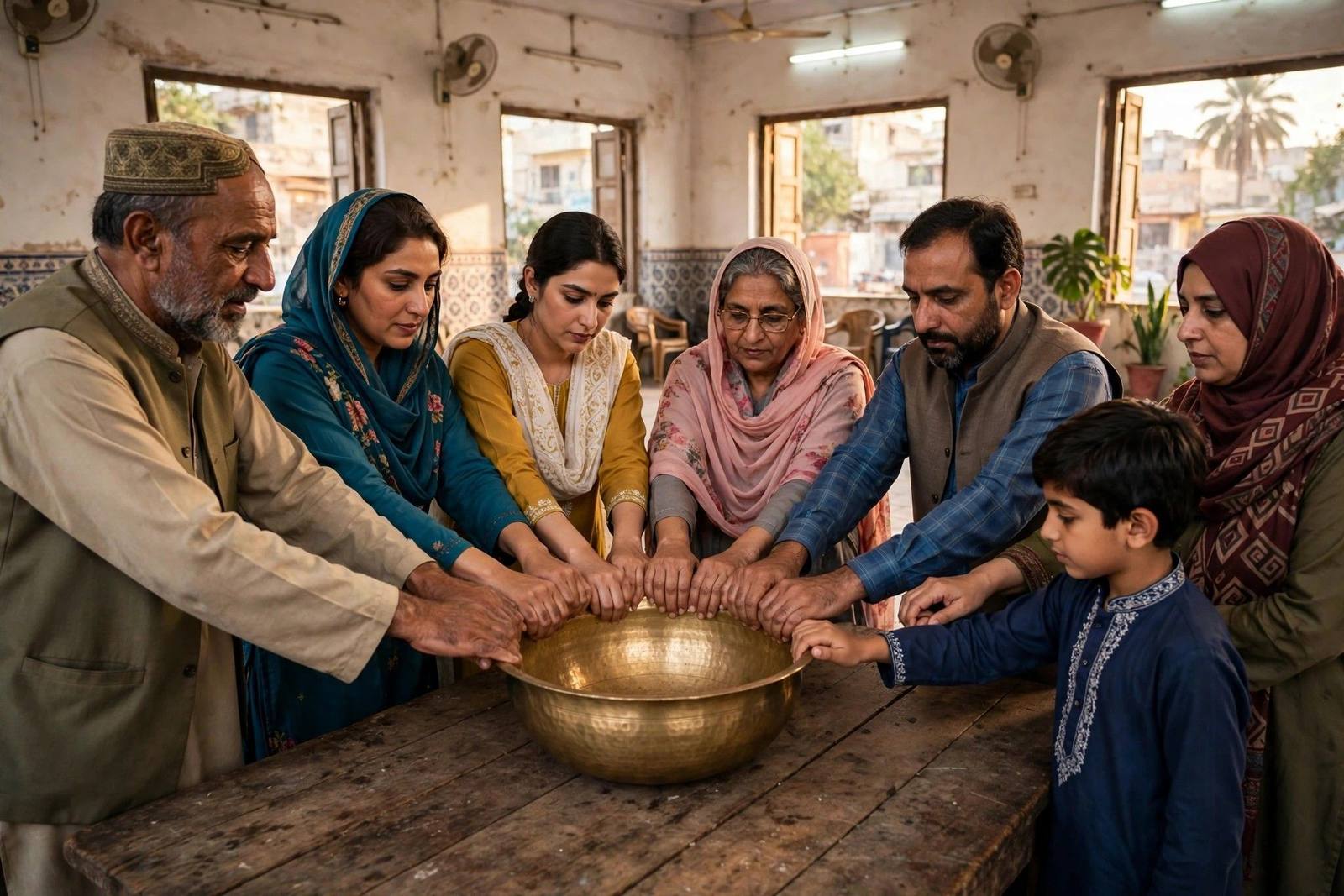
The avoidance works by changing what the payment legally is. In conventional insurance, your premium buys a promise from a company. In takaful, your contribution is structured as a donation — tabarru — into a common fund, made with the intention of mutual help. Because it is a donation to a pool you co-own rather than a price paid to a counterparty, the uncertainty objection is treated differently: nobody has sold you a payout, the participants have agreed to help each other from shared money. The word itself comes from the Arabic kafala, meaning guarantee or mutual support — participants, in effect, guarantee one another.
The pool: the Participants' Takaful Fund
The heart of the system is the Participants' Takaful Fund, often shortened to PTF. Every contribution you make flows into this fund (after the operator's fee, explained below), and every claim is paid out of it. Legally and in accounting terms the fund is segregated: it is not the operator's money, it cannot be used to pay the operator's office rent or shareholders' dividends, and it is invested only in Shariah-compliant assets — sukuk, Islamic funds, screened shares and similar instruments rather than conventional interest-bearing bonds. The fund's investments and underwriting are overseen with the involvement of a Shariah adviser or board, whose role in Islamic finance is described in our guide to Islamic banking in Pakistan.
Two consequences follow from the pool design, and both surprise people used to conventional policies. First, if the fund ends a period with a surplus — contributions and investment returns exceeded claims and reserves — that surplus belongs to the participants, not the company. Depending on the operator's stated policy and its Shariah board's approval, surplus may be distributed among participants, held back as a buffer for bad years, or partly shared with the operator as a performance incentive. Second, participants bear the pool's fortunes collectively. A conventional insurer that misprices its policies hurts its shareholders; a takaful pool that misprices hurts the fund its own members own, which is why pricing discipline and honest disclosure by the operator matter so much.
The operator: agent, partner, but never owner of the pool
If participants own the fund, who runs the business — sells the policies, assesses claims, invests the money? That is the takaful operator, a company licensed by the Securities and Exchange Commission of Pakistan under the Takaful Rules. The operator is paid through transparent contracts rather than by quietly pocketing the difference between premiums and claims. The most common arrangement in Pakistan is a hybrid of two classical contracts. Under wakala, agency, the operator acts as the participants' agent for underwriting and administration and charges a stated fee, usually a percentage of contributions. Under mudaraba, the operator acts as investment manager of the fund's assets and shares the investment profit in an agreed ratio, as explained among the contracts in our guide to murabaha, ijara and musharaka.
The operator's own money sits in a separate Shareholders' Fund, which pays the company's expenses, holds its capital and earns the wakala fees and its share of investment profit. This separation is the single most useful thing to grasp when reading a takaful company's accounts: two funds, two owners, two purposes. It also creates a distinctive incentive question that honest guides should not hide. A conventional insurer profits when claims are low, which can tempt it to resist claims. A takaful operator paid mainly by fee has less direct gain from refusing a valid claim — the claim is paid from the participants' pool, not its pocket — though it still has every reason to police fraud, because a leaky pool harms the members it serves and its own reputation.
When the pool runs short: deficits and the qard
Pools can have bad years. A flood season, a spate of factory fires or a pandemic can push claims above contributions. Takaful handles this with an instrument called qard-e-hasan, an interest-free loan from the Shareholders' Fund to the Participants' Fund. The operator lends its own money to cover the deficit, and the loan is repaid only out of future surpluses of the pool — if those surpluses never fully materialise, the operator's shareholders absorb the pain. The mechanism matters because it answers the sceptic's question — who stands behind the promise? — without recreating a conventional guarantee: support exists, but it is a benevolent loan, not an interest-bearing one, and repayment is contingent on the pool recovering.
Around this core sits retakaful, the equivalent of reinsurance, where operators cede part of their risk to retakaful companies so that one catastrophic event cannot drain the pool. Pakistan's market also has a state reinsurer in conventional lines, and the wider insurance landscape includes listed insurers whose groups an investor meets on the exchange. For the participant, the practical point is simpler: a well-run operator combines sound pricing, adequate reserves, retakaful cover and a Shariah-compliant investment book, and its annual report should let you see each of those.
Family takaful versus general takaful
Takaful comes in the same two broad families as conventional insurance. General takaful covers things: motor vehicles, fire and property, marine cargo, engineering projects, health and accident risks, usually for a year at a time. Family takaful — the counterpart of life insurance — covers people over long horizons: protection for dependants if the participant dies, savings-and-protection plans, education plans and retirement arrangements. In family takaful each participant's contributions are typically split between a protection element flowing to the shared pool and an investment element held in individual participant investment accounts, invested in Shariah-compliant funds, so a maturity value builds alongside the cover. The contrast with conventional life products — endowment policies, unit-linked plans and their traps — is drawn in our guide to life insurance in Pakistan.
Motor cover is where most Pakistanis actually meet takaful, often through their bank or dealer, and the mechanics of cover types, third-party liability and claims are the same territory covered for conventional policies in our guide to car insurance in Pakistan. The differences a buyer should actually compare are not theological alone: compare the contribution, the wakala fee level where disclosed, the surplus-distribution policy, the claims process and the operator's financial strength — the same consumer discipline as any insurance purchase, plus the Shariah governance that is the product's reason to exist.
Takaful in Pakistan: windows, licences and the listed names
Pakistan's takaful sector developed under SECP supervision through dedicated Takaful Rules, first issued in the 2000s and comprehensively revised since, which set licensing, fund segregation, Shariah governance and reporting requirements. The market includes standalone takaful companies — dedicated family and general operators — and, significantly, window takaful operations: conventional insurers permitted to run takaful windows alongside their conventional books, provided the funds, accounting and Shariah oversight stay strictly separate. Window operations brought takaful distribution into the branch networks of established insurers and are a large reason the sector's contributions have grown from a small base.
Investors meet the sector through listed insurers whose groups include takaful arms — the EFU and Jubilee families, among others, operate window or dedicated takaful businesses beside their conventional companies — and through the reports those groups publish. When reading such a group, separate the takaful segment from the conventional segment before judging either: growth rates, combined ratios and surplus treatment differ by design, and a group total can hide a small, fast-growing takaful book inside a large conventional one, or the reverse.
The sector's growth story is ultimately a distribution story. Takaful struggled for years as a niche sold by specialists; window operations put it on the shelf of every major insurer, bancatakaful put it into bank branches beside conventional bancassurance, and employer health schemes introduced thousands of salaried Pakistanis to the word through their medical cards. Scholarly endorsement matters to adoption in a way it does not for most financial products: many participants choose an operator partly on the standing of its Shariah board and the clarity of its annual Shariah report, documents worth reading before purchase. The SECP's published industry statistics, released for the insurance sector as a whole, let a careful reader track how contributions, claims ratios and surplus treatment are evolving across operators rather than relying on any single company's advertising.
A worked picture ties the machinery together. Imagine a general takaful pool with ten thousand motor participants, each contributing for a year's cover. The operator deducts its disclosed wakala fee to run the business; the remainder enters the Participants' Fund and is invested in sukuk and Islamic money-market instruments. Through the year, accident claims, thefts and third-party liabilities are assessed and paid from the pool, retakaful absorbs the largest shocks, and reserves are set aside for claims incurred but not yet reported. At year-end the fund's position is struck: if contributions and investment income exceed claims and reserves, a surplus exists and is handled exactly as the policy documents and Shariah board direct; if a deficit exists, the shareholders' interest-free loan bridges it. No participant can tell in advance which year they have joined — which is, of course, precisely the uncertainty the pool exists to share.
Choosing a policy like an owner, not a customer
Because you are, structurally, a part-owner of the pool, choose like one. Ask what the wakala fee is and how surplus is treated — distributed, reserved, or shared, and on whose approval. Ask how claims are decided and how long settlement typically takes, and check the operator's licensing on the SECP's registers. For family plans, separate the protection contribution from the investment contribution in your own mind, and judge the investment side by the same standards you would apply to any Islamic fund: what it holds, what it charges in total, and how it has behaved in falling markets. Beware any agent who sells takaful purely as an investment with insurance as a footnote, or who promises returns: the pool structure removes interest and the conventional insurance contract, it does not remove investment risk, inflation or the possibility of a hard claims year.
Takaful is best understood as Pakistan's insurance market rebuilt around a cooperative idea: risk shared by donation into a common fund, managed for a disclosed fee, invested without interest, and backstopped by an interest-free loan when the pool runs short. It is neither magic nor merely conventional insurance with Arabic vocabulary — the ownership of the fund, and of its surplus, genuinely sits in different hands. This article is educational content, not financial advice.
Key takeaway: In takaful your contribution is a donation to a participants' fund that you co-own — claims and surpluses belong to the pool, the operator earns a disclosed wakala fee for managing it, and deficits are covered by an interest-free qard from shareholders.