KARACHI: Ask a Pakistani homeowner which paint tin they remember from childhood and Berger is one of the names that comes back. The brand has been selling paint in Pakistan since 1950, three years after the country itself was created, and it was the first organised paint company in the new state — importing premium products from Britain before it built factories of its own. Since then Berger Paints Pakistan has painted the full arc of Pakistani building: the post-Partition housing of Karachi, the factories of the industrial decades, the apartment towers and housing societies of the modern city, and millions of ordinary bedrooms repainted before Eid, a wedding or a new tenant. On the Pakistan Stock Exchange it trades as BERG, a small but unusually long-lived member of the chemicals sector, and its story is really the story of how a British paint name became a Pakistani household one.
Two centuries of Berger, seven decades in Pakistan
The Berger name itself is far older than Pakistan. The company's own histories trace the global Berger business back roughly two centuries, to British paint-making that eventually sat inside Jenson & Nicholson Limited in the United Kingdom. That lineage matters because Berger Paints Pakistan began as an outpost of it. The Pakistani company was incorporated on 25 March 1950 as a private limited company, and Berger's own account describes it as the first organised paint company to offer premium products in Pakistan, initially through imports from the United Kingdom.
The timing was not accidental. Pakistan in 1950 was building everything at once — government offices, mills, cantonments, refugee housing — and almost all of its manufactured goods still came from abroad. A paint importer with a British parent could sell quality and consistency to a market that had neither a local coatings industry nor the standards bodies to police one. Berger's early job was therefore as much about setting a benchmark as about selling tins: architects, contractors and government engineers learned what a branded, factory-made paint was supposed to do from products like these.
Local manufacture followed quickly. Berger established its first Pakistani manufacturing facility in Karachi in 1955. Moving from importing finished paint to making it changed the economics completely: lower landed costs, formulations adapted to local conditions — fierce sun, coastal salt air in Karachi, dust, monsoon damp — and a reason to build the dealer and applicator networks that still define how paint is sold in Pakistan. The company also says it was the first paint company in Pakistan to set up its own resin production facility, resin being a core ingredient of paint that most makers would otherwise have to buy in. Vertical steps like that, taken early, are part of why the brand survived when competition multiplied.
1974: a public company, and a change of control
Berger Paints Pakistan became a public limited company in 1974. In that year, according to the company's own history, 49.38 per cent of its shares were acquired by Pakistani investors, while the remaining 50.62 per cent stayed with the UK parent, Jenson & Nicholson. The detail is worth pausing on: the early 1970s were the years of nationalisation in Pakistan, when banks, insurance and large industry were taken into state hands. Berger was not nationalised, but the 1974 shareholding change put a substantial Pakistani stake alongside the British parent — a halfway house between a foreign subsidiary and a local company, at exactly the moment when that balance had become politically and commercially sensible.
Control later passed again. Slotrapid Limited, a company registered in the British Virgin Islands with diversified business interests, acquired control of Berger Paints Pakistan by gaining about 52 per cent of its shares, and Slotrapid remains the holding company named in the company's PSX profile. So the modern Berger is neither a state firm nor a straightforward subsidiary of a global paint giant: it is a listed Pakistani manufacturer controlled by an offshore holding company, licensing and collaborating internationally while being run from Lahore. That structure shapes how followers of the stock read it — the brand and technology links are international, but the profits, risks and governance are Pakistani.
What Berger actually makes and sells
Paint sounds like one product. In practice Berger's catalogue, as the company describes it, covers most of the places a coating can go. The best-known side is decorative paint — interior and exterior emulsions, enamels and finishes for homes and commercial buildings, sold in tins through dealers and chosen, ultimately, by families arguing over colour cards. Around that sit harder, more technical businesses: automotive paints and vehicle refinishes for car plants and workshops; general industrial finishes and protective coatings for factories, steel and infrastructure; powder coatings; road and runway markings; marine and government work; construction chemicals; printing inks; and adhesives.
Berger says it built parts of that range through technical collaboration agreements with international manufacturers — arrangements it lists with, among others, a major Japanese paint company for automotive, vehicle refinishes and industrial paints, a Japanese chemical company for bumper paints, Belgium's Protech Oxyplast for powder coatings, Malaysia's DPI for road and runway markings, and Cerachem for construction chemicals. These collaborations explain how a mid-sized Pakistani maker offers product lines that would be expensive to develop alone: the formulations and standards come through partners, while manufacture, distribution and service stay local.
The physical footprint grew with the market. In 2006 Berger established a modern manufacturing facility in Lahore, and its head office is now in Lahore. Regional sales offices in Karachi, Lahore, Islamabad and Multan, backed by a large sales team and a wide network of dealers and distributors, serve urban centres across the country. The geography mirrors Pakistan's construction map: Karachi, where it started; Punjab, where most building happens; and the northern cities reached from Islamabad.
How a paint company makes money
The revenue logic is simple to state and hard to execute. Berger sells volume — litres of paint — through dealers, distributors, project contractors and institutional buyers, at prices that have to cover raw materials that are among the most globally exposed in Pakistani manufacturing. Titanium dioxide, resins, solvents and pigments are petrochemical- or mineral-linked and substantially imported, so the rupee's value and world commodity prices run straight through Berger's cost line. When the currency falls, the tin on the shelf becomes more expensive to make long before the company can raise its price to a homeowner who is already postponing the repaint.
Against those costs, a paint maker has three levers. The first is mix: premium decorative lines, automotive and industrial coatings carry better value per litre than basic economy paint, which is why Berger's breadth matters. The second is distribution — paint is heavy, bought locally and often chosen on a dealer's advice, so shelf presence in thousands of shops is a genuine asset. The third is the contractor and painter ecosystem: in Pakistan the person applying the paint heavily influences the brand bought, and manufacturers invest in training, tinting machines and painter loyalty accordingly. Readers comparing Berger with other listed chemical businesses will find the same import-cost pattern at producers such as Sitara Chemical Industries, though the products and customers differ entirely.
Demand, meanwhile, is a derivative of building. New housing, commercial construction and infrastructure drive first coats; repainting drives the steady replacement market; car production drives automotive volumes. That makes Berger a quiet proxy for the construction cycle — the same cycle that moves cement and the steelmakers profiled elsewhere in this series, from Amreli Steels downwards. When interest rates are high and construction slows, paint volumes feel it within quarters.
Strengths, risks and the honest caveats
Berger's clearest strength is time. A brand present since 1950, trusted by dealers and specified by architects, cannot be bought quickly by a new entrant, and the company's claim to the most comprehensive product range across price points reflects decades of line extensions rather than a single launch. Local resin production, two manufacturing bases and international technical tie-ups add operational depth behind the brand.
The risks are equally structural. Raw-material imports expose margins to currency and commodity swings the company cannot control. The decorative market is intensely competitive, contested by multinational subsidiaries, strong local makers and a large informal sector of cheap unbranded paint that wins whenever household budgets are squeezed. Construction downturns cut volumes. And because Berger is a relatively small listed company with a controlling shareholder holding about half the shares, the free float available to trade is limited — the PSX profile puts the free float at about 40 per cent — which tends to make the share price move in jumps when it moves at all, rather than in a smooth daily flow. None of this is a verdict; it is the standard list of things a careful reader of Berger's annual reports checks first.
The name on the PSX
BERG sits in the exchange's chemical sector alongside fertiliser, polymer and gas names that are much larger than it, which is why beginners often overlook it: in index terms Berger is a minnow, and it is not the stock that moves the KSE-100. What it offers a student of the market instead is legibility. One brand, one country, a handful of product families and a cost base you can explain in a paragraph — few listed companies let a new investor practise reading annual reports on something this understandable. Berger has also paid cash dividends in a number of years, in the uneven pattern typical of smaller cyclical manufacturers: payouts follow profitable years rather than arriving like a utility's rent, and anyone studying its dividend record should read it as a history of the construction cycle as much as of the company.
There is a useful comparison close at hand. Like Pakistan Oxygen, Berger is a former foreign-owned industrial name that passed into new controlling ownership while keeping its brand, plants and listed status — a common Pakistani pattern in which the signboard outlives the shareholder. Understanding that pattern helps explain a large slice of the older end of the PSX.
What kind of investor studies Berger
Berger tends to be studied by patient, fundamentals-first investors: people interested in consumer-adjacent manufacturing, brand value and the construction cycle, who are comfortable holding a smaller, less liquid share and reading results half-year by half-year. The observation points are consistent — volume growth against construction activity, gross margin against the rupee and raw-material prices, the balance between decorative and industrial sales, dealer network health, and whether dividends resume or grow after strong years. It is also a natural teaching stock for the ideas in the Aktzien learning library: pricing power, input-cost pass-through and why small listed companies trade differently from giants. This article is educational content, not financial advice.
Paint in everyday Pakistani life
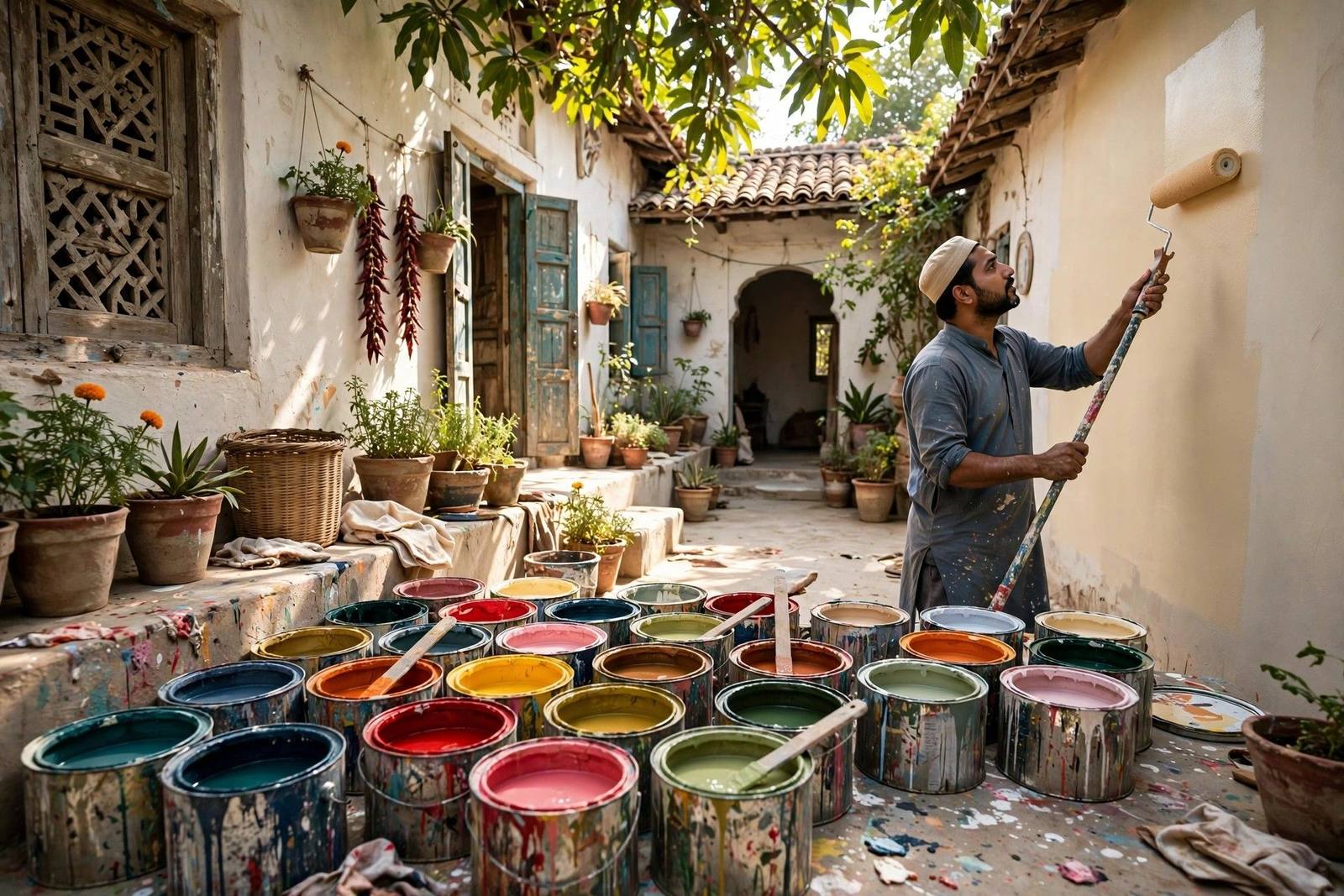
It is easy, reading financial pages, to forget what paint actually is in Pakistan: a household event. Repainting clusters around the rhythms of life — before Eid, before a daughter's wedding, when a flat changes tenants, when a shop is refitted or a school is reopened. The famous seasonal rush puts Berger's dealers, tinting counters and painter networks under pressure at predictable points of the year, and the brand's visibility in that ritual — the tin carried home on a motorbike, the colour card fanned out on a bed — is advertising no campaign can buy. Industrial paint has its own quieter presence: the finish on a locally assembled car, the coating on a gas cylinder, the lines on a runway or a city road all come from product families Berger lists among its businesses. A company can be systemically unimportant and socially ubiquitous at the same time; Berger is a good example, and that ubiquity is precisely what has carried the name from the import counters of 1950 to the paint aisles of today's hardware superstores.
Key takeaway: Berger Paints Pakistan has sold paint in Pakistan since 1950 — importing first, manufacturing in Karachi from 1955 and Lahore from 2006, going public in 1974 and now controlled by Slotrapid — and its fortunes still rise and fall with imported raw-material costs and the Pakistani building cycle.