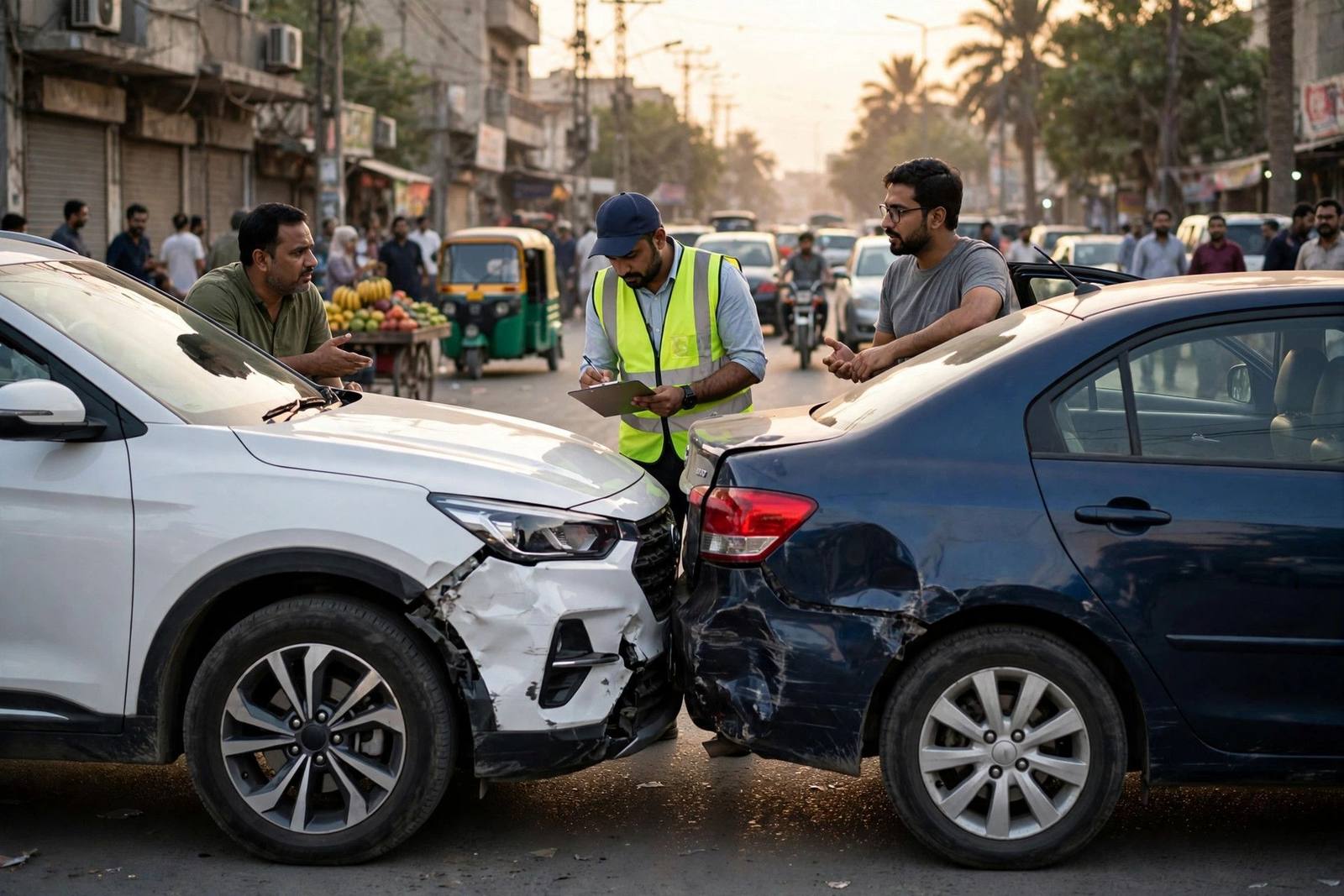
KARACHI: Every car on a Pakistani road is legally required to carry insurance, and a large share carry almost none in any sense that would survive an accident. The certificate exists — often bought in minutes at the point of registration or financing, chosen by price alone — but what it promises, what it excludes and what it actually pays when two cars fold into each other on Shahrah-e-Faisal is a mystery to most of the drivers holding it. Motor insurance in Pakistan divides into two fundamentally different products sharing one name: third-party cover, which pays for the damage you do to others, and comprehensive cover, which also pays for your own car. The price gap between them is enormous, the protection gap larger, and the claims experience — assessors, depreciation deductions, workshops, delays — decides what either is worth. This guide explains both products, the legal floor beneath them, and the claims reality that glossy premium quotations omit.
The legal floor: third-party liability and why it exists
Motor insurance begins as a legal obligation rather than a consumer choice. Pakistan's motor vehicles law framework has long required vehicles on public roads to be insured against third-party liability — the death, injury and property damage your vehicle causes to others — a requirement carried forward in modern provincial motor vehicle legislation and enforced, in principle, at registration, transfer and roadside checks. The logic is social, not commercial: an accident victim's compensation should not depend on the driver's personal solvency, so the law forces every driver into a pool that guarantees at least this layer. The product that satisfies it, third-party-only insurance, is priced accordingly cheaply — a small annual premium reflecting that the insurer's exposure is limited to claims others bring against you, and paying nothing, ever, toward your own car's repair.
The floor's thinness shows in practice. Third-party cover in Pakistan has historically been sold as a compliance artefact — the cheapest certificate that satisfies the requirement — with sums insured and enforcement that lag the real costs of modern accidents, where a single collision can generate third-party vehicle damage alone exceeding the modest limits of bargain policies. Victims' recovery in serious injury cases runs through legal processes few households can sustain, and in practice much accident cost in Pakistan is settled by negotiation at the roadside, family pressure and out-of-pocket payment regardless of what the certificates say. None of this makes third-party cover worthless — it is the law, it does respond to liability claims, and it is infinitely better than driving uninsured, which exposes the driver to personal liability and legal consequences — but the buyer should hold no illusions: third-party-only is a legal shield against claims from others, sized modestly, and your own car remains entirely your own problem. Drivers of financed vehicles have the question settled for them, as lenders require comprehensive cover; it is cash buyers, and owners of older cars, who face the real choice.
Comprehensive cover: what the premium actually buys
Comprehensive — in market language, "full" insurance — adds own-damage protection to the third-party base: accidental damage to your car, fire, theft, and, depending on the policy, flood, earthquake, riot and strike damage and terrorism extensions that Pakistan's risk environment has made standard talking points at renewal. The premium is calculated principally as a percentage of the car's insured value, with rates varying by insurer, vehicle type, age and use, and tracker requirements layered on for theft-prone categories: insurers commonly require an approved tracker in financed and higher-value vehicles, its cost borne by the owner, as a condition of theft cover. Add-ons proliferate at the margin — rent-a-car during repairs, personal accident cover for occupants, depreciation waivers where offered — each priced, each to be judged on whether the underlying risk is real for you.
The concept a comprehensive buyer must master is insured declared value and depreciation, because together they decide every claim. You insure the car for a value — ideally its current market value, since under-insuring scales claims down and over-insuring buys premium without payout, the insurer never paying more than the car's worth. Then, at claim time, the insurer deducts depreciation on replaced parts according to the policy's schedule, which rises with the car's age: new parts in an old car are treated as betterment, and the owner funds the difference. This single mechanic explains most "the insurance paid only half" stories in Pakistan: the policy performed as written, on parts priced new, depreciated per schedule, minus the policy excess — the first slice of each claim the owner always bears. A buyer who understands depreciation and excess before the accident experiences the claim as arithmetic; a buyer who learns them at the workshop experiences it as betrayal. Neither the rate nor the brand tells you this; the policy schedule does, in tables that take four minutes to read.
Takaful, the players and where policies are sold
Motor is where most Pakistanis meet the insurance industry at all: it is the largest line of the general insurance market regulated by the SECP, written by a roster of general insurers — from the sector's founding names profiled in our PSX company pages, such as EFU General, to Adamjee, Jubilee General and a long competitive tail — alongside general takaful operators and window operations running the cooperative model explained in our guide to takaful. Distribution runs through agents, banks arranging cover on financed cars, dealers bundling first-year policies into the purchase, and increasingly direct digital channels whose comparison screens have made premium shopping easier while leaving claim-quality comparison as hard as ever. The financed-car channel deserves the note sounded in our guide to car financing: where the bank's panel supplies the insurance, the buyer may have limited insurer choice in year one — but at renewal within the loan, and entirely after it, shopping the market is the owner's right and recurring saving.
Price competition in motor insurance is real and useful, but the product is a claim, so the comparison must include the insurer's claims reputation: the speed and fairness with which it assesses, approves workshops and pays. Fellow owners, workshops and agents all hold this knowledge informally; ask them, because a premium five per cent cheaper from an insurer famous for attrition is the expensive policy wearing a discount. Policy wording differences also matter in the small print — whether the policy is comprehensive or "third-party, fire and theft" in disguise, whether parts replaced are new or the policy permits quality used parts on older vehicles, the list of panel workshops, and the territorial and use restrictions that can void cover for commercial use of a privately insured car, a trap awaiting owners who quietly put their vehicles on ride-hailing work without endorsing the policy.
The claims reality: from accident scene to settlement
A claim begins in chaos and must be converted, by the owner, into process. The sequence that protects you: inform the insurer promptly through its helpline or app — policies set notification windows, and delay is a standard ground of friction — and, where injury or significant third-party damage is involved, ensure the police report is filed, since insurers require it for theft and for liability events. The insurer appoints a surveyor, the loss assessor who inspects the vehicle, photographs damage, and authorises repair scope before work begins; repairs started without survey and approval are repairs the insurer may decline to recognise. Choose the workshop with the claim in mind: panel workshops bill the insurer directly for the covered share, while non-panel repairs typically mean pay-first, claim-later reimbursement against the surveyor's assessment — slower, and exposed to deductions you could have negotiated in advance.
Settlement arithmetic then applies the policy's mechanics in order: approved repair cost, minus depreciation on parts per the age schedule, minus the excess, minus any under-insurance scaling, equals the insurer's payment — with theft claims following a separate, slower track involving police final reports, waiting periods for recovery, tracker records and transfer of the vehicle's ownership documents to the insurer on payment. Read the final offer against your policy before accepting; surveyors and workshops are professionals in a negotiation the amateur joins once a decade, and the SECP's complaint channels, the insurer's own grievance process and the insurance ombudsman framework exist for claims that curdle into disputes. The recurring verdict of experienced owners is unfashionable and consistent: buy from an insurer whose claims you have seen handled, keep the car insured at honest value continuously — a lapsed year restarts no-claims benefits and invites inspection and loading on return — and treat the policy document, not the agent's summary, as the contract you purchased.
Theft and total loss: the slowest claims of all
Two claim types test a policy — and its owner — beyond the workshop routine. In a theft, the claim moves at the speed of investigation rather than repair: immediate notification to insurer and police, the FIR, tracker records where fitted, a waiting period during which recovery remains possible, and the police final report before settlement discussions conclude. The insured value, not the price of a replacement car in an inflated market, caps the payment, and owners who under-insured to save premium meet the shortfall personally at the worst moment. In a total loss — accident or fire damage whose repair cost approaches the car's value — the insurer may settle on a total-loss basis, paying the insured value less excess and the salvage value of the wreck, whose ownership and disposal then matter financially and must be settled in writing. Both tracks share one lesson with the repair claims: documentation is the currency. Service records, the original policy and endorsements, tracker certificates, both keys where the policy expects them — files assembled in calm times are what convert a total loss from a negotiation about facts into a settlement about figures. Owners should also note the treatment of accessories and modifications: undeclared additions are routinely outside cover, while declared ones belong in the insured value from the start.
Should a cash owner buy comprehensive? The honest maths
For owners free to choose, the decision is an expected-value judgement about their own car and street. Comprehensive earns its premium where the car's value is high relative to household savings, where the vehicle is financed (mandatory anyway), parked insecurely, driven daily in dense traffic, or irreplaceable in the family's working life — the car that takes a father to the job and children to school concentrates risk worth transferring. It earns less where the car is old and low in value: depreciation schedules consume claims, premiums as a percentage of a shrunken value buy shrinking absolute protection, and the rational owner self-insures repairs from a savings buffer while keeping robust third-party cover — noting that some insurers decline comprehensive on older vehicles entirely, or price it punitively, which is the market delivering the same verdict. Add the family's own variables honestly: a household with a full emergency fund can absorb a repair the uninsured household cannot, so insurance and savings substitute for each other at the margin, and the young family's scarce rupees may be better sequenced — third-party plus buffer first, comprehensive when the car's value or the loan demands it.
Whichever cover stands on the car, complete the stack deliberately. Third-party liability is not optional and should never be the cheapest fiction available, because liability to others is the one risk no household can size in advance — a family can price its own fender, not a stranger's injuries. Personal accident cover for occupants, where not bundled, fills the human gap that metal-focused policies ignore, and connects to the wider protection review in our life insurance guide. And keep the documents alive: renewed on time, value updated to market, tracker subscription paid, insurer's claim number saved in the phone of everyone who drives the car. Insurance fails at the edges of administration far more often than at its centre. This article is educational content, not financial advice; premium rates, depreciation schedules and coverage terms vary by insurer and change over time, so decide from the actual policy schedule and the insurer's current wording, not from the certificate's reassuring existence.
Key takeaway: Third-party cover satisfies the law and pays others; comprehensive also pays you — minus depreciation and excess, at the car's honest value — so buy claims quality and correct cover for the car's real value, and keep the policy continuously alive.