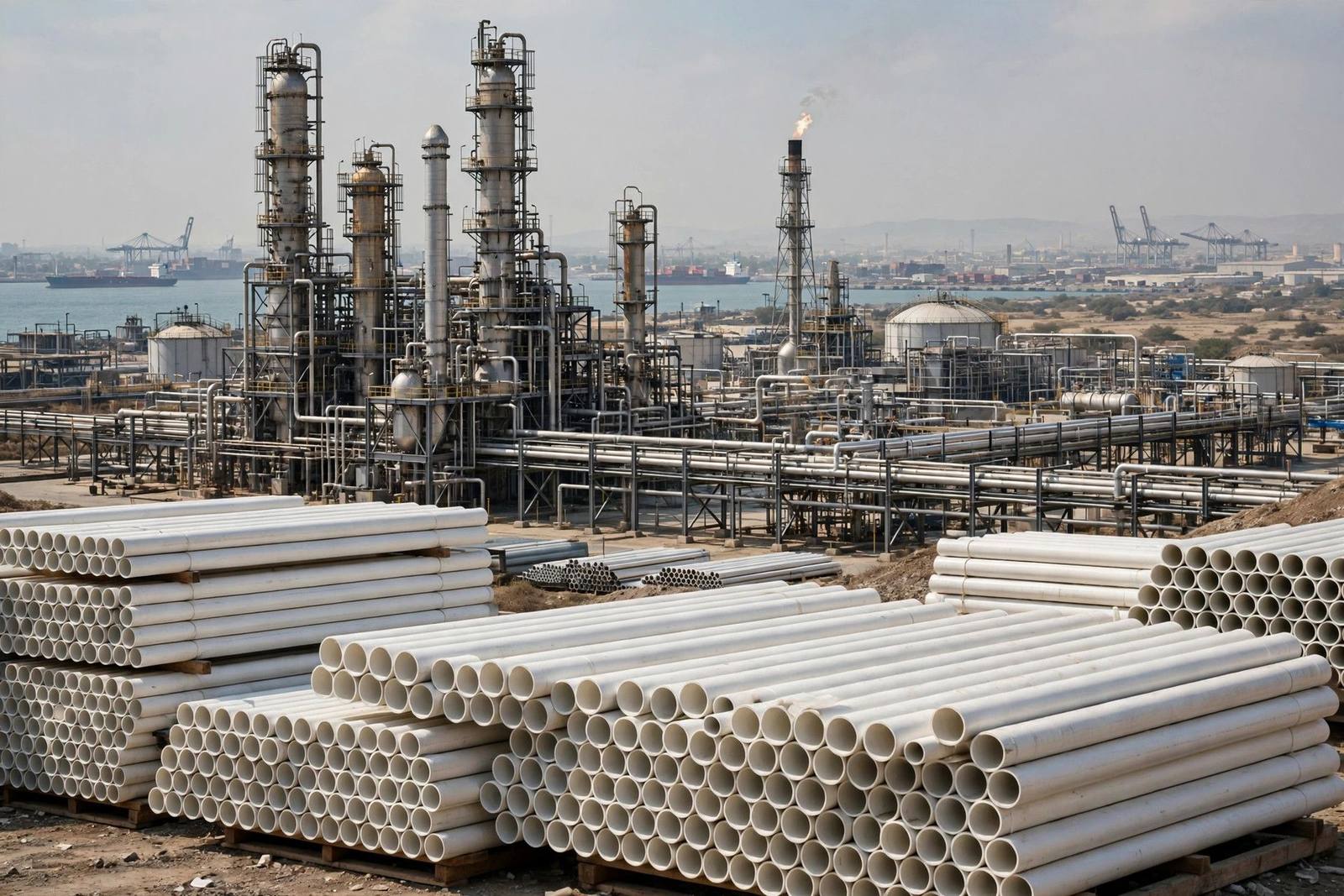
KARACHI: Every PVC pipe in a Pakistani water line, every length of cable insulation, every pair of synthetic-leather shoes begins, if it was made in Pakistan, in one place: Port Qasim. Engro Polymer & Chemicals — EPCL on the Pakistan Stock Exchange — is the country's only producer of PVC resin, the white powder that processors turn into pipes, fittings, cables, footwear and film. A monopoly is a strong word and the company prefers "sole producer", but the economic fact is the same: if Pakistan's construction and agriculture sectors want PVC, this plant is where the domestic supply starts.
A joint venture is born: 1997 to 1999
EPCL was founded in 1997 within Engro Chemical Pakistan, the fertiliser-rooted Engro group, as a deliberate step into petrochemicals. In November 1997 Engro signed a joint venture with two Japanese partners — Mitsubishi Corporation and Asahi Glass Company — to build a suspension-grade PVC plant at Port Qasim, near Karachi. The financing tells you how 1990s Pakistan built big industry: a project of about $80 million, funded with equity split roughly half to Engro and the rest to the Japanese partners, and debt shared between the International Finance Corporation, the Commonwealth Development Corporation and local and foreign banks.
Production began in 1999 at a plant engineered for 100,000 tonnes of PVC resin a year — output that replaced imports one-for-one, since every tonne of Pakistani PVC demand had previously been bought abroad. The resin was marketed under the SABZ brand, and the venture traded as Engro Asahi Polymer & Chemicals, carrying its Japanese parentage in its name.
Backward integration and the Engro name
The first plant polymerised imported vinyl chloride monomer (VCM), the chemical halfway point between basic feedstocks and finished resin. The decisive second act came in 2006, when EPCL commissioned its chlor-vinyl complex: in-house production of VCM at a scale of roughly 204,000 tonnes a year, together with chlorine capacity, lifting PVC capacity to about 150,000 tonnes. Making your own monomer rather than importing it changes the business — more capital at risk, more process to run, but control of the cost chain and of supply security.
The same period tidied the shareholding and the name: Engro acquired Asahi Glass's stake, the company became Engro Polymer & Chemicals Limited, and Mitsubishi remained as the significant Japanese shareholder. In 2008 the company listed on the Karachi Stock Exchange through an initial public offering — bringing the public into a business that had, by then, nearly a decade of operating history. Later expansion announcements, including the PVC and caustic soda growth projects unveiled from 2018 onwards, have kept the Port Qasim site on the same trajectory: bigger, and more integrated.
What the Port Qasim complex actually makes
Start with salt, water and power. The chlor-alkali side of the complex electrolyses brine to produce chlorine and caustic soda. Chlorine combines with ethylene-derived intermediates to make EDC, then VCM, then — by polymerisation — PVC resin. Caustic soda, the co-product of electrolysis, is sold in its own right to soap, textile, paper and chemical buyers. Around that spine sit related ventures in plasticisers, peroxide and PVC products that the group has housed in subsidiaries over the years, including businesses trading under names such as Think PVC.
The customer list is an economy in miniature. Pipe makers serving housing, sewerage and tube-well irrigation take the largest share of resin; cable makers insulate wire with it; footwear, artificial leather, packaging film and medical and household goods take the rest. That is why PVC demand is such a clean proxy for Pakistani construction and consumer manufacturing — a fact that shapes everything about how EPCL's earnings behave, as the sector map in our guide to chemical stocks on the PSX sets out.
Ownership: Engro's chemicals arm
EPCL is a subsidiary of Engro Corporation, which has held a majority stake of a little over half the shares, with Mitsubishi Corporation retaining a significant minority and the balance held by institutions and the public. For group context — how Engro grew from a single fertiliser plant into Pakistan's defining conglomerate — our profile of Engro's holding company and the explainer on how Engro makes money are the natural companions to this one.
Majority control by a strong parent brings EPCL professional management systems, group treasury support and a long investment horizon. It also means strategy — expansions, leverage, dividend upstreaming — is set with the group's needs in view. Single-product companies rarely survive as independents in petrochemicals; inside Engro, EPCL's cycles can be carried by a balance sheet larger than its own.
How the money is made: the PVC margin
Petrochemicals earnings are, at core, a spread. On one side stands the international price of PVC, set in Asian markets where giant Chinese and regional producers trade; on the other, EPCL's cost of making it — ethylene-linked feedstocks, chlorine, and above all energy, since electrolysis is electricity-hungry work. The gap between the two, the PVC margin, widens and narrows with global cycles that no Pakistani management controls. When Asian PVC prices spike — a plant outage in China, a construction boom — EPCL's integrated cost base turns the windfall into profit. When global prices sag, the same plant defends itself with scale, integration and its home-market logistics advantage.
Caustic soda adds a second, steadier leg whose price moves on its own textile-and-soap demand logic, and the chlorine balance disciplines the whole complex: chlorine must go somewhere — into VCM, into hydrochloric acid and other derivatives — so the plant's operating rate is an exercise in balancing co-products, not simply maximising one output. Exchange rates matter throughout: resin is priced with reference to import parity in dollars, while a large share of costs are rupee costs, so currency weakness can flatter rupee earnings even in flat global markets.
Strengths, risks and controversies
The strengths are singular: the only domestic PVC resin plant, backward integration into VCM and chlor-alkali, an established SABZ brand with technical support for processors, and Engro's sponsorship. A local monopoly in an import-substituting product, protected by the freight and duty structure around imported resin, is a genuinely privileged market position.
The risks match it. PVC is a single-product exposure to one global price. Energy costs can erase the margin advantage. Safety and environmental performance at a chlorine-handling complex is a permanent, serious obligation — chlor-alkali chemistry tolerates no casualness — and the industry everywhere operates under scrutiny for the environmental footprint of PVC itself. Monopoly positions also invite policy attention: the tariff protection that shelters domestic resin is a political decision, revisited in budget after budget, and downstream processors lobby against it as energetically as the producer defends it.
The name on the PSX and the investor who studies it
EPCL listed in 2008 and trades among the larger chemical names, followed by institutional research in a way most mid-cap chemicals are not — its results are read as a proxy for construction demand and for the global PVC cycle simultaneously. Dividends have been paid in profitable periods, varying with the margin cycle and the group's expansion funding needs; the mechanics of any payout are covered in our guide to how PSX dividends work.
The investor who studies EPCL learns to watch Asian PVC prices, ethylene costs, domestic pipe demand and the gas and power tariffs that feed its cost line. This article is educational content, not financial advice. A sole-producer petrochemical is neither a utility nor a lottery ticket: it is a well-defended plant riding a global commodity spread, and it should be analysed as exactly that.
PVC in everyday Pakistan — and the import question
It is worth pausing on how completely this one plant underpins a material. PVC pipe is the default for water supply, sewerage and drainage in Pakistani construction, and for the pressure pipe that lifts groundwater in agriculture; PVC insulation wraps the wiring of the same buildings; PVC film, footwear and leather-cloth clothe and package the economy that lives in them. Before 1999 all of that resin arrived by ship, paid for in dollars, hostage to freight rates and import policy. Since 1999 the processors' first call has been Port Qasim, and the economic debate has inverted: the question is no longer whether Pakistan can make PVC, but at what protected price it should — the tariff on imported resin that shelters EPCL is simultaneously a tax on every pipe maker, and both sides of that argument appear, in their respective vocabularies, in every budget season's lobbying.
For the investor, the import-parity frame is the analytical key. EPCL does not price in a vacuum: its resin competes, at the customer's gate, with the landed cost of Chinese, Korean or Middle Eastern resin plus duty. Its margin therefore widens not only when world prices rise but when freight rates spike or the rupee falls — anything that raises the import alternative — and narrows when world markets are long and shipping is cheap. Add the second leg, caustic soda, whose buyers sit in textiles and soap rather than construction, and you have a company whose two products watch different cycles: in a weak year for building, caustic can carry the complex; in a global PVC squeeze, resin does the heavy lifting alone.
Reading the results, then, means reading spreads, not sales. Note the production volumes by product, the commentary on Asian PVC pricing, the energy cost line that electrolysis dominates, and the utilisation of the VCM and chlorine chain that disciplines how much resin the site could make if demand called for it. A petrochemical plant's accounts are a weather report from markets in Shanghai and Jubail as much as in Karachi — which is precisely what makes EPCL unlike any other chemical name on this exchange.
The subsidiaries and side ventures around the core deserve a mention in any complete reading, because petrochemical groups rarely stay inside one fence. Over the years EPCL's perimeter has included plasticiser production, hydrogen peroxide through an associated venture, and downstream PVC-products ambitions under group branding — the pattern of a resin maker repeatedly tempted, sensibly, to secure demand for its own molecule by helping the industries that consume it. Each such venture is small beside the Port Qasim complex, and each should be weighed that way: as optionality around a single great asset, not as diversification away from it. The company's centre of gravity was, is, and for the foreseeable future remains the chlor-vinyl chain on the Port Qasim shore — and the quality of an investment analysis of EPCL is measured by how directly it confronts that chain's spreads, energy costs and protected market, rather than by how much else it finds to talk about.
One more structural point completes the picture: demand development was part of the founding design, not an afterthought. A country that imports all its resin has few processors and thin applications; a local plant with technical-service staff has every reason to teach pipe makers new grades, promote PVC windows and doors, and help small processors standardise quality — growing its own market in the process. EPCL's early literature is explicit about that mission, and the depth of Pakistan's present PVC-processing industry, thousands of small and mid-sized factories deep, is partly its monument. Monopoly, in this telling, was also market-making.
For the new reader, a closing practical note: EPCL reports on a December financial year, unlike most of the June year-end industrials around it — a small calendar fact that matters when comparing quarters across the chemical sector. Align the periods before comparing the spreads, and the company's rhythm against global PVC reporting becomes considerably easier to follow.
That market-making role continues in quieter forms today, in application development and processor support up and down the country — the sole producer's long shadow, cast over an industry it called into being.
Key takeaway: EPCL is Engro's Port Qasim petrochemical — founded in 1997 with Mitsubishi and Asahi Glass, producing since 1999, integrated back to chlorine and caustic soda — and Pakistan's only PVC resin maker, earning the spread between global PVC prices and its integrated local costs.