KARACHI: Not every cement company on the Pakistan Stock Exchange is a giant, and Flying Cement is the proof a beginner needs that the market also lists the small, the simple and the single-kiln. Flying Cement Company — FLYNG — runs one plant at Mangowal in Khushab district, Punjab, on a site of about 127 acres, with mining land measured in thousands of acres around it. It makes ordinary Portland cement by the dry process, sells it into the northern market, and offers investors something the big diversified groups cannot: a business you can understand in an afternoon, for better and for worse.
From Zaman Cement to Flying Cement
The company was incorporated on 24 December 1992 as a public limited company, originally under the name Zaman Cement Company Limited, and is listed on the Pakistan Stock Exchange. Its registered office is in Lahore, while the factory sits in Khushab — the classic Pakistani split between the counting house in the provincial capital and the kiln where the limestone is.
The 1992 incorporation date places its birth in the decade when Pakistan's cement industry was being privatised and re-imagined, but the plant's operating life belongs to the following era: the great capacity expansion of the 2000s, when rising demand, easier credit and new Chinese equipment lines redrew the industry's map and a generation of mid-sized plants — Flying among them — joined a market previously dominated by older state-built works. The later adoption of the Flying name, shared with the wider Flying group of industries around the sponsors, completed the rebranding from Zaman to the identity the market now trades.
One kiln at Mangowal
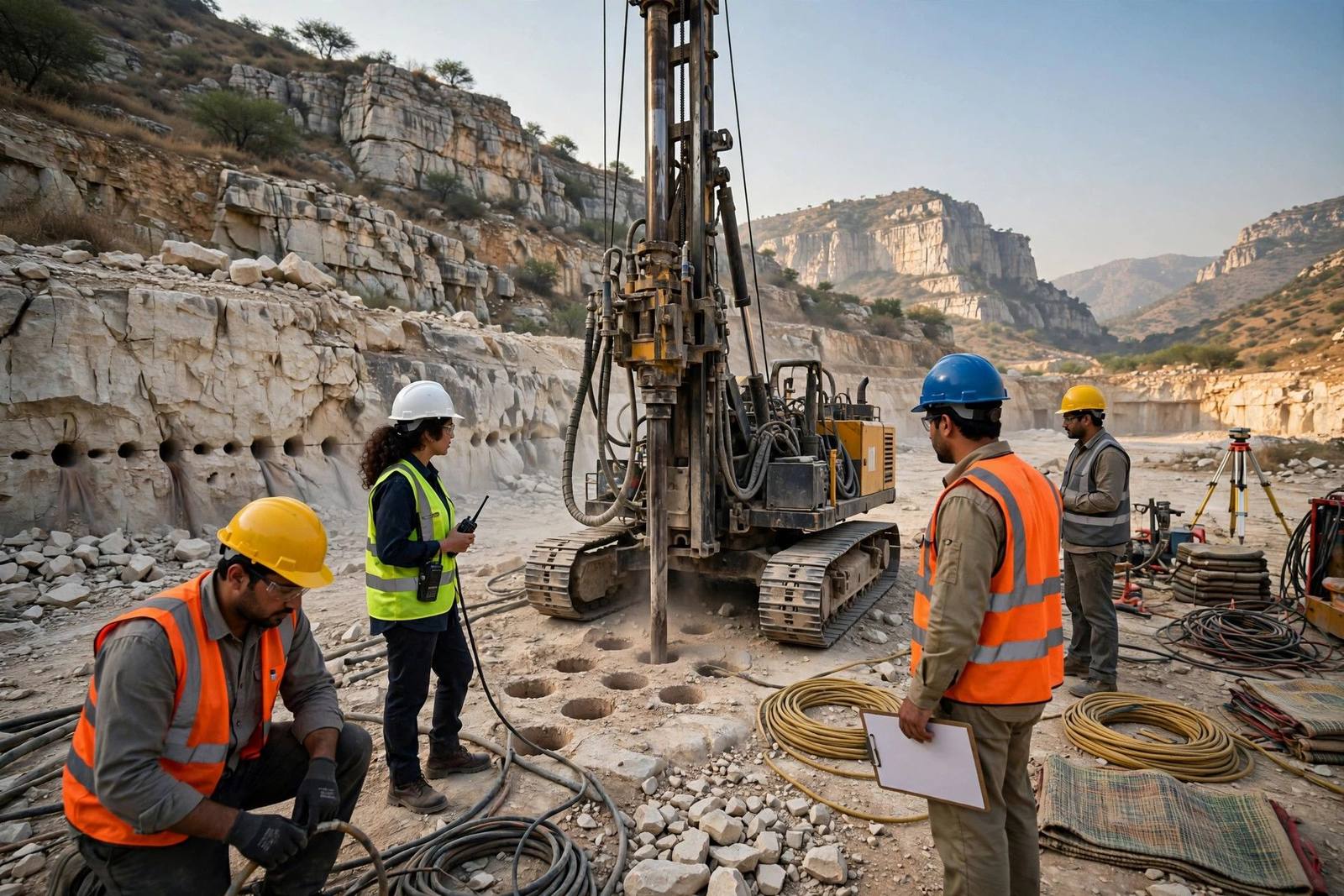
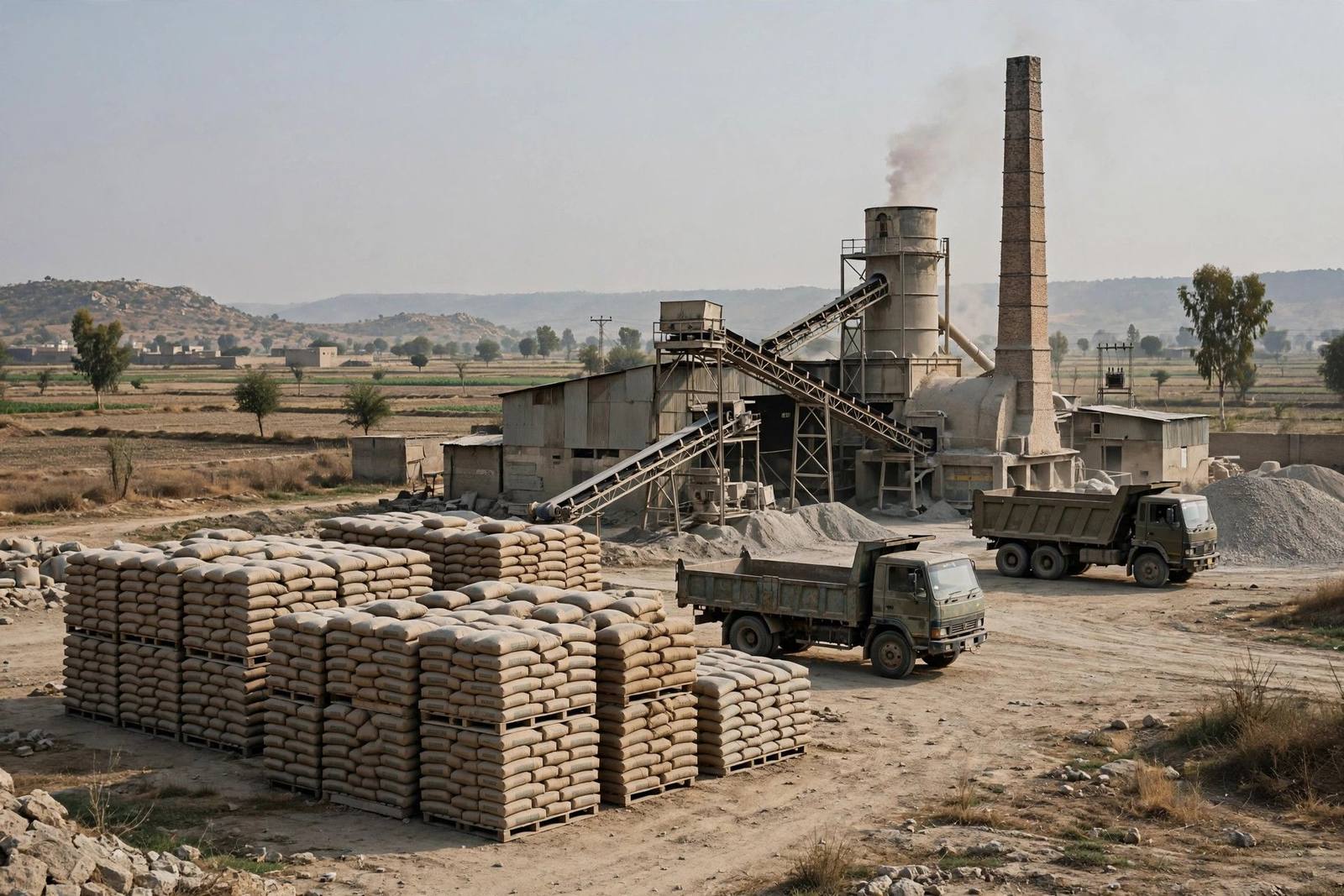
The Mangowal plant is built around a single kiln with installed clinker capacity of about 4,000 tonnes per day, producing Portland grey cement by dry-process technology. Around it sits the asset that ultimately matters most: a mining area of roughly 4,000 acres allocated for limestone and clay, which the company has described as carrying a useful life of more than a century at its planned consumption rates. Cement plants are, in the end, a licence to convert a particular hill into bags over decades; Flying's hill is not running out.
Single-kiln simplicity defines everything else. There is no second line to carry production through a shutdown, no coastal jetty for exports, no grinding unit in another province. What there is, is focus: one process to optimise, one cost structure to defend, one regional market to serve. In the industry geography set out in our guide to cement stocks on the PSX, Flying sits among the smaller northern producers, competing for the same central-Punjab demand as Gharibwal Cement to its east and the larger groups beyond.
Ownership and the Flying group
Flying Cement sits within the orbit of the Lahore-based Flying group of industries, whose interests have included paper and other manufacturing ventures alongside cement. As with many mid-cap Pakistani listings, effective control rests with the sponsoring family and its associates, and the public float is the minority partner in someone else's industrial project. That is neither indictment nor endorsement — it is simply the governance fact a shareholder should start from, checking the pattern of shareholding in the annual report to see who actually decides on expansion, debt and dividends.
Credit assessors have followed the company over the years — PACRA has rated it in the single-A category for long-term debt in published profiles — a reminder that even smaller cement makers are substantial borrowers, because kilns are bought with other people's money in every country on earth.
How a small northern plant earns its keep
The revenue model needs no diagram: limestone and clay are quarried, ground, burned into clinker with coal, milled with gypsum into cement, and sold — bagged for the retail and dealer trade that dominates Pakistani construction, or in bulk where buyers take it. Flying's market is the construction demand within economical trucking distance of Khushab: the towns and cities of central and northern Punjab, where its bags compete shelf by shelf, or rather stack by stack, with those of Pioneer Cement and Kohat Cement and every other northern brand.
Profit is decided by three spreads. The first is price over fuel: coal, whether local, Afghan or imported, is the kiln's appetite and the P&L's largest variable. The second is volume over fixed cost: a 4,000-tonne-a-day line carries the fixed weight of its staffing, maintenance and debt whether it runs full or half, so capacity utilisation is the single most revealing number in any half-year report. The third is the freight spread: every kilometre a bag travels costs money the maker or the buyer must absorb, which is why small plants live or die on the health of construction in their own districts rather than the national average.
Strengths, risks and the small-cap reality
Flying's strengths are its long-life raw material, a modern dry-process line rather than an inherited antique, and the strategic patience a single-plant sponsor can show — it does not need to chase national share, only to run its kiln well in its own territory. In strong northern demand years, that formula has produced perfectly respectable economics, and the expansion logic of adding grinding or clinker capacity remains available to it as it does to every holder of a good quarry.
The risks are the industry's risks without the big groups' shock absorbers. A kiln breakdown or an extended maintenance stop is a total, not partial, production event. Coal and currency shocks land on a smaller equity base. Northern overcapacity, when the giants discount into its districts, squeezes the small maker's retention price first. And the share itself trades as small caps trade on the PSX: turnover can be thin for long stretches, prices can gap on modest orders, and exiting a large position is a project, not a click. None of that makes the company uninvestable; all of it belongs in position sizing.
The name on the PSX
FLYNG is classified in the cement sector and sits well outside the KSE-100 heavyweight tier — exactly the segment of the market where company-specific research matters most, because analyst coverage is sparse and the annual report is often the only serious document available. Its dividend history, like most expansion-minded cement makers', has been subordinate to capital spending and debt service rather than run as a steady income promise. New readers should ground themselves in the mechanics — announcements, book closures, payment through the CDC — in our guide to how PSX dividends work before reading anything into a single year's payout.
What kind of investor studies FLYNG
Flying Cement is a stock for the investor who deliberately shops in the market's quieter aisles: comfortable reading a small company's accounts closely, tracking northern dispatches and coal costs, and accepting thin liquidity as the price of admission. It is also an excellent teaching case, precisely because there is so little to hide behind — one plant, one product, one region. This article is educational content, not financial advice. Master the analysis here — quarry, kiln, fuel, freight, float — and the larger, louder cement names become variations on a theme you already know.
The 2000s expansion era, in context
To understand why a company incorporated in 1992 belongs to the 2000s story, recall what that decade did to Pakistani cement. Demand climbed with remittance-fuelled housing, motorway and dam building and a credit boom; capacity that had been scarce became abundant as new lines — many Chinese-built, many in the northern limestone belt — commissioned one after another; and the industry's centre of gravity shifted decisively towards large, modern, dry-process plants of exactly the type installed at Mangowal. Smaller and older works that could not match the new lines' fuel efficiency were squeezed, merged or closed. Flying Cement's plant was born into that competitive settlement: efficient enough to earn its place, small enough that its place had to be defended district by district.
The decades since have tested the model in both directions. In the industry's fat years — infrastructure pushes, housing booms, export openings — a single well-run line prints money, because its fixed costs are few and its quarry is paid for. In the lean years of high interest rates and stalled construction, the same simplicity means there is no second business, no property arm, no export jetty to lean on; the P&L is the northern cement price, full stop. Investors who held the large diversified groups through those swings were cushioned by grinding units in two zones and power or paper sidelines. Flying's holders were not, and were compensated, when the cycle turned, by the purity of the recovery in a stock the market had priced for the trough.
Reading a small cement maker's accounts.
Three habits serve the reader of FLYNG's reports. First, dispatches before profits: tonnes sold, and the utilisation they imply against the 4,000-tonne-a-day line, explain most of any result before a single price is discussed. Second, the fuel paragraph: which coals the kiln burned, and at what landed cost, is the margin story in miniature, especially for an inland plant paying freight on every imported tonne. Third, the debt schedule: small cement makers expand and modernise in lumps, and the distance between a comfortable balance sheet and a strained one is usually one expansion loan meeting one demand downturn — the directors' commentary on repayments and any rescheduling is never boilerplate in a company of this size.
Add a fourth, governance habit: read the shareholding pattern and related-party notes for the wider Flying group's footprint, since group companies share directors, sometimes services, and occasionally ambitions. None of this requires forecasting genius. It requires only the willingness to treat a small annual report as a complete text — in a thinly covered stock, the reader who does the reading owns the informational edge.
Khushab itself adds a final context. The district is better known nationally for heavy water and atomic-age associations than for cement, but its limestone and its position between the Sargodha, Mianwali and central-Punjab markets make it rational kiln country: close enough to demand to sell, far enough from rivals' home districts to hold a territory. Flying's plant draws its workforce, its contractors and much of its dealer network from that region, and its payroll and purchases are a real, if unheralded, part of the district economy. Small listed industrials all over Pakistan play that double role — market security in Karachi or Lahore's exchange, economic anchor in a district town — and Flying is a clean example of the type: locally significant far beyond what its market capitalisation would ever suggest, and nationally legible only to investors willing to do the small-cap reading.
Simplicity, finally, is a governance fact as well as an operating one. With one plant and one product, there is nowhere in Flying's accounts for complexity to hide: no web of subsidiaries, no unrelated diversifications, no cross-holdings to unpick. What the sponsors earn, they earn from cement made at Mangowal, and what the minority shareholder owns is a defined fraction of exactly that. In a market where some listed industrials require a diagram before they require an opinion, a company that can be drawn on an index card has a transparency that deserves to be counted among its assets.
For the new reader, a closing practical note: FLYNG reports on a June financial year, in the same results season as the rest of the cement sector, and the comparison habit matters more than any single figure — tonnes, retention and fuel cost against the northern mid-caps for the identical quarter. Small stocks reward that discipline disproportionately, because so few other readers bother to apply it.
One kiln, one quarry, one region — and, for the reader who masters it, one complete education in how Pakistani cement actually works.
Key takeaway: Flying Cement is a single-kiln Khushab producer — incorporated in 1992 as Zaman Cement, reborn under the Flying name in the 2000s expansion era — whose investment case is the northern cement cycle in its simplest, most concentrated form.