KARACHI: Every index has a newest member, and in Pakistan's benchmark that distinction currently belongs to a company its shoppers know better than its investors do. Image Pakistan Limited — IMAGE — entered the KSE-100 in the index recomposition that took effect on 1 October 2026, the newest textile name in the benchmark. Women browsing its stores in Karachi, Lahore or Islamabad know it as a fashion label: embroidered fabrics and ready-to-wear clothing, heavy with the chikankari and schiffli work that define Pakistani festive dressing. Behind the shopfront sits a listed Karachi manufacturer incorporated in 1990, whose history runs from industrial embroidery through a discontinued yarn business to a focused, brand-led apparel company. Its arrival in the index is a small case study in how Pakistan's market is changing — consumer brands now sit in the benchmark alongside banks, cement plants and oil fields.
Incorporated in 1990, renamed for its brand in 2021
Image Pakistan Limited was incorporated in Pakistan as a public limited company on 14 November 1990, and its shares are listed on the Pakistan Stock Exchange. The company's own financial statements record a telling milestone: it changed its name to Image Pakistan Limited on 15 March 2021. Renamings usually signal a strategic tidying, and here the logic is visible in the shops — the listed company took the name of the consumer brand it sells under, aligning the corporate identity with the label customers already recognised. Where earlier filings described the business in industrial terms, the renamed company presents itself as what it had become: a branded apparel and embroidered-fabric house.
The registered office and manufacturing facilities are at S.I.T.E., Karachi's oldest industrial estate — a reminder that for all its retail polish, Image remains a manufacturer first. From that base it operates retail outlets, owned and rented, across Karachi, Lahore, Islamabad, Rawalpindi and Peshawar, a footprint that maps neatly onto Pakistan's urban middle-class shopping geography.
What Image makes: embroidery as a specialisation
The company's stated principal activity is the manufacture and sale of embroidered fabric and ready-to-wear garments, together with polyester filament yarn — a segment whose operations, the accounts note, have remained discontinued. That footnote is part of the story: the modern Image is the business that remained after an older, industrial yarn sideline was set aside, and its centre of gravity moved decisively toward value-added, design-led products.
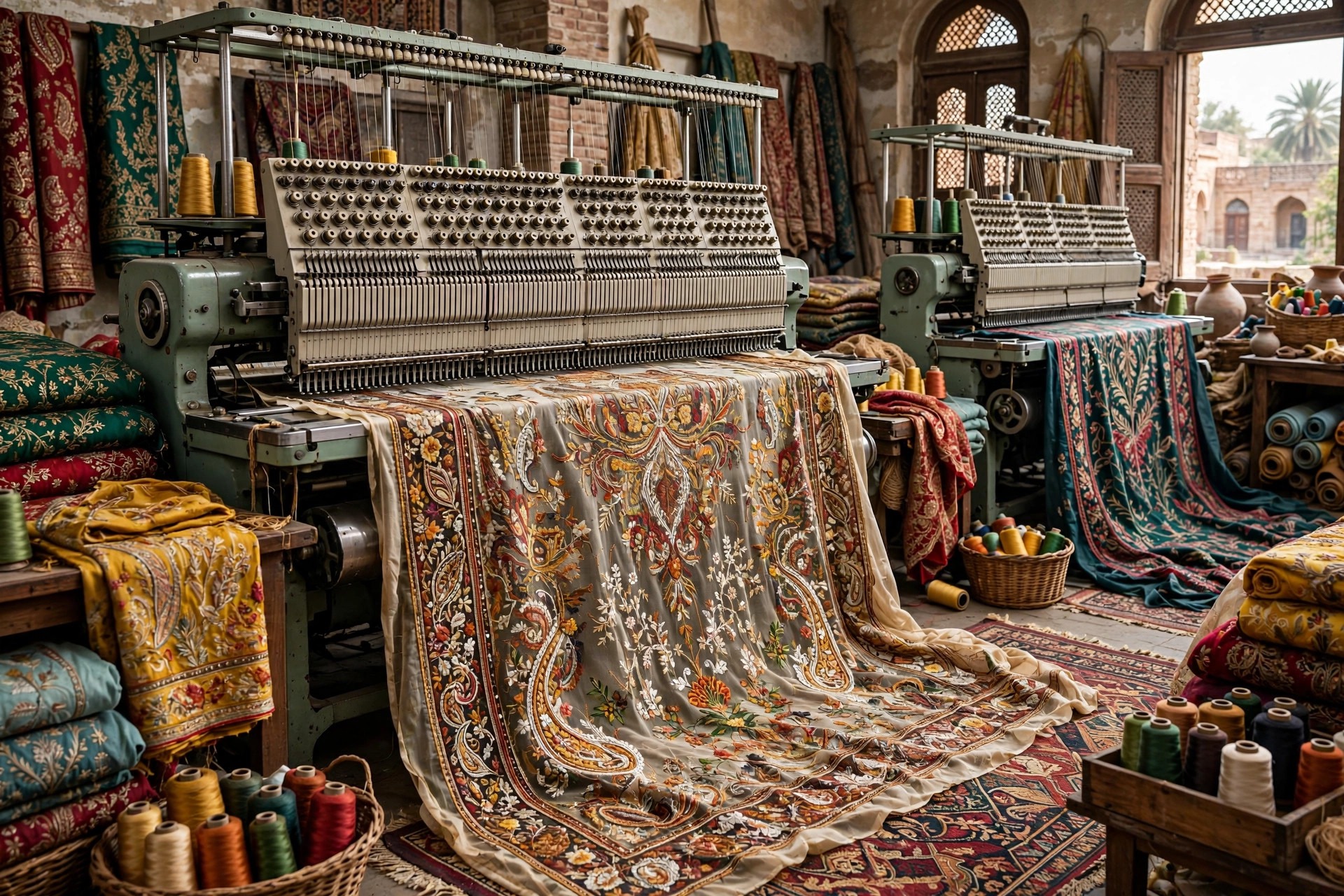
Embroidery is a genuine specialisation, not a decoration added at the end. Two machine technologies dominate. Schiffli machines embroider across wide fabric widths with hundreds of needles at once, producing the all-over embroidered lawn and chiffon that anchor Pakistani summer and festive collections. Multi-head machines handle smaller, precise motifs — necklines, borders, panels — with flexibility for shorter runs. Image's own product world, as presented to customers, spans signature embroidered collections including chikankari and cutwork, daily-wear lines, printed ranges and luxury lines, sold as unstitched fabric, as ready-to-wear outfits, or in the traditional three-piece format. The distinction between unstitched and ready-to-wear is economically important: unstitched embroidered fabric is a distinctly Pakistani retail category with no real equivalent in Western high streets, while ready-to-wear captures more of the value chain — design, stitching, finishing and branding — inside the company.
A 2021–22 expansion programme shows how the company invested behind that model. Image raised funds through a rights issue completed in September 2021, applying the proceeds to install additional schiffli and multi-head embroidery machines — reducing reliance on outsourced embroidery — to open new outlets in several cities, and to meet working-capital needs. In the same period the company publicised its status as an approved seller on Amazon as Pakistan opened to the marketplace, and announced plans for a wholly owned technology subsidiary to pursue government incentives for technology businesses and e-commerce. The direction across all three moves was consistent: more production in-house, more channels to the customer, and more of the margin kept within the group.
How a branded apparel company makes money
Image's revenue model differs from most of Pakistan's textile sector, and the difference is the point. The classic Pakistani mill sells yarn or grey fabric to other businesses, at home or abroad, on thin conversion margins. Image sells finished, branded products to end consumers, through its own stores and online. Each embroidered outfit carries not just fabric, thread and stitching costs, but design, brand, retail rent and the customer's willingness to pay for a label she trusts for Eid and wedding season. Branded retail margins are structurally higher than commodity textile margins — and structurally more exposed to consumer mood, fashion risk and markdowns on unsold seasonal stock.
The cost stack runs: base fabric and embroidery thread; the embroidery process itself, where machine hours are the scarce resource; stitching and finishing for ready-to-wear; and the heavy distribution layer of a retail business — store rents, staff, packaging, marketing and e-commerce delivery. Seasonal rhythm dominates: collections are designed and produced months ahead of the selling seasons they target, so working capital swells with inventory before each peak, and the quality of a season's design bets is only revealed when the tills report back. The discontinued yarn segment is a useful contrast inside the same accounts — a reminder of the commodity business the company chose to leave behind as the branded model took over. Among PSX textile stocks, Image is the outlier that behaves partly like a consumer retailer, which is precisely why analysts describe it differently from the spinning and weaving names.
Joining the KSE-100 in October 2026
Image's admission to the KSE-100 took effect on 1 October 2026, in the periodic recomposition of the index based on the review period covering March to August 2026, as reported by Mettis Global in September 2026. It entered alongside Bank Makramah, Nishat Chunian Power and Thatta Cement, while four other names departed. Index entry is not a prize for virtue; it is a mechanical outcome of the rules — free-float market capitalisation and trading liquidity over the review period — set out in how the KSE-100 is calculated, and the turnover of members is explained in KSE-100 index rebalancing explained.
Still, membership changes a company's market life. Index funds and benchmark-aware investors must hold it, research coverage tends to deepen, and the shares become part of the daily conversation about "the market" in a way a small-cap retail name rarely is. For a company of Image's size relative to the benchmark's giants, it also brings scrutiny: quarterly results, governance and disclosures are now read by an audience that includes institutions which never previously covered embroidered fabric. Whether that attention proves comfortable depends on execution — the index door revolves at every review, and members that shrink or stop trading actively can leave as mechanically as they arrived.
Stores, screens and the festive calendar
Image's retail rhythm follows Pakistan's social calendar. Demand for embroidered clothing peaks around Eid al-Fitr, Eid al-Azha, the winter wedding season and the launch of summer lawn collections — the annual ritual in which Pakistani women's-wear brands unveil printed and embroidered ranges to queues of loyal customers. A branded house like Image plans its year backwards from those peaks: designs finalised months ahead, embroidery capacity booked on its schiffli and multi-head machines, fabric and finished garments distributed to stores from Karachi to Peshawar, and marketing concentrated into the few weeks when the country's wardrobes are decided. The financial statements inherit that rhythm — inventory builds before the peaks, cash returns after them — which is why single quarters can mislead and full-year comparisons matter for this company more than most.
The second channel is the screen. Image built an e-commerce operation alongside its stores and publicised, in 2021, its position as an approved seller on Amazon as Pakistan was added to the marketplace's seller countries — an early attempt to take a distinctly Pakistani product, embroidered eastern wear, to the global diaspora and beyond. Its announced plan for a wholly owned technology subsidiary in the same period pointed the same way: management saw the brand's future growth lying partly in digital reach rather than only in new physical outlets, each of which carries rent and staffing costs in expensive retail locations. For a company of Image's size, the blend matters: stores provide trust, fitting and the tactile experience embroidered fabric demands; online provides reach into cities — and countries — where it will never open a shop.
There is a cultural footnote worth recording. Embroidered fabric is one of the few Pakistani consumer categories where local brands face no foreign competition of consequence: the product itself — its cuts, motifs and occasions — is indigenous. Image's competitors are other Pakistani labels, from listed peers' brands to a swarm of private and social-media-native labels. In that contest, manufacturing depth is a genuine edge: a pure retailer must buy embroidery capacity in a crowded market before Eid, while Image owns its machines. The 2021 rights issue that funded additional schiffli and multi-head capacity was therefore not routine expansion; it was the company buying control over the scarcest input in its own business model.
Governance and scale form the counterweight to the growth story. Image is, by the standards of the index it has joined, a small company, with the concentrated ownership and modest free float typical of Pakistani family-controlled listings. Its shares' trading liquidity — one of the very criteria that carried it into the benchmark — will be tested in quieter markets, and its cost base now includes the compliance and reporting obligations of a company under institutional scrutiny. None of that diminishes the achievement of the October 2026 recomposition; it simply defines the next examination. A brand that delighted shoppers was enough to reach the KSE-100. Staying there is a financial discipline, renewed at every review.
It is worth pausing on what "textile composite" — Image's official index sector classification — conceals in this case. The classification groups the company with integrated mills that spin, weave and stitch, yet Image's economics are governed less by mill variables than by brand variables: design acceptance, retail footfall, and the price ladder of women's fashion. Classifications are conveniences, not descriptions, and Image is a good first lesson in reading past them — the sector label tells an investor where the index files the company, while the annual report tells them what the company actually is.
What investors typically watch in Image Pakistan
This profile is educational content, not financial advice. The observation points that recur for a branded apparel manufacturer-retailer include:
- Same-store and overall sales growth — whether the brand is gaining shoppers in a competitive women's-wear market crowded with private labels.
- Gross margin and markdowns — the balance between premium pricing and clearing seasonal inventory.
- Store network expansion — new outlets add sales but also rent and overhead; their payback is a key judgement.
- Online and export channels — e-commerce and marketplace sales, including the Amazon channel the company highlighted, as higher-growth complements to physical retail.
- Working capital through the seasons — inventory built ahead of festive peaks, and the finance costs of carrying it, which company results have shown can move earnings materially.
Image Pakistan's journey — incorporated in 1990, refocused on embroidered fabric and ready-to-wear, renamed for its consumer brand in 2021, expanded with fresh embroidery capacity, and admitted to the KSE-100 in October 2026 — mirrors a wider shift in Pakistani business: value migrating from anonymous industrial production toward brands that face the customer directly. It remains a small company by benchmark standards, and its sector seat will be re-tested at every index review. But for new investors learning the market, it may be the most recognisable product in the entire index: the only constituent whose output they can try on. New readers can build the foundations — what an index is, what free float means, how dividends work — in the Aktzien learning library.
Key takeaway: Image Pakistan is a Karachi embroidery and ready-to-wear specialist — incorporated in 1990, renamed for its brand in 2021 — whose consumer-facing model carried it into the KSE-100 in the October 2026 recomposition, the newest textile name in the benchmark.