KARACHI: Ask a Pakistani of a certain age to name a jelly sweet and the answer arrives before the question ends: Chilli Milli. The tangy jelly that flavoured a generation of school tuck shops is a Candyland product, and Candyland belongs to Ismail Industries Limited — the Karachi group that turned one confectionery brand into a small food-and-films empire: Bisconni biscuits and its Cocomo, SnackCity crisps and its Kurleez, Astro Films packaging, a pharmaceutical subsidiary, a stake in a bank, and a PET resin plant. Its history reaches back to a confectionery factory in Sukkur in the 1960s that failed, a second attempt in Karachi that faltered with a family tragedy, and a refounding in 1988 — under the name of the lost heir, Ismail — that finally worked. Listed in 1989, the company is now also known to newspaper readers as the family business of Miftah Ismail, who joined it in 1994 after his education in the United States and later became Pakistan's finance minister. This profile follows the sweets.
A factory in Sukkur, a name in Karachi
The family's recorded history begins with Haji Ahmad Chandia, who founded a confectionery factory in Sukkur, in interior Sindh, in the 1960s. The venture did not succeed and was closed in 1964. Chandia tried again with his four sons, establishing Union Biscuit Private Limited in Karachi, and this second business worked — until it was struck by the kind of event no business plan survives unchanged: the death of Ismail, the son regarded as the heir apparent, after which the enterprise went into decline. The family's response, in 1988, was to re-establish the business under a new company bearing his name: Ismail Industries Limited, incorporated in Karachi in June 1988 as a private limited company and converted to a public limited company in November 1989, with its shares listed on the Karachi Stock Exchange the same year — the ancestor quotation of today's PSX listing, ISML.
The naming matters because it explains the company's character. Ismail Industries is a family firm in the full sense — founded by one generation, rebuilt by the next, and still directed by the family whose name is on the gate — but it was corporatised early, listed within eighteen months of its refounding, and built from the start as a branded-goods manufacturer rather than a trading house. Production was concentrated in Karachi's industrial geography and its satellites: company reporting places its manufacturing across sites at Hub, Port Qasim and Sundar near Lahore among its food and film operations, with the registered office on Shahrah-e-Faisal in Karachi. Miftah Ismail joined the family business in 1994; his later public career — including service as the country's finance minister — has made the share register unusually legible to newspaper readers, though the company's story is older and wider than any one member of the family, a pattern common to the family businesses of the PSX.
Candyland first: the house that jellies built
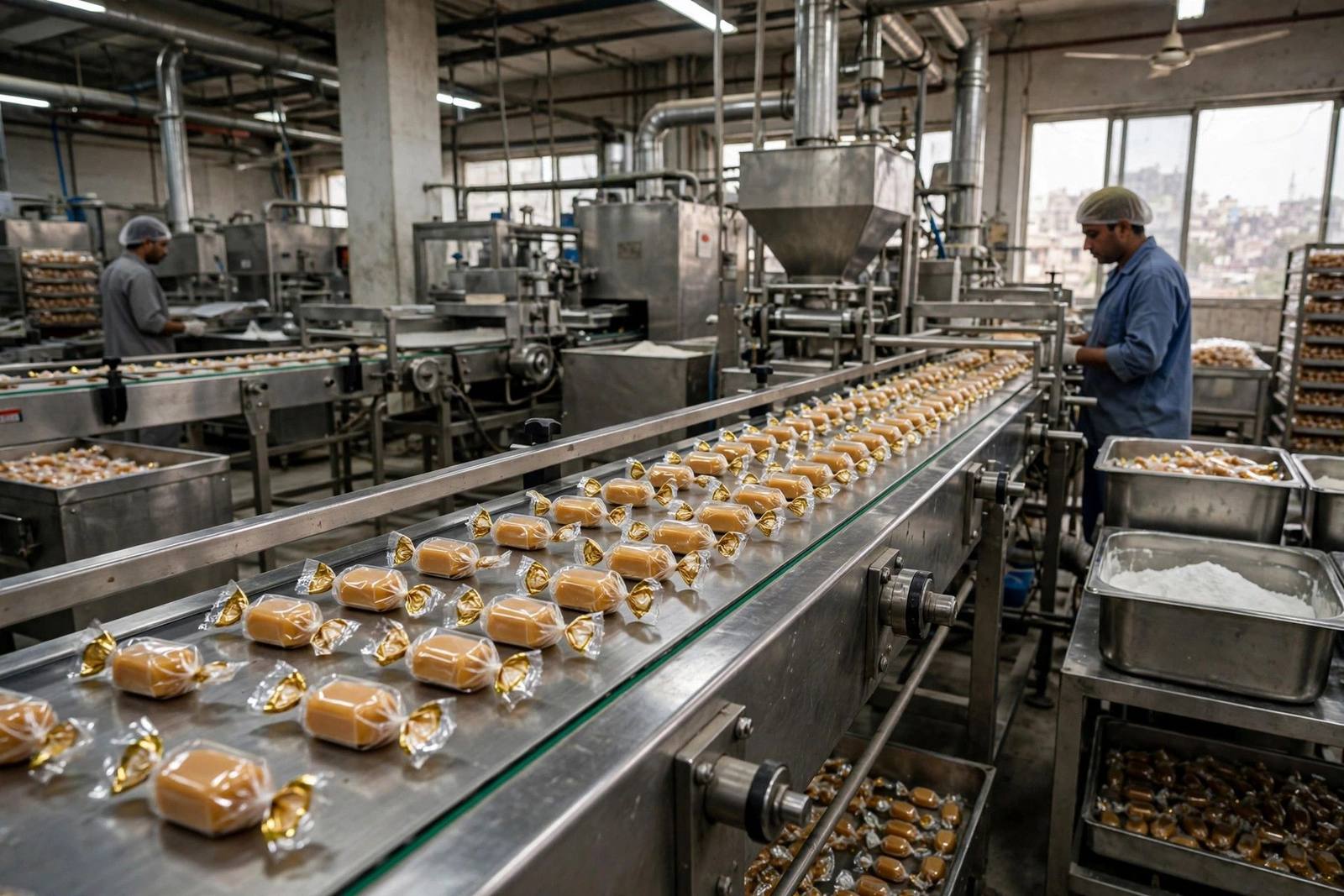
The flagship came first. Candyland's operations commenced on 21 June 1988 — the group's founding date in its own telling — from a first production plant laid out on a modest single acre, with its first brand launched in 1990. The division's founding insight was that Pakistani confectionery, then a loose and largely unbranded bazaar trade of boiled sweets, could support modern branded categories that did not yet exist locally. Candyland pioneered the jelly category in Pakistan — soft jellies such as Chilli Milli, alongside names its catalogues made familiar including Fanty, Super Twister and Paradise — and then moved deliberately into technically difficult territory: lollipops and marshmallows, products whose manufacture defeated casual imitators. The site grew from its original acre to more than eight, and the range widened across jellies, chocolates, marshmallows, candies, toffees, chews, lollipops, gums, milk chocolates, spreads, brittles and truffles, produced to international food-safety standards — the company records ISO 22000 certification and halal certification for the Candyland range — and exported, by the company's account, to more than forty countries.
Confectionery taught the group its durable skills: building brands children ask for by name, pricing in coins rather than notes, and running a sales force able to reach shops in the country's remotest bazaars — the distribution muscle on which every later division would ride. It also taught the group's defining habit: when a category works, build the neighbouring category yourself rather than buying the input or renting the shelf.
The coin-pricing point deserves a paragraph of its own, because it is the economics of Pakistani confectionery in miniature. A jelly or a toffee sold for a few rupees cannot absorb cost inflation the way a litre of oil can; there is no smaller coin to move the price to. The manufacturer's real choices are harder: shrink the piece, thin the recipe, absorb the cost, or spend on the brand until the customer accepts a new price point — and each choice shows up somewhere in the accounts, as gross margin, as volume, or as advertising. Companies that survive decades in this trade are, without exception, masters of that arithmetic, and Candyland's longevity through Pakistan's repeated inflationary episodes is the clearest evidence that Ismail's managers learned it early and never forgot it.
Bisconni, SnackCity and the film behind the packet
The neighbouring categories arrived in sequence. In 2002 the group entered biscuits with Bisconni, the division that later became known above all for Cocomo — the chocolate-filled biscuit that achieved the rare status of a generic name in its niche — alongside lines such as Rite cookies; a second Bisconni production facility followed. In 2006 came SnackCity, the savoury snacks arm, known for the Kurleez range of crisps, with production later expanded to a second unit in Lahore. And behind the food, the packaging: Astro Films, which began as a cast polypropylene film producer in the early 2000s, added a second plant in the following decade and a BOPET film plant around 2010 — the biaxially oriented films that wrap, among much else, the group's own biscuits and sweets. Read the three moves together and the strategy is plain: own the brands, own the categories beside them, and own the film they are wrapped in. Our sector guide to food and personal care stocks on the PSX sets this group among its listed peers.
The perimeter kept widening in the second decade. In 2013 Ismail Industries acquired a stake of roughly a quarter in the Bank of Khyber — an unusual move for a confectioner, giving the family a listed banking interest alongside its factories, and linking its name to the Bank of Khyber story. A nutrition business and a Dubai subsidiary for proximity to export markets followed in the group's own milestone accounts, Hudson Pharmaceuticals sits within the group as a majority-held subsidiary, and in 2020 an associated venture began producing rice glucose and related syrups — the sweeteners its own industry consumes. In 2021 the company commissioned a polyester resin plant, making PET resin — the raw material of the plastic bottle — at a scale its reporting put above a hundred thousand tonnes a year, a step from consumer brands into industrial polymer that surprised the market less than it might have: a group that already made the film, the sweets and the snacks was now making the bottle's substance too. Each extension follows the founding logic one step further out along the chain of things a Pakistani consumer touches daily.
How Ismail Industries makes money
The food divisions earn the branded-goods way. Revenue is a multitude of small transactions — a child's coins for a jelly, a family's rupees for a biscuit packet — aggregated through one of the country's more extensive confectionery distribution networks, which the company describes as reaching even remote areas. Margin is manufactured from three levers: brand strength, which lets a Cocomo or a Chilli Milli hold its price point against unbranded rivals; input costs, dominated by sugar, wheat flour, edible oils, cocoa and packaging film, several of which the group has moved to make or influence itself; and throughput, since food plants earn by running full. The film and resin businesses run on different physics — industrial, specification-led, sold business-to-business at margins set by regional polymer prices — and they diversify the group away from the consumer's mood, at the price of exposure to commodity resin spreads that no brand can sweeten. Exports thread through the food divisions, with Candyland's forty-country reach the headline, converting the same plants' output into dollars when the home market is soft.
For the reader of the accounts, the group's shape is the lesson. Consolidated results blend high-frequency consumer brands with industrial film and resin, a pharmaceutical subsidiary and an equity-accounted banking stake, and the segment notes are where the truth of each year lives: which divisions carried the group, what sugar and resin did to costs, and how much of the profit arrived as share-of-profit from associates rather than cash from customers. The family's near-total sponsorship — credit-rating assessments of the company have historically described the Ismail family as holding the overwhelming majority through its members and associates, leaving a small public float — means minority shareholders are passengers in a vehicle the family drives with a very long horizon, for better and occasionally for worse.
Strengths, risks and controversies
The strengths are the brands and the bench. Few Pakistani groups can list multiple category-defining names across sweets, biscuits and snacks; fewer still support them with their own film, their own syrups venture and their own distribution reach. The diversification into pharma, resin and banking, whatever its conglomerate discount in the market's eyes, has repeatedly given the group a second engine when one category's inputs turned hostile. Longevity counts too: a company rebuilt in 1988 that has compounded through every Pakistani macro cycle since is, by definition, managed for survival.
The risks are those of the model and of the country in combination. Sugar, wheat, edible oil and energy inflation squeeze snack and sweet margins that cannot be fully passed on at coin-denominated price points — the pack shrinks or the margin does, and both are visible in results. Resin and film expose the group to global polymer cycles and to import competition. The small free float that accompanies family dominance can make the share price an unreliable narrator, moving on thin volume; and the political prominence of a family member cuts both ways, bringing a level of public scrutiny to a biscuit company that its peers never face. None of these is hidden; all of them are the ordinary price of admission for a Pakistani family conglomerate with beloved brands.
The name on the PSX
ISML trades as a mid-cap food-sector name with a register dominated by its sponsors and a float that has historically been small relative to the group's size — the classic profile of a stock that rewards readers of annual reports over watchers of tickers. Its character as an investment study is the conglomerate study: brand value in the food divisions, cycle exposure in the industrial ones, governance by a family with a public profile, and dividends that reflect a group habitually reinvesting across its perimeter. New readers can use the Learn section for the vocabulary — segment reporting, associates, free float — that this particular set of accounts demands.
The investor who studies Ismail Industries is usually buying, intellectually at least, the proposition that Pakistan's branded-food formalisation has decades to run and that the houses which own the childhood brands of one generation tend to sell to the next. The sweets, at least, have a forty-year record of proving that proposition in the bazaar, whatever the market has thought in any given year. This profile is educational content, not financial advice.
Key takeaway: Ismail Industries, rebuilt by its Karachi family in 1988 and listed in 1989, grew from Candyland jellies into a branded food group — Bisconni, SnackCity, Astro Films, pharma and PET resin — still directed by the family whose lost son it is named for.