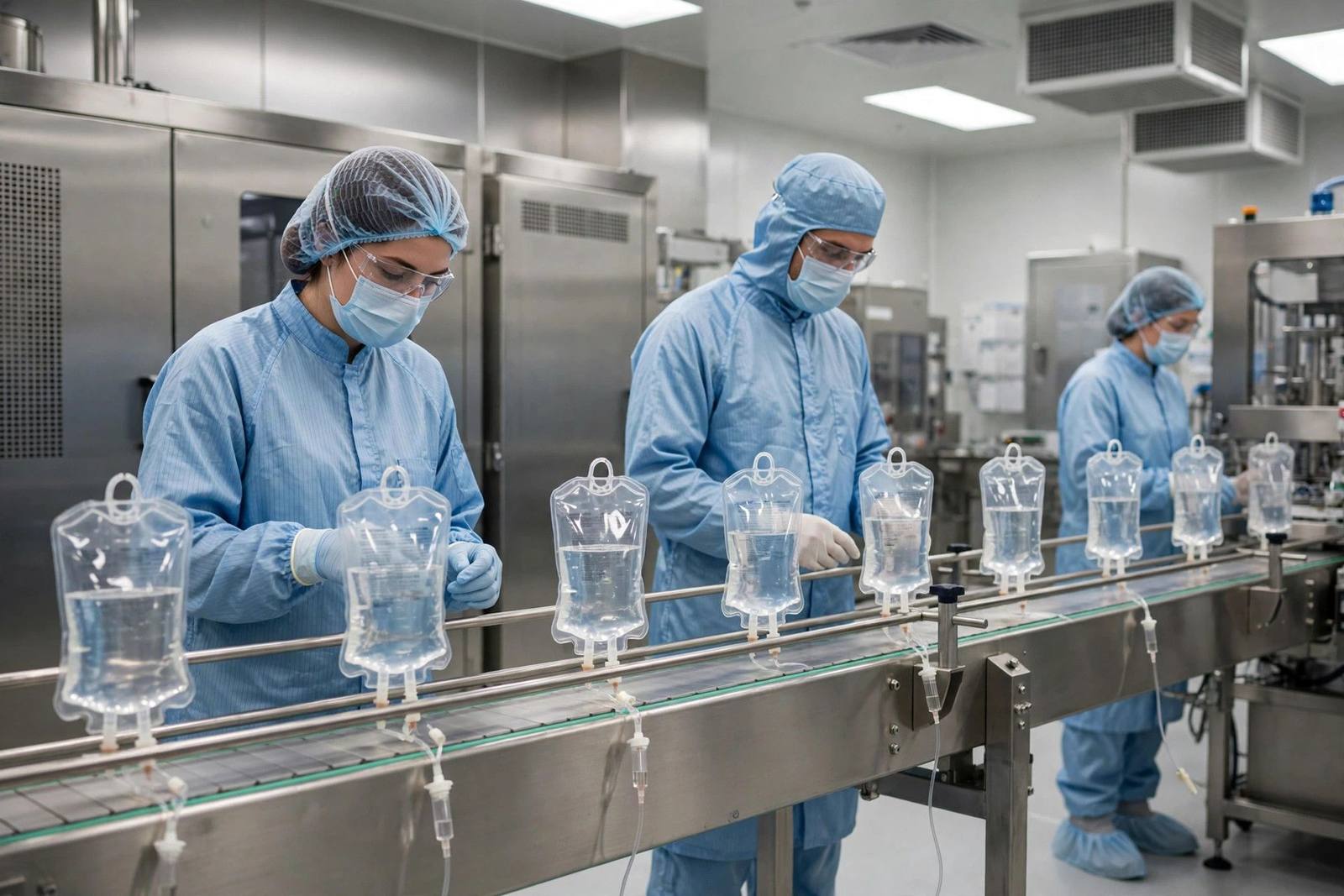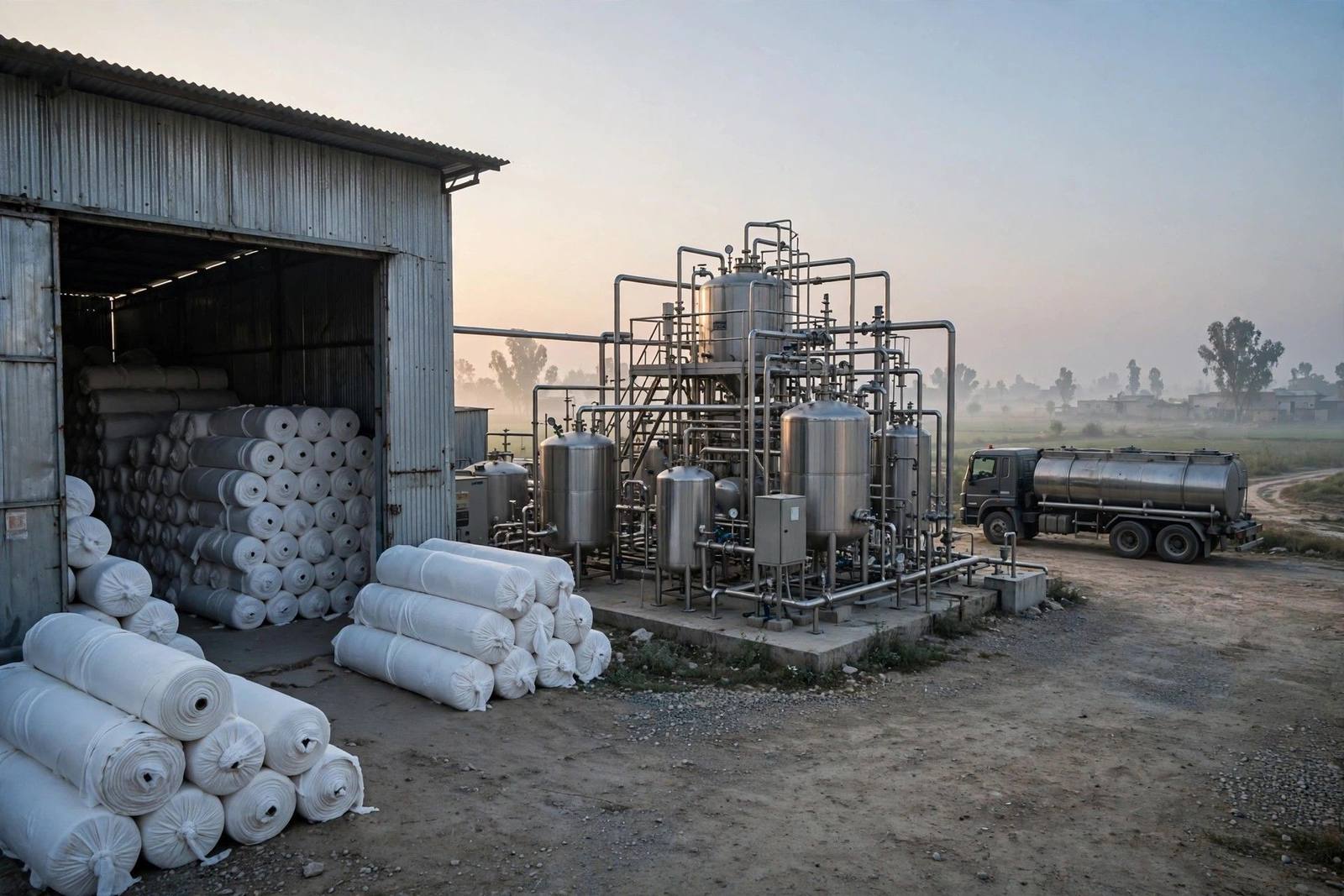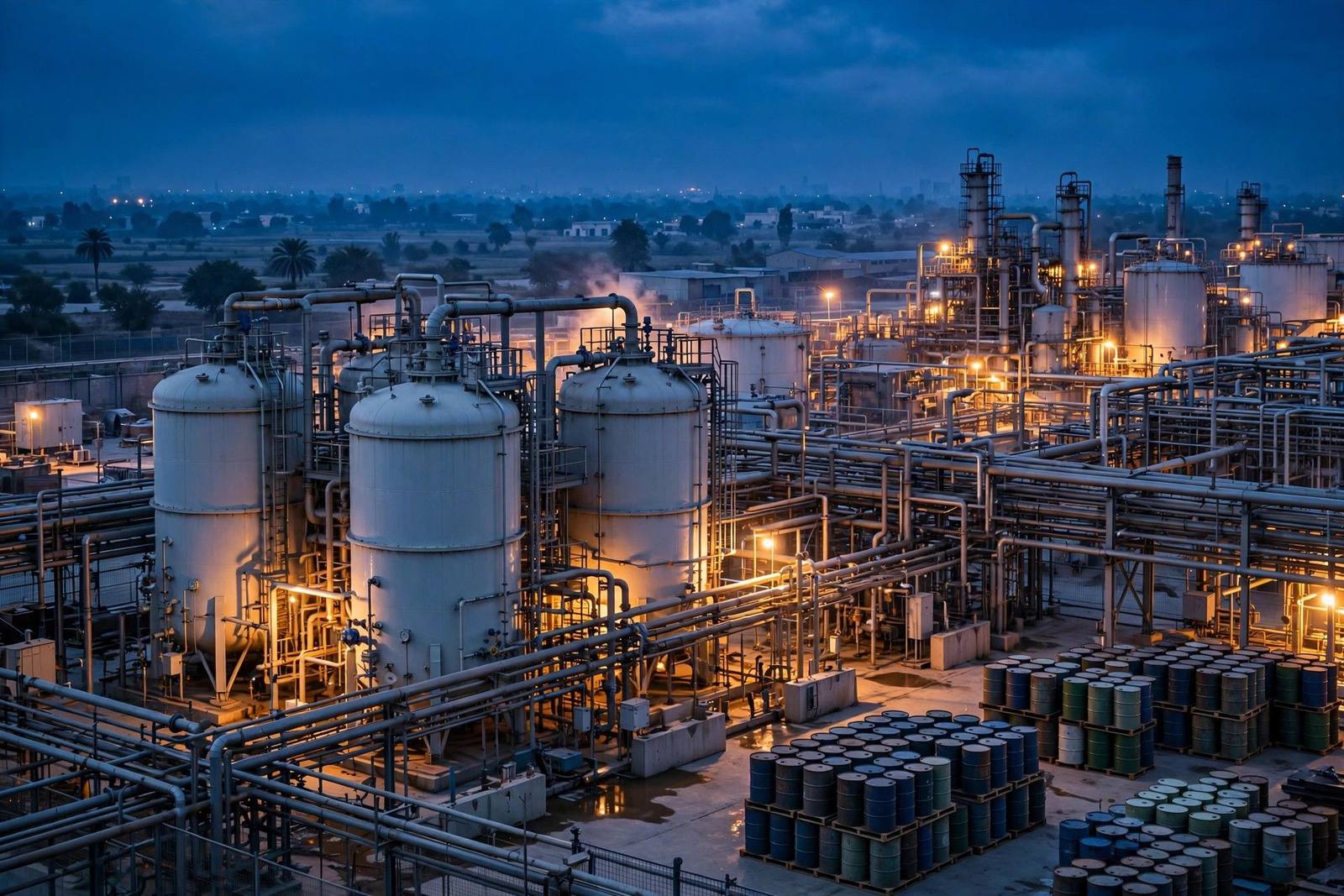
KARACHI: You will never see Nimir Resins' name on a shop shelf, yet its products are on the shelf itself — in the paint on the wall behind it, the resin inside the board it is made from, and the finishing chemicals on the fabric of the clothes hanging nearby. Nimir Resins Limited — NRSL on the Pakistan Stock Exchange — is a Lahore specialty-chemicals maker whose customers are other factories: paint companies, textile mills, paper makers and composite manufacturers. Companies like this are the supply chain's quiet middle, invisible to consumers and indispensable to producers. For a beginner exploring the PSX chemical stocks, NRSL is the coatings-and-resins specialist, with a corporate history that passes through two famous Pakistani industrial names — Reichhold and Descon — before settling into the Nimir group.
The chemicals inside other people's products
A resin is, in essence, industrial glue and skin in one: the binder that holds pigment to a wall as paint, stiffens a fibre-glass panel, coats a sheet of paper or finishes a length of cloth. Nimir Resins' own summary of its principal activity covers the manufacture of surface-coating resins, polyesters for the paint industry, optical brightener and textile auxiliaries. In plainer language, it sells chemistry by the drum and the tanker to manufacturers who turn it into things households actually buy.
That business-to-business character shapes everything about the company. There is no advertising budget to speak of and no consumer brand to defend; instead there are technical relationships with factory customers who test every batch, negotiate hard on price and switch suppliers only when quality or supply fails them. Revenue follows Pakistan's industrial pulse — construction and repainting cycles for coatings, export orders for textiles, packaging demand for paper — rather than the retail footfall that drives a consumer company.
Origins in 1964 and the Reichhold years
The company was incorporated in Pakistan on 17 December 1964 as a private limited company, in the first great wave of import-substituting industry after independence, when making locally what had previously been shipped in was national policy as much as business strategy. Resins were a natural candidate: paint and textile finishing were growing industries, and their imported binders and auxiliaries were exactly the kind of intermediate good a young industrial economy learns to make. Company histories and data providers record earlier identities in the Reichhold family of names — Reichhold was an international resins group — and the Lahore operation carried that lineage in its former names before its later transformations.
On 19 August 1991 the company converted into a public limited company as Nimir Resins Limited, and its shares took their place on the stock exchange. For roughly two decades it traded as a small, specialist listed chemical maker: known to its industrial customers, little known to the wider investing public, and valued mainly on the steady arithmetic of volumes, feedstock costs and the construction and textile cycles.
The Descon decade and the Nimir buyout
The calm ended with a merger. On 1 April 2010 the company entered a scheme of arrangement merging it with Descon Chemicals (Private) Limited — the chemicals arm of the Descon engineering group — and took the name Descon Chemicals Limited. The logic was industrial: combine two Lahore chemicals operations, widen the product range across decorative and industrial coatings, printing inks, adhesives and composites, and run the merged plant base as one business. For six years the listed company lived inside the Descon orbit under Descon's name.
Then control changed again. Following a change of management, the board was reconstituted on 5 January 2016, and with effect from 18 April 2016 the company took back the name Nimir Resins Limited. Behind the renaming stood the Nimir group's acquisition of the business: Nimir Industrial Chemicals Limited — itself the product of a management buyout from its former American owners earlier in the decade — acquired Descon Chemicals through its subsidiaries in January 2016 and restored the Nimir Resins name to the listed company. Nimir Resins today sits as a subsidiary of Nimir Management (Private) Limited, within a group whose ultimate listed parent is Nimir Industrial Chemicals, the NICL counter — a family of Lahore chemical companies spanning soaps and industrial chemicals at the parent and resins and auxiliaries here.
What Nimir Resins actually makes
The company reports its business through segments that map neatly onto its customers. The largest is coating, emulsion and blending: alkyd resins and modified alkyds, amino resins, saturated polyesters, epoxy esters and urethane alkyds, rosin-modified resins and acrylic systems — the binders that paint makers turn into decorative enamels, industrial coatings, automotive refinishes and wood finishes. Beside it sits the unsaturated polyester resin trade, supplying the composites industry that moulds fibre-glass tanks, pipes, panels, sanitary ware and boat and vehicle parts. The textile, paper and other side supplies optical brightener — the compound that makes white fabric look white — textile auxiliaries and binders, paper surface-sizing agents and chemicals, and adhesives and graphics products for packaging and printing.
Production is anchored on the Lahore–Sheikhupura corridor, the historic chemicals belt north-west of Lahore: the registered office and plant at 14.5 kilometres on the Lahore–Sheikhupura Road, with a further production site on the Sheikhupura–Faisalabad Road. The head office sits in New Muslim Town, Lahore. Rating agency commentary on the company has noted a modern manufacturing facility and an established internal control framework, and has also recorded a significant governance step in the induction of Rudolf Pakistan as a strategic shareholder with a substantial minority stake — bringing a global textile-chemicals name into the register of a company whose textile-auxiliaries line it complements.
How a resins maker makes money
The arithmetic is that of a converter. Nimir Resins buys petrochemical-derived feedstocks — oils, glycols, acids, monomers and solvents, many of them imported or priced off imports — and converts them, through reactors, quality control and technical service, into resins and auxiliaries sold by weight to industrial customers. The margin lives in the spread between feedstock costs and the prices factories will pay, defended by formulation know-how, batch consistency and the service chemists who help a paint maker or textile mill make the product work on their own lines.
Three forces therefore drive earnings. The first is volume, which tracks construction, repainting, textile exports and packaging demand. The second is the feedstock cycle: oil-linked input prices and the rupee's exchange rate can compress or flatter margins between the day chemicals are bought and the day customers accept a price increase. The third is working capital. Industrial customers buy on credit and feedstock suppliers must often be paid faster, so growth itself consumes cash — a stretched working-capital cycle is, as the rating commentary puts it in substance, an industry norm rather than a company failing, but it must be financed either way. Readers comparing converters across the sector will find a useful contrast in Karachi's listed paint maker in our profile of Berger Paints Pakistan — a customer-side business to Nimir's supplier-side one — and in the diversified chemistry of Lucky Core Industries.
The product range is usefully read as five doors into Pakistan's factories. Textile auxiliaries and binders go to the mills that dye, print and finish cloth for export. Unsaturated polyester resins go to the composites shops described above. Coatings and emulsions go to paint makers serving construction and industry. Pulp and paper chemicals go to the mills and board makers behind Pakistan's packaging boom. Adhesives and graphics products go to packaging, printing, furniture and footwear. A trading and exports line rounds out the offer. The point of the list is diversification by customer industry rather than by product chemistry: the same reactor skills, applied to five different demand cycles, so that a weak season in denim exports can be partly offset by a strong season in house painting, and vice versa.
For the reader of the annual report, three habits repay the effort with a converter like this. First, follow the segment split: the balance between coatings, composites and textile-and-paper lines tells you which Pakistan the company is currently selling into. Second, watch receivables and inventory together, because in this trade growth is financed by the supplier long before it is paid for by the customer, and a rising sales line funded by swelling trade debts is a different quality of growth from one funded by cash. Third, track the sponsor group — the parent, Nimir Industrial Chemicals, and the group's other companies share management attention, banking lines and strategy, so decisions taken at group level, from acquisitions to the induction of strategic partners such as Rudolf, can reshape NRSL's prospects as surely as anything in its own reactor hall.
Geography quietly reinforces the model. Pakistan's paint, textile and paper industries cluster in Punjab and around Karachi, and a Lahore-based resin maker sits inside economical trucking distance of an unusually large share of its customers. In a business where the product is heavy, margins are thin and a customer's production line cannot wait, proximity is a competitive weapon: shorter lead times, smaller safety stocks for customers, and service chemists who can be at a mill the same day a batch misbehaves. It is one reason Pakistan's specialty-chemicals map is so regional, and why Nimir's Lahore–Sheikhupura base, far from being a footnote, is part of the investment story itself.
Strengths, risks and controversies
The strengths are positional. Six decades of continuous operation give the company formulations, customer qualifications and plant knowledge that a newcomer cannot quickly replicate; its range spans coatings, composites, textiles and paper, so a slump in one customer industry need not idle the whole plant; and the Nimir group connection, reinforced by a strategic international shareholder, offers both a controlling sponsor with chemicals in its blood and technical collaboration beyond Pakistan. PACRA, the domestic rating agency, has maintained ratings on the company with a stable outlook, citing operational stability through the cycle.
The risks are those of any mid-sized converter. Feedstock and currency swings arrive faster than customer price increases. Customers are larger and fewer than a consumer company's, so losing one account matters. Construction and textiles — its two great demand engines — are among Pakistan's most cyclical industries, and both are sensitive to interest rates and export orders. The company's history also carries a lesson in corporate turbulence: two changes of control and name in a single decade are a reminder that small listed industrials can be reshaped by their sponsors' decisions, for better or worse, with minority shareholders along for the ride.
The name on the PSX
Nimir Resins trades as NRSL in the chemical sector — a symbol that, like the company, survived the Descon interlude and returned in 2016. It is a small-capitalisation share whose register is dominated by the sponsor group and associated holders, leaving a limited free float for public trading; liquidity is therefore modest and prices can gap on small volumes. The company has paid cash dividends in stronger years, in the irregular pattern typical of cyclical industrials rather than the steadier rhythm of a consumer staple; anyone learning how such a payout would be announced and credited can follow our guide to how PSX dividends work.
What kind of investor studies Nimir Resins
NRSL rewards the industrial detective: an investor willing to track paint and construction demand, textile export orders, oil-linked feedstock prices and the sponsor group's wider moves, and to read a chemicals annual report for capacity, segment mix and receivables rather than headlines. It is a way of owning Pakistan's factory economy at one remove — the economy of the drum and the reactor rather than the shop shelf. This article is educational content, not financial advice, and a converter's margins deserve the same sceptical reading as any other cyclical business before any decision is taken.
Key takeaway: Nimir Resins, founded in 1964, survived a Descon merger and a Nimir buyout to remain Lahore's listed resins specialist — selling the binders and auxiliaries inside Pakistan's paints, textiles and composites, and rising or falling with its customers' cycles.