KARACHI: Oil & Gas Development Company Limited — OGDC, or OGDCL as the company styles itself — is the state's explorer: the organisation Pakistan created in 1961, when foreign oil companies were packing up and exploration was at its lowest ebb, to go and look for the country's own hydrocarbons. It was born as a statutory corporation with Soviet equipment and Soviet experts, financed by a Soviet loan. It drilled its first well on the Potwar Plateau in 1964, found gas at Sari in 1966 and oil at Toot soon after, and spent three decades as an arm of government before becoming self-financing in 1989, a public limited company in October 1997, and then — through a landmark public offer in 2003 and a London listing of depositary receipts in 2006 — one of the heaviest companies on the Pakistan Stock Exchange, with the Government of Pakistan still its majority owner. How OGDC earns from the fields it finds is explained in our companion guide on how OGDC makes money. This profile is the companion history: how a Cold War corporation became a market heavyweight without ever quite ceasing to be an instrument of the state.
1961: a corporation built from a loan agreement
OGDC's founding documents tell you everything about its era. In February and March 1961, Pakistan signed a long-term agreement with the Soviet Union under which it received a loan — recorded as some 27 million roubles, or around $30 million — to finance equipment and technical services for oil exploration. Pursuant to that agreement, the Oil & Gas Development Corporation was established by ordinance in 1961 — the company's own milestones date its establishment as a statutory corporation to 20 September 1961, while the ordinance itself is dated in some accounts to April of that year; what is not in dispute is the year, the mechanism or the motive. Foreign exploration had dwindled, and the government concluded that if Pakistan's sedimentary basins were to be explored systematically, a national organisation would have to do it.
The early corporation was a state instrument in the full sense: government financed it, government appointed its five-member board, and its first decade and a half were given to building people and infrastructure rather than to quick discoveries. Drilling of its first well began in November 1964 at Toot, on the Potwar Plateau near the country's oldest oil province, with Soviet rigs and technicians. In 1966 it found a small gas field at Sari in Sindh; in October 1967 its first Toot well struck oil deep underground, and by 1969 the Toot field was producing modest quantities of oil. It also explored in East Pakistan, finding gas at Jaldi; after 1971, its operations there were reorganised under what became Bangladesh's Petrobangla — a reminder that OGDC's early map, like Pakistan's, was drawn for a larger country. Soviet experts departed around 1970, and the corporation's own later chairmen took pride in the point that Pakistani engineers thereafter ran the work themselves.
Discoveries, institution-building and self-financing
The 1970s gave OGDC its first finds of national consequence beyond Potwar. Dhodak, in southern Punjab west of the Indus, was announced by Prime Minister Zulfikar Ali Bhutto in December 1976 as the first discovery of liquid hydrocarbons outside the Potwar fields. In October 1977 the corporation found commercial gas at Pirkoh in Balochistan — the first of the Balochistan gas finds that would matter greatly to the national gas balance. The World Bank's first lending to OGDC, a $30 million IDA credit for developing Toot approved in December 1978, marked its arrival as a borrower in its own right. The corporation founded its Oil and Gas Training Institute in Karachi in 1977 and moved it to Islamabad in 1979 — institution-building of the unglamorous, essential kind, even as low public-sector pay leaked its trained people to Gulf and private employers.
The 1980s brought the discoveries — Thora, Sono, Lashari, Bobi and others among oil and condensate fields; Pirkoh, Uch, Loti and more among gas — that changed the corporation's finances fundamentally. In July 1989, noting that success, the government took OGDC off the federal budget and made it a self-financing entity, funding its exploration from its own generated resources. The 1990s added further major finds, including the Qadirpur gas field discovered in 1992 and the Uch field — names that still anchor Pakistan's gas supply. Self-financing was the halfway house between ministry department and company: OGDC now had to earn its exploration budget in the field, a discipline that prepared it for what came next.
1997–2006: company, public offer, London
On 23 October 1997 the statutory corporation was converted into a public limited company, Oil & Gas Development Company Limited — the legal conversion later formalised with retrospective effect by a reorganisation ordinance in 2001. Corporatisation did not change the owner; it changed the grammar. OGDC now had shares, a Companies Ordinance constitution, audited commercial accounts and a board operating in company form — the prerequisites for selling stakes to the public.
The sale came in 2003, when the government divested an initial slice of its holding — 2.5 per cent of equity offered with a green-shoe option for a further 2.5 per cent — in an initial public offering that the company's histories record as a landmark in Pakistan's capital markets for the public response it drew. Listing on Pakistan's stock exchanges followed in January 2004. In December 2006 the government divested a further portion through global depositary shares listed on the London Stock Exchange, making OGDC one of the very few Pakistani companies with a London presence. The state, through these steps, discovered that its explorer was also its most saleable asset — and, characteristically, sold only minorities, keeping control. The Government of Pakistan remains the majority shareholder, which is why OGDC's dividend cheques are, in substantial part, payments from one arm of the state to another, with public shareholders sharing alongside.
What OGDC is today
OGDC is Pakistan's largest exploration and production company by the measures the industry uses — acreage, reserves and production share — operating fields across all four provinces and holding interests in many exploration licences and producing leases, some operated by itself and others held with partners, including fellow listed Pakistani producers and foreign companies. Its named fields — Qadirpur and Uch among the gas anchors, Kunnar-Pasakhi Deep, Nashpa, Chanda and a long tail of others — are the physical form of six decades of drilling. It owns drilling rigs, seismic crews and engineering parties of its own, employs a workforce in the thousands, and holds minority interests in related ventures, including a stake in Mari Petroleum (now Mari Energies) that links the two state-born explorers on each other's registers.
Its customer list is the Pakistani energy system itself: gas utilities and industrial buyers take its gas, refineries take its crude and condensate, distributors take its LPG. That makes OGDC foundational in a literal sense — a significant share of the molecules Pakistan burns each day begins as an OGDC well — and it places the company inside the sector's payment problems as firmly as any generator, since its gas buyers sit within the same strained chain described in our explainer on circular debt. The sector frame is set out in our guide to exploration and production stocks on the PSX.
The explorer's dilemma, at national scale
Every E&P company depletes itself by succeeding: each barrel and each cubic foot sold is inventory that geology will not replace. For a private producer the answer is an investor's question — drill, acquire, or return cash. For OGDC the same arithmetic carries national weight. Pakistan consumes more gas than it produces, imports LNG and crude at heavy cost to the balance of payments, and has watched mature onshore basins decline while frontier and offshore exploration repeatedly disappointed. OGDC's exploration programme — its seismic, its wildcat wells, its occasional bright discoveries such as the Wali gas and condensate find of 2022, and its 2021 award of a stake in an offshore block in Abu Dhabi, its first outward step of that kind — is therefore read not only as company news but as energy-security news. The golden jubilee it celebrated in 2011, and production milestones such as the record gross oil output day it recorded in November 2016, were national-press events in a way no textile mill's anniversary could be.
That dual identity cuts both ways for shareholders. The state's majority brings strategic patience, privileged access to acreage rounds and an implicit national mission that can justify frontier spending a purely commercial board might decline. It also brings the frictions of state ownership familiar from National Bank of Pakistan's story: appointments and strategy influenced by government, prices for its gas set within a regulated policy framework rather than a free market, and periodic fiscal temptation to treat the company as a revenue source. Reading OGDC well means holding both halves at once — a genuinely capable exploration organisation, and an instrument of the state that owns it.
What investors typically watch
The companion explainer details the pricing mechanics; the profile watch-list is about trajectory. Watchers track production trends — whether new wells and workovers offset natural decline; reserve replacement — discoveries against what was produced, the industry's vital sign; exploration results, well by well, since one large find rewrites the story and dry holes write off real money; receivables and settlements, the cash truth behind reported profit; the dividend, where board, cash position and the majority owner's appetite meet; and policy — petroleum policy revisions, pricing notifications and privatisation talk, which for a state-majority company is never background noise. OGDC's weight in the KSE-100 follows mechanically from its market capitalisation and free float, which is why its results move index-level sentiment on results days.
For a first-time reader of the PSX, OGDC is the natural starting company: big enough to matter, documented across six decades, and connected to everything else in the energy chain. Aktzien, the app being built behind this site, plans to make following such anchor companies straightforward for new investors — and the Learn section already collects the background to do it yourself. This profile is educational content, not financial advice.
Four products, and the service crews behind them
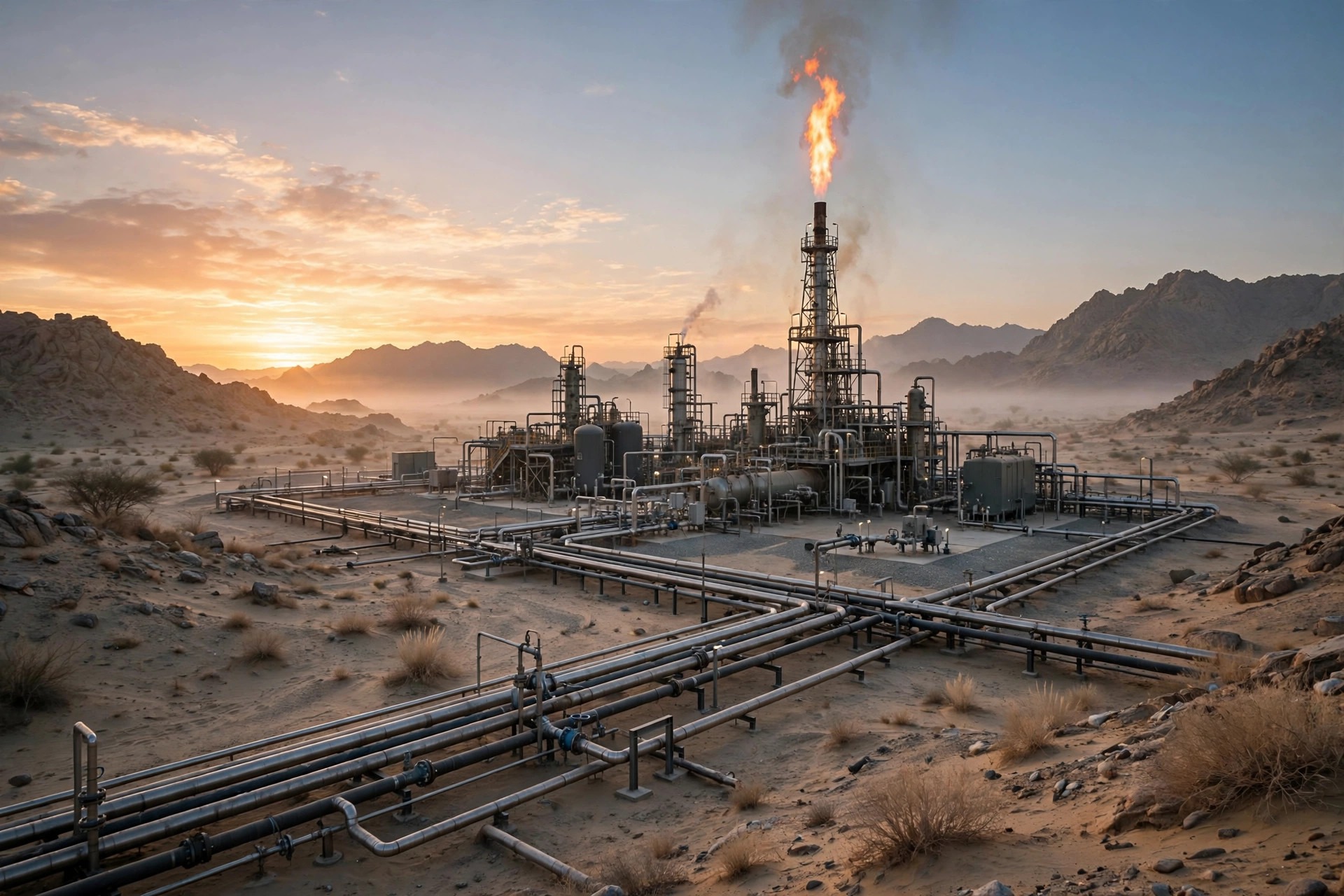
OGDC is usually described as an oil and gas company, but its own product accounts list four output streams, and the fourth is the one most readers miss. Alongside crude oil and condensate — historically produced from fields including Dakhni, Dhodak, Bobi, Tando Alam, Chanda, Toot and Rajian — and natural gas, from fields including Dakhni, Dhodak, Qadirpur, Nandpur, Panjpir, Pirkoh and Uch, the company produces liquefied petroleum gas at fields including Dakhni, Dhodak and Bobi, and sulphur, recorded as produced at the Dakhni field near Jand, in Attock district. Sulphur is a small line beside gas, but it is a useful reminder that a producing field is a chemical system, not a tap: associated gases and liquids must be separated, treated and sold or disposed of, and by-products such as sulphur and LPG are part of how a field's full value is recovered rather than flared or wasted.
The operating machinery behind those products is equally part of the company. Descriptions of OGDC's operational base record that it has maintained its own seismic crews, geological parties, engineering field parties, a data processing centre and geological and analytical laboratories, together with drilling and workover rigs and specialist units for wireline logging, cementing and related well services. That in-house service depth is a legacy of its corporation years, when a state explorer in a thin market had to own capabilities that a producer in a mature oil province would simply hire from contractors. It also explains a recurring feature of OGDC's story: joint ventures. The company has long held working interests alongside foreign and local partners in exploration blocks and producing leases, sharing geological risk on expensive wells while contributing acreage, data and operating capability of its own — the partnership structure through which much of Pakistan's exploration has actually been drilled.
A note on dates and the record
Careful readers will find OGDC's founding told with two dates in 1961 — an ordinance dated in April in some accounts, and establishment as a statutory corporation on 20 September 1961 in the company's own milestone lists, following the loan agreement signed that February and March. The discrepancy is a small lesson in reading Pakistani corporate history: ordinances, loan agreements, incorporation and operational start were separate events, compressed differently by different chroniclers. The robust facts are the sequence — Soviet-financed creation in 1961, first drilling in 1964, first finds in the later 1960s, self-financing in 1989, company form in 1997, public offer in 2003, London listing in 2006 — and those are the facts this profile has relied on. Where the record itself disagrees on a day or a month, the honest course is to say so rather than to pretend a precision the sources do not support. This profile is educational content, not financial advice.
Key takeaway: OGDC was created in 1961 as a state corporation with Soviet support, made self-financing in 1989, converted to a public limited company in 1997 and partly sold to the public from 2003 — Pakistan's largest explorer, still majority state-owned, whose fields supply a significant share of the country's oil and gas.