KARACHI: Pick up a can of cola in Pakistan and turn it over in your hand. For most of the country's history, that can was made abroad — formed, printed and shipped in empty, at great expense, because nobody manufactured beverage cans in Pakistan. That changed in 2017, when a new plant in the M-3 Industrial City outside Faisalabad began turning aluminium sheet into printed cans for the country's bottlers. The company behind it is Pakistan Aluminium Beverage Cans Limited — PABC on the Pakistan Stock Exchange — a business with a history of barely a decade that already sits, invisibly, inside one of Pakistan's most familiar consumer habits. This profile explains how a single-product packaging maker came to exist, why its location and ownership matter, and what kind of company a can plant really is.
A young company built for an obvious gap
Pakistan Aluminium Beverage Cans was incorporated on 4 December 2014 as a public unlisted company, and its founding logic, as set out in its listing documents, was substitution: Pakistan's and Afghanistan's carbonated soft-drinks markets were growing, canned drinks were gaining share against other formats, and every can used in the country was imported. Importing an empty can is an absurdity of logistics — you are paying freight on air, in a bulky, crushable package — so the case for a local plant near the bottlers wrote itself, provided the volume existed to run a can line at the speed such lines demand.
The plant was built in the Faisalabad Special Economic Zone, in M-3 Industrial City at Sahianwala, on a site its listing documents describe as a little over twenty acres. The location was chosen with a map in hand: central Punjab places the factory near several of the country's major bottlers — the local operations of the global cola franchises among them — and on the motorway network that serves both the domestic market and the route toward Afghanistan, the natural export hinterland for Pakistani drinks and packaging. The SEZ status brought a further, financial advantage: a ten-year tax holiday under the Special Economic Zones framework, running from 2017, subject to minimum turnover tax — a meaningful support in a capital-hungry project's early years, and a feature a careful reader should note has a built-in expiry as the holiday window closes.
Installation, testing and commissioning were completed in September 2017, when commercial operations began. PABC started, by its own description, as the sole local manufacturer of aluminium beverage cans in Pakistan, and its early growth, as reported in its listing documents, was rapid — volumetric sales roughly doubling within its first few years as bottlers switched volume from imports to a local supplier who could deliver faster, in smaller lots, without the importer's lead times and currency exposure. Listing documents at the time put the plant's rated capacity in the region of seven hundred million cans a year — a figure that conveys the scale a single modern can line represents, and which later reporting should be checked against for expansions.
The listing, and the parent behind the plant
For its first years PABC operated unlisted, and it joined the Pakistan Stock Exchange on 16 July 2021 through an offer for sale — the mechanism, explained in our PSX IPO guide, by which existing shareholders sell part of their holding to the public rather than the company issuing new shares. The exchange's equity profile records a free float of about fifteen per cent: this is a controlled company with a public minority, not a widely held one, and its share trading should be read with that shape in mind.
Control rests with Ashmore Mauritius PABC Limited, which the company's financial statements identify as its parent, holding about fifty-one per cent of the shares. Ashmore is an investment group focused on emerging markets, and its sponsorship explains both how a project of this capital intensity was financed and how the board is composed — the chairmanship has sat with the sponsor's nominees, alongside local directors and management based between the registered office and the Faisalabad plant. For minority shareholders, the structure is the familiar emerging-market packaging story: a professional sponsor with a controlling stake, a strategic asset with no local listed peer, and governance that runs through the parent relationship.
What a can plant actually does
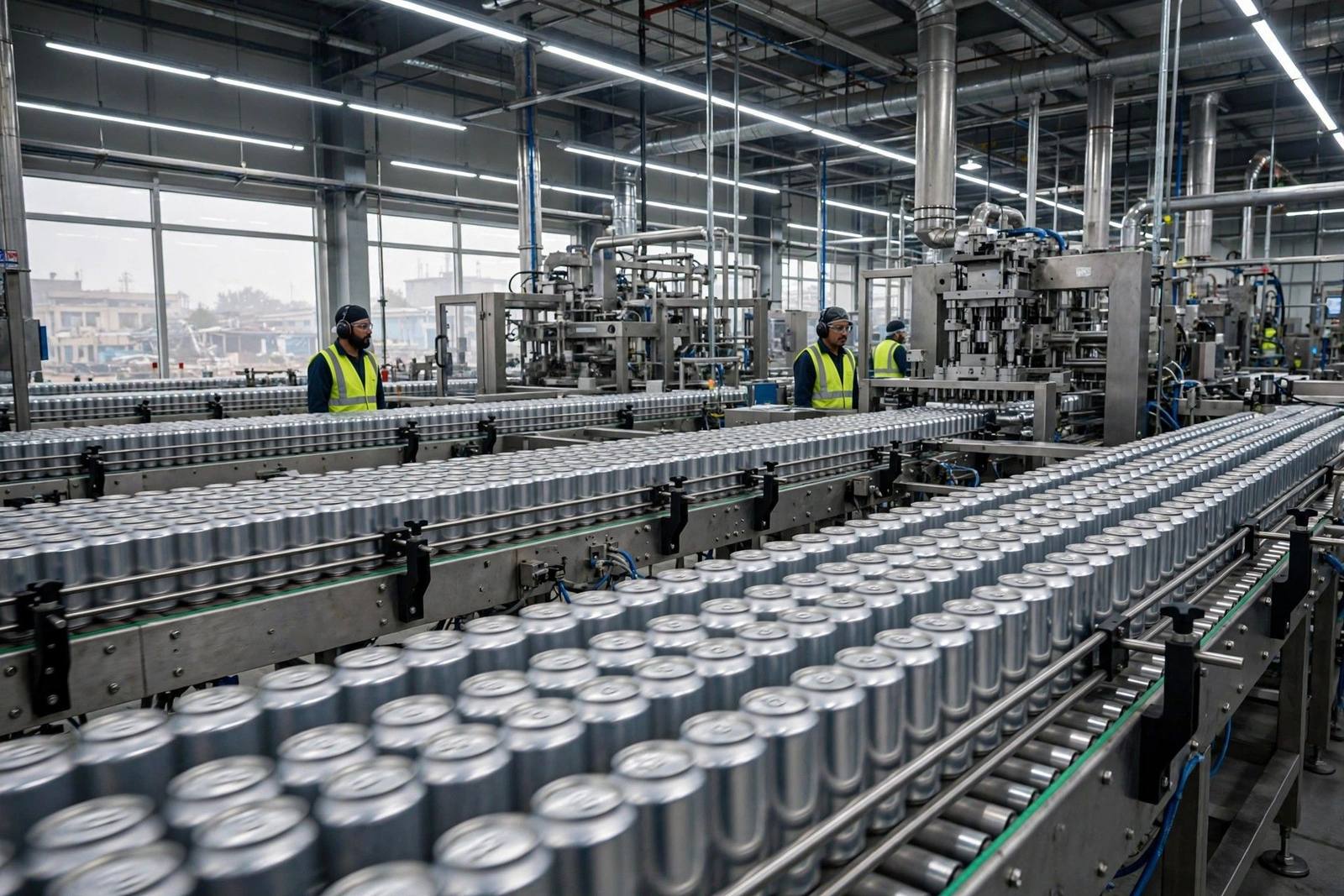
A beverage can begins as a coil of thin aluminium sheet. In the plant, the sheet is drawn and ironed — stretched and thinned by high-speed presses into a seamless cup, then a full-height can body — washed, printed at speed with the customer's artwork, coated inside with a protective lacquer so the drink never truly touches bare metal, and necked at the top so the lid, added later by the bottler, seals onto a smaller rim. The economics live in the speed of that line: can-making machinery is designed to produce at rates of many hundreds of cans a minute, and a plant earns its return by running, not by pausing. Lids are the complementary half of the package; the body-maker's product is the printed, open can that bottlers fill on their own lines.
The customer list is therefore short and concentrated by construction. PABC sells to drinks bottlers — above all the carbonated soft-drinks industry, whose canned volumes anchor demand, with energy drinks, juices and other canned beverages around them — and to export markets, which its listing-era reporting described as led by Afghanistan, where it built a leading share of the can supply, with newer sales further afield in Central and South Asia and beyond. Set it beside its packaging neighbour in this series, EcoPack, which makes the PET bottles that compete with cans for the same drinks, and the two together explain Pakistan's beverage-packaging economy: glass for returnable tradition, PET for cheap volume, and the can for the premium, portable, export-friendly end.
How a can maker earns its money
PABC's revenue is cans multiplied by price per thousand, and its cost stack is dominated by one input: aluminium. Can sheet is priced off international aluminium markets and bought substantially with foreign currency, so the company's gross margin is, in large part, the management of a spread — the conversion premium it charges bottlers over the metal cost — negotiated with customers who are themselves large, sophisticated buyers. Contracts in this industry typically pass metal costs through with formulas and lags, which softens but does not abolish the exposure: timing gaps between metal purchases and price resets, and the rupee's movement in between, still land in the results.
Volume is the second engine, and it has a seasonal heartbeat. Canned-drink demand peaks in Pakistan's long summer and around Ramadan and Eid consumption patterns, and bottlers build can stocks ahead of the peak. A plant that can run flat through the high season and still sell into export markets in the quieter months uses its fixed assets far better than one hostage to domestic seasonality alone — which is why the Afghan and regional export book matters strategically beyond its share of sales. The third factor is mix and specification: printed cans for different sizes and customers carry different values, and every artwork changeover on a printing line costs minutes that a well-scheduled plant defends carefully.
The demand underneath all of this is the story told across our guide to PSX food and personal-care stocks: a young, urbanising population drinking more packaged beverages per head over time, with cans taking share within that growth because they chill fast, travel well, stack efficiently and carry a brand's printing beautifully. PABC does not need to persuade anyone to drink cola; it needs the cola that is drunk to arrive in its cans rather than in a rival format — a share-of-format bet rather than a share-of-brand one.
Strengths, risks and honest caveats
The moat is physical and singular. For its formative years PABC was the only local maker of its product, and can plants are not built casually: they demand heavy capital, specialised lines, technical crews, and — hardest of all — the anchor volumes of bottlers willing to qualify a new supplier for a package whose failure would stop their filling lines. Incumbency with qualified status at major bottlers, a tax-advantaged SEZ base, and proximity that beats any importer's landed cost on freight alone give the company structural advantages a challenger must spend years and serious money to contest.
The risks are the mirror image. Customer concentration is inherent: a handful of bottlers and their franchise systems decide most of the demand, and a lost specification or an in-house move by a customer would be a material event. Aluminium and the exchange rate drive the cost line. Export earnings carry the politics and payment frictions of the Afghan market and regional trade. The SEZ tax holiday that flattered early economics is time-limited by design. And the format war is permanent — every shift of drinks volume between glass, PET and cans, driven by bottlers' costs and consumers' habits, shows up in a can maker's volumes. None of this is hidden; it is the standard risk register of a single-product packaging manufacturer, and PABC's annual report is where a reader tests how each item is moving.
The name on the PSX, and who studies it
PABC's 2021 arrival made it one of the exchange's few pure packaging plays, and its fifteen-per-cent free float means the traded share can move sharply on modest volume — the mechanics of float and price formation are covered in the Aktzien learning library. Its dividend decisions, like its strategy, are taken under a controlling sponsor and should be read in that light: a young, capital-intensive company balancing growth, debt and distributions, rather than a mature utility-style payer.
The investors who follow PABC tend to be those who like a clean industrial thesis: one plant, one product, a substitution story against imports, and demand geared to the packaged-drinks growth of two countries. Their observation points are consistent — can volumes and capacity utilisation, the metal-cost spread and currency, the domestic-versus-export balance through the summer season, bottler relationships and any sign of competing capacity, and the approach of the tax holiday's end. This article is educational content, not financial advice.
Why the can keeps winning its corner
The format contest PABC lives inside deserves one more look, because it explains the plant's resilience. Glass is returnable and traditional but heavy, breakable and bound to deposit-and-return logistics that suit local delivery rounds better than national distribution. PET is light and cheap but carries a humbler image and, for carbonated drinks, a shorter fizz-keeping life. The aluminium can sits at the premium end of that triangle: it chills quickly, seals completely against light and air, stacks densely for transport, prints like a poster and — a point that grows louder in Pakistan's waste debate — aluminium is endlessly recyclable, with scrap value high enough that used cans are actively collected rather than littered and left. None of that guarantees the can's share of any given drink, which bottlers reset with every packaging tender. But it explains why a format that had to be imported at absurd cost for decades supported a local industry the moment the volumes justified one — and why the company that built that industry first holds the qualified-supplier ground that any future rival must take from it, can by printed can.
There is a quieter point about industrial geography in PABC's siting, too. Faisalabad built its name on textiles, yet its industrial estates now host food, chemical and packaging plants drawn by the same assets that served the mills: a skilled industrial workforce, power and gas infrastructure, and a position at the centre of Punjab's road network. A can plant is a different kind of factory from a spinning mill — cleaner, faster, more automated — but it runs on the same civic foundations, and its presence in M-3 Industrial City is a small marker of how Pakistan's oldest industrial city keeps re-tooling itself for new industries. For a bottler's procurement manager, of course, none of that sentiment enters the calculation; what enters is delivered cost per thousand cans, on time, in full, printed exactly to artwork. PABC's whole story is that, year after year, it has kept winning that unglamorous calculation against the alternative of importing air.
Key takeaway: Pakistan Aluminium Beverage Cans, incorporated in 2014 and producing at Faisalabad since 2017 under Ashmore's majority ownership, replaced imported cans for Pakistan's bottlers — a single-product plant whose fortunes turn on drinks volumes, aluminium prices and the can's share of the bottle-versus-can contest.