KARACHI: Pick up a bottle of cola, mineral water or squash anywhere in Pakistan and there is a fair chance the bottle itself — not the drink, the bottle — passed through one company's machines. EcoPack Limited, listed on the Pakistan Stock Exchange as ECOP, is the country's pioneering maker of PET bottles and preforms, the clear plastic packaging that replaced glass across the drinks industry during the 1990s. From its main plant in the Hattar Industrial Estate in Khyber Pakhtunkhwa, it supplies the bottlers behind internationally renowned soft-drink brands as well as home-grown names in water, juices, syrups and edible oils. It is a small company by market standards, in an unglamorous corner of manufacturing, doing something genuinely foundational: without firms like EcoPack, Pakistan's modern beverage industry would quite literally have nothing to pour itself into. This profile tells its story — the early bet on PET, the two-stage process it introduced, the customers it lives by, and the economics of selling an empty bottle.
A 1991 bet on a new kind of bottle
EcoPack was incorporated on 25 August 1991 as a private limited company, converted into a public limited company in April 1992, commenced commercial production in 1993, and listed on the Karachi Stock Exchange in March 1994. The timing was the strategy. At the start of the 1990s, Pakistan's carbonated soft-drink market was still dominated by returnable glass bottles — heavy, breakable, and tied to a deposit-and-return logistics system that limited how far and how fast drinks brands could grow. PET, or polyethylene terephthalate, was the material displacing glass worldwide: light, shatterproof, resealable and cheap to transport. EcoPack was set up specifically to manufacture PET preforms and bottles for the Pakistani carbonated beverage and mineral water markets, before that transition had properly begun at home.
The location of the first factory was chosen with the same foresight. Hattar Industrial Estate, in Haripur district, offered the tax incentives then available in what was the North-West Frontier Province, and — more durably — strategic proximity to Punjab, the country's most populous and thirsty province, and to the trade routes toward Central Asia. A bottle is mostly air: empty PET bottles are ruinously expensive to transport far, so a packaging maker lives or dies by distance to the bottling plants it serves. Hattar put EcoPack within economical reach of the northern bottling belt while keeping its cost base in an industrial estate designed to attract exactly such plants.
The two-stage idea, and a second home in Karachi
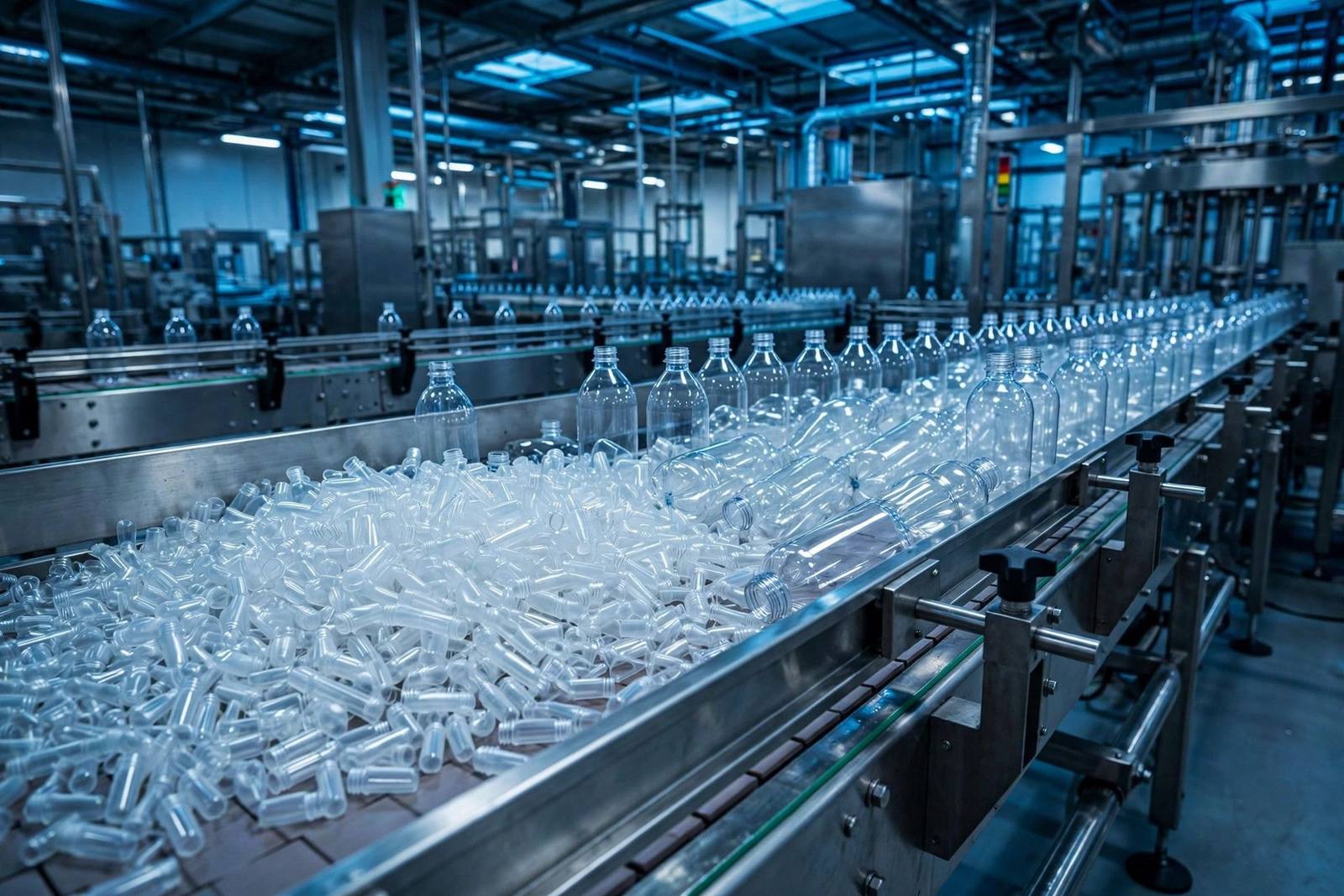
EcoPack's technical claim on history is that it was the first in Pakistan to introduce the high-speed two-stage manufacturing process for PET packaging. In plain language, the two-stage method uncouples the two halves of bottle-making. In the first stage, injection moulding produces a preform — a small, thick-walled test-tube-like piece with the bottle's neck already finished. In the second stage, the preform is reheated and stretch-blow-moulded into a full bottle. Splitting the stages matters commercially: preforms are dense and cheap to ship, so they can be made centrally and blown into bottles near — or even inside — the customer's filling plant, while bottle-blowing can run at the speed and in the shapes each drinks brand demands. EcoPack's own history includes exactly such an arrangement, commissioning a blowing line inside a Pepsi bottling factory under a through-the-wall setup, where bottles pass directly from EcoPack's machines to the customer's filler.
Growth followed the map of Pakistan's thirst. In 1999 the company set up a second factory in Karachi to blow PET bottles for the southern market, completing its coverage of the country's breadth — preforms and bottles from Hattar for the north, blowing capacity in Karachi for the south. Successive investments at both sites multiplied capacity over the years; company briefing material in recent years has described capacity in the hundreds of millions of bottles and preforms a year. The company also holds the quality and food-safety certifications — ISO 9001, ISO 22000 and Halal certification appear in its corporate briefings — that multinational drinks customers require of a packaging vendor before a single bottle is accepted.
What EcoPack sells, and to whom
The product list is short to describe and vast in volume. PET preforms, in the range of neck finishes and weights that different drinks require, are sold to bottlers who blow their own bottles in-house. PET bottles, blown by EcoPack itself, serve customers who prefer to receive finished packaging ready for the filling line. The customers named in the company's own briefings tell the story of its market: it describes itself as a premier vendor to international brands including Pepsi and Coca-Cola and to Unilever, alongside leading national names such as the Murree group, Hamdard's Rooh Afza, Qarshi's Jam-e-Shirin, Gourmet Cola and a string of water, juice and edible-oil brands. That list explains the second half of the product story: PET escaped the cola wars long ago. Cooking oil, cordials and squashes, juices, bottled water and household liquids all moved into PET, and each new category widened EcoPack's potential customer base beyond the two global giants whose volumes anchor it.
There is a useful comparison inside the same batch of PSX packaging stories. Where EcoPack makes the plastic bottle, Pakistan Aluminium Beverage Cans makes the metal can for many of the same drinks groups, and Century Paper & Board Mills makes much of the cartonboard those drinks are boxed in. Read together, the three profiles show how a single bottle of cola on a Lahore shelf supports a small ecosystem of listed Pakistani manufacturers before the drink itself is even made.
How an empty-bottle business makes money
EcoPack's economics start with a single raw material: PET resin, a petrochemical product whose price follows global oil and paraxylene markets and, for a Pakistani buyer, the rupee's exchange rate. The company converts resin into preforms and bottles and sells them at prices negotiated with bottlers who are typically far larger than it is. The margin in the middle — conversion margin — has to cover energy-intensive injection and blowing machines, moulds for each bottle design, labour, maintenance, freight, and the financing of resin inventory bought ahead of the drinks industry's fierce summer season.
Seasonality is the rhythm of the whole business. Soft-drink and water volumes surge in the hot months and around Ramadan's shifting position in the calendar, so a bottle maker's year is a build-up of stock and machine time followed by a peak it must not fail — a bottler whose line stops for want of bottles in May does not forgive quickly. Utilisation is the other key variable: injection and blowing machines earn nothing when idle, so winning anchor volumes from the big bottlers, and filling the shoulders of the season with oil, juice and water customers whose peaks differ, is how a plant like Hattar sweats its assets. Pricing power, by contrast, is limited — resin cost movements are usually passed through by formula or negotiation, but with a lag, and a sharp resin spike or rupee slide can squeeze a quarter's margins before new prices bite. It is, in short, a volume-and-efficiency business wearing a packaging label, exposed to the same consumer cycle described in our sector guide to PSX food and personal-care stocks, one step removed.
Strengths, risks and the plastic question
EcoPack's strengths are position and incumbency. It pioneered its category in Pakistan, it sits close to the northern bottling belt, it has decades-long vendor relationships with the drinks industry's most demanding customers, and its food-safety certifications and through-the-wall experience are qualifications a new entrant cannot print overnight. Its risks begin with concentration: when a handful of beverage giants anchor your volumes, their insourcing decisions, tender rounds and own capacity expansions set your ceiling. The large bottlers can and do blow their own bottles from bought-in preforms, and rival preform makers compete for the same resin-to-bottle margin.
Then there is the question that hangs over every PET business in the world: the environmental politics of plastic. Single-use plastic is under regulatory and consumer pressure everywhere, Pakistan included, and possible futures range from deposit-and-recycling systems to taxes and partial bans on particular formats. For a company like EcoPack the honest reading is double-edged. PET is among the most recyclable of plastics and Pakistan already has an informal collection economy built around it, and recycled-PET content is a growing part of global bottlers' own commitments — which could make an established, certified local manufacturer a partner in that transition rather than merely its target. But any abrupt restriction on bottled formats would hit volumes directly, and investors studying ECOP should treat the regulatory debate as a standing item, not a footnote — much as our explainer on Pakistan's subsidies and policy economy shows how quickly state decisions can redraw an industry's economics.
The name on the PSX: ECOP
ECOP has been quoted since March 1994, originally on the Karachi exchange and now on the unified PSX, in the packaging corner of the market. It is a small-cap, comparatively thinly traded share: the register has historically had a substantial free float for its size, but daily volumes are modest next to the big index names, which means prices can gap on small orders and the stock rewards the patience described in our guide to reading the PSX order book. Its dividend behaviour, like most small manufacturers, has followed the year's resin prices, volumes and investment needs rather than any fixed payout habit; the machinery of declarations and book closures is the standard one explained in our dividend calendar guide. Credit-rating coverage by PACRA over the years — the company has carried ratings in the BBB band with a stable outlook in its briefings — gives followers an additional, independent read on its balance sheet that many companies of its size lack.
Two industry shifts will decide what kind of company EcoPack becomes in its second thirty years. The first is lightweighting: every generation of preform design shaves grams of resin off each bottle while keeping it strong enough to stack and ship, and because the bottler ultimately pays for plastic by weight, the maker who masters lighter preforms can cut a customer's packaging bill without cutting his own conversion margin — a quiet, technical arms race that rewards exactly the process expertise EcoPack pioneered locally. The second is recycled content. As global drinks companies extend their recycled-PET commitments into every market they serve, and as Pakistan's own collection economy — the kabari network that already recovers PET bottles at rates many richer countries envy — is gradually formalised, the bottlers will need local suppliers who can source, certify and process food-grade recycled resin at scale. That is a new capability, not a variation of the old one, and it will cost money to build. Whether EcoPack invests ahead of that demand, in step with its anchor customers, or behind it is the most interesting strategic question in its recent briefings — and a fair summary of the choice facing every first-generation Pakistani packaging pioneer as its industry globalises underneath it. There is a pleasing symmetry in it: the company that once made its name by teaching Pakistan a new way to make a bottle may have to do something similar all over again, this time with a bottle that has already been a bottle once before.
What kind of investor studies EcoPack
ECOP suits the kind of investor who enjoys supply-chain detective work: tracking soft-drink and bottled-water demand, resin and oil prices, the rupee, and the capacity decisions of both bottlers and rival packaging makers, then seeing those forces arrive, a quarter later, in a Hattar manufacturer's margins. It is also a case study in how much of the PSX's real economy hides in companies whose products you hold in your hand every day without ever reading the maker's name. This article is educational content, not financial advice, and nothing in it is a recommendation to buy or sell any security.
Key takeaway: EcoPack bet on PET in 1991, taught Pakistan's drinks industry the two-stage preform process, and still lives by a simple formula — resin in, bottles out, and margins decided by volume, seasonality and the price of plastic.