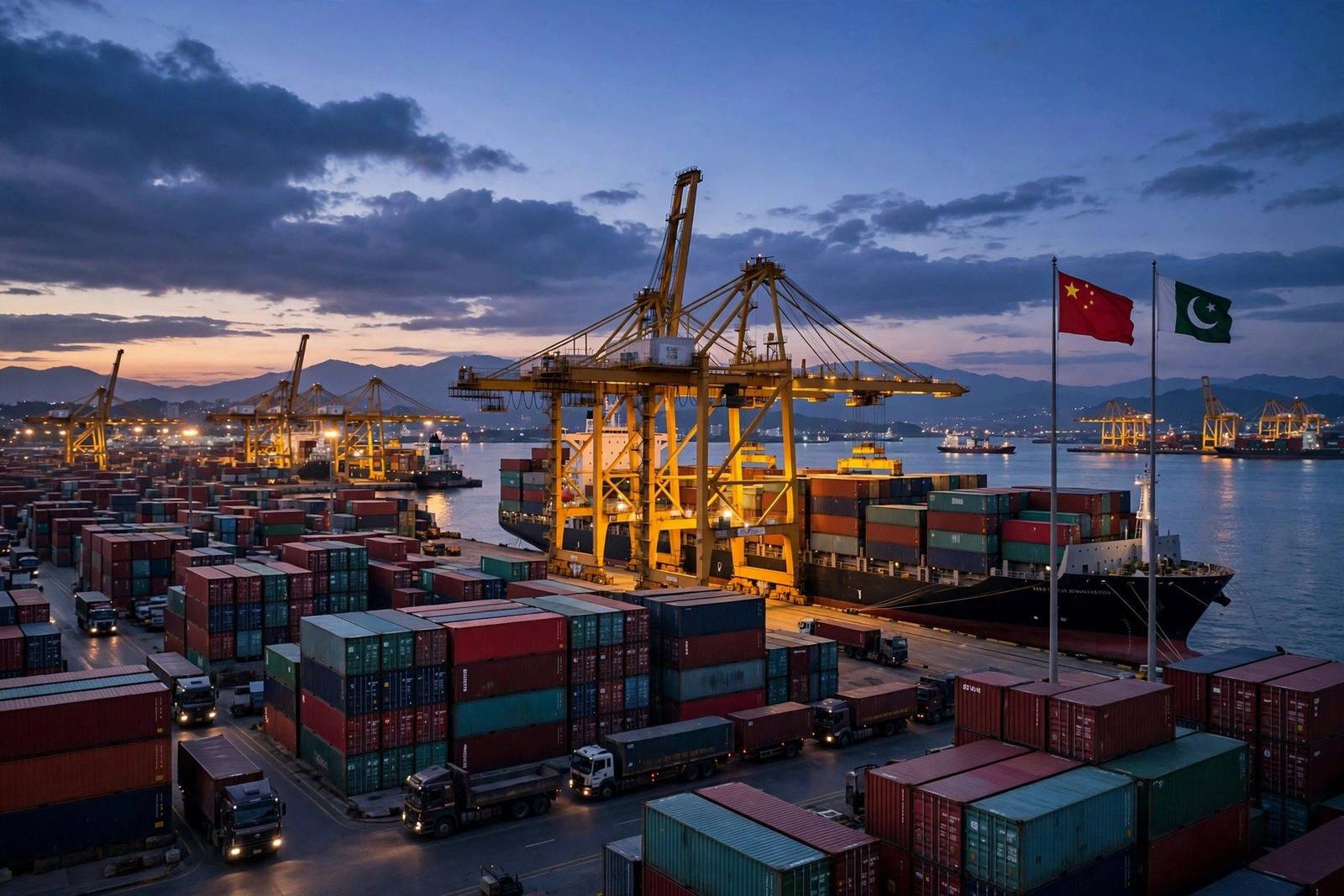
KARACHI: China is Pakistan's largest trading partner, its largest source of imports, and — by a distance that defines the relationship — a partner Pakistan buys far more from than it sells to. The imbalance is not a rounding error or a bad year; it is the settled shape of the trade, visible in every monthly customs release and in every Pakistani factory that runs on Chinese machinery, Chinese chemicals and Chinese components. This guide explains how the trade is structured, what the free trade agreement between the two countries actually did, why Pakistani exports to China remain concentrated and small, and what levers — realistic ones, not slogans — could narrow a gap that shapes the rupee as surely as any loan.
The shape of the trade
Read Pakistan's import basket and you are largely reading a catalogue of Chinese industry: electrical machinery and electronics, mechanical equipment, iron and steel products, organic chemicals, man-made fibres and fabrics, plastics, fertiliser and components for almost every assembling industry in the country. Read the much shorter export list in the other direction and you are reading an older economy: cotton yarn and textiles, rice, leather, copper and a handful of agricultural and mineral lines. The State Bank and Pakistan Bureau of Statistics publish the bilateral detail regularly, and their consistent picture — imports a large multiple of exports — is the factual floor under every debate in this article; precise monthly figures move with prices and should be taken from those releases rather than from any summary, including this one.
Two distinctions keep the discussion honest. First, trade is not CPEC: the China–Pakistan Economic Corridor is an investment and financing programme that built power plants, roads and a port connection, while the trade imbalance is a flow of goods that predates CPEC and would exist without it — though CPEC-era project imports of machinery swelled it for a time. Second, the imbalance is not uniquely Pakistani behaviour: China runs surpluses with most of the world. What is distinctly Pakistani is the narrowness of the export side, a weakness shared with the country's overall export story told in Pakistan's exports explained.
The free trade agreement, in two phases
The formal frame is the China–Pakistan Free Trade Agreement, signed in the 2000s and implemented in phases. Phase one cut tariffs on broad lists of goods on both sides and is remembered in Pakistani industry as a shock: local manufacturers, especially in light engineering, plastics, ceramics and consumer goods, found themselves competing with tariff-reduced Chinese products before they had the scale, energy prices or technology to respond, and the phase acquired a reputation — fair in parts, overstated in others — for hollowing out small industry. Phase two, negotiated over years and in force from 2020, was Pakistan's attempt to rebalance the instrument itself: deeper Chinese concessions on lines of Pakistani export interest, phased over a longer horizon, safeguards for sensitive domestic lines, and an electronic data-exchange mechanism aimed at the chronic problem of under-invoicing — goods declared at artificially low values at Pakistani customs, which cheapens imports, evades duty and falsifies the statistics everyone argues from.
An FTA, however, is a door, not a delivery. Tariff concessions only convert into exports when a country can produce the conceded goods at competitive quality, volume and delivery reliability — and Pakistan's binding constraints sit mostly behind its own border: energy costs, logistics, standards certification, and the small number of firms operating at export scale. The agreement's second phase can therefore be judged only alongside those domestic facts, and so far the bilateral numbers have moved far less than the negotiating communiqués promised.
Why Pakistan sells so little to the world's biggest buyer
China imports food, minerals and consumer goods on a planetary scale, so the puzzle is real. Part of the answer is composition: Pakistan's strongest export industries sell what China makes for itself — cotton textiles face Chinese and Vietnamese competition inside China itself — while China's fastest-growing import appetites, from high-end components to branded consumer goods, sit outside Pakistan's current capabilities. Part is market access in practice: sanitary and phytosanitary approvals for meat, fruit and processed food are negotiated product by product and plant by plant, and each approval is a small diplomatic project. Part is presence: Pakistani firms are thinly represented in Chinese distribution, e-commerce and trade-fair circuits compared with the ASEAN exporters whose China trade surged under their own agreements. And part is simply scale and continuity — Chinese buyers order in volumes and on schedules that punish the power cuts, port delays and policy reversals that Pakistani suppliers have historically had to apologise for.
There are working counter-examples, and they matter because they show the constraint is not destiny. Pakistani rice, sesame and other agricultural lines have found growing Chinese demand where quality protocols were agreed; copper and minerals have an obvious Chinese buyer as projects like Reko Diq advance; and Pakistani textiles do enter China in specific yarn and fabric niches. Each success shares a pattern: a protocol signed, a standard met, a buyer relationship built over years — export development as plumbing, not proclamation.
The import side is not one story either
It is tempting, and wrong, to treat the import bill as pure consumption leakage. A large share of Chinese imports are capital and intermediate goods — the machinery that equipped Pakistan's power, cement and textile expansions, the CKD kits and components its assemblers turn into finished products, the chemicals its pharmaceutical and plastics industries process. Cutting these imports by fiat would cut domestic production with them, as every episode of import compression has demonstrated when factories slowed for want of parts and the current account improved only by shrinking the economy — the trade-off dissected in Pakistan's current account. The genuine policy problem is narrower and harder: consumer goods that domestic industry could plausibly make, chronic under-invoicing, and an exchange-rate and tariff structure that for long periods made importing more profitable than producing.
Currency, settlement and the newer channels
Two mechanical questions recur in coverage of the trade. The first is settlement currency: both central banks have maintained a currency-swap arrangement for years, and officials periodically encourage invoicing in yuan to save scarce dollars. In practice, most trade remains dollar-invoiced because exporters, importers and their banks price in the currency their own supply chains use — a reminder that settlement follows commerce more than it leads it, within the wider system described in the rupee exchange rate explained. The second is informal and semi-formal flow: trade through third-country hubs, border commerce, and e-commerce parcels all blur the official bilateral picture at the margins, which is why serious analysts cross-check Pakistani import data against Chinese export data and treat the gap between them as information, not error.
What narrowing the gap would actually take
The realistic menu is unglamorous and mostly domestic: complete the standards-and-protocol pipeline for agricultural exports; give exporters to China the same trade-promotion seriousness Pakistan reserves for its traditional Western markets; enforce customs valuation so honest domestic producers are not undercut by fiction; keep the FTA's safeguard and review mechanisms active rather than ceremonial; and fix the energy and logistics costs that tax every Pakistani exporter to every destination. On the Chinese side, the asks are equally concrete — faster protocol approvals, buying missions with follow-through, and treatment of Pakistan inside Chinese supply chains as more than a construction market. None of this closes a structural gap in a year. All of it is measurable, which is the point: judge the relationship by the export lines that gain Chinese approvals and the Pakistani firms that win repeat Chinese orders, not by the size of the delegations photographed.
How the trade reaches the stock market
For PSX readers, the bilateral flow shows up inside companies rather than in any China index: assemblers whose kits arrive from Chinese parents and suppliers, textile mills competing with Chinese fabric at home and abroad, chemical and steel producers living alongside Chinese import parity prices, and the currency itself — since the import bill is a first-order claim on the dollars whose scarcity drives the macro cycle. This article is educational content, not financial advice.
CPEC's shadow over the trade numbers
Although trade and CPEC are different things, the corridor years left fingerprints all over the bilateral statistics. Building power plants and motorways meant importing generating equipment, transmission hardware, construction machinery and materials at project scale, much of it from Chinese suppliers tied to the financing — a surge of capital-goods imports that inflated the deficit in the construction years and then subsided as projects completed, leaving the underlying consumer-and-intermediate import flow more visible. The corridor also changed what a narrower deficit could look like in future: the special economic zones built under its second phase, at Rashakai, Dhabeji and elsewhere, are explicitly aimed at relocating Chinese-linked manufacturing — textiles, electronics assembly, agro-processing — into Pakistan for export to China and third markets. Their occupancy and export record to date is modest beside the ambition, and they will be judged, like the FTA itself, on shipped containers rather than memoranda. If they work, they attack the imbalance at its root, by changing what Pakistan produces; if they remain real-estate projects with tax holidays, the trade pattern of the last two decades will simply continue inside newer buildings.
The consumer end: what Chinese goods did to Pakistani markets.
Walk through Karachi's wholesale markets or any city's electronics and mobile-phone trade and the bilateral relationship acquires faces. Chinese manufactures — phones and accessories, solar panels and inverters in the recent rooftop boom, motorcycles' components, toys, fabrics, LED lighting — set the price points at which Pakistani retail operates, and entire local trading communities specialise in sourcing from Guangzhou and Yiwu. For consumers, especially poorer ones, this has been a genuine welfare gain: goods that were luxuries a generation ago are ordinary now. For domestic manufacturers of similar goods, it has been a competitive education delivered without mercy, and the survivors — in fans, cables, plastics, footwear — tend to be firms that matched Chinese cost discipline or retreated into branded, serviced niches where a container from Shenzhen cannot follow. Policy that ignores the consumer half of this story, and reaches only for bans and duties, reliably produces smuggling and shortages rather than industry; policy that ignores the producer half produces deindustrialisation with good shops. The FTA debate, at its best, is the search for the narrow path between those two failures.
Statistics deserve a final caution. Bilateral trade numbers are revised, partner-country mirror data rarely match exactly, and a meaningful slice of commerce — border trade, third-country routing, small-parcel e-commerce — sits at the edge of the customs record. Analysts who follow the relationship therefore triangulate: Pakistani customs, Chinese customs, the State Bank's settlement-based data and industry sources each tell a slightly different version of the same large truth. The versions differ in detail; none of them describes a balanced trade, and the policy task is unchanged in all of them.
Key takeaway: Pakistan–China trade is a wide, durable imbalance — Chinese machinery and manufactures in, a narrow band of textiles, food and minerals out — that the two-phase FTA framed but only domestic export capacity, standards and customs honesty can narrow.