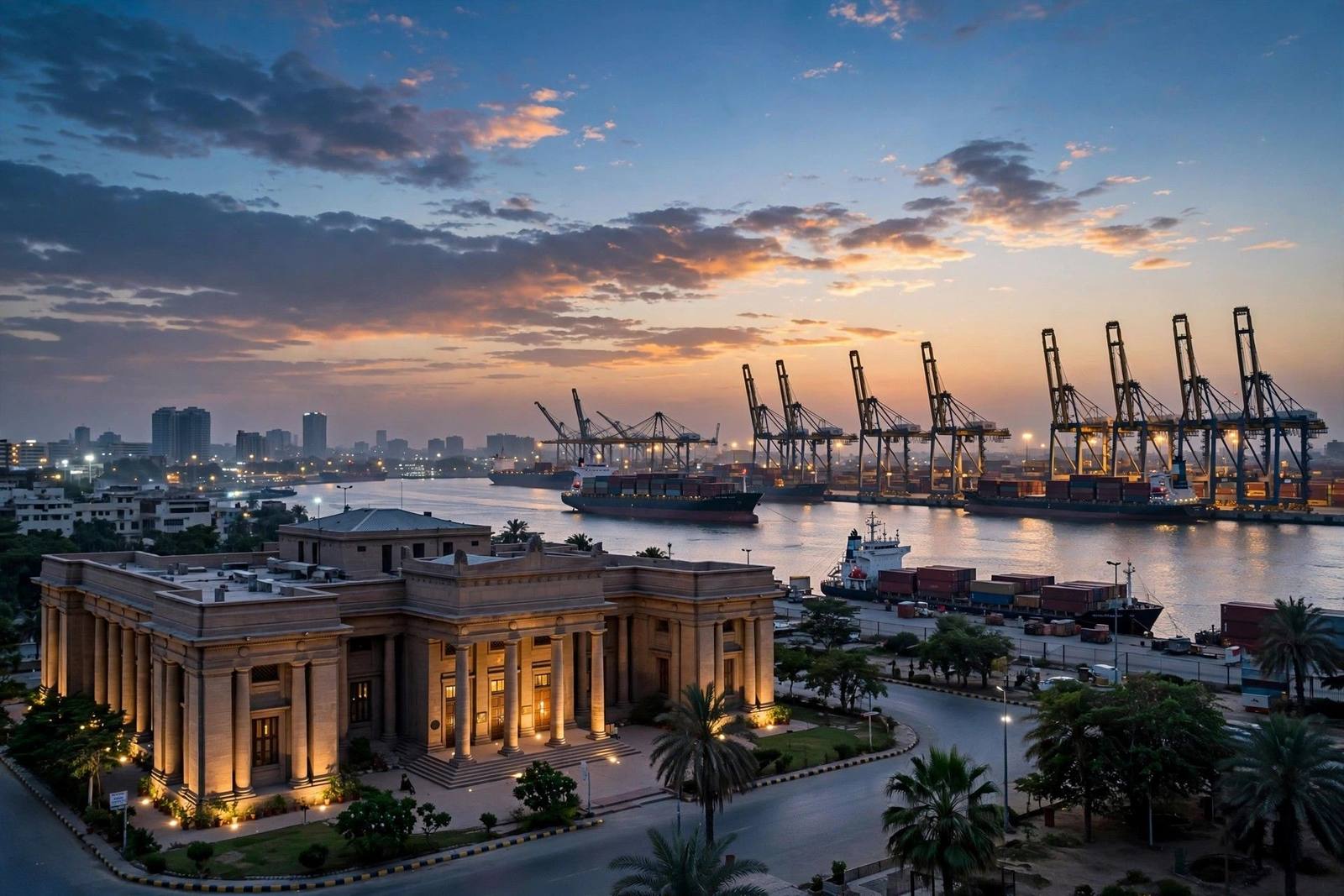
KARACHI: Pakistan's classic exports are visible: containers of textiles, rice and sports goods moving through Karachi's ports. Its newest export success is invisible. Software and IT-enabled services — code, design, customer support, back-office processing — leave the country over fibre-optic cables and arrive as dollars in bank accounts. Officially recorded IT exports have grown from a small base into a multi-billion-dollar annual flow, and everyone involved agrees the recorded figure understates the true one, because part of the work is billed through foreign accounts or arrives disguised as remittances.
The attraction is obvious for an economy chronically short of dollars. IT exports need no imported raw material, no port, no shipping line — the inputs are educated young people, laptops and electricity. Set beside the import-hungry model described in our guide to what Pakistan sells the world, tech looks like the export Pakistan was designed to have and somehow built last. A note on measurement is essential before the triumphalism. The State Bank's IT export series captures receipts channelled and coded as computer services; surveys and industry estimates have long suggested the true flow, including freelancer income and receipts booked abroad, is substantially larger. Both numbers can be useful — the official series for trend and credibility with lenders like the IMF, the estimates for understanding the sector's real weight in urban employment. What neither supports is complacency: even the generous estimates leave Pakistan's tech exports far below India's and below what its graduate output and wage advantage would predict, which is the gap policy exists to close.
The three tribes: software houses, BPO and freelancers
The industry has three distinct tribes. The first is the software house: firms in Lahore, Karachi and Islamabad building products and projects for clients in North America, Europe and the Gulf. A few are listed — Systems Limited and NetSol Technologies are the textbook examples — and their results give public investors a rare window into the sector's pricing, hiring and dollar revenue. Below them sit hundreds of mid-sized firms and thousands of small ones, many unregistered or registered only loosely.
The second tribe is IT-enabled services: call centres, medical transcription, finance back offices, design studios and e-commerce support operations that sell hours rather than software. The third is the freelancer — the individual selling skills on global platforms — numerous enough to deserve their own guide. The tribes overlap: today's freelancer founds tomorrow's agency, and agencies quietly staff projects with freelance specialists.
Geography inside Pakistan is concentrating even as the work disperses. Lahore and Karachi anchor the large firms and the client-facing leadership; Islamabad adds public-sector and donor-funded work; and a long tail of smaller cities supplies remote talent at lower living costs — a distribution remote work has flattened further since the pandemic. The constraint in the smaller cities is rarely talent; it is the senior layer — architects, product managers, sales engineers — that clusters where the clients visit. Building that layer outside the big three is the difference between a national industry and three successful neighbourhoods.
How the money actually flows home
An IT export begins as a contract priced in dollars, pounds or dirhams. When the client pays, the money arrives through banking channels into the exporter's account, and the State Bank's reporting systems record it under computer and information services — the statistic that becomes the headline 'IT exports' number. Exporters historically were required to repatriate proceeds and convert most of them into rupees; rules have been progressively relaxed to let firms keep a share in special foreign-currency accounts for paying foreign expenses — cloud servers, software subscriptions, overseas staff and marketing.
Those retention rules matter more than they sound. A software company's costs are partly in dollars by nature: AWS bills, GitHub seats, a sales office in Texas or Dubai. Forcing full conversion and re-conversion wastes spread and time, so each liberalisation has been greeted as a competitiveness measure. Freelancers operate under their own account arrangements with per-month retention limits that the State Bank has adjusted over time; the direction of policy has consistently been toward letting digital earners hold and use more of what they earn.
The client map is equally concentrated, and deliberately so. North America takes the largest share of Pakistani IT exports, followed by Europe and the Gulf, whose sovereign digital programmes and Pakistani diaspora executives make it the fastest-growing frontier. Concentration buys depth — firms learn one market's compliance, procurement and culture — and costs resilience, as any US tech downturn demonstrates when project pipelines freeze within a quarter. The listed exporters' results are the public seismograph for these tremors, one reason analysts read Systems Limited's order commentary the way they read a central bank statement.
Why Pakistan, why now: the cost and language equation
Pakistan's pitch to a foreign client is arithmetic. A competent software engineer in Lahore or Karachi costs the client a fraction of the equivalent hire in California, London or even Dubai, while working in English — the working language of Pakistani higher education and of the industry itself — and in time zones that overlap both Europe's afternoon and the Gulf's whole day. A large annual output of graduates, many in computing and engineering, keeps the funnel filled, and the diaspora supplies the sales bridgeheads: Pakistani engineers in Toronto, London and Silicon Valley who send work home.
The same arithmetic explains the industry's fragility. It sells a cost advantage, and cost advantages are contested — by India and Bangladesh, by the Philippines, and increasingly by automation and AI tools that compress the value of junior coding hours. The durable defence is moving up the stack: products rather than projects, domain expertise in finance, health or logistics, and firms with their own intellectual property. The listed leaders are watched precisely because their revenue mix shows whether that climb is happening.
Talent pipelines are the industry's quiet infrastructure. Universities produce the raw graduates; the finishing is done by the firms themselves, by bootcamps and online academies, and increasingly by platform work that teaches client discipline early. English remains the sorting mechanism — the industry's working language is the client's language — which is why communication training outsells another programming certificate in the private training market. Where the pipeline leaks is emigration of the mid-career layer, whose departure is individually rational and collectively expensive: every senior who leaves takes a training capacity of five juniors with them.
The state's scaffolding: PSEB, STZAs and tax treatment
Government involvement runs through the Pakistan Software Export Board, which registers exporters, runs delegations and subsidises participation in foreign tech fairs, and through the Special Technology Zones Authority, which offers licensed zones with tax and customs incentives for tech firms and freelancers. IT exports have also enjoyed concessional income-tax treatment for long stretches — low effective rates for registered exporters, periodically extended and periodically threatened in budget season, an annual ritual of lobbying that tells you how much the sector values the concession.
Readers of our guide to Pakistan's federal budget will recognise the pattern: a sector too small to tax heavily today is nurtured as a future earner, and each finance bill tests the bargain. The policy arguments are genuine — concessions cost revenue now — but the counter is visible in the data: the formal, recorded share of IT exports tends to rise when banking and tax rules make formality cheap, and to leak abroad when they do not.
Venture capital wrote a dramatic subplot. Pakistani startups raised record sums in the global liquidity boom, then watched funding collapse when global rates rose — a cycle that pushed the ecosystem from growth-at-all-costs toward revenue, and pushed hundreds of startup-trained product managers, designers and engineers into the services firms and freelance market. The residue is valuable: a generation that has built consumer products, not just client projects, now sits inside the wider industry. Whether Pakistan converts that residue into product companies of its own — the step India took a decade longer over — is the sector's defining open question.
The uncounted economy: under-recording and its costs
Ask industry veterans for the true size of tech exports and you will get numbers well above the official series. The gap has mundane causes: freelancers paid into foreign wallets or accounts held abroad, small firms invoicing through a partner's company in Dubai or Delaware, and receipts booked as home remittances — the worker-remittance line explained in our guide to remittances — rather than as service exports. Some of it is tax avoidance; much of it is friction avoidance, a rational response to slow banking, documentation demands and shifting rules.
The costs of invisibility are real, though. Unrecorded earnings understate Pakistan's export capacity in IMF programme arithmetic, weaken the industry's hand when it lobbies, and keep firms small: a company whose books hide its revenue cannot borrow against it, sell equity to investors or list on the PSX. The gradual formalisation of the sector — more firms audited, banked and visible — is therefore an economic statistic worth watching in itself, quite apart from the growth rate.
Infrastructure complaints deserve precision, because not all of them are equal. Power backup is a solved, if costly, problem for any serious firm — generators and UPS systems are a line in every budget. The harder problem is connectivity governance: episodes of throttling, firewall experiments and platform disruption that foreign clients read as country risk, priced into contracts as demands for backup teams in other jurisdictions. The industry's argument to the state is blunt: bandwidth reliability is now export infrastructure, as much as a port, and should be governed with the same reluctance to improvise.
Risks: power, broadband, politics and the AI question
The industry's inputs are people, power and bandwidth, and two of the three are unreliable. Electricity outages and expensive backup, episodes of internet throttling or platform disruption, and the sudden policy shifts that accompany Pakistan's political cycles all appear in foreign clients' risk assessments; a missed deadline in Austin is blamed on Karachi's infrastructure, fairly or not. Skilled emigration is the double-edged risk: every engineer who leaves for a Gulf or Western job raises remittances and diaspora connections, and thins the senior layer that trains the next cohort at home.
Artificial intelligence hangs over the junior end of the market. Routine coding, testing and support work — the industry's traditional entry rungs — are exactly what AI tools automate first. The optimistic reading is that Pakistan's firms sell outcomes, not keystrokes, and can adopt the same tools; the pessimistic reading is a training ladder with its bottom rungs sawn off. Either way, the sector's next decade depends on skills upgrading more than on headcount.
There is a distributional story worth naming, too. IT and freelance income has built a visibly new urban middle class — young, often first-generation salaried or self-employed, paid in dollars and comparatively insulated from the domestic inflation cycle. Its consumption shows up in private education, housing societies on city edges, car sales and the cafés of Lahore and Karachi; its savings increasingly show up in the formal financial system the sector's formality drive is building. Economies rarely get a new class delivered by fibre-optic cable; Pakistan is mid-delivery, and the social consequences will outlast any single export statistic.
What kind of investor studies IT exports
Public-market exposure is narrow — a handful of listed technology names carry the sector's hopes, and their dollar revenues make them partial hedges against rupee weakness, as the exchange-rate guide explains. The broader investor watches IT exports as a macro variable: a growing, import-free dollar stream that eases the external accounts, employs the urban young and slightly loosens Pakistan's dependence on textiles and remittances. This article is educational content, not financial advice. The habit to build is simple: when the State Bank publishes its services data, read the IT line the way an older generation read the cotton crop — as a harvest report for the digital economy.
Key takeaway: Pakistan's IT exports turn English-speaking engineers and fibre-optic cables into dollars without touching a port — a small flow today, but the most scalable hard-currency earner the economy has.