KARACHI: You have probably never bought anything with Rafhan Maize's name on it, yet you have almost certainly consumed its work this week. The stiffness in a shirt, the glaze on a tablet, the sweetness in a soft drink, the coating on a sheet of paper, the body in a sauce — behind an surprising share of Pakistan's manufactured everyday life sits maize starch from Faisalabad. Rafhan Maize Products Company Limited, ticker RMPL on the Pakistan Stock Exchange, is the country's pioneering corn refiner: a company founded in 1953 that takes in maize by the trainload and separates it, through wet milling, into the industrial starches, sweeteners and feed ingredients that dozens of other industries build on. It is majority-owned by Ingredion Incorporated of the United States, it has been one of the exchange's most distinctive high-priced shares for decades, and its recent departure from the KSE-100 — the event in its title — makes it a perfect case study in how index membership works.
1953: a corn refinery in a textile city
Rafhan Maize was incorporated in Pakistan in 1953, headquartered from the start in Faisalabad — then, as now, one of the country's great industrial cities, though famous for textiles rather than food processing. The location was not a coincidence. Faisalabad sits in the middle of Punjab's maize-growing belt, close to the farming districts that could supply a refinery's enormous appetite for grain, and on the rail and road arteries that could carry finished starch to customers across the country. A corn refinery is a bulk business in both directions: heavy raw material in, heavy ingredients out, and freight economics reward sitting near the crop.
The company's founding era matters. The early 1950s were Pakistan's first industrial decade, when the new state was trying to build, almost from nothing, the processing industries a modern economy needs. A maize wet-milling plant was an ambitious thing to build in that setting: the process — steeping grain in water, then grinding and separating it into starch, protein, germ and fibre — demands continuous operation, chemical know-how, reliable power and water, and customers sophisticated enough to use standardised industrial ingredients. Rafhan's original plant on Rakh Canal East Road in Faisalabad has remained its head office and first production site ever since, a continuity of place that is itself unusual in Pakistani industry.
Ownership settled early into the pattern that still defines the company. The majority of Rafhan's shares has for decades rested with the international corn-refining group whose present-day form is Ingredion Incorporated, based near Chicago in the United States — a global ingredients business operating in dozens of countries. The company's own financial statements state the relationship plainly: Ingredion holds the majority of its shares. For the Pakistani business, that parentage has meant access to process technology, product development and export connections from one of the world's specialist corn refiners; for investors, it has meant a company run to a multinational subsidiary's standards of reporting and process discipline, with a controlling shareholder whose time horizon is industrial, not financial.
Three plants and one raw material
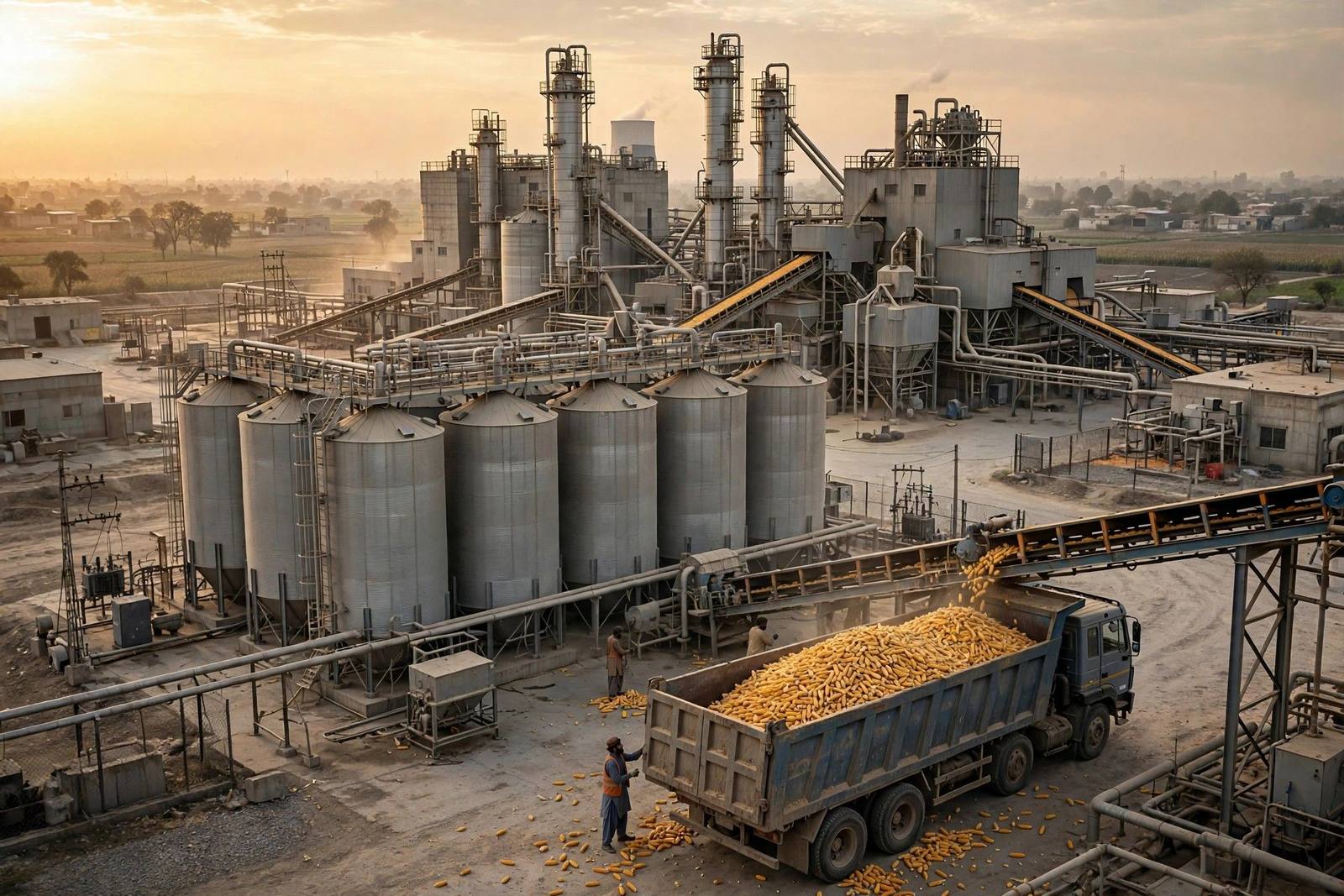
Rafhan today operates three production sites. The original Faisalabad plant on Rakh Canal East Road combines head office and production. The Cornwala plant, on the Jaranwala–Khurrianwala road outside Faisalabad, is the group's expansion site in Punjab — described in industry reporting as carrying the largest single share of the company's grinding capacity, with divisions for wet milling, dry starch, dextrose and sweeteners. The Mehran plant at Kotri, in Sindh's Jamshoro district, extends the same model south, nearer to Sindh's maize areas and to Karachi's port and industrial customers. Industry profiles describe total grinding capacity in the region of nineteen hundred tonnes of maize a day, with utilisation historically running high — figures a reader should treat as the scale of the operation rather than a promise about any given year, and check against the latest annual report.
Everything starts with the grain itself. Maize is bought in bulk around the harvests, stored, cleaned and steeped, and then separated into its components, each of which becomes a product line. Nothing much is wasted: the starch stream feeds the ingredient range, the germ goes to oil and feed uses, and the protein-rich gluten fractions become gluten meals sold into the poultry, livestock and aquaculture feed industries — the same animal economy that supplies the milk behind companies such as FrieslandCampina Engro Pakistan. Understanding Rafhan means understanding that it is not really a food company or a chemical company; it is a separation business, earning its margin on how completely and cleverly it takes one cheap agricultural commodity apart.
What comes out of the refinery
The product list in the company's own reporting is compact — industrial starches, liquid glucose, dextrose, dextrin and gluten meals headline it — but the customer list those products feed is anything but. Native and modified starches go into food and beverages as thickeners and stabilisers; into paper and corrugated board as binders and coatings; into textiles as sizing that strengthens yarn for the loom — a trade woven into Faisalabad's own mills; and into pharmaceuticals as a filler and binder in tablets. Liquid glucose and other sweeteners serve confectionery, bakery, soft drinks, ice cream and brewing. Dextrose and dextrins serve food, pharma and industrial users in turn. The company itself notes that its ingredients find applications across dozens of types of industry, which is the defining feature of its demand: no single customer sector makes or breaks Rafhan, because starch is one of those invisible inputs, like electricity or packaging, that modern manufacturing simply assumes.
That breadth changes how the business should be read. A cement company lives and dies by construction; a car assembler by vehicle sales. Rafhan lives by the general level of Pakistani manufacturing and food processing — a slower-moving, more diversified demand base — overlaid with the seasons and world prices of one agricultural input. Its customers are businesses, not households, so brand and shelf presence matter little; specification, consistency and delivered cost matter entirely, and switching suppliers is a technical decision, not a marketing one. Once a food or paper maker's process is tuned to a supplier's starch grades, the relationship tends to endure.
How Rafhan makes money
The refinery's profit is a spread: the value of everything separated out of a tonne of maize, minus the cost of the maize, the energy, chemicals and water the separation consumes, and the freight of moving bulk in both directions. Maize is therefore the whole game on the cost side. Grain prices swing with harvests, weather, competing demand from the poultry-feed sector — Pakistan's maize is pulled hard by the feed industry — and with government policy on grain trade. A refiner cannot store its way out of a bad crop year indefinitely, and cannot pass every cost increase to industrial customers whose own markets are competitive; the working skill of the business is procurement — buying well across the harvest, grading reliably, and holding stocks at the right level into the lean months.
On the revenue side, the levers are capacity utilisation and mix. A wet mill is a continuous-process plant: it earns best run flat out, around the clock, which is why the reported history of high utilisation matters — idle grinding capacity earns nothing while its fixed costs continue. Mix is the subtler lever: a tonne of maize sold as commodity starch earns the base return, while the same starch stream modified, dried into dextrose, or converted to sweeteners for higher-specification customers carries more value per tonne. The long Cornwala expansion story — adding dextrose and sweetener divisions beside basic milling — is that mix logic made concrete. Energy costs thread through everything, since steeping, separation, drying and evaporation are heat-hungry steps, and any reader comparing Rafhan with other processors in our PSX food sector guide will find the same maize-versus-energy arithmetic in different dress.
Strengths, risks and controversies
Rafhan's strengths are incumbency and integration. It pioneered corn refining in Pakistan, operates at a scale no domestic rival matches in its category, sells into an unusually diversified customer base, and draws technology and product development from a global parent whose entire business is this process. Its ingredient relationships are sticky, its plants sit in the right places, and its co-product streams — oil-bearing germ and protein meals — monetise parts of the grain that a cruder processor would discount.
The risks begin with the crop. Maize price spikes — from poor harvests, feed-sector competition or trade restrictions — compress the refiner's spread from the input side, while weak industrial demand compresses it from the customer side; a bad year can deliver both at once. Energy tariffs and gas availability press on drying and evaporation costs. The controlling-shareholder structure cuts both ways for minorities: professional and stable, but with strategic decisions — expansion, pricing within the group, dividend policy — taken with a parent's priorities in view. And like every food-chain processor, Rafhan operates inside food-safety and environmental regulation, where effluent from a wet mill is a serious operational responsibility in the canal country its plants sit among.
There is also the standing peculiarity of RMPL as a share. The company's issued share count is small and the parent's majority holding leaves only a few million shares in public hands, so the nominal price per share has long been among the highest on the exchange — a share priced in thousands of rupees rather than tens. That is arithmetic, not quality: as our explainer of market capitalisation sets out, what matters is the value of the whole company, not the price of one slice. But the small float has real consequences — thin trading, wide spreads between buying and selling prices, and days when the quoted price moves on very few transactions.
Leaving the KSE-100: what it does and does not mean
Rafhan was for many years a constituent of the KSE-100 index, and its removal at a recent rebalancing — the "just left the KSE-100" of this profile's title — is best understood mechanically. Index membership is not a medal for quality; it is a rules-based outcome of market capitalisation and trading liquidity, recalculated at periodic reviews. A company with a small free float can be a substantial, profitable business and still drift out of the index, because the index measures the investable, tradeable market — and a tightly held share offers little of either. Our explainer of KSE-100 index rebalancing walks through how constituents enter and leave, and why index funds and trackers must trade the changes, which can itself move a small-float share's price and volume around the review.
For Rafhan's followers, the practical meaning is modest. The refinery grinds the same maize the day after the index change as the day before; what changes is the audience — fewer index-driven holders, less research attention, and a share that trades even more on the patience of its existing holders. Dividend character, likewise, is untouched by the index: Rafhan has historically been among the market's more generous dividend payers in profitable periods, in the pattern of a mature, cash-generative subsidiary — but payouts remain board decisions, varying with earnings, maize economics and the parent's plans, and no history guarantees the next one.
What kind of investor studies Rafhan
RMPL is studied by investors who like industrial moats they can walk around: a hard-to-replicate plant, a dominant position in a niche input, a global parent, and demand diversified across the whole manufacturing economy. Their checklist is stable — maize procurement costs and harvest conditions, capacity utilisation, the mix shift toward higher-value derivatives, energy costs, export sales of starches and meals, and the dividend declared against the year's cash generation. It rewards readers comfortable with a thinly traded, high-priced share and with annual reports that speak the language of process industry rather than brands. This article is educational content, not financial advice.
A final reading habit is worth adding. Because Rafhan's customers are other manufacturers, its results often move a step ahead of the consumer economy rather than with it: starch orders soften when food, paper and textile producers trim production, and firm up when factory Pakistan is busy. Readers who track Rafhan alongside cement dispatches and large-scale manufacturing data get a small, early window into the industrial cycle — one more reason this quiet Faisalabad refiner has kept its following among the exchange's fundamental readers, inside the index or out of it.
Key takeaway: Rafhan Maize, refining maize at Faisalabad since 1953 under Ingredion's majority ownership, turns one grain into the starches and sweeteners dozens of industries depend on — and its exit from the KSE-100 says more about its small free float than about the refinery itself.