KARACHI: Every Pakistani city runs on the three-wheeler. The auto-rickshaw — part taxi, part delivery van, part family car — is the workhorse of urban Pakistan, and for two decades the name most associated with building it has been Sazgar. Then, in the space of a few years, the same Lahore company did something almost nobody in Pakistan's auto industry had managed: it moved from rickshaws into modern sport-utility vehicles, assembled locally with a Chinese partner, and launched the country's first locally assembled hybrid car. Sazgar Engineering Works Limited, traded as SAZEW, is now read two ways at once — as a three-wheeler and auto-parts manufacturer with deep roots, and as the local face of Great Wall Motor's Haval brand. This profile traces how one business grew out of the other.
What Sazgar makes
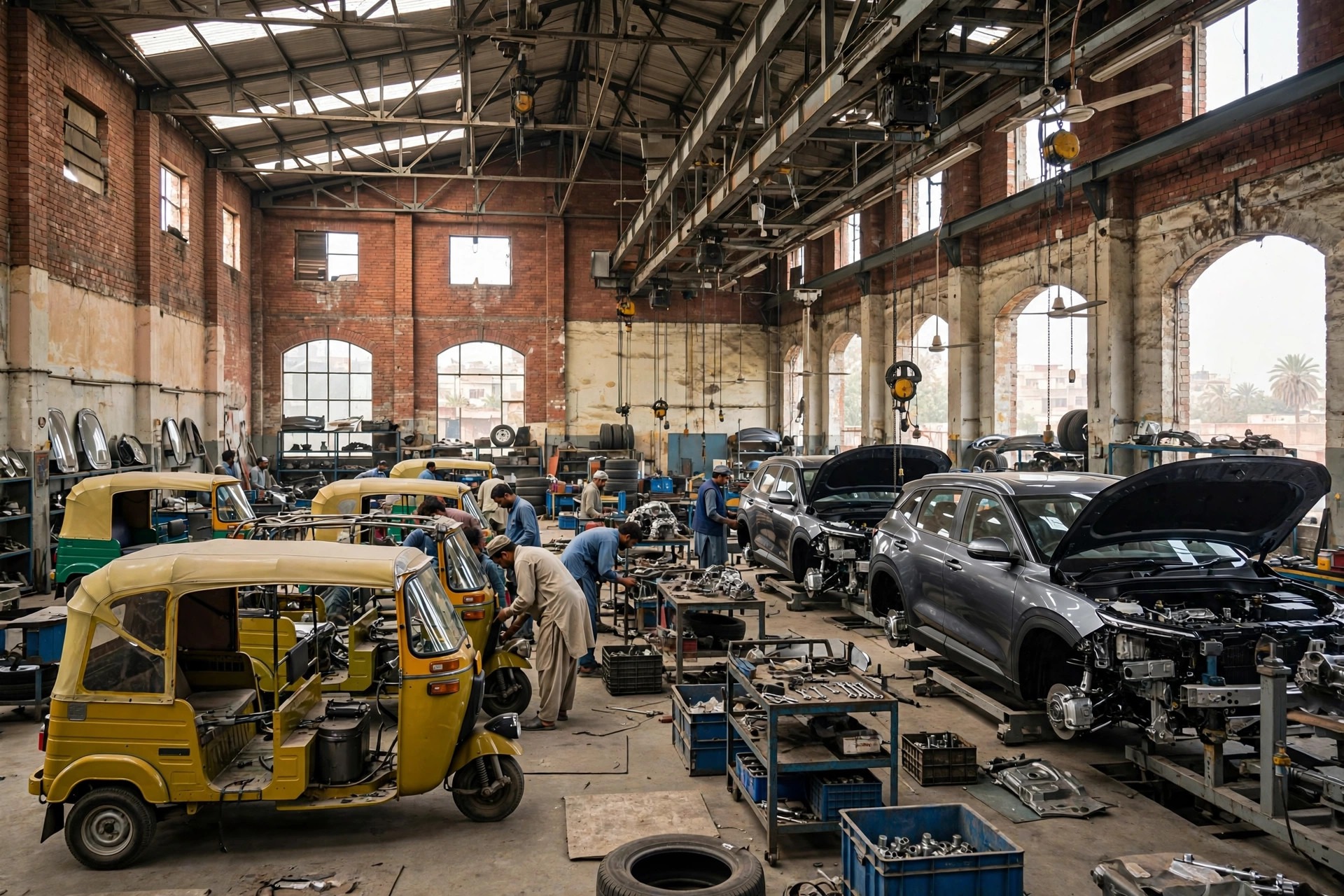
Sazgar's operations fall into three connected lines. The oldest visible business is three-wheelers: motorised rickshaws for passengers and cargo, sold across Pakistan and exported to regional markets, including, more recently, electric versions. The second is automotive parts — the engineering works in the company's name. Sazgar began as a maker of components, and parts and wheel rims for tractors, vehicles and rickshaws remain part of its output and its identity as a genuine manufacturer rather than a pure assembler. The third, and now the most prominent, is four-wheel vehicles: SUVs assembled at its Lahore plant under the Haval brand of China's Great Wall Motor, and earlier vehicles produced with another Chinese partner, BAIC.
The combination is unusual in Pakistan's auto sector, where the established pattern is a joint venture between a local group and a single Japanese brand. Sazgar instead built its own manufacturing base in three-wheelers and parts, then layered foreign four-wheel brands on top of it — keeping ownership local and the partnerships contractual. Our sector guide to automobile stocks on the PSX shows how that structure compares with the Toyota, Honda and Suzuki assemblers and the parts makers around them.
1991–2005: an engineering works grows up
Sazgar Engineering Works was founded in September 1991 as a private limited company, headquartered in Lahore, with Mian Asad Hameed as its founder. It converted to a public limited company in November 1994 and was listed on the Karachi Stock Exchange in 1996 — early steps that gave a young parts maker access to public capital while its founding family retained control, an arrangement that persists: the Hameed family remains the company's dominant shareholder bloc and supplies its chairman and chief executive.
Through the 1990s the company operated in the less glamorous, more durable end of the industry: components, including wheel rims, for the vehicle and tractor makers, and engineering work that built machining, fabrication and quality capabilities. That base mattered later. When Pakistan's auto policy rewarded local manufacturing depth — the deletion programmes that pushed assemblers to source parts domestically — Sazgar was already a manufacturer in its own right, not merely a trader with a shed.
2005 onwards: the rickshaw business
Sazgar began producing motorised rickshaws in 2005, entering a market long served by informal workshops and imported or locally copied designs. It professionalised the product: a branded, warranted vehicle, a dealer and parts network, and variants for the different ways Pakistan actually uses three-wheelers — passenger hire, school and factory runs, and load-carrying for small traders. The rickshaw is a serious economic machine: for its owner-driver it is a business asset bought on instalments, and its purchase price, fuel economy and uptime determine a family's income. A manufacturer who keeps parts cheap and available keeps that customer for life, and Sazgar built a leading position in the segment on exactly those economics.
The three-wheeler line has continued to evolve. In February 2024 Sazgar became the first company in Pakistan to obtain a licence to produce electric three-wheelers, positioning its oldest business for the fuel-cost pressures that bear hardest on the poorest drivers. Rickshaws still provide volume, diversification and a hedge: when car demand slumps in a downturn, the three-wheeler market — tied to livelihoods rather than discretionary spending — behaves differently.
2021–2022: the Great Wall bet
The transformation came through China. Great Wall Motor, one of China's largest vehicle makers, entered Pakistan with Sazgar as its local partner, and its SUV brand Haval reached the market in 2021, initially with imported vehicles. In July 2021 Sazgar was awarded Category-A Greenfield status under Pakistan's auto policy — the incentive framework for new entrants — covering Haval assembly alongside the BAIC vehicles it was already producing. Sazgar completed a new manufacturing plant for the programme, finished trial production ahead of schedule in 2022, and began local assembly of the Haval Jolion and Haval H6 SUVs.
The landmark arrived on 17 November 2022: the launch of the Haval H6 HEV, billed as Pakistan's first locally assembled hybrid electric vehicle. The significance was strategic as much as technical. Pakistan's auto market had been dominated for decades by a small set of Japanese assemblers selling mature designs; a locally built hybrid SUV from a Lahore rickshaw maker announced that the industry's centre of gravity was shifting — towards Chinese partners, towards electrified drivetrains, and towards newer entrants willing to localise them. Larger Haval models followed, including the Tank line of off-road SUVs, with Great Wall's electric Ora brand also presented for the market. Each addition kept the same structure: Sazgar invests in plant and localisation, Great Wall supplies designs, kits and brand.
How Sazgar makes money
Like other local assemblers, Sazgar's four-wheel model is built on CKD kits — completely knocked-down packs of parts imported from its partner and assembled in Lahore with progressive local content. Revenue is the sticker price of each vehicle; profit is what remains after the kit cost (denominated in foreign currency and therefore sensitive to the rupee), duties and taxes under the prevailing auto policy, localisation spending, plant costs and dealer margins. Pricing power comes from product freshness and brand demand; the constraint is that a weak rupee raises kit costs faster than customers' incomes, squeezing either margins or volumes. Hybrids add a further twist: favourable duty treatment for electrified vehicles under government policy has directly shaped the economics of the H6 HEV and its successors.
The older businesses behave differently. Rickshaws are high-volume, lower-ticket and fiercely price-competitive, with earnings driven by manufacturing efficiency and parts availability. Auto parts earn steadier, business-to-business margins tied to the wider industry's output. Put together, the group can grow very fast when a new SUV catches the market — and is exposed, in the same proportion, to the policy incentives, exchange rate and consumer credit conditions that govern all Pakistani car sales. Understanding those mechanics is the real content of following SAZEW; our explainers on market capitalisation and how the KSE-100 is calculated help place a fast-growing mid-sized company in the context of the wider index it joined.
Sazgar in Pakistani life
Few listed companies touch daily life at so many income levels. The Sazgar rickshaw carries schoolchildren in Gujranwala and cargo in Karachi's wholesale markets; its parts keep other makers' vehicles moving; and its Haval SUVs have become a common sight in the affluent districts of Lahore, Karachi and Islamabad, where they compete head-on with the Japanese brands that once owned the segment unchallenged. The company is also a case study in industrial upgrading that policymakers cite: a firm that climbed from components to three-wheelers to hybrid SUVs over three decades, adding skills at each rung rather than leaping on the strength of protection alone.
Haval was not Sazgar's first four-wheel partnership, and the earlier experiment explains the later one's design. Around 2020 Sazgar began producing vehicles with BAIC, the Beijing automotive group, assembling models including a small hatchback and SUVs under BAIC's brands at Lahore. Volumes were modest and the range never achieved the breakout of the Haval line, but the episode taught the company — and demonstrated to prospective partners — that it could homologate foreign models, build to a partner's quality standards, run CKD logistics and support a dealer network. When Great Wall came looking for a Pakistani partner with greenfield incentives and manufacturing credibility, Sazgar's résumé was already written. The BAIC programme also underlines a risk in the multi-brand model: a local assembler's fortunes depend on partners it does not control, their model cycles, pricing decisions and commitment to the market. Sazgar's answer has been to keep the parts and rickshaw base — businesses wholly its own — beneath whatever brands sit on top.
Policy, plants and the economics of local assembly
Pakistani auto assembly exists inside a policy greenhouse. Greenfield status under the Auto Industry Development and Export Policy brought Sazgar concessional duties on imported kits and parts for a defined period — the oxygen in which the Haval launch economics worked. What happens as incentives taper is the standard industry question, answered by localisation: the more value Sazgar and its suppliers add in Pakistan — pressings, plastics, seats, glass, tyres, wheels — the less the finished vehicle costs in foreign exchange and the more durable its margin when concessions end. Sazgar's parts heritage is a genuine asset here; few assemblers anywhere in the sector began life as component makers.
The physical footprint has grown with the ambition. The Lahore manufacturing complex — welding, painting and assembly for four-wheelers alongside three-wheeler and parts production — was expanded for the Haval programme, and the company has acquired additional land adjacent to its plant for further capacity, signalling that management expects the SUV chapter to be a long one. Employment has grown correspondingly, and Sazgar's expansion is regularly cited in industry debates as evidence that new-entrant policy can work — contested evidence, since sceptics note the protection the policy extends, but evidence either way that a rickshaw maker now anchors a meaningful slice of Pakistan's passenger-vehicle output.
The oldest business still finds new maps. Sazgar's rickshaws are exported to markets in the region and beyond where the three-wheeler serves the same livelihood role it does at home, and the electric three-wheeler licence of 2024 points the line at export markets that are electrifying their informal transport fastest. For a company whose newer fame rests on SUVs, the rickshaw remains the purest expression of its founding competence: designing for Pakistani road conditions, Pakistani fuel prices and Pakistani repair economics — and selling that understanding wherever similar conditions hold.
After-sales is the unglamorous half of the SUV story. A premium vehicle is a promise about parts availability, trained technicians and resale value, and a newcomer brand must build all three while it sells. Sazgar has accordingly invested in dealer and service networks in the major cities, parts warehousing and technician training with its partner — the infrastructure that determines whether early Haval buyers become advocates or cautionary tales. In Pakistan's market, where a vehicle is often a family's second-largest asset, that ownership experience decides the second purchase and the brand's durability long after launch pricing is forgotten.
What investors typically watch
Followers of SAZEW track monthly production and sales figures published for the auto industry — Haval volumes above all, since four-wheelers drive the earnings swings — alongside rickshaw volumes as the stabiliser. They watch the rupee, because kit costs are imported; auto-policy and budget decisions, because greenfield incentives and hybrid duty structures are written into the company's margins; new model launches and the degree of localisation achieved, which affects both cost and policy standing; and the competitive response from rival assemblers launching their own hybrids and Chinese-brand SUVs. Capacity expansion announcements are read as management's own verdict on demand.
As with every profile here, this is educational content about the company's story and model — not financial advice, and no view on whether the shares should be bought or sold.
Key takeaway: Sazgar climbed Pakistan's auto ladder rung by rung — parts in 1991, rickshaws from 2005, then Great Wall's Haval SUVs and Pakistan's first locally assembled hybrid in 2022 — a locally owned manufacturer whose earnings now swing with SUV demand, the rupee and auto policy.