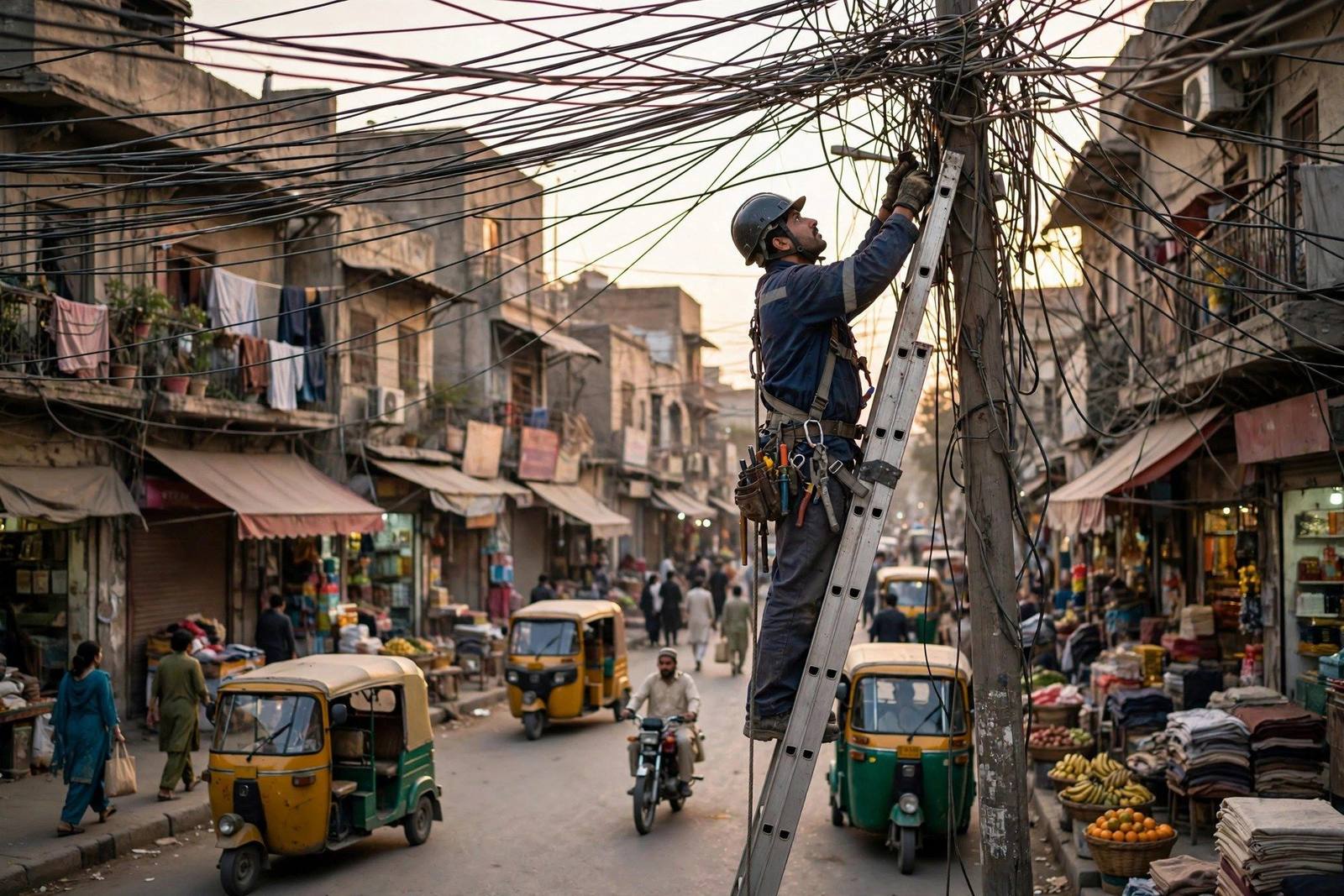
KARACHI: Telecard's founding product is extinct, and the company is still here. Incorporated in 1992 as a public company, Telecard built its first business on payphones — the coin- and card-fed booths that were, for a brief decade, Pakistan's answer to a telephone system most households could not get a line from. It added wireless local loop telephony and long-distance services as the sector liberalised, watched mobile phones annihilate the payphone and squeeze every fixed-line business in the country, and arrived in the present as something its founders could not have pictured: a holding company whose most valuable asset is Supernet, the satellite-and-data-network subsidiary it founded in 1995, later listed in its own right and folded into a listed technology group. TELE is therefore less a telecom operator's story than a survival story — and a lesson in reading a listed parent whose substance sits one level down, inside a business you can also buy separately.
Origins: telephones for a country waiting for telephones
To understand Telecard's birth, recall the Pakistan of the early 1990s: a state telephone monopoly, waiting lists for home connections measured in years, and a vast unmet demand for basic communication. Private capital was invited into the gaps — value-added services, payphones, paging, and later competitive telephony. Telecard Limited was incorporated on 29 October 1992 as a public limited company, and built a business around public call offices and payphone services under licence, alongside the integrated telecommunication services its licences allowed: wireless telephony, long-distance and international services and payphone networks. For millions of Pakistanis in the 1990s, a Telecard booth or card was not a brand curiosity; it was how you called a relative in the Gulf, arranged a job, or heard family news.
The company's most consequential early decision came in 1995, when the group established Supernet as its data-communications arm — providing satellite and microwave connectivity, internet services and related equipment to businesses that could not rely on the public network. Where the payphone business sold minutes to individuals, Supernet sold reliability to institutions: banks linking branches, companies linking offices, organisations that needed a connection in places the wired network barely reached. That institutional DNA — enterprise contracts, managed links, nationwide reach — is what survived every subsequent upheaval in the consumer market.
The upheavals were severe. The mobile revolution of the 2000s did to payphones what it did everywhere: made them unnecessary within a few years, as handsets and prepaid SIMs put a phone in every pocket. Wireless local loop services, in which Telecard and rivals offered fixed-style telephony over radio networks, enjoyed a brief boom before mobile prices collapsed through them too. Long-distance and international (LDI) services remained a real business but a brutally competitive, thin-margin one, exposed to regulatory shifts and to the grey-traffic of illegal call termination that plagued the era. Telecard's consumer-facing empire shrank accordingly, and the listed company entered a long chapter of restructuring, losses and reinvention that its annual reports chronicle in detail.
What Telecard does today
The modern group, as its consolidated accounts describe it, is a small constellation around the parent. Telecard itself holds the legacy licences and telecommunication operations — integrated services spanning wireless telephony, long-distance and international traffic and the remnants of the payphone estate. Around it sit wholly owned subsidiaries built over the years: Telecard E-Solutions for telecommunication and IT solutions, Telegateway and other small vehicles for communication services — and above all Supernet, the business that gives the group its present relevance.
Supernet's own evolution tracks Pakistan's enterprise-technology market: from satellite links and internet provision in the 1990s to nationwide data connectivity across more than two hundred cities and towns, and onward into managed services, cybersecurity, internet-of-things work and integrated ICT solutions for corporate and public-sector clients. It is the group's engine and its storefront to the technology economy, which is precisely why Telecard's management chose to give it a stock-market life of its own — first exploring a listing around 2021, then floating it on the PSX's Growth Enterprise Market board in May 2022, where reporting at the time described it as the first technology company to list on that board. Supernet subsequently set about qualifying for the main board as its capital grew, and in a later restructuring the business was merged into Supernet Technologies Limited, a listed vehicle in which Telecard emerged with a controlling stake of roughly three-fifths — consolidating the group's technology assets under one listed roof while leaving Telecard as the controlling shareholder above it.
Ownership: a parent whose value sits downstairs
Telecard is best understood as a listed holding layer. Its own operations are modest; its economic substance is its equity in the Supernet business, held first directly and, after the merger into Supernet Technologies, through a controlling interest in that listed company. For a reader of the accounts this has practical consequences. The consolidated statements blend the parent's legacy telecom results with the technology subsidiary's; the separate statements show a much thinner business plus the investment. Minority interests matter, because part of the technology earnings belongs to the subsidiary's outside shareholders, not to TELE's. And the market often prices such parents at a discount to the value of their listed stakes — the classic holding-company discount our guides discuss — reflecting governance, double costs and the possibility that value stays trapped downstairs.
How Telecard makes money
At group level there are two money engines of very different quality. The legacy telecom engine earns from services sold by the minute and the link — long-distance and international termination, wireless services and managed communication contracts. It is a price-competitive, regulation-shaped business in structural decline or, at best, hard stability, and it carries the cost base and obligations of licences won in another era. The technology engine, Supernet, earns from enterprise contracts: monthly charges for connectivity and managed networks, project revenue for building and securing them, and support and cybersecurity services that recur as long as the client's network must not go down. Its customers pay for uptime and reach, not minutes, and its growth follows Pakistan's slow institutional digitalisation rather than consumer fashion.
Costs mirror the split. The parent carries listing, governance and legacy costs on a small revenue base — a persistent drag that restructuring has repeatedly tried to shrink. The subsidiary carries the engineer's cost base: network operations, satellite and bandwidth capacity bought from upstream providers, field teams across the country, and the specialist staff whose cybersecurity and managed-services skills command market salaries. Group cash flow therefore depends less on the parent's own sales than on the subsidiary's contract wins, collections from institutional clients — who can pay slowly — and on how much of the subsidiary's cash is upstreamed or reinvested.
Strengths, risks and the long restructuring
Honesty about Telecard requires holding two facts at once. The first is that its founding market vanished and its consumer ambitions were comprehensively beaten: in the great Pakistani telecom shakeout, the mobile operators and the state incumbent took the mass market, and Telecard, like its fellow survivor WorldCall Telecom, was left with niches. Anyone describing TELE as a broadband contender in the modern sense would be flattering it; the hook's phrase "broadband also-ran" is the accurate summary of the consumer chapter.
The second fact is that the company nonetheless preserved and grew one genuinely valuable thing. Supernet's three decades inside banks, companies and government networks — satellite heritage, nationwide field presence, enterprise trust — are hard to replicate, and the decision to list it, first on the GEM board and later within a main-board technology vehicle, converted a buried subsidiary into visible, separately priced value: the explicit aim management gave when the listing was first explored was unlocking the subsidiary's value for Telecard's shareholders. That remains the core of the modern TELE proposition: not the parent's own operations, but a controlling window on an enterprise-technology business, bought through a holding company with a complicated history.
The risks follow from the same facts. Holding-company opacity and discount; a parent with a long record of losses and restructurings whose legacy obligations have repeatedly needed attention; dependence on a single subsidiary whose own listed shares an investor could buy directly, raising the permanent question of why to own the parent at all; institutional receivables and contract concentration inside Supernet; and the governance complexity of layered listings, where value and information must pass through two public companies to reach TELE's shareholders. There is also technology risk in Supernet's markets: satellite and terrestrial connectivity face competition from fibre, mobile networks and global cloud and security providers moving down into its customer base.
The GEM board chapter, and what it taught the market
Supernet's route to the market is itself a piece of PSX history worth a beginner's attention. The Growth Enterprise Market — the exchange's board for smaller, earlier-stage companies, explained in our guide to the PSX GEM board — was designed to let firms list with lighter requirements and accredited-investor participation before graduating to the main board. Supernet's May 2022 debut made it the board's first technology listing, and its subsequent trajectory — growing its capital, seeking main-board status, and finally merging into the listed Supernet Technologies vehicle — retraced the graduation path the board's designers had imagined. Telecard's role in that sequence is the sophisticated part of the TELE story: management converted an unlisted subsidiary, invisible inside consolidated accounts, into separately priced public assets, first partially and then through a merger that left Telecard holding a controlling stake in a listed technology company. That is the same carve-out logic Avanceon used with Octopus Digital, executed by a company with a fraction of Avanceon's resources — and it reframes Telecard's "new ambitions" from slogan into method: the parent intends to be the sponsor and controlling shareholder of listed technology assets, with its enterprise-connectivity champion, built on satellite-era reach into hundreds of towns, as the foundation. Against the fibre and wireless scale of Pakistan Telecommunication Company it will never win a consumer war; in the institutional niche — banks, government, distributed enterprises that need managed networks anywhere in Pakistan — it holds a defensible, decades-old position that the market now prices directly, one corporate layer down.
The name on the PSX
TELE trades in the technology and communication sector alongside the operators and software names in our telecom sector guide. It is a small-capitalisation share with a long trading history and a shareholder base seasoned by restructuring news; it has not been a dividend payer in the ordinary sense, and its price tends to respond to developments at Supernet — listings, mergers, contract news — as much as to the parent's own results. Liquidity comes and goes with that news flow, and the gap between the share's price and the look-through value of its listed stake is itself one of the most-watched numbers among its followers.
What kind of investor studies Telecard
Telecard suits the student of corporate archaeology: the watchlist is the subsidiary first — Supernet Technologies' contract wins, margins and receivables — then the parent's restructuring steps, any movement of the holding-company discount, and announcements about simplifying the structure or distributing value upward. It teaches skills few blue chips demand: reading consolidated versus separate accounts, tracing minority interests, and asking, of any listed parent, the blunt question — what do I own here that I could not own more directly? For investors drawn to Pakistan's enterprise-technology growth but willing to approach it through a survivor's holding company, TELE is a genuinely instructive case, provided the homework is done at both levels of the structure. This article is educational content, not financial advice, and nothing in it is a recommendation to buy or sell any security.
Key takeaway: Telecard began in 1992 selling payphone calls to a phone-hungry country; the mobiles destroyed that market, but its 1995 data-network child, Supernet, grew into an enterprise-technology business that Telecard listed and still controls — which is why TELE today is priced less as an operator than as a holding company over that one valuable asset.