KARACHI: Pakistani telecom history is a graveyard of confident launches, and WorldCall Telecom is the name that refuses to stay buried. It began in June 1996 with payphones, incubated inside a Lahore financial group; grew into cable television, cable broadband, wireless telephony and long-distance services; sold a controlling majority to Oman's national operator, Omantel, in 2008; lost money, restructured, changed parents again; and still sits on the Pakistan Stock Exchange, running cable and broadband networks and carrying international calls. Beginners meet WTL as one of the market's most heavily traded small shares and often mistake trading volume for business scale. This profile separates the two: the real, modest, stubborn operating company underneath one of the PSX's most speculative tickers.
Origins: a payphone venture from a securities house
WorldCall's own company histories trace the business to June 1996, when First Capital Securities Corporation — part of a Lahore-based financial group — incubated a payphone venture, WorldCall Payphones. The timing placed it beside Telecard in the first wave of private telephony: Pakistan's state network could not meet demand, and prepaid payphones and public call offices were a profitable bridge between scarcity and the mobile era. WorldCall's first payphone entered service that June, and the operation grew into one of the country's larger payphone networks.
The listed vehicle came later. WorldCall Telecom Limited was incorporated in Pakistan on 15 March 2001 and commenced operations on 1 December 2004, gathering the group's telecom ambitions into one licensed company at exactly the moment the sector was being thrown open: wireless local loop licences that let new entrants offer fixed-style telephony by radio, long-distance and international (LDI) licences that broke the incumbent's monopoly on international calls, and cable television and broadband permissions under the media regulator. In a few years WorldCall assembled the full challenger bundle — payphones, WLL telephony, LDI services, a fibre backbone, cable TV re-broadcasting and cable broadband — organised, in its own description, under three service families: data, entertainment and voice.
Then the ground moved. Mobile subscriptions exploded past every forecast, prepaid prices collapsed, and the fixed-line challengers' core proposition — cheaper telephony for the home — evaporated. Cable and broadband, where WorldCall's hybrid fibre-coaxial networks passed homes in Lahore, Karachi and other cities, proved the most durable of its bets, because the product was not a phone line but television and internet access. The LDI business survived as a competitive, regulated wholesale trade. The payphone network, the founding asset, faded into irrelevance with the booths themselves.
The Omantel decade and the changes of control
In 2008 the group sold control abroad: Oman Telecommunications Company, Omantel, acquired a majority stake of about fifty-seven per cent of WorldCall's ordinary shares, making the Lahore company an associate of the Omani state-linked operator — "an Omantel company", as its annual reports of the era proudly put it. The logic was familiar from telecom privatisations worldwide: a regional incumbent with capital and expertise would fund the challenger's networks, and WorldCall would gain a strategic parent. The reality was harder. The Pakistani market's economics deteriorated, the company accumulated losses and debt, and Omantel's enthusiasm for funding a subscale Pakistani cable and telephony business waned; for years afterwards the financial pages carried a recurring story of intended sales of the Omantel stake, announced intentions to acquire it, negotiations that ended without conclusion, and fresh offers.
Control eventually passed back toward Pakistani hands through that long process: more recent financial statements describe Worldcall Services (Private) Limited as the company's parent, with an overseas holding entity, Global Tech Corporation, shown as the ultimate holding company and the ultimate beneficial ownership described as unchanged through the reorganisation. For the reader, the sequence matters more than the corporate plumbing: WorldCall has been, in turn, a local financial group's venture, an Omani incumbent's associate, and a locally controlled company again — three ownership regimes over one set of networks, licences and obligations, with each transition consuming years of management attention and market speculation.
What WorldCall does today
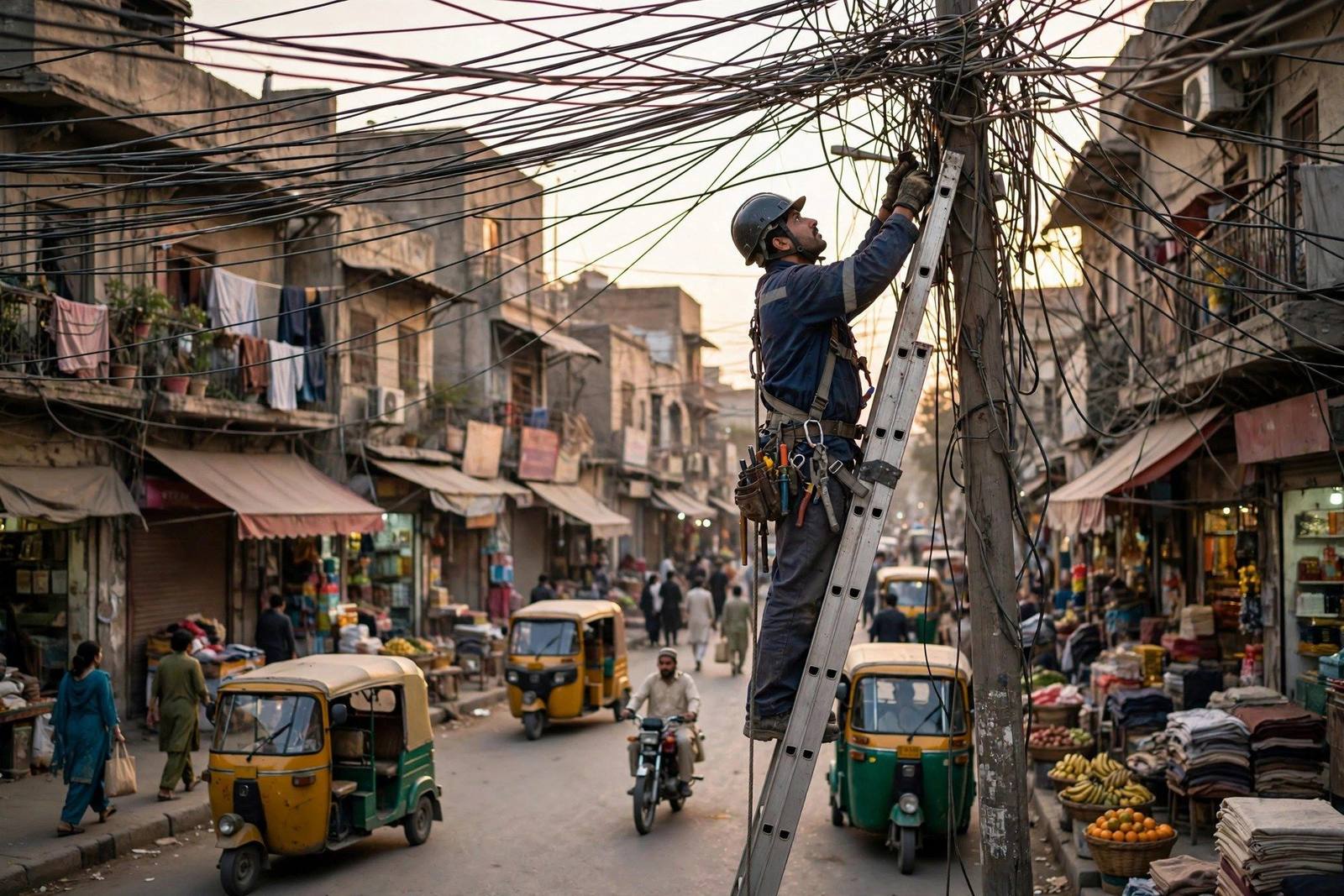
Strip away three decades of announcements and the operating company is compact. Its licences from the Pakistan Telecommunication Authority cover long-distance and international services and local telephony; its permissions from the electronic media regulator cover cable television distribution. In practice the business that reaches households is cable: television channels re-broadcast over its networks and broadband internet delivered over the same wires, sold in the dense urban neighbourhoods where its plant passes homes. The wholesale business carries international voice traffic under its LDI licence, buying and selling minutes in a market where margins are set by regulation, competition and the constant fight against illegal grey traffic. Fibre assets and network services support both.
That footprint puts WorldCall in a specific competitive corner. For broadband it faces, street by street, the incumbent's fibre, the large cable operators, wireless providers and the mobile networks' fixed-wireless offers — a contest in which scale, content bundles and installation capacity decide, and where a subscale network must defend profitable pockets rather than a national map. For cable television it faces the industry's structural headwind: viewers migrating to streaming and mobile video, a shift our telecom sector guide tracks across the listed operators. Its distinction is longevity and licence breadth rather than size — few Pakistani companies hold its combination of permissions, however modestly exploited.
How WorldCall makes money
Revenue, in the company's own framing, falls into data, entertainment and voice. Data means broadband subscriptions and related connectivity — monthly recurring income, the highest-quality stream the company has, earned connection by connection and churned just as granularly. Entertainment means cable television fees from subscribers and operators. Voice, now largely wholesale, means LDI settlement income on international traffic and the remnants of local-loop telephony. Against these stand the costs of a network business with old plant: maintaining and powering ageing cable infrastructure, content and carriage costs for television, bandwidth and interconnection charges, licence and regulatory fees, and the financing cost of a balance sheet that has carried significant debt through its restructurings.
The economics explain the history. Cable broadband is a good business at density and a punishing one below it: the network costs roughly the same to run whether the street's take-up is high or low, so profitability concentrates in the pockets where WorldCall's plant is strong. Voice wholesaling is a volume game on sliver margins. And a company that built networks in the debt-fuelled expansion era must service yesterday's borrowing from today's subscription income — the arithmetic behind the repeated restructurings, reschedulings and equity story resets that fill WTL's announcement history.
Strengths, risks and controversies
The strengths are stubbornness and assets. WorldCall owns real networks and real licences assembled in an era when they were contestable, holds a recognised brand in its home markets, and has demonstrated an institutional will to survive that many better-funded rivals — the WLL operators and payphone networks that vanished entirely — did not. Its LDI licence and cable footprint give any owner options: build, bundle, sell capacity, or sell the company, and the procession of would-be acquirers over the years shows that strategic buyers have repeatedly seen value in the bundle even when public shareholders have struggled to.
The risks and controversies are the flip side of the same record. This is a company whose modern history includes years of losses, a leveraged balance sheet, drawn-out changes of control, and takeover intentions announced and withdrawn — a pattern that long ago made WTL a byword on the exchange for speculative trading detached from operating results. The share's enormous trading volumes at low prices attract momentum traders, and announcements about stake sales or new investors have repeatedly moved the price far more than the underlying broadband business could justify. Technology risk compounds the financial risk: cable plant ages, streaming erodes television income, fibre competitors overbuild, and the capital required to modernise is precisely what a stretched balance sheet finds hardest to raise. Governance and disclosure discipline — reading the actual filings rather than the market's rumours — matters with WTL more than with almost any other liquid PSX name, a point our guide to reading PSX announcements makes in general form.
Two businesses that deserved their own obituaries
Two of WorldCall's chapters repay a closer look, because they explain both the company's scars and the market's memory of it. The first is wireless local loop. In the mid-2000s WLL was Pakistan's great fixed-line hope: licences were auctioned, networks were built on CDMA technology, and households queued for wireless desk phones that promised a landline without the incumbent's waiting list. WorldCall invested in that boom alongside rivals — and then mobile prepaid prices fell through the floor, GSM handsets became cheaper than desk phones, and the entire WLL category was stranded within a few years, leaving its owners with networks engineered for a market that had ceased to exist. The second is long-distance and international traffic. LDI licences created real businesses in terminating the world's calls into Pakistan, above all the diaspora's calls home, but the trade was plagued by illegal grey routes that bypassed the official gateways, provoked repeated regulatory crackdowns and rate interventions, and compressed legitimate margins to slivers. A company could do everything honestly in LDI and still watch its economics dictated by smugglers and regulators in turn. WorldCall lived both stories at full length; that it emerged with any operating business at all is the factual core of the "survivor" label.
The wires that still earn. What survived was the cable plant, and its economics deserve precision. A hybrid fibre-coaxial network is a local monopoly of a modest kind: once the cable passes a street, the marginal cost of connecting one more home is small, and a combined television-and-broadband bundle defends itself against churn better than either product alone. The threat is technological succession — fibre-to-the-home overbuilders and mobile fixed-wireless — which does not arrive street by street but neighbourhood by neighbourhood, and whose defence is capital: upgrading plant before the competitor's fibre reaches your best districts. That is why every WorldCall revival story is, at bottom, a financing story. The network's pockets of density in Lahore and Karachi are worth real money to the right owner with upgrade capital, which explains the decades-long procession of stake discussions around this company; and the listed shell, the licences and the brand arrive in the same parcel. Whether public shareholders ultimately share proportionately in that asset value, after the debt and the dilution of past rescues, is the analytical question that separates studying WTL from merely trading it — and it can only be answered in the audited accounts and the terms of each restructuring as it is announced.
The name on the PSX
WTL is quoted in the technology and communication sector and has, for long stretches, been among the exchange's volume leaders by share count — a mechanical consequence of a very large number of shares in issue at a low price, not evidence of institutional enthusiasm. It is not a dividend story: a company working through its balance sheet does not distribute cash, and its followers treat it as a restructuring and asset story. Index compilers have generally kept it at the margins of the main benchmarks, and serious students of the sector usually pair it with the market's anchor telecom name, Pakistan Telecommunication Company, to see the shakeout's winner and survivor side by side.
What kind of investor studies WorldCall
WorldCall suits the investor learning to separate a business from its ticker: the watchlist is unglamorous — broadband subscriber trends, the mix between subscription and wholesale revenue, debt levels and restructuring terms in the actual filings, the state of the cable plant and any funded plan to upgrade it, and ownership announcements verified against PSX notices rather than market chatter. It also teaches the central lesson of Pakistan's telecom liberalisation: licences and launches were the easy part; density, capital discipline and surviving the mobile revolution were the business. Those who study WTL with that lens get a real education in sector economics — those who trade it on rumour tend to provide the liquidity for everyone else's. This article is educational content, not financial advice, and nothing in it is a recommendation to buy or sell any security.
Key takeaway: WorldCall began with payphones in 1996, was incorporated in its listed form in 2001, spent a decade as Omantel's Pakistani associate and is controlled locally again — a small cable, broadband and long-distance operator whose networks and licences are real, whose balance-sheet history is heavy, and whose frantic share trading says more about speculation than about the business itself.